

P1621 on 2007-2011 Cadillac DTS: Control Module Memory Failure Causes and Fixes
On a 2007-2011 Cadillac DTS, code P1621 almost always indicates an internal memory failure within the Transmission Control Module (TCM). The fix involves replacing the control module assembly (known as the TEHCM) inside the transmission oil pan and requires professional programming. Expect shop costs to range from $700 to $1,500.
- P1621 on a 2007-2011 Cadillac DTS indicates an internal memory failure, almost certainly within the Transmission Control Module (TCM/TEHCM).
- This is not a DIY-friendly repair. The TCM is located inside the transmission, and the replacement part requires special equipment for programming.
- Before condemning the expensive module, always check the vehicle's battery and charging system first, as low voltage can cause false codes.
- Do not replace the entire transmission; the problem is electronic, not mechanical.
- Expect the repair to cost between $700 and $1,500 at a qualified independent shop or dealership.
What's Unique About the 2007-2011 Cadillac DTS
The Cadillac DTS, which uses the GM G-platform and a 4-speed 4T80-E automatic transmission, integrates the Transmission Control Module (TCM) with the valve body and solenoids into a single unit called the Transmission Electro-Hydraulic Control Module (TEHCM). This assembly is located inside the transmission oil pan, constantly subjected to heat and vibration, which are primary contributors to its eventual electronic failure. While P1621 can technically be set by other modules, its appearance on a DTS is overwhelmingly linked to this known failure point within the transmission, a problem shared with other GM vehicles of the era.
Diagnostic Flowchart
Tap your situation to follow the diagnostic path that matches what you're seeing on this vehicle.
Symptoms You May Notice
- Check Engine Light (Malfunction Indicator Lamp) is on
- Harsh, erratic, or delayed shifting
- Transmission is stuck in one gear (limp mode), often 2nd or 3rd gear
- Reduced engine power
- Vehicle may not start intermittently
- Gear position indicator on the dashboard may be blank or incorrect
- Complete loss of communication with the TCM via a scan tool
- Replacing the entire transmission when only the internal electronic module (TEHCM) has failed.
- Replacing shift solenoids individually when the fault lies within the control module that commands them.
- Replacing the Powertrain Control Module (PCM/ECM) when the code is being stored by the Transmission Control Module (TCM).
Most Likely Causes
- Internal Transmission Control Module (TCM/TEHCM) Failure 🔴 High Probability → Shop Transmission Assembly The control module is located inside the transmission, where it is exposed to high temperatures and constant vibration, leading to a well-documented history of electronic failure on this GM platform. Thermal stress can cause solder joints or internal components on the circuit board to fail over time.
How to confirm: After using a professional scan tool to confirm P1621 is stored in the TCM and verifying that external wiring, power, and grounds are intact, the diagnosis points to an internal module failure. Often, this code will be accompanied by U0101 (Lost Communication with TCM), which strongly indicates the module has failed completely.
Typical fix: Replace the Transmission Electro-Hydraulic Control Module (TEHCM) assembly located inside the transmission oil pan. The new module must be programmed to the vehicle's VIN. Some companies sell pre-programmed modules.
Est. part cost: $350-$950 - Low Battery Voltage or Poor Charging System Performance 🟡 Medium Probability → Shop Vehicle Battery Modern GM vehicles have complex electrical systems that are highly sensitive to voltage. A weak battery, failing alternator, or poor ground connection can cause voltage to drop during startup, which can corrupt a module's self-check and trigger false memory codes like P1621. Some owners report strange charging behavior where voltage drops 🎬 Watch how ignition issues can sometimes mimic transmission faults. after the car has been running for a few minutes.
How to confirm: Test the battery with a digital battery tester. Check the voltage with the engine off (should be >12.4V) and while running (should be 13.7-14.7V). Inspect battery terminals and main chassis ground straps for corrosion or looseness.
Typical fix: Recharge or replace the battery. If the charging system is at fault, replace the alternator. On some DTS models, a faulty battery current sensor, which is part of the negative battery cable assembly, can cause improper charging and may need replacement.
Est. part cost: $150-$400 - Poor Power or Ground Connection to the Transmission Module ⚪ Low Probability → Shop Transmission Assembly GM TSB #08-07-30-021H addresses issues with the large, round 16-pin transmission pass-through connector. Vibration and age can cause terminals to back out or corrode, leading to intermittent communication and power loss to the TEHCM, which can mimic an internal failure.
How to confirm: Inspect the main transmission harness connector for corrosion, moisture, or backed-out pins. Use a multimeter to verify the module is receiving consistent power and has a solid ground according to the vehicle's wiring diagram. Wiggling the harness while testing can help identify intermittent connections.
Typical fix: Clean or repair the connector pins and wiring. Secure the ground connection. If a pin has backed out, it may need to be re-seated and the connector's terminal position assurance (TPA) lock secured.
Est. part cost: $0-$100
Diagnosis Steps
- Scan the vehicle with a professional-grade tool capable of reading manufacturer-specific codes from all modules. Confirm that P1621 is stored in the Transmission Control Module (TCM). Note any accompanying codes like P0700 or U0101.
- Check the battery's state of health and the charging system's performance. Ensure voltage is stable and within the 13.7-14.7V range when the engine is running. A voltage drop during cranking can trigger false codes.
- Raise the vehicle and locate the main transmission harness connector. Disconnect it and inspect thoroughly for any signs of corrosion, moisture, or damaged/pushed-out pins, as detailed in GM TSB #08-07-30-021H.
- Using a wiring diagram, verify that the TCM is receiving proper power and has a solid ground at the main connector. Check for less than 0.5 ohms of resistance on the ground circuit.
- If all external wiring, power, and grounds are good, the fault is internal to the Transmission Electro-Hydraulic Control Module (TEHCM).
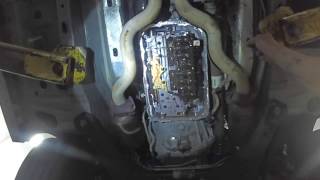
- Replacement of the TEHCM is required. This involves draining the transmission fluid, removing the oil pan, unbolting the TEHCM/valve body assembly, and swapping the module. 🎬 Watch this walkthrough of a Cadillac TEHCM replacement. It is highly recommended to also replace the transmission fluid filter and pan gasket at this time.
- After installation, the new TEHCM must be programmed to the vehicle's VIN using GM's Service Programming System (SPS) or an equivalent J2534 pass-thru tool. Some aftermarket suppliers offer pre-programmed modules.
Parts You'll Likely Need
- Transmission Electro-Hydraulic Control Module (TEHCM)
(OEM #Varies by specific year and calibration; a related GM family part number is 24256861, though it may not be direct fit for the DTS's 4T80-E. Always verify with VIN.)— This is the component that houses the failing Transmission Control Module (TCM). On these vehicles, it is the direct cause of code P1621 in the vast majority of cases.
Trusted brands: ACDelco, Dorman (e.g., 609-000 for other GM models, verify DTS fitment)
OEM price range: $500-$950
Aftermarket price range: $350-$600 - Transmission Fluid and Filter Kit — Required for the TEHCM replacement job, as the transmission pan must be removed and fluid drained. It is best practice to replace the filter and gasket at the same time.
Trusted brands: ACDelco, Wix, ATP
OEM price range: $80-$150
Aftermarket price range: $50-$100
Related Codes That Often Appear With This One
- P0700 — This is a generic code that simply means the Transmission Control Module has stored a fault and requested the check engine light. It will almost always accompany a specific TCM code like P1621.
- P0601 — This code means 'Internal Control Module Memory Check Sum Error' and, like P1621, points directly to an internal failure of the module's processor or memory.
- P0603 — Indicates an internal Keep Alive Memory (KAM) error, further confirming a memory-related fault within the control module.
- U0101 — This code means 'Lost Communication With TCM'. It often appears when the internal failure of the TCM is so severe that it stops communicating on the vehicle's data network, strongly confirming a condemned module.
Technical Service Bulletins (TSBs) & Recalls
- 05-06-04-060A: Communicates Information to technicians on control module Diagnostic Trouble Code(s) (DTC)(s) P0601, P0602, P0603, P0604, P0606, P062F, P06F3, P1621 which can be shared in multiple modules.
- 08-07-30-021H: Details diagnosis and repair for loss of high-speed GMLAN communications due to issues in the transmission harness connector, which can cause symptoms associated with P1621.
Platform-Specific Known Issues
- GM Technical Service Bulletin #05-06-04-060A specifically mentions P1621 as one of several codes indicating a control module issue that may be shared across multiple modules, confirming it as an internal electronic fault.
- GM TSB #08-07-30-021H, while not directly citing P1621, details the common failure point of the external transmission connector, which can cause communication loss (like U0101) and performance issues that often accompany a P1621 code.
Mechanic-Grade Diagnostic Values
- Battery Hold Down Bolt Torque — expected: 17 N.m (13 lb ft). Failure: N/A - This is an installation specification to ensure proper battery seating and connection.
- Positive Battery Cable Bolt Torque — expected: 17 N.m (13 lb ft). Failure: N/A - This is an installation specification to ensure proper electrical connection.
- Transmission Fluid Temperature for Adaptive Learn — expected: 35°C (95°F) to 95°C (203°F). Failure: If the temperature is outside this range, adaptive learning procedures will not complete successfully.
Scan Tool Commands That Help
- GDS2 (Global Diagnostic System 2): Transmission Service Fast Learn — After replacing the TEHCM or valve body, this procedure is used to reset and relearn transmission adaptive values. It is the recommended method for newer GM vehicles.
- Professional-grade scan tool: Reset TCM / Clear Adaptive Memory — Can be used as a first step if experiencing erratic shifting after a repair or battery disconnect. It resets the TCM to factory defaults, forcing it to relearn shift patterns. This will not fix an internal hardware fault like P1621 but can resolve software glitches.
Wiring & Ground Locations
- Main Engine Ground Strap — On the 4.6L Northstar, a primary ground strap connects the engine block to the front frame rail.. A corroded or broken main engine ground can cause unstable voltage and communication errors across multiple modules, including the TCM, potentially triggering false codes like P1621.
- TCM Ground Splice (S108) — In the engine harness, approximately 10 cm (4 in) from the breakout to the main automatic transmission connector.. This is the specific splice point for the Transmission Control Module's ground circuit. Corrosion or a break at this splice would directly interrupt the TCM's ground path, causing communication loss and internal fault codes.
- 4T80-E Connector Pin E & U — Pins E and U on the main round transmission connector.. These pins supply the main 12V+ power to the TEHCM. Verifying battery voltage at these pins is a critical step to rule out a wiring issue before condemning the module.
- G306 — Located on the left 'C' pillar of the vehicle.. While not the primary ground for the TCM, various body control modules use this ground. A fault here can contribute to general network instability on the vehicle.
Real Owner Repair Stories
- YouTube user 'Cliff's Cast' (2007-2014 GM SUV/Truck (similar electrical architecture)) — Weak start, eventual no-start, various electrical issues.
❌ Tried (didn't work) Initially suspected a weak battery.
✅ What actually fixed it The main negative battery cable, which includes multiple ground points, was internally corroded and broken. Replacing the entire negative battery cable assembly (GM Part #22846471 for trucks, similar principle for DTS) resolved the starting and electrical issues.
Model Year Variations Within This Range
- 2007-2011: The 4T80-E transmission used in the DTS received a change in its torque converter clutch design around 2005. Earlier models used a viscous clutch, while later models, including the 2007-2011 range, use an Electronically Controlled Converter Clutch (ECCC). While this doesn't directly cause P1621, it's a key difference in the transmission's control strategy and internal components.
- 2009-2011: A mild styling refresh occurred for the 2009 model year, but the core powertrain (Northstar V8 and 4T80-E transmission) and its known failure points, including the TEHCM, remained unchanged through the end of production in 2011.
Helpful Videos
We Have This Part in Stock

The information in this article is provided for general reference and educational purposes only. Vehicle specifications, procedures, and part compatibility can vary by production date, trim level, and region. Always consult your vehicle's factory service manual and verify part numbers before purchasing or performing repairs. Safety-critical components such as airbags, seat belts, and braking systems should be installed by a qualified professional.
- Cadillac DTS:
- 🧭 Diagnostic Flowchart
- 🎬 Helpful Videos
- 🛍️ Shop This Part
- What's Unique About the 2007-2011 Cadillac DTS
- Symptoms You May Notice
- Most Likely Causes
- Diagnosis Steps
- Parts You'll Likely Need
- Related Codes That Often Appear With This One
- Technical Service Bulletins (TSBs) & Recalls
- Platform-Specific Known Issues
- Mechanic-Grade Diagnostic Values
- Scan Tool Commands That Help
- Wiring & Ground Locations
- Real Owner Repair Stories
- Model Year Variations Within This Range
- 🎟️ Get 5% Off