

P1621 on 2007-2013 Cadillac Escalade EXT: Control Module Memory Failure Guide
P1621 on a Cadillac Escalade EXT typically indicates an internal memory failure in a control module, most often the Transmission Control Module (TCM) or Engine Control Module (ECM). The fix usually requires replacing the faulty module—often the entire valve body assembly for the TCM—and having it professionally programmed.
- P1621 means a critical control module (likely TCM or ECM) has an internal memory error.
- On the Escalade, the TCM is the most common culprit and is located inside the transmission, requiring professional replacement.
- Symptoms are serious and include stalling, limp mode, and no-start conditions.
- Always check wiring, connectors, and grounds before condemning an expensive module.
- Any replacement module (TCM or ECM) MUST be programmed to the vehicle with special tools.
What's Unique About the 2007-2013 Cadillac ESCALADE EXT
For the 2007-2013 Escalade EXT and its GMT900 platform mates, this code is specifically called out in Technical Service Bulletins. TSB #PIP4653E notes that P1621 may be found specifically in the Transmission Control Module (TCM). A critical detail for this platform is that the TCM is not a separate, externally-mounted box; it is integrated into the valve body assembly (known as a TEHCM) located inside the transmission oil pan 🎬 Watch: Step-by-step guide to removing the TCM from the transmission., making it susceptible to heat and fluid contamination. Another bulletin, #05-06-04-060A, clarifies that this code, along with other control module integrity codes, can be set in multiple different modules, confirming it's not exclusive to just one component.
Diagnostic Flowchart
Tap your situation to follow the diagnostic path that matches what you're seeing on this vehicle.
Symptoms You May Notice
- Check Engine Light (Malfunction Indicator Lamp) is on
- Engine stalling or cutting out while driving.
- Transmission may not shift properly, shift harshly, or go into a default 'limp' mode (often stuck in one gear).
- Vehicle may not start, or may crank but not start.
- "Reduced Engine Power" message may appear on the dashboard.
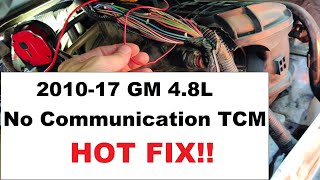
- Loss of communication with scan tool or other modules (may be accompanied by codes like U0100 or U0101).
- Gear position indicator on the dashboard may be blank or incorrect.
- Replacing sensors when the root cause is the control module reading them.
- Replacing the battery without checking if a low voltage event caused permanent damage to a module's memory.
- Replacing the ECM when the actual fault is a poor ground connection or a bad pin in the transmission harness connector.
Most Likely Causes
- Internal Failure of the Transmission Control Module (TCM) 🔴 High Probability → Shop Transmission Assembly This is specifically mentioned in GM TSB #PIP4653E. The TCM is part of the TEHCM (Transmission Electro-Hydraulic Control Module) located inside the hot environment of the transmission oil pan, making it prone to failure from heat cycles and potential fluid contamination over time.
How to confirm: A professional scan tool is needed to confirm if the P1621 code was set by the TCM. If it is the only code, or is accompanied by transmission-related communication codes (like U0101), and all power/grounds to the module are good, the TCM is likely faulty.
Typical fix: Replace the Transmission Control Module, which involves dropping the transmission pan and replacing the entire valve body/TCM assembly (TEHCM). The new module must then be programmed to the vehicle.
Est. part cost: $200-$600 for a remanufactured TEHCM - Internal Failure of the Engine Control Module (ECM/PCM) 🟡 Medium Probability → Shop Engine Control Module (ECM) As a central processing unit for the powertrain, the ECM is susceptible to internal faults from heat, vibration, and age. TSB #05-06-04-060A acknowledges this code can appear in various modules, including the ECM.
How to confirm: If a scan tool shows the code originated in the ECM, often alongside other P06xx codes, the ECM is suspect. Diagnosis involves verifying stable power, clean grounds, and solid communication lines before condemning the module.
Typical fix: Replace the Engine Control Module and program it to the vehicle.
Est. part cost: $300-$700 - Poor Power or Ground Connection to a Control Module ⚪ Low Probability Corrosion and vibrations over the vehicle's life can degrade electrical connections. TSB 08-07-30-021H specifically points to unseated pins in the main transmission connector as a cause for widespread communication issues and related codes. Bad grounds are a known issue on the GMT900 platform, with specific ground points like G103 on the cylinder head being critical.
How to confirm: Visually inspect the wiring harnesses and connectors for the ECM and TCM for corrosion, damage, or loose pins. Pay special attention to the large round connector on the transmission. Use a multimeter to perform a voltage drop test on all power and ground circuits for the suspect module to ensure the connections are solid under load.
Typical fix: Clean or repair the corroded or damaged wiring and connectors. Add redundant ground straps if necessary.
Est. part cost: $10-$100
Rare But Worth Checking
- Aftermarket Performance Tune ('Chip'): If the vehicle has been modified with an aftermarket engine or transmission tune, it can sometimes cause memory checksum errors if the tune is corrupt or not perfectly compatible. Multiple owners have reported P1621 appearing immediately after installing a programmer. Returning the vehicle to the stock tune may resolve the issue.
- Failed or Unsuccessful Module Reprogramming: If a recent attempt was made to update the software on the ECM or TCM and it was interrupted (e.g., by a voltage drop) or failed, it can corrupt the memory and set this code. The module may need to be recovered or replaced.
Diagnosis Steps
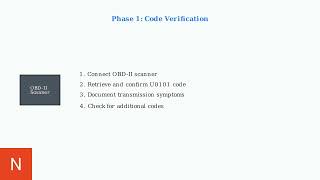
- Connect a professional scan tool capable of communicating with all vehicle modules (ECM, TCM, BCM, etc.), such as a GM MDI with GDS2 software.
- Attempt to communicate with all major modules. Note any 'No Communication' errors.
- Retrieve all stored Diagnostic Trouble Codes (DTCs) and note which module set the P1621 code.
- Check and record freeze frame data for context.
- Verify battery and charging system health. A stable voltage above 12.4V is critical. Low or unstable voltage can cause module communication issues.
- Visually inspect the wiring harness and connectors for the module that set the code. For the TCM, this is the large, round connector on the passenger side of the transmission. Per TSB 08-07-30-021H, check for unseated pins or corrosion.
- Using a wiring diagram and multimeter, verify the module has proper power and ground connections. Perform a voltage drop test on these circuits to ensure they can carry a load. Pay special attention to grounds G101, G103, and G104.
- If wiring, power, and grounds are confirmed to be good, the issue is most likely an internal fault within the control module itself.
- Consult TSBs to see if a software update (reflash) is a recommended first step before replacement.
- If a reflash is not applicable or does not solve the issue, replace the faulty control module. Note that a new TCM may cause a no-start condition until it is programmed.
- Program the new module to the vehicle using specialized equipment and GM's Techline Connect software (TIS2Web).
- Clear all DTCs and perform a drive cycle, including a 'Service Fast Learn Adapts' procedure for a new TEHCM, to ensure the repair is complete and the code does not return.
Parts You'll Likely Need
- Transmission Control Module (TCM) / TEHCM Assembly
(OEM #Examples include 24254908, 24275874, 24256124 (Verify with VIN))— TSB #PIP4653E specifically identifies the TCM as a potential source. Its location inside the transmission makes it a common failure point. This part integrates the TCM with the transmission valve body.
Trusted brands: ACDelco (OEM), Dorman (Remanufactured, e.g., 609-003)
OEM price range: $400-$800
Aftermarket price range: $250-$500 - Engine Control Module (ECM) — This is the primary computer for the powertrain and a common source for internal memory faults as described by code P1621.
Trusted brands: ACDelco
OEM price range: $350-$700
Aftermarket price range: $250-$550
Related Codes That Often Appear With This One
- U0100 — Lost Communication With ECM/PCM. A P1621 fault in the ECM can cause it to stop communicating on the network, or a fault in the TCM can disrupt the network and cause other modules to report a loss of communication with the ECM.
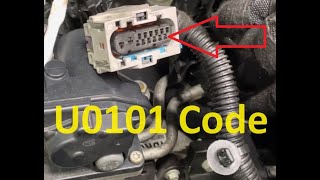
- U0101 — Lost Communication With TCM. If the TCM sets a P1621 and fails internally, it will stop communicating with the ECM and other modules, logging this code.
- P0601 — Internal Control Module Memory Check Sum Error. This is a very similar code that directly points to a memory integrity failure.
- P0700 — Transmission Control Module (TCM) Requested MIL Illumination. This is a general code indicating the TCM has detected a fault (like P1621) and has asked the ECM to turn on the Check Engine Light.
- P062F — Internal Control Module EEPROM Error. This points to an error in the electrically erasable programmable read-only memory, where critical data is stored.
Technical Service Bulletins (TSBs) & Recalls
- PIP4653E
- 05-06-04-060A
- 08-07-30-021H
Platform-Specific Known Issues
- TSB #PIP4653E: A Technical Service Bulletin was issued for vehicles that may have a Malfunction Indicator Lamp on with DTC P1621 (among others) stored in the Transmission Control Module.
- TSB #05-06-04-060A: This bulletin informs technicians that DTC P1621 is part of a group of codes related to control module integrity that can be shared across multiple modules.
- TSB #08-07-30-021H: This bulletin addresses widespread communication issues (including U0100, U0101) and symptoms like no-start or hard shifting, pointing to unseated pins in the transmission's main electrical connector as a possible cause.
Mechanic-Grade Diagnostic Values
- TEHCM On/Off Shift Solenoid Resistance — expected: 20-40 Ohms. Failure: A reading outside this range indicates a failed solenoid, requiring TEHCM replacement.
- TEHCM PWM (Pressure Control) Solenoid Resistance — expected: 3-8 Ohms. Failure: A reading outside this range suggests an internal solenoid fault within the TEHCM.
- TCM Regulated Voltage to Solenoids/Sensors — expected: 8.3 - 9.3 Volts. Failure: Voltage outside this range could indicate a fault within the TCM's power regulation circuits.
- Battery Voltage (Key On, Engine Off) — expected: Above 12.4 Volts. Failure: Voltage below this level can cause modules to fail self-tests during power-up, potentially setting spurious memory codes.
Scan Tool Commands That Help
- GDS2 / Tech2: Solenoid Automated Cleaning Process — If a solenoid performance DTC is present alongside P1621, this function can be used to cycle the solenoids and attempt to flush debris before condemning the TEHCM.
- GDS2 / Professional Scan Tool: Service Fast Learn Adapts — This procedure is mandatory after installing a new TEHCM. It allows the new module to learn the specific hydraulic characteristics of the transmission clutches.
- GM TIS2Web with J2534 device: SPS (Service Programming System) — This is the required function for flashing the vehicle's VIN and correct software calibration into a new or remanufactured ECM or TCM/TEHCM.
Wiring & Ground Locations
- G103 — On the front of the right (passenger side) cylinder head.. This is a primary engine and module ground. A poor connection here can cause intermittent power loss or voltage drops to the ECM and TCM, leading to memory and communication errors.
- G104 — On the left (driver side) rear corner of the engine, attached to the cylinder head.. This ground strap connects the engine block to the firewall/chassis. A faulty connection can disrupt the ground path for multiple electronic modules, causing unpredictable behavior.
- G101 — Located at the lower front of the engine block.. This ground point is listed as a ground for both the Engine Control Module (ECM) and Transmission Control Module (TCM). A fault here directly impacts the modules most likely to set P1621.
- Frame Grounds (Driver Side) — Under the driver's side door area, attached to the vehicle frame.. Owners have reported that corrosion at these main body-to-frame grounds can cause a wide array of bizarre electrical issues, including dash warnings and module problems, which could precipitate a P1621 code.
Real Owner Repair Stories
- YouTube user (Unknown car, but symptoms and codes are relevant) — Engine kept cutting out while driving. Could restart, but problem would repeat and worsen.
❌ Tried (didn't work) Replacing the ECU (Engine Control Unit) with a brand new kit.
✅ What actually fixed it The P1621 code was later joined by P0193 (Fuel Rail Pressure Too High). The final fix was replacing the fuel rail pressure sensor, which resolved all codes and symptoms. - Tahoe Yukon Forum user (GMT900 Platform Vehicle) — Weird electrical problems: dash lights and messages, possessed rear wiper, poor fuel mileage.
❌ Tried (didn't work) Initial diagnostics pointed to various unrelated systems.
✅ What actually fixed it Found a corroded and broken ground wire on the frame under the driver's side door. Cleaning the frame connection point and reattaching the ground with a new bolt solved all the strange electrical issues.
"I Checked Everything" — The Actual Cause
- A P1621 code can be a misleading symptom of a non-module-related failure. In one documented case, a vehicle presented with P1621 and engine stalling. The root cause was not the ECM or its memory, but a faulty fuel rail pressure sensor that was sending bad data and causing system instability, which the ECM interpreted as a critical internal error.
OEM Part Supersession History
Various (Gen 1 TEHCM)→Various (Later Gen TEHCMs)— GM revised the 6L80 TEHCM multiple times to improve solenoid design, pressure manifold gaskets, and thermal tolerance.
Heads up: TEHCMs are not universally interchangeable. Different hardware and software versions exist, identified by part number or 'Tag ID'. Installing the wrong TEHCM, even if it physically fits, can result in a no-start condition, communication errors, or immediate limp mode. The replacement module MUST be correct for the vehicle's VIN and application.
Model Year Variations Within This Range
- 2007-2013: The internal design of the 6L80 TEHCM evolved. Early units (approx. 2007-2010) were more prone to pressure switch and solenoid failures due to heat. Later designs featured improved components and logic. While functionally similar, the part numbers are not always interchangeable.
Helpful Videos




Used OEM Parts in Stock
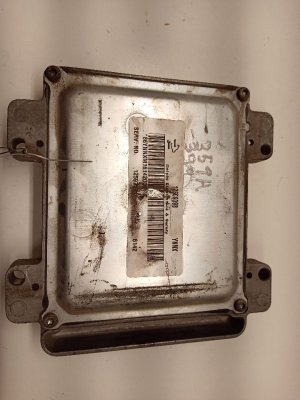
New Aftermarket Parts Available


The information in this article is provided for general reference and educational purposes only. Vehicle specifications, procedures, and part compatibility can vary by production date, trim level, and region. Always consult your vehicle's factory service manual and verify part numbers before purchasing or performing repairs. Safety-critical components such as airbags, seat belts, and braking systems should be installed by a qualified professional.
- Cadillac ESCALADE EXT:
- 🧭 Diagnostic Flowchart
- 🎬 Helpful Videos
- 🛍️ Shop This Part
- What's Unique About the 2007-2013 Cadillac ESCALADE EXT
- Symptoms You May Notice
- Most Likely Causes
- Rare But Worth Checking
- Diagnosis Steps
- Parts You'll Likely Need
- Related Codes That Often Appear With This One
- Technical Service Bulletins (TSBs) & Recalls
- Platform-Specific Known Issues
- Mechanic-Grade Diagnostic Values
- Scan Tool Commands That Help
- Wiring & Ground Locations
- Real Owner Repair Stories
- "I Checked Everything" — The Actual Cause
- OEM Part Supersession History
- Model Year Variations Within This Range
- 🎟️ Get 5% Off