

P1621 on 2015-2019 Hyundai Sonata: A/C Relay or Fuel Cut Valve Fault? Causes and Fixes
P1621 on a 2015-2019 Hyundai Sonata is an ambiguous manufacturer-specific code, most commonly indicating a fault in the A/C compressor relay circuit. Less frequently, it can point to a problem with the fuel cut-off valve. The most common and easiest first step is to check and swap the A/C relay in the engine bay fuse box, which is a simple and inexpensive part.
- P1621 on a 2015-2019 Sonata is ambiguous; it can point to an A/C relay fault OR a fuel cut valve fault.
- Always start diagnosis with the easiest and cheapest fix: check the A/C relay by swapping it with another identical relay in the fuse box.
- If your main symptom is the A/C not working, focus on the A/C relay, fuse, and compressor wiring.
- If your main symptom is the engine stalling or hesitating, focus on the fuel cut-off valve, its wiring, and potentially the fuel rail pressure sensor.
- Do not replace expensive components like the PCM or A/C compressor without thoroughly testing the simpler, more common failure points first.
What's Unique About the 2015-2019 Hyundai Sonata
The main challenge with P1621 on the seventh-generation (LF) Sonata is the lack of a single, clear definition from Hyundai, a common issue with manufacturer-specific codes. While older Hyundai models specifically define P1621 as an A/C relay circuit fault, general repair information and parts catalogs show a 'Fuel Cut Valve' is also a possibility for the brand. This ambiguity is shared with its platform-mate, the Kia Optima. This means a technician or DIYer must be prepared to investigate two separate systems (A/C electrical and fuel system) to find the root cause.
Symptoms You May Notice
- Check Engine Light is on
- Air conditioning does not blow cold or the compressor does not engage
- Engine hesitates, loses power, or stalls intermittently
- Difficulty starting the engine
- Replacing the A/C compressor when the issue is just the relay.
- Replacing the fuel pump when the issue is the fuel cut-off valve or its wiring.
- Immediately replacing the PCM without testing the associated circuits and components first.
- Confusing the generic definition of P1621 ('Control Module Memory Performance' or 'Immobilizer Error') with Hyundai's specific definitions.
Most Likely Causes
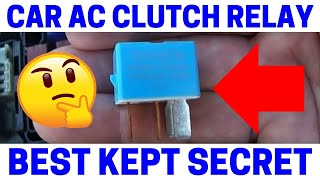
- Faulty A/C Compressor Relay 🔴 High Probability → Shop A/C Compressor Relays are common wear items and can fail from heat and vibration in the engine bay. This is often the simplest and cheapest potential fix, and the most frequently reported solution in owner forums. 🎬 Watch: See how a technician fixed a Sonata's A/C issue.
How to confirm: Locate the A/C relay (often marked 'A/CON') in the engine compartment fuse box. You can swap it with an identical relay from a non-critical system (like the horn) to see if the A/C starts working and the code can be cleared.
Typical fix: Replace the A/C relay. The common multi-use relay for this function is part number 95225-38050.
Est. part cost: $10-$30 - Faulty Fuel Cut-Off Valve 🟡 Medium Probability Also called a Fuel Shut-Off Valve or Roll Over Valve, this component is part of the fuel tank or EVAP system and can fail electrically or mechanically over time.
How to confirm: Requires testing the valve's circuit for proper voltage and ground with a multimeter. The valve itself may need to be tested for operation. It is typically located on or near the fuel tank assembly, making access difficult.
Typical fix: Replace the fuel cut-off valve assembly. The OEM part number is often cited as 31160-3R000.
Est. part cost: $50-$150 - Wiring Harness or Connector Issue ⚪ Low Probability Wires can become damaged from heat, vibration, or corrosion, leading to an open or short circuit in either the A/C or fuel cut-off valve systems.
How to confirm: Visually inspect the wiring and connectors leading to both the A/C compressor clutch and the fuel cut-off valve. Use a multimeter to check for continuity and shorts to ground.
Typical fix: Repair or replace the damaged section of the wiring harness or the connector.
Est. part cost: $5-$100
Rare But Worth Checking
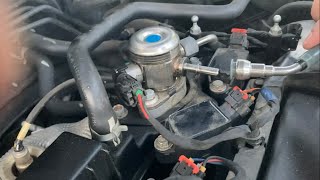
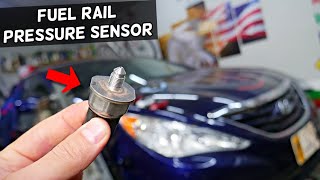
- Faulty Fuel Rail Pressure Sensor: → Shop Fuel Pressure Sensor In at least one documented case, a P1621 code with engine cutting-out symptoms was ultimately caused by a failing fuel rail pressure sensor, which later triggered a more specific P0193 code. 🎬 Watch: How to fix P1621 and P0193 codes together. If fuel-related symptoms are present, this sensor is worth investigating. A video guide for locating this sensor on a Sonata is available. 🎬 See this walkthrough for locating the fuel rail pressure sensor.
- Powertrain Control Module (PCM) Fault: → Shop Engine Control Module (ECM) In very rare cases, the driver circuit within the PCM that controls the A/C relay or fuel cut valve can fail. This should only be considered after all other possibilities have been exhausted, as it is an expensive and complex repair.
Diagnosis Steps
- Scan for other codes. If other codes are present, diagnose them first, as P1621 could be a secondary code.
- Path A - A/C System Diagnosis: If your primary symptom is that the A/C is not working, start here. This is the most common path.
- Locate the A/C relay in the engine compartment fuse box using the diagram on the cover. It is often labeled 'A/CON'.
- Swap the A/C relay with an identical relay from a non-essential circuit (e.g., horn relay). If the A/C now works, the relay was faulty. Replace it with a new one (Part No. 95225-38050).
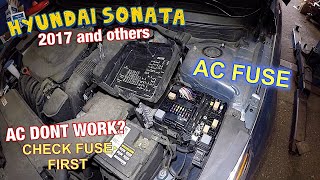
- If swapping the relay does not work, inspect the A/C fuse (often labeled F6, 7.5A in the passenger compartment fuse box). If blown, replace it. If it blows again, there is a short circuit that needs to be traced.
- Inspect the wiring and connector at the A/C compressor clutch for damage or corrosion. Use a multimeter to check for voltage at the compressor when the A/C is commanded on.
- Path B - Fuel System Diagnosis: If your primary symptoms are engine stalling, hesitation, or no-start, start here.
- Inspect fuses related to the fuel system, including the fuel pump fuse and relay (Relay R6 in engine compartment box).
- Attempt to locate the fuel cut-off valve (Part No. 31160-3R000). It is typically part of the fuel tank assembly or nearby EVAP system. Inspect its connector and wiring for any visible damage.
- Using a wiring diagram, test the fuel cut-off valve circuit for proper voltage, ground, and signal from the PCM.
- If fuel-related symptoms are strong, consider testing the fuel rail pressure sensor's output with a scan tool. Erratic or out-of-spec readings could point to a faulty sensor.
- If all wiring and components test good, the final step would be to consider a fault with the Powertrain Control Module (PCM), which requires professional diagnosis.
Parts You'll Likely Need
- A/C Compressor Relay (Multi-Purpose Relay)
(OEM #95225-38050)— This is the most common failure point and the easiest and cheapest potential fix for the A/C-related definition of P1621. It's a standard multi-purpose relay used in many Hyundai/Kia vehicles.
Trusted brands: Hyundai (Genuine), Four Seasons, Standard Motor Products
OEM price range: $20-$40
Aftermarket price range: $10-$25 - Fuel Cut-Off Valve
(OEM #31160-3R000)— This part is the primary suspect for the fuel-system-related definition of P1621. It can cause stalling or no-start conditions.
Trusted brands: Hyundai (Genuine)
OEM price range: $70-$120
Aftermarket price range: $40-$80 - Fuel Rail Pressure Sensor
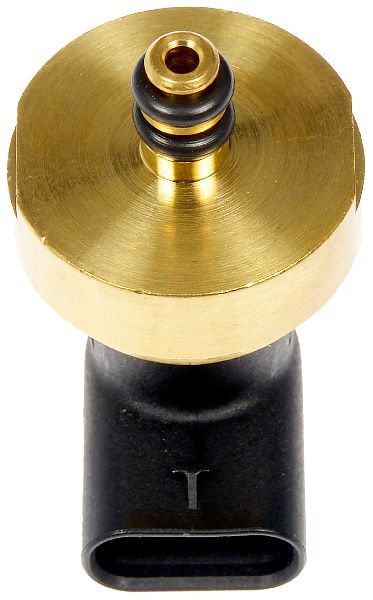
(OEM #35342-2G710)— A notable, though less common, cause for P1621, especially if accompanied by engine stalling and a subsequent P0193 code.
Trusted brands: Bosch, Delphi, Hyundai (Genuine)
OEM price range: $150-$220
Aftermarket price range: $70-$160
Related Codes That Often Appear With This One
- P0193 — If the underlying issue is related to the fuel rail pressure sensor, you may see a 'Fuel Rail Pressure Sensor Circuit High' code appear alongside or after the P1621.
Platform-Specific Known Issues
- A/C Relay Swap Fix: Numerous owners on forums like Hyundai-Forums and Reddit have confirmed that their P1621 code, accompanied by a non-functional A/C, was resolved simply by swapping the A/C relay with the horn relay for testing, and then replacing the faulty relay. This is the most widely reported successful fix.
- Fuel Cut Valve on Hybrids: The Fuel Shut-Off Valve (31160-3R000) is explicitly listed as fitting the 2011-2019 Sonata Hybrid, confirming its presence on at least some models within this generation.
Mechanic-Grade Diagnostic Values
- A/C Relay Control Circuit Voltage — expected: The ECM/PCM grounds the control side of the relay to activate it. When commanded OFF, voltage should be high (near battery voltage). When commanded ON, voltage should drop to near 0V.. Failure: A P1621 for the A/C relay can be set if the ECM detects high voltage on the control circuit for an extended period (e.g., >655 seconds on some models) when it expects the relay to be on, indicating an open circuit or faulty relay.
- A/C Relay Coil Resistance — expected: A specific Ohm value is not published, but a good relay coil should show some resistance (typically 70-100 Ohms for similar automotive relays).. Failure: A reading of infinite resistance (OL) indicates an open coil. A reading of zero resistance indicates a shorted coil. Either requires relay replacement.
- Live Data - Fuel Rail Pressure (if stalling occurs) — expected: Varies with engine load, but should be stable and respond logically to throttle input.. Failure: A wildly inaccurate reading, such as the 180,000 (psi/kPa not specified, but clearly erroneous) seen in a documented repair, points directly to a failed Fuel Rail Pressure Sensor.
Scan Tool Commands That Help
- Hyundai GDS (or equivalent bidirectional scanner): Actuation Test: A/C Relay ON/OFF — This is a critical diagnostic step after checking fuses. It allows a technician to command the A/C relay on and off directly from the scan tool. If the relay clicks and the A/C compressor engages, the control circuit and relay are likely good, pointing the diagnosis towards other issues (like the pressure switches). If the relay does not click, it confirms a fault in the control circuit wiring or the relay itself.
Wiring & Ground Locations
- A/C Relay ('A/CON') — Located in the engine compartment fuse/relay box.. This is the primary component for the most common definition of P1621. Its location is needed for visual inspection, testing, and swapping.
- Fuel Pump Relay (R6) — Located in the engine compartment fuse/relay box.. If P1621 is related to the fuel cut-off system, checking the main fuel pump relay and its circuit is a logical related step, as they are part of the same overall fuel delivery system.
- A/C Control Module Fuse (F6) — Typically a 7.5A fuse located in the passenger compartment fuse panel.. A blown fuse here would disable the A/C control module, preventing it from sending the request signal to the PCM to engage the A/C relay, which could be a root cause.
- PCM/ECM Connectors — The main engine computer, typically located in the engine bay.. Wiring diagrams are required to identify the specific pins from the PCM that control the A/C relay and the fuel cut-off valve for continuity and voltage checks.
Real Owner Repair Stories
- YouTube channel 'No Nonsense Know How' (Vehicle not specified, but symptoms and codes (P1621, then P0193) are directly relevant to the Sonata issue.) — Engine kept cutting out while driving. Could restart initially, but the problem became progressively worse.
❌ Tried (didn't work) Replaced the ECU kit, which made no difference.
✅ What actually fixed it After the P0193 (Fuel Rail Pressure Sensor Circuit High) code appeared, the scan tool showed an impossible fuel pressure reading of 180,000. Replacing the fuel rail pressure sensor fixed the stalling and cleared both the P0193 and the initial P1621 code.
When the Usual Fixes Don't Work
- While the most common fix for an A/C-related P1621 is the relay, and the most cited cause for a stalling-related P1621 is the fuel cut-off valve, there is strong evidence that a failing Fuel Rail Pressure Sensor can also be the root cause. In one documented case, a P1621 with stalling symptoms was only resolved after a P0193 code also appeared, leading to the replacement of the fuel rail pressure sensor. This indicates that if stalling is the primary symptom, the fuel rail pressure sensor should be considered a primary suspect alongside the fuel cut-off valve.
OEM Part Supersession History
95225-29050→95225-38050— Standard part revision/update by the manufacturer.
Heads up: The parts are interchangeable; the newer part number is the correct service replacement.
Model Year Variations Within This Range
- 2018-2019: The Sonata received a major refresh for the 2018 model year, including revised styling, a new 8-speed transmission for the 2.0T engine, and updated interior electronics (new steering wheel, audio/nav unit). While the fundamental components causing P1621 (A/C relay, fuel system parts) are believed to be the same, wiring harnesses and control module software may differ from the 2015-2017 models. Technicians should use a VIN-specific wiring diagram.
Diagnostic Flowchart
Other Known Issues on This Vehicle
Issues unrelated to this code that are worth knowing about as an owner of this generation:
- Theta II Engine Failure (Rod Bearing Failure) 🔴 High — Widespread across 2.0L and 2.4L GDI engines. Can occur at various mileages, often leading to engine seizure. (Ref: Multiple recalls (e.g., Hyundai Recall 198) and a class-action lawsuit settlement led to extended warranties and a Knock Sensor Detection System (KSDS) software update (TSB 21-01-023H-1).)
- Excessive Oil Consumption 🟠 Medium — Common on Theta II engines, often a precursor to more serious engine failure. Owners report needing to add oil between changes. (Ref: Related to the main engine failure issue; dealers may perform an oil consumption test as part of the diagnosis for engine warranty claims.)
- Faulty Starter Motor 🟠 Medium — Relatively common, presenting as a no-start or intermittent starting condition, sometimes with just a click. Often occurs after 60,000 miles.
- Peeling Exterior Paint 🟡 Low — Particularly common on white and other light-colored Sonatas of this generation. The paint can begin to delaminate and peel off in large sheets. (Ref: No official recall, but some owners have reported receiving goodwill assistance from Hyundai for repainting.)
- Worn Steering Coupler 🟠 Medium — The flexible rubber coupler in the steering column can disintegrate, causing a noticeable clicking sound and play in the steering wheel. (Ref: No recall, but it is a well-documented and common repair.)
- Smart Junction Box (SJB) Logic Flaw 🟡 Low — Affected vehicles could have turn signals that activate in the opposite direction of the driver's input. (Ref: Hyundai Recall 210 (NHTSA Campaign 21V753000) was issued to update the SJB software.)
Used vs. New Parts: Buying Guide for This Vehicle
When a used part is the smart pick: A used A/C relay from a junkyard is a perfectly acceptable and cost-effective choice. It is a simple mechanical switch and can be tested easily by swapping.
Donor-vehicle mileage cap: roughly under 120000 miles for the part to have meaningful remaining life.
What to inspect on the donor part:
- For a relay, ensure the plastic housing is not cracked or melted.
- Check that the metal prongs are straight and free of any green or white corrosion.
OEM-only on this vehicle (don't cheap out):
- Powertrain Control Module (PCM): A used PCM will not work without being 'neutralized' and reprogrammed to the car's VIN and immobilizer system using dealer-level tools like GDS. This is a job for specialists or the dealer using a new or properly refurbished unit.
Aftermarket brands forum-validated for this vehicle:
- For sensors like the Fuel Rail Pressure Sensor, brands like Bosch, Delphi, and NTK are generally considered reliable alternatives to OEM.
- For relays, Standard Motor Products (SMP) and Four Seasons are reputable aftermarket suppliers.
Brands owners have reported issues with on this vehicle:
- Avoid unbranded, 'white-box' electronic sensors and relays from online marketplaces, as their quality control, internal components, and calibration are often poor and can fail prematurely or provide incorrect data.
Real Owner Stories
Aggregated from forums and TSBs cited above. Mileages and costs reflect what owners reported in those sources.
2017 Hyundai Sonata
Symptoms: The A/C stopped blowing cold air and the Check Engine Light came on with code P1621.
What fixed it: Swapped the A/C relay with the horn relay to confirm the fault, then replaced the A/C relay with a new one (Part No. 95225-38050).
Source hint: Vehicle-specific issues section citing Hyundai-Forums and Reddit
2017 Hyundai Sonata Limited
Symptoms: Start up issues and intermittent no-start conditions.
What fixed it: Diagnosis of the fuel system components, specifically checking the fuel pump relay (R6) and fuel cut-off valve circuit.
Source hint: forum_citations: cartalk.com/t/2017-hyundai-sonata-limited-immobilizer-fob-issues-no-start/132109
Related OBD-II Codes
Frequently Asked Questions
My 2017 Sonata won't start and I have a P1621 code. Could this be related to the immobilizer or key fob?
Can I use the horn relay to fix the A/C on my 2015-2019 Sonata?
Is the P1621 code related to the Theta II engine failure recall?
Where is the fuel cut-off valve located on my Sonata Hybrid?
My turn signals are acting strange along with the Check Engine Light; is this P1621?
Which fuse should I check if my A/C stops working on my 2015-2019 Sonata?
Helpful Videos
![HOW TO Check Relay of the Car AC Compressor Clutch [EASY]](https://img.youtube.com/vi/b5co1ZZtmgE/mqdefault.jpg)
Used OEM Parts in Stock
New Aftermarket Parts Available


The information in this article is provided for general reference and educational purposes only. Vehicle specifications, procedures, and part compatibility can vary by production date, trim level, and region. Always consult your vehicle's factory service manual and verify part numbers before purchasing or performing repairs. Safety-critical components such as airbags, seat belts, and braking systems should be installed by a qualified professional.
- Hyundai Sonata:
- 🧭 Diagnostic Flowchart
- 🎬 Helpful Videos
- 🛍️ Shop This Part
- What's Unique About the 2015-2019 Hyundai Sonata
- Symptoms You May Notice
- Most Likely Causes
- Rare But Worth Checking
- Diagnosis Steps
- Parts You'll Likely Need
- Related Codes That Often Appear With This One
- Platform-Specific Known Issues
- Mechanic-Grade Diagnostic Values
- Scan Tool Commands That Help
- Wiring & Ground Locations
- Real Owner Repair Stories
- When the Usual Fixes Don't Work
- OEM Part Supersession History
- Model Year Variations Within This Range
- Other Known Issues on This Vehicle
- Used vs. New Parts: Buying Guide for This Vehicle
- Real Owner Stories
- 2017 Hyundai Sonata
- 2017 Hyundai Sonata Limited
- Related OBD-II Codes
- Frequently Asked Questions
- 🎟️ Get 5% Off