

P1621 on 2012-2017 Kia Rio: Decoding an Ambiguous Manufacturer Code
P1621 on a 2012-2017 Kia Rio is an ambiguous code with no single definition. It could mean an immobilizer error (crank, no-start), an A/C relay fault (A/C not working), or a fuel cut valve issue (stalling). Diagnosis must start by observing the main symptom or using a Kia-specific scan tool.
- P1621 is an ambiguous code on the 2012-2017 Kia Rio; it does not have one single meaning.
- The most important diagnostic step is to identify the main symptom: a no-start condition, a non-working A/C, or an engine stalling issue.
- For a no-start, suspect the immobilizer system (key, antenna coil).
- For a non-working A/C, suspect the A/C relay.
- A Kia-specific scan tool is highly recommended to get a precise definition before replacing parts.
What's Unique About the 2012-2017 Kia Rio
The challenge with the third-generation (UB) Kia Rio and its platform-mate, the Hyundai Accent (RB), is the lack of a single, clear definition for P1621. Unlike other platforms where this code consistently points to one system (e.g., immobilizer on a Kia Sportage or Soul), on the Rio it remains ambiguous. This forces a symptom-based diagnosis. The car's primary problem—whether it's a failure to start, a non-functional air conditioner, or a stalling engine—is the main clue to understanding which of the possible meanings of P1621 applies.
Symptoms You May Notice
- Engine cranks but does not start (suggests Immobilizer issue).
- Engine starts and then immediately stalls (suggests Immobilizer or Fuel Cut issue).
- Air conditioning (A/C) does not blow cold or the compressor clutch does not engage (suggests A/C Relay issue).
- Immobilizer warning light (a car with a key symbol) is illuminated or flashing on the dashboard.
- Check Engine Light is on.
- Replacing the A/C compressor when the fault is just a simple relay.
- Replacing the starter motor for a 'crank, no-start' when the immobilizer is the actual cause.
- Replacing the fuel pump when a fuel cut valve or immobilizer is preventing fuel delivery.
Most Likely Causes
- Immobilizer Antenna Coil Failure 🟡 Medium Probability → Shop Antenna This is a common failure point on many Kia/Hyundai models of this era that use a similar anti-theft system, including the Sorento, Tucson, and Soul. The fine wire windings in the coil can break due to vibration and heat cycles.
How to confirm: If the engine cranks but won't start and the immobilizer light is on or flashing, this is the prime suspect. Try using a spare key; if the spare key also fails to start the car, the antenna coil is likely faulty. The coil is located around the ignition lock cylinder. You can test the coil's resistance with a multimeter; an open loop ('OL') reading confirms it's bad. The expected resistance is approximately 7.5 Ω.
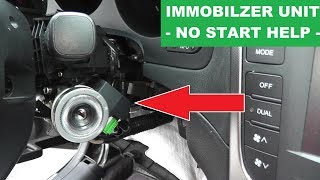
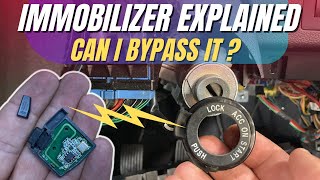
Typical fix: Replace the immobilizer antenna coil. This part is typically not expensive, is accessible by removing the plastic shrouds around the steering column, and does not require reprogramming. 🎬 Watch: How to test and replace an immobilizer coil
Est. part cost: $60-$120 - Faulty A/C Compressor Relay 🟡 Medium Probability → Shop A/C Compressor Relays are common failure items across all vehicles. On some Hyundai/Kia models, P1621 specifically points to this relay. Note: Some later models in this generation may use a variable displacement compressor without a traditional relay.
How to confirm: If the primary symptom is a non-working A/C, locate the A/C relay in the engine compartment fuse box. Swap it with an identical relay from a non-critical system (like the horn). If the A/C starts working, the relay is bad. 🎬 See how to diagnose a bad A/C compressor relay
Typical fix: Replace the faulty relay. This is a simple plug-and-play part.
Est. part cost: $10-$30 - Faulty Fuel Cut-Off Valve ⚪ Low Probability While listed as a possible definition for P1621 on Hyundai/Kia vehicles, it appears to be a less common cause than immobilizer or A/C faults. It is more frequently associated with stalling symptoms.
How to confirm: This is more difficult to diagnose. It requires testing for voltage at the valve's connector with a multimeter while a helper attempts to start the engine. A professional diagnosis is recommended.
Typical fix: Replacement of the fuel cut-off valve.
Est. part cost: $50-$100
Rare But Worth Checking
- Damaged Key Transponder: If the immobilizer system is the cause, the issue could be with the transponder chip inside the key fob itself. Try a spare key first. If the spare key works, the original key is the problem.
- Faulty Engine Control Module (ECM): → Shop Engine Control Module (ECM) In rare cases, the ECM itself can fail, causing memory errors or faulty signals to the immobilizer, A/C, or fuel systems. This should only be considered after all other possibilities have been ruled out. A 2012 Hyundai Accent with a crank/no-start was diagnosed with a faulty ECU after all other checks passed.
- Low Battery Voltage: → Shop Vehicle Battery A weak or failing battery can cause numerous random electrical codes to appear during startup due to voltage drops below 9.6V during cranking. Always ensure the battery is fully charged and the charging system is working correctly before diagnosing other codes.
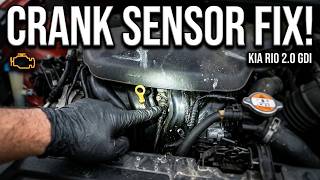
- Faulty Crankshaft Position Sensor: While not a direct cause of P1621, a failing crankshaft position sensor is a very common cause for a 'crank, no start' or stalling issue on the 1.6L Gamma engine. If the P1621 diagnosis leads to a dead end, this sensor should be investigated as a potential underlying cause of the symptoms. 🎬 Watch: DIY crankshaft position sensor replacement walkthrough
Diagnosis Steps
- Connect a high-quality OBD-II scanner. Check if the tool provides a manufacturer-specific definition for P1621. If it does, follow that diagnostic path. A Kia GDS or equivalent is highly recommended.
- Observe the primary symptom. Is it a no-start, no A/C, or a stalling issue? This is your biggest clue.
- If Crank/No-Start: Check for a flashing immobilizer light on the dashboard. Try your spare key. If it also fails, the immobilizer antenna coil around the ignition is the most likely culprit. Test its resistance if possible.
- If A/C is Not Working: Locate the A/C relay in the engine bay fuse box. Swap it with an identical relay (e.g., the horn relay) and see if the A/C engages. If it does, replace the faulty relay.
- If Stalling: This is more complex. It may point to the fuel cut valve or even an unrelated but common issue like a failing crankshaft position sensor. Professional diagnosis is recommended to test the valve and its circuit.
- Check for TSBs and Recalls: Contact a Kia dealership with your VIN to see if any technical service bulletins or recalls apply to your vehicle for this code or related symptoms.
- Inspect Wiring: Visually inspect the wiring harnesses related to the suspected system (ignition cylinder, A/C compressor, fuel rail) for any signs of damage, corrosion, or loose connections.
- Test the Battery: Ensure the battery and charging system are healthy to rule out low voltage as the cause of the code. Voltage should not drop below 9.6V during cranking.
Parts You'll Likely Need
- Immobilizer Antenna Coil
(OEM #95440-2K500 (Verify with VIN, this is from a related model))— If the code is due to an immobilizer fault causing a no-start, this is the most common failure point on related Kia/Hyundai models.
Trusted brands: Kia Genuine, Hyundai Genuine
OEM price range: $80-$120
Aftermarket price range: $50-$90 - A/C Compressor Relay
(OEM #95225-38050)— If the code is due to an A/C system fault, this inexpensive relay is the most likely cause and the easiest to replace.
Trusted brands: Bosch, Standard Motor Products, Carquest
OEM price range: $15-$30
Aftermarket price range: $8-$20
Related Codes That Often Appear With This One
- P1690 / P1693 —
- P0193 —
Platform-Specific Known Issues
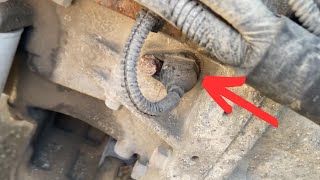
- Crank/No-Start on a 2012 Hyundai Accent: A video from 'DJ Mobile Auto Services' on YouTube shows a 2012 Hyundai Accent (the Rio's platform-mate) with an intermittent crank/no-start and stalling. The diagnosis ultimately pointed towards a faulty ECU that was not consistently powering the main relay.
Mechanic-Grade Diagnostic Values
- Immobilizer Antenna Coil Resistance — expected: Approximately 7.5 Ω. Failure: An open loop ('OL') or significantly different resistance reading indicates a faulty coil.
- Battery Voltage During Cranking — expected: Should remain above 9.6V - 10.0V. Failure: A drop below this threshold indicates a weak battery or charging system issue, which can cause spurious electronic fault codes like P1621.
Hidden / Shadow Codes Worth Checking
- P1621 (Contextual Definition): P1621 does not have a traditional sub-code, but its true meaning is 'hidden' from generic scanners. The Kia GDS tool reveals the fault's context by showing which module (e.g., Immobilizer Control Module, Engine Control Module) stored the code, thereby defining it as an immobilizer, A/C, or fuel system issue. (see via Kia GDS (Global Diagnostic System) or equivalent high-level scan tool with manufacturer-specific data.)
Scan Tool Commands That Help
- Kia GDS (Global Diagnostic System): DTC Analysis — This is the first and most critical step. It will show which specific control unit (Immobilizer, ECM, etc.) logged the P1621 code, which determines the correct diagnostic path.
- Kia GDS (Global Diagnostic System): Current Data (Live Data) — When diagnosing an immobilizer fault, use this to monitor the 'Key Status' parameter to see if the system is recognizing the key transponder in real-time.
- Kia GDS (Global Diagnostic System): Actuation Test (e.g., A/C Compressor Relay) — If the GDS defines P1621 as an A/C fault, this command allows you to manually turn the A/C relay on and off to test the integrity of the relay, wiring, and compressor clutch.
- Kia GDS (Global Diagnostic System): Key Teaching / ID Register — This function is required after replacing a key, immobilizer module, or ECM to program the new components to the vehicle's anti-theft system.
Wiring & Ground Locations
- Engine Compartment Fuse Box — Located in the engine bay, typically on the driver's side.. Contains the A/C relay if that is the suspected cause. Also contains critical fuses labeled 'SNSR', 'IGN', and 'ECU' that power the engine control and immobilizer systems. A failure of one of these can cause a no-start that mimics an immobilizer fault.
- Instrument Panel Fuse Box — Located behind a cover on the driver's side dashboard, below the steering wheel.. Contains fuses related to the Body Control Module (BCM) and other interior electronics which communicate with the immobilizer system.
Real Owner Repair Stories
- Professional Mechanic on JustAnswer (2013 Kia Rio) — Crank but no start. No spark at plugs. Owner had already replaced fuel pump, coil pack, camshaft sensor, crankshaft sensor, and throttle body. Critically, the immobilizer warning light was NOT coming on at all during key-on.
❌ Tried (didn't work) Replacing fuel pump, Replacing coil pack, Replacing camshaft position sensor, Replacing crankshaft position sensor, Replacing throttle body
✅ What actually fixed it The diagnosis from the mechanic pointed to a fundamental power or validation issue, not the parts themselves. The advice was to stop replacing parts and check fuses labeled 'SNSR', 'IGN', and 'ECU' in the engine fuse box, and to verify the main relay was activating. The absence of the immobilizer light indicated the ECU was likely not powering up or not validating the key, which is why it would not send a spark command. The final fix was not posted, but this diagnostic path is the key takeaway. - Kia-Forums.com user report (2011 Kia Sorento (related platform)) — Crank but no start, flashing key/security light on the dash, P1621 code present.
❌ Tried (didn't work) Checking battery, Checking fuses
✅ What actually fixed it Replacement of the immobilizer antenna coil around the ignition switch resolved the no-start problem and cleared the code.
OEM Part Supersession History
95440-2K500→N/A— Part number verification
Heads up: This part number is for the closely related Kia Soul and is often cited as the fix. Other potentially related part numbers include 95440-1E000 (older Rio) and 95440-2P100 (Sorento). Always verify the correct part number with your vehicle's VIN before ordering.
Model Year Variations Within This Range
- 2012-2017: Vehicles may be equipped with a traditional turn-key ignition or a push-button start with a smart key. While both use an immobilizer system, the components (e.g., antenna location, control module) and diagnostic procedures can differ slightly. For example, a smart key system's backup starting procedure involves touching the fob to the start button.
Diagnostic Flowchart
Other Known Issues on This Vehicle
Issues unrelated to this code that are worth knowing about as an owner of this generation:
- Worn Steering Coupler 🟠 Medium — Very common, typically manifests after 50,000 miles as a clicking or knocking sound in the steering column when turning. (Ref: Kia extended the warranty for this part to 10 years/unlimited mileage (Customer Satisfaction Program CS1604), though the Rio was not explicitly named in all documents.)
- 1.6L GDI Engine Problems (Carbon Buildup, Oil Consumption) 🟠 Medium — Carbon buildup on intake valves is inherent to GDI engines and can cause rough idle and power loss over 60,000 miles. Some engines may also experience oil consumption or, in rarer cases, connecting rod bearing issues which were part of a wider class-action settlement for Hyundai/Kia engines. (Ref: Multiple class-action settlements and recalls have affected Hyundai/Kia GDI engines, including the 1.6L Gamma.)
- HECU Fire Risk 🔴 High — Affects a wide range of Kia models including the 2012-2017 Rio. An electrical short in the Hydraulic Electronic Control Unit (HECU) can cause an engine compartment fire while parked or driving. (Ref: NHTSA Recall 23V-652. The remedy involves installing new fuses.)
- Transmission Hesitation / Rough Shifting 🟡 Low → Shop Transmission Assembly — Owners report the automatic transmission can feel 'confused,' with delayed shifts or jerking, most commonly between 40,000 and 80,000 miles. Often linked to the transmission control module or fluid.
- Ignition Coil Failure 🟡 Low — Can occur after 50,000-70,000 km, leading to misfires, rough idle, and increased fuel consumption.
Used vs. New Parts: Buying Guide for This Vehicle
When a used part is the smart pick: For an A/C-related P1621, a used A/C relay from a junkyard is an excellent, low-cost diagnostic step and permanent fix. For an immobilizer-related issue, a used immobilizer antenna coil is also a very sensible and cost-effective repair, as the part is not coded to the vehicle and is a simple electronic component.
Donor-vehicle mileage cap: roughly under 150000 miles for the part to have meaningful remaining life.
What to inspect on the donor part:
- For relays, look for clean, uncorroded terminals. Avoid parts from vehicles with signs of flood or fire damage.
- For an immobilizer coil, ensure the plastic housing is not cracked and the connector pins are straight and clean.
- Whenever possible, pull parts from a vehicle with lower mileage and a clean interior, which often suggests better overall care.
OEM-only on this vehicle (don't cheap out):
- Engine Control Module (ECM): Due to the need for VIN programming and immobilizer synchronization, a new or professionally remanufactured and programmed ECM from a reputable source is strongly recommended. A used ECM will not be plug-and-play.
- Key Fob / Transponder Key: New keys must be programmed to the vehicle using specialized equipment like the Kia GDS. While you can buy blanks online, you will still need to pay for programming.
Aftermarket brands forum-validated for this vehicle:
- For relays: Bosch, Standard Motor Products (SMP), WVE/NTK are generally reliable choices.
- For immobilizer coils: Aftermarket options are available, but OEM (Kia/Hyundai Genuine) is often preferred for fit and finish, though not strictly necessary for function.
Brands owners have reported issues with on this vehicle:
- Avoid unbranded, 'white-box' electronic parts from online marketplaces, as their quality and durability can be highly inconsistent.
Real Owner Stories
Aggregated from forums and TSBs cited above. Mileages and costs reflect what owners reported in those sources.
2012 Hyundai Accent (Platform Mate)
Symptoms: The vehicle experienced an intermittent crank/no-start condition and stalling.
What fixed it: The diagnosis revealed a faulty ECU that was not consistently powering the main relay.
Source hint: video from 'DJ Mobile Auto Services' on YouTube
Related OBD-II Codes
Frequently Asked Questions
My 2012 Kia Rio won't start and I see a car icon with a key symbol flashing. Is this P1621?
Is there a recall for the fire risk mentioned in relation to my 2012-2017 Rio?
Can I use a used immobilizer antenna coil to fix P1621 on my Rio?
My Rio has P1621 and the A/C isn't blowing cold. Do I need an expensive compressor?
Does the steering wheel clicking sound have anything to do with code P1621?
Will a spare key help if my Rio cranks but won't start with P1621?
Helpful Videos

Used OEM Parts in Stock



New Aftermarket Parts Available


The information in this article is provided for general reference and educational purposes only. Vehicle specifications, procedures, and part compatibility can vary by production date, trim level, and region. Always consult your vehicle's factory service manual and verify part numbers before purchasing or performing repairs. Safety-critical components such as airbags, seat belts, and braking systems should be installed by a qualified professional.
- Kia Rio:
- 🧭 Diagnostic Flowchart
- 🎬 Helpful Videos
- 🛍️ Shop This Part
- What's Unique About the 2012-2017 Kia Rio
- Symptoms You May Notice
- Most Likely Causes
- Rare But Worth Checking
- Diagnosis Steps
- Parts You'll Likely Need
- Related Codes That Often Appear With This One
- Platform-Specific Known Issues
- Mechanic-Grade Diagnostic Values
- Hidden / Shadow Codes Worth Checking
- Scan Tool Commands That Help
- Wiring & Ground Locations
- Real Owner Repair Stories
- OEM Part Supersession History
- Model Year Variations Within This Range
- Other Known Issues on This Vehicle
- Used vs. New Parts: Buying Guide for This Vehicle
- Real Owner Stories
- 2012 Hyundai Accent (Platform Mate)
- Related OBD-II Codes
- Frequently Asked Questions
- 🎟️ Get 5% Off