

OBD-II Code P1632: Smart Alternator & Charging System Fault
What P1632 means, why it triggers, and how to fix it
- P1632 has completely different meanings based on the brand: it indicates a smart charging failure on Ford and Jaguar, but a Passlock anti-theft fuel cutoff on GM vehicles.
- On Ford and Jaguar models, inspect the 3-pin alternator connector first; a broken $20 wiring pigtail causes this code more often than a failed $500 alternator.
- For GM vehicles experiencing a no-start with P1632, check fuel pressure; 0 PSI confirms the anti-theft system disabled the injectors, requiring a 30-minute security relearn or a new ignition switch.
- Never replace the Powertrain Control Module (PCM) for this code until you verify battery voltage exceeds 12.4V and bench-test the alternator.
What Does P1632 Mean?
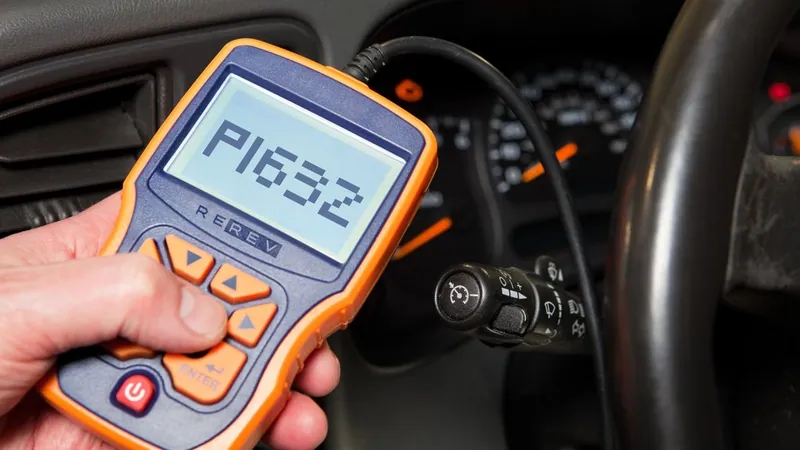
P1632 is a manufacturer-specific code that most often points to a problem with the vehicle's charging system or anti-theft system. The Powertrain Control Module (PCM) detects a fault with the 'smart' alternator control circuit (Ford/Jaguar) or receives a fuel disable signal from the immobilizer (GM). Because its meaning varies dramatically by manufacturer, it is one of the most commonly misdiagnosed codes.
Technical definition: The SAE/OBD-II definition for P1632 varies by manufacturer. For Ford, Jaguar, Kia, and Mazda, it means "Smart Alternator Faults Sensor/Circuit Malfunction". For General Motors (GM), it means "Theft Deterrent Fuel Disable Signal Received". For BMW, it indicates a throttle body adaptation fault. For Volkswagen, it points to the accelerator pedal position sensor. For Harley-Davidson, it means 'Odometer Learned Up'.
Can I Drive With P1632?
No — Do Not Drive. Do not drive. If the code indicates a charging system failure, your vehicle runs only on battery power and shuts down completely within 20-60 minutes without warning. This causes a sudden loss of power steering, headlights, and braking assists, creating a severe safety hazard. Fluctuating voltage permanently damages sensitive electronics like the Engine Control Module (ECM), adding $800-$2,200 to repair costs. If it is a GM anti-theft code, the engine stalls in traffic or refuses to restart.
Common Causes

- Damaged wiring or connectors in the alternator circuit (Very Common) — On 'smart charge' systems (Ford, Jaguar), the thin wires in the 3-pin alternator connector break, fray, or corrode. This severs communication between the alternator and the PCM, immediately triggering the code even with a new alternator.
- Failed ignition switch or Passlock sensor (GM) (Very Common) — For the GM anti-theft variant, a worn-out ignition switch or Passlock sensor inside the lock cylinder fails to read the key's resistor pellet, triggering an immediate fuel cut.
- Defective or failing alternator (Very Common) — Internal components like the diode trio or built-in voltage regulator fail, preventing the alternator from generating power or communicating with the PCM.
- Weak, incorrect, or failing battery (Common) — An old battery unable to hold a 12.4V charge strains the charging system. Ford's smart charge system requires a Silver-Calcium battery; using a standard lead-acid battery triggers this code.
- Loose or corroded battery terminals and ground cables (Common) — Poor connections at the battery or main chassis grounds cause voltage drops that the PCM interprets as a charging fault.
- Faulty Body Control Module (BCM) losing key sync (GM) (Less Common) — A dead battery or improper jump start corrupts the BCM's programming, causing it to lose sync with the key and send a 'fuel disable' signal to the PCM.
- Blown charging or security circuit fuse (Less Common) — A blown fuse for the alternator's field circuit or battery monitoring system causes P1632. This is a known issue on Jaguars, where a 5A or 7.5A fuse frequently fails.
- Faulty Powertrain Control Module (PCM) (Rare) — The vehicle's main computer fails and misinterprets signals. Consider this only after exhaustively checking all wiring, grounds, and components.
Symptoms

- Engine cranks but will not start, or starts and immediately stalls — The hallmark symptom for the GM anti-theft version of P1632. The PCM cuts off fuel supply due to a failed security check.
- Security light is solid or flashing — On GM vehicles, a solid or flashing security light indicates the anti-theft system is active and causing the no-start condition.
- Battery or charging system warning light is on — The most common symptom for the charging system fault, appearing as a battery icon or 'Check Charging System' message.
- Engine stalls while driving — When the alternator fails, the electrical system loses power once the battery depletes, shutting the engine off unexpectedly.
- Dimming headlights and interior lights — System voltage drops as the alternator fails, causing lights to dim or flicker at idle or under electrical load.
- Erratic gauge readings or electrical accessory failure (also visible on scanner) — Unstable voltage causes speedometer needles to drop, radios to cut out, and control modules to malfunction.
Diagnostic Flowchart
Tap your situation to follow the diagnostic path that matches what you're seeing on this code.
Common Fixes & Costs
- Repair charging system wiring/connector (Ford/Jaguar)
— Parts: $15-$50, Labor: $150-$300, ~1.5 hr book time
(Professional)
Ford Focus (2005-2007): OEM Motorcraft WPT-119 (Alt: Dorman 645-136) - Replace ignition switch (GM)
— Parts: $60-$120, Labor: $100-$200, ~1.2 hr book time
(Intermediate)
Chevrolet Cobalt (2005-2010): OEM GM 23228993 (Alt: Dorman 901-5601) - Replace the alternator
— Parts: $250-$600 (Standard), $600-$1200 (Euro Smart), Labor: $150-$350, ~1.5 hr book time
(Intermediate)
Ford Focus (2008-2011): OEM 8S4Z-10346-A (Alt: Bosch AL7656X) - Perform security system relearn (GM) — Parts: $0, Labor: $0-$100, ~0.5 hr book time (DIY)
- Replace the battery
— Parts: $150-$300, Labor: $0-$50, ~0.3 hr book time
(DIY)
Ford Focus (2004-2008): OEM Motorcraft Silver-Calcium (Alt: AGM Equivalent)
Used vs. New Parts: Buying Guide
When a used part is worth it: A quality remanufactured alternator is a cost-effective compromise for older vehicles. Never buy a used, untested alternator from a salvage yard for this code.
Donor-vehicle mileage cap: roughly under 80000 miles for the part to have meaningful remaining life.
Donor quality checklist:
- Favor remanufactured units over used parts. Remanufactured alternators have new bearings, brushes, and regulators.
- Verify the exact part number matches. Smart alternators are highly vehicle-specific.
- Check for a 1-year minimum warranty.
Decision logic:
- If Vehicle is newer or kept long-term → Buy a new OEM or high-quality new aftermarket alternator for maximum reliability.
- If Budget is tight and the vehicle is older → Buy a reputable remanufactured alternator to save money.
- If Considering a salvage yard part → Avoid it. The labor cost of replacing a failed used alternator negates any initial savings.
Warranty tradeoff: Used parts offer 30-90 day warranties. Remanufactured alternators offer 1-year to lifetime warranties. Labor is never covered.
Worst-case if a used part fails: $300-$650 if a cheap used part fails early, requiring repeat labor and a second replacement part.
What Happens If You Wait — Timeline
- 0-1 week (Charging Fault): Battery Light turns on. Intermittent dimming of lights at idle. Voltage fluctuates but keeps the battery charged. (MPG impact: 0-2%% · Added cost: $0)
- 1-4 weeks (Charging Fault): Alternator output drops. The battery deep-cycles and degrades. Vehicle struggles to start and stalling becomes possible. (MPG impact: 2-5%% · Added cost: $150-$300 (for a new battery))
- 1-2 months (Charging Fault): Complete alternator failure. The vehicle runs on battery power for 20-60 minutes before stalling completely. Voltage spikes destroy control modules. (MPG impact: N/A (Vehicle is undriveable)% · Added cost: $800-$2200 (for PCM/BCM damage))
- Immediate (GM Anti-Theft Fault): The vehicle cranks but will not start, or starts and stalls within 2 seconds. The car is completely immobilized. (MPG impact: N/A (Vehicle is undriveable)% · Added cost: $100-$250 (for a tow))
Cost of Not Fixing It
- Immediate: Charging system faults cause stalling within minutes, losing power steering and braking assist. GM anti-theft faults immobilize the car entirely. (Added cost: $100-$250 (for a tow))
- Days to Weeks: Driving on a failing alternator destroys the battery through repeated deep discharging. (Added cost: $150-$300 (for a new battery))
- Weeks to Months: Severe voltage spikes from a faulty alternator permanently damage the Powertrain Control Module (PCM) or other control units. (Added cost: $800-$2200 (for PCM replacement and programming))
Diagnosis Steps

- Identify the Code's Meaning for Your Vehicle
Determine what P1632 means for your specific make. Is it a charging system fault (Ford, Jaguar, Kia) or an anti-theft fault (GM)? This dictates your entire diagnostic path.
Tools: OBD-II scanner, vehicle-specific repair manual (Beginner) - Inspect the Alternator Wiring Harness Connector (Ford/Jaguar)
Unplug the 3-pin connector at the alternator. Inspect for green corrosion, pushed-out pins, or broken wires. The thin wires break right at the connector from engine vibration.
Tools: Flashlight, inspection mirror (Intermediate) - Perform a Full Battery and Charging System Test
Check battery terminals for corrosion. With the car off, a healthy battery reads above 12.4V. Start the engine; a healthy conventional system reads 13.8V-14.4V. If voltage remains below 12.4V running, the alternator is not charging.
Tools: Wrench set, wire brush, multimeter (Beginner) - [PRO TIP] Test the GM Passlock Sensor Circuit
For GM anti-theft issues, use a scan tool to read BCM Passlock data. Voltage must be between 0.5V and 4.5V and remain stable when turning the key. If voltage is 0V, 5V, or fluctuates erratically, the ignition switch/lock cylinder is faulty.
Tools: Advanced scan tool, multimeter (Advanced) - [PRO TIP] Check Fuel Pressure on GM No-Start
For a GM vehicle that cranks but won't start, check fuel pressure at the rail. With the key on and engine off, pressure should be 55-62 PSI. A reading of 0 PSI confirms the PCM executed the 'fuel disable' command, pointing to the Passlock system.
Tools: Fuel pressure gauge (Advanced) - Perform an Anti-Theft Relearn Procedure (GM)
If a GM battery died recently, the BCM lost key programming. Turn the key to 'ON' (don't start) for 10 minutes until the security light goes out. Turn 'OFF' for 10 seconds. Repeat two more times for a total of 30 minutes, then start the engine.
Tools: Vehicle key, battery charger (Intermediate) - Inspect All Related Fuses
Check all fuse boxes for fuses labeled 'Alternator', 'Generator', 'Charging System', or 'BCM'. On Jaguars, a blown 5A or 7.5A fuse in the rear or engine bay fuse box is a primary failure point.
Tools: Fuse puller, multimeter (Beginner) - [PRO TIP] Test the Ford Smart Charge LIN Bus Signals
Back-probe the 3-pin alternator connector. Pin 3 (Reference) must match battery voltage. Pin 2 (GENCOM) shows a square wave from the PCM changing duty cycle with electrical load. Pin 1 (GENMON) shows a constant square wave. If Pin 2 shows no signal, the PCM or wiring is bad.
Tools: Oscilloscope, back-probe kit (Advanced) - Get the Alternator Professionally Bench-Tested
Remove the alternator and take it to an auto parts store for a bench test. This spins the alternator under load to definitively confirm internal failure before purchasing a replacement.
Tools: Socket set, serpentine belt tool (Intermediate)
When This Code Triggers (Freeze-Frame Conditions)
- Engine Coolant Temp: 170-230°F (The fault sets after the engine reaches normal operating temperature.)
- RPM: 1000-2500 (Triggers during idle or steady-state cruise when the PCM actively monitors the charging system's response to electrical loads.)
- Engine Load: 15-40% (Occurs under light to moderate engine load.)
- Vehicle Speed: Any (Charging system faults occur at any speed. GM anti-theft faults trigger at 0 mph during a failed start attempt.)
Related Codes
- P1631 — On GM vehicles, P1631 ('Theft Deterrent Password Incorrect') causes P1632. P1631 means the security password exchange failed. P1632 ('Fuel Disable') is the action the PCM takes because of P1631.
- P0562 — A generic code for 'System Voltage Low'. P1632 is more specific, meaning the PCM identified a fault with the 'smart' alternator's control circuit.
- P1794 — On Jaguars, this code for 'Battery Supply Malfunction' appears with P1632. P1632 is reported by the ECM, while P1794 is reported by the Transmission Control Module (TCM) experiencing low voltage.
- P0622 — On Fords, this means 'Generator Field Control Circuit Malfunction'. It confirms the PCM is trying but failing to control the alternator, pointing to the wiring harness pigtail.
Climate & Environmental Factors
- Cold Weather: Increases battery internal resistance, requiring more power to start. Heavy use of heaters and defrosters puts a constant load on the alternator, accelerating failure.
- High Humidity and Road Salt: Moisture and salt accelerate corrosion on battery terminals and the fragile wires in the alternator's 3-pin control connector on Ford/Jaguar models, leading directly to P1632.
How to Talk to a Mechanic About This Code
Say this: "I have a P1632 code on my [Make, Model, Year]. I know this code means different things for different brands. Please confirm if this is a charging system, anti-theft, or throttle fault for my specific vehicle and provide a diagnostic plan before quoting parts."
This prevents a shop from incorrectly assuming it is a common alternator failure and forces them to perform a proper diagnosis, saving you from paying for unnecessary parts.
Avoid saying:
- 'My battery light is on, I think I need a new alternator.'
- 'My car won't start, just fix it.'
- 'The internet said it's probably the ignition switch, replace it.'
Questions to ask before authorizing the repair:
- For a Ford/Jaguar: Did you inspect the 3-pin alternator connector and wiring for breaks before recommending an alternator?
- For a GM: Did the 30-minute security relearn procedure fail, and can you show me the live data from the Passlock sensor?
- For any charging fault: Did you bench-test the current alternator to confirm its failure?
- Can you provide an itemized quote showing parts and labor separately?
Where to Take It: Dealer vs Independent vs Chain
- Dealer:
Recommended for anti-theft or throttle-related versions of P1632 requiring proprietary software for module programming.
Best for: Vehicles under warranty, Complex manufacturer-specific issues (GM anti-theft programming, BMW throttle adaptation)
Downsides: Highest labor rates, May replace an entire assembly when only a small component failed (Typical cost: +50% vs. baseline) - Independent Shop:
Good fit, provided the shop is experienced with your vehicle's brand. Ask if they have dealt with this specific code on your model.
Best for: Out-of-warranty vehicles, Common P1632 variants (Ford Focus wiring, Chevy Impala ignition switch)
Downsides: A shop unfamiliar with your car's specific P1632 meaning easily misdiagnoses it. (Typical cost: +0% vs. baseline) - Chain Shop:
AVOID for initial diagnosis. Their business model is not suited for complex, brand-specific codes like P1632.
Best for: Simple part replacements after a correct diagnosis is made elsewhere (e.g., battery replacement).
Downsides: High pressure to upsell services., Follows a generic diagnostic path, which is wrong for P1632. (Typical cost: -10% vs. baseline)
When to Walk Away From the Repair
If the total estimated repair cost exceeds 50% of your car's current private-party value, seriously consider not fixing it.
- Car worth $3000, fix is $350: Fix it. A wiring repair or ignition switch replacement restores full function well below the threshold.
- Car worth $4000, fix is $1600: Walk away. A $1,600 repair for a new alternator and PCM damage on a $4,000 car is a poor investment.
- Car worth $15000, fix is $800: Fix it. The repair cost is a small fraction of the vehicle's value.
What Scan Tool You Need for This Code
Minimum: A scanner that reads manufacturer-specific fault codes and accesses live data from the BCM and PCM.
A basic $20 code reader only shows 'P1632' without the manufacturer's definition. It cannot read live data (like GM Passlock voltage) required for accurate diagnosis, leading to incorrect part replacement.
Budget: BlueDriver Pro or Autel AutoLink AL619 (~$100) — Reads manufacturer-specific codes to distinguish between GM theft and Ford charging issues. Displays live data from the PCM and BCM.
Mid-range: Innova 5610 or Foxwell NT510 Elite (~$300) — Offers bidirectional controls. Accesses deeper security module data for GM and monitors alternator response to PCM commands for Ford.
Professional: Autel MaxiCOM MK808S or Launch X431 series (~$500-1200) — Provides dealer-level functions. Performs advanced key programming or module initialization required after replacing a BCM or PCM.
Rent vs buy: Rent a tool only to confirm the code's specific definition. For actual diagnosis, you need live data, which rental tools lack. Buy a capable scanner in the $100+ range if you plan to DIY.
How to Clear the Code After You Fix It
- Reconnect battery and ensure terminals are tight.
- Use an OBD-II scan tool to clear the fault code.
- Perform a complete drive cycle to run readiness monitors.
Drive cycle (~30 minutes): Start cold (engine off 8+ hours). Idle 3 minutes with A/C and defroster on. Accelerate to 55 mph and hold for 5 minutes. Decelerate without braking. Accelerate to 60 mph and hold for 5 minutes. Stop and idle for 2 minutes.
Readiness monitors affected: Comprehensive Component Monitor, Catalyst Monitor, Oxygen Sensor Monitor
Before emissions retest: drive at least 100 miles to fully set monitors.
Watch out for:
- Clearing the code without a drive cycle leaves readiness monitors incomplete, causing an emissions test failure.
- The code returns immediately if the root cause (e.g., a broken wire) was not repaired.
- GM anti-theft faults require a specific 30-minute key relearn procedure, not a standard drive cycle.
Will This Fail Emissions / State Inspection?
Yes — this code typically fails an OBD-II emissions inspection.
- California: An illuminated Check Engine Light is an automatic failure. A full drive cycle must set all readiness monitors before a re-test.
- New York: Active codes fail the emissions inspection. Clearing the code is insufficient; the vehicle must be driven until monitors are set.
- Texas: An active P1632 code causes an automatic failure of the OBD-II portion of the inspection.
Most Commonly Affected Vehicles
- Ford Focus, Mondeo, Transit Connect (2000-2012) — Extremely common. The fault is almost always a broken wire in the 3-pin smart charge connector on the alternator.
- Jaguar XK, XJ, S-Type (1999-2009) — Check Fuse F5 (10A) in the engine compartment fuse box or rear junction box before replacing the alternator.
- Chevrolet/GM Cobalt, Impala, Silverado (2000-2016) — This is an anti-theft code. Causes are a failed ignition switch or a BCM that lost programming after a battery failure.
- Kia Optima, Sorento, Sportage (2005-2011) — Points directly to a malfunction in the alternator regulator's battery voltage detection circuit.
- Volkswagen Jetta, Golf, Passat (2002-2010) — Indicates an 'Accelerator Pedal Position Sensor Power Supply Malfunction'. The issue is with the drive-by-wire throttle system.
- Chrysler/Dodge/Jeep 300, Charger, Grand Cherokee (2004-2012) — Points to general electrical supply problems, frequently caused by corroded connections at the front power distribution center.
Manufacturer-Specific Notes

- General Motors (Chevrolet, GMC, Buick, Cadillac): P1632 means 'Theft Deterrent Fuel Disable Signal Received'. The cause is a bad ignition switch or BCM. This was part of a massive safety recall (GM Recall 14092) for millions of vehicles where faulty switches shut engines off while driving.
- Ford / Mazda: P1632 is for the 'Smart Alternator Faults Sensor/Circuit'. The cause is frequently a broken wire in the alternator's plug. These systems require a Silver-Calcium battery; standard batteries trigger faults.
- Jaguar: P1632 is an 'Alternator Fault'. Always check the 5A or 7.5A fuse in the engine compartment or rear fuse box that powers the charging circuit before replacing the alternator.
- BMW: P1632 is for 'Throttle Valve Adaptation; Adaptation Conditions Not Met'. This is an electronic throttle body issue, completely unrelated to charging or security.
- Volkswagen / Audi: P1632 means 'Accelerator Pedal Position Sensor Power Supply Malfunction'. This points to the 5V reference voltage for the drive-by-wire throttle system.
- Harley-Davidson: P1632 means 'Odometer Learned Up'. This indicates a mileage mismatch between the odometer and ECM, often occurring after a total loss of battery power.
Real Owner Stories
2005 Ford Focus - P1632 and battery light on
The battery light illuminated with code P1632. The owner replaced the alternator and battery, but the code returned immediately.
What they tried:
- Replaced alternator
- Replaced battery
Outcome: The owner inspected the 3-pin connector on the alternator harness and found a broken wire inside the loom. Splicing in a new pigtail connector (Ford WPT-119) permanently fixed the issue.
Lesson: On Ford smart charge systems, the wiring harness connector fails more frequently than the alternator. Always inspect the thin wires before replacing expensive components.
2004 Chevrolet Impala - Cranks but won't start, flashing security light
The car started and immediately died with a flashing security light. A scan showed P1632, indicating the Passlock system disabled the fuel.
What they tried:
- Attempted the 30-minute security relearn procedure multiple times without success.
Outcome: The owner determined the Passlock sensor in the ignition lock cylinder failed. They installed a $10 resistor bypass kit, cutting the sensor wires and connecting a resistor to permanently send the correct signal to the BCM.
Lesson: If the GM security relearn procedure fails, the issue is a hardware failure in the ignition switch. A resistor bypass is a common, low-cost DIY fix.
2007 Jaguar XK - 'Battery Not Charging' message
After the battery died from infrequent use, the car showed a 'Battery Not Charging' warning and P1632, even with a new battery.
What they tried:
- Replaced the battery
- Attempted multiple jump starts
Outcome: A mechanic diagnosed a failed alternator. Replacing the alternator and serpentine belt resolved P1632. New lean codes (P0171/P0174) appeared shortly after, a common occurrence as systems recalibrate after major electrical repairs.
Lesson: On Jaguar, P1632 almost always points to a charging hardware failure. Check the fuse first, but expect to replace the alternator.
How to Prevent This Code From Triggering
- Keep battery terminals clean and tight (Every 6 months) — Corroded terminals cause voltage drops, forcing the alternator to work harder and fail prematurely.
- Ensure serpentine belt tension is correct (Inspect annually) — A loose belt slips, reducing alternator output. A tight belt destroys the alternator's internal bearings.
- Address engine fluid leaks immediately (As needed) — Oil or coolant leaking onto the alternator saturates its internal windings, causing short circuits.
- Avoid forcing the key in GM ignitions (Daily habit) — The Passlock system relies on delicate sensors in the lock cylinder. Rough handling damages the sensor, triggering a P1632 no-start.
- Use a battery tender for long-term storage (When storing vehicle for 2+ weeks) — A completely flat battery causes the GM BCM to lose security programming, leading to a P1632 fault on restart.
Frequently Asked Questions
I replaced my alternator but the P1632 code came back. What now?
If you have a Ford or Jaguar, the problem is almost certainly the 3-pin connector pigtail on the alternator harness. The thin wires break internally from vibration. Splice in a new pigtail to permanently clear the code.
My Chevy won't start and has code P1632. Is the alternator bad?
No, on a Chevrolet or GM vehicle, P1632 is an anti-theft code indicating the computer shut off the fuel. Your alternator is fine; the issue lies with your key, ignition switch, or Body Control Module (BCM). Try a 30-minute security relearn procedure first.
Can a dead battery or a jump start cause code P1632?
Yes. On GM vehicles, a sudden power loss causes the BCM to lose its key programming, triggering the anti-theft P1632 code. On Ford smart charge systems, an improper jump start creates a voltage spike that damages the alternator regulator or PCM.
How much does it cost to fix P1632?
A GM security relearn is free to DIY. Replacing a GM ignition switch costs $160-$320, while repairing a Ford wiring pigtail runs $165-$350. Alternator replacement ranges from $400 for a standard unit to over $1,400 for European smart alternators.
What is the biggest mistake when diagnosing P1632?
The biggest mistake is ignoring the manufacturer-specific definition. Technicians frequently replace a perfectly good alternator on a GM car with a security issue, or replace a battery on a Ford when the real problem is a single broken wire.
Why does my Ford need a special Silver-Calcium battery?
Ford's smart charge system commands charging voltages up to 18V, which destroys conventional lead-acid batteries. It requires the specific charging and discharging characteristics of a Silver-Calcium battery. Using the wrong battery triggers P1632 and causes premature battery failure.
Can I fix P1632 myself?
Beginner tasks like checking fuses, cleaning battery terminals, and performing a GM security relearn are highly DIY-friendly. Stop and consult a professional shop if you need to diagnose LIN bus communication with an oscilloscope or replace a deeply buried ignition switch.
What is a LIN Bus and how does it relate to P1632?
A LIN (Local Interconnect Network) bus is a single-wire communication network used in newer Ford smart charge systems. It allows the PCM to command the alternator and receive feedback. A break in this single wire immediately triggers P1632 and disables smart charging.
Key Takeaways
- P1632 has completely different meanings based on the brand: it indicates a smart charging failure on Ford and Jaguar, but a Passlock anti-theft fuel cutoff on GM vehicles.
- On Ford and Jaguar models, inspect the 3-pin alternator connector first; a broken $20 wiring pigtail causes this code more often than a failed $500 alternator.
- For GM vehicles experiencing a no-start with P1632, check fuel pressure; 0 PSI confirms the anti-theft system disabled the injectors, requiring a 30-minute security relearn or a new ignition switch.
- Never replace the Powertrain Control Module (PCM) for this code until you verify battery voltage exceeds 12.4V and bench-test the alternator.
Shop the Parts Behind P1632
Below are the parts most often responsible for code P1632, ranked by how frequently each one is the actual culprit (per the diagnosis above). Tap any to see what we have for your vehicle.



The information in this article is provided for general reference and educational purposes only. Vehicle specifications, procedures, and part compatibility can vary by production date, trim level, and region. Always consult your vehicle's factory service manual and verify part numbers before purchasing or performing repairs. Safety-critical components such as airbags, seat belts, and braking systems should be installed by a qualified professional.
- 🧭 Diagnostic Flowchart
- 🛍️ Shop This Part
- What Does P1632 Mean?
- Can I Drive With P1632?
- Common Causes
- Symptoms
- Common Fixes & Costs
- Used vs. New Parts: Buying Guide
- What Happens If You Wait — Timeline
- Cost of Not Fixing It
- Diagnosis Steps
- When This Code Triggers (Freeze-Frame Conditions)
- Related Codes
- Climate & Environmental Factors
- How to Talk to a Mechanic About This Code
- Where to Take It: Dealer vs Independent vs Chain
- When to Walk Away From the Repair
- What Scan Tool You Need for This Code
- How to Clear the Code After You Fix It
- Will This Fail Emissions / State Inspection?
- Most Commonly Affected Vehicles
- Manufacturer-Specific Notes
- Real Owner Stories
- 2005 Ford Focus - P1632 and battery light on
- 2004 Chevrolet Impala - Cranks but won't start, flashing security light
- 2007 Jaguar XK - 'Battery Not Charging' message
- How to Prevent This Code From Triggering
- Frequently Asked Questions
- I replaced my alternator but the P1632 code came back. What now?
- My Chevy won't start and has code P1632. Is the alternator bad?
- Can a dead battery or a jump start cause code P1632?
- How much does it cost to fix P1632?
- What is the biggest mistake when diagnosing P1632?
- Why does my Ford need a special Silver-Calcium battery?
- Can I fix P1632 myself?
- What is a LIN Bus and how does it relate to P1632?
- Key Takeaways
- 🎟️ Get 5% Off