

P1715 on 2013-2018 Ford C-Max: What This 'Ghost Code' Really Means
On a 2013-2018 Ford C-Max, P1715 is a 'ghost code' from generic scanners that usually indicates a severe internal transmission failure, specifically bearing failure. The vehicle does not have the 'Shift Solenoid B' this code normally refers to. The actual repair is often a full transmission replacement, costing thousands.
- P1715 on a Ford C-Max is not a valid code for a specific part; it's a sign your scanner can't read the real problem.
- The actual issue is almost always a severe internal transmission bearing failure, a known problem for this vehicle.
- Do not attempt to diagnose or replace a 'Shift Solenoid B'; it does not exist on this car.
- Immediate professional diagnosis with a Ford-specific scan tool is required to find the true fault codes.
- The only reliable fix is an expensive transmission replacement or professional rebuild, with costs ranging from $5,000 to over $10,000.
What's Unique About the 2013-2018 Ford C-Max
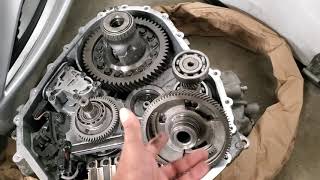
The Ford C-Max's HF35 hybrid transmission is a complex eCVT without the conventional shift solenoids found in other Ford models. Therefore, the standard P1715 definition is not applicable. The code is a misinterpretation by generic scan tools, masking deeper trouble codes like P0C2F or P1920, which point to internal bearing failure—a known issue on this platform documented in Ford Technical Service Bulletins. This issue is common enough that specialized independent shops have emerged focusing on rebuilding these specific transmissions.
Symptoms You May Notice
- Grinding, thumping, whirring, or rubbing noises from the transmission area, often described as sounding like a bad power steering pump or a blender.
- "Stop Safely Now" warning light illuminating on the dashboard.
- Sudden loss of motive power, where the car may only run for a few seconds before shutting down.
- Check Engine Light is on.
- The noise is present when the vehicle is moving (even in neutral) but stops when the vehicle is stationary.
- Replacing 'Shift Solenoid B'. This part does not exist on the Ford C-Max's eCVT, and any attempt to diagnose or replace it is a complete misdiagnosis.
- Replacing transmission fluid. While good maintenance, a fluid change will not fix a mechanically failed bearing.
Most Likely Causes
- Internal Transmission Bearing Failure 🔴 High Probability → Shop Transmission Assembly This is a well-documented issue in the HF35 transmission, addressed by Ford TSBs 22-2396 and 19-2391. The failure of differential side bearings or transfer shaft bearings is common. Teardowns show these bearings become loose and 'crusty', eventually leading to catastrophic failure 🎬 See: How these internal bearings fail and cause damage where the stator magnet can grind into the windings, locking up the transmission.
How to confirm: A professional technician must use a high-end scan tool (like Ford IDS) to pull the true manufacturer-specific codes (e.g., P0C2F, P1920). Diagnosis is often confirmed by the distinct whirring/grinding noises from the transmission while the vehicle is in motion.
Typical fix: Complete replacement or professional rebuild of the HF35 transmission assembly. Some independent specialists offer rebuilds using higher-quality Japanese bearings. Ford's procedure per the TSB is to install a remanufactured transmission assembly.
Est. part cost: $3000-$7000 - Generic Scan Tool Error 🔴 High Probability The complex nature of the eCVT's control modules means that non-Ford diagnostic tools often cannot correctly interpret fault data, mapping it to the incorrect P1715 code.
How to confirm: Scan the vehicle with a Ford-specific diagnostic tool (IDS). If P1715 disappears and other codes like P0C2F or P1920 appear, the original code was a scanner error.
Typical fix: This is not a part failure itself, but a diagnostic dead-end. The fix is to diagnose the *real* trouble codes revealed by a proper scan tool.
Est. part cost: $0
Diagnosis Steps
- Note any symptoms, especially grinding/whirring noises or the 'Stop Safely Now' message.
- DO NOT rely on the P1715 code from a generic scanner. Treat it as a symptom, not a diagnosis.
- Have the vehicle towed to a qualified repair shop, preferably a Ford dealership or a hybrid specialist with HF35 experience.
- Request a diagnostic scan using the Ford Integrated Diagnostic System (IDS) or an equivalent professional-grade tool to retrieve the true manufacturer-specific trouble codes from all modules.
- Analyze the retrieved codes (likely P0C2F, P1920, etc.) and check for related Technical Service Bulletins (TSBs), such as TSB 22-2396.
- Based on the real codes and audible symptoms, confirm the diagnosis of internal transmission failure. A specialist may be able to identify the noise immediately.
- Obtain a quote for transmission replacement or rebuild. A dealer quote may be significantly higher ($9,000-$11,000) than an independent specialist ($5,000-$7,000).
Parts You'll Likely Need
- HF35 Transmission Assembly
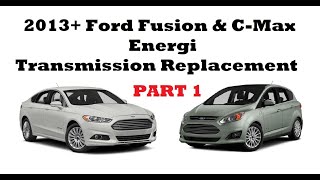
(OEM #JM5Z-7000-ARM (2013-14 FHEV), HG9Z-7000-BRM (2015-16 FHEV))— The root cause is typically a catastrophic internal bearing failure that is not serviceable for a DIY or most general shops, requiring a full unit replacement. 🎬 Watch: Step-by-step HF35 transmission removal and replacement The failure often causes collateral damage to the case and stator, making a simple bearing swap impossible.
Trusted brands: Motorcraft (OEM Remanufactured)
OEM price range: $4000-$7000+
Aftermarket price range: $3000-$5000 (Used/Rebuilt) - HF35 Transmission Bearing Kit — For professional transmission rebuilders, a kit of all 11 bearings is used to overhaul the unit. This is not a DIY job.
Trusted brands: FridayParts
OEM price range: N/A
Aftermarket price range: $120-$200
Related Codes That Often Appear With This One
- P0C2F — This is often the true, underlying code indicating a speed mismatch between motor-generators inside the transmission, usually due to bearing failure. P1715 is a misinterpretation of this code by generic scanners.
- P1920 — Another common underlying code that points to an engine speed signal fault, related to the internal transmission failure.
- U1010 — This code for invalid data from the hybrid drivetrain control module often appears alongside P0C2F and P1920 during a major transmission failure event.
Technical Service Bulletins (TSBs) & Recalls
- TSB 22-2396: Supersedes earlier versions and addresses grinding/thumping/rubbing noises from the HF35 transmission in C-Max, Fusion, and MKZ models, pointing to internal bearing failure as the cause. The noise is present while moving but not when stationary.
- TSB 19-2391: An earlier version of the TSB for the same bearing failure issue. It specifies the cause may be the differential side bearings and/or the transfer shaft and housing, and lists specific part numbers for remanufactured transmission assemblies.
Platform-Specific Known Issues
- The HF35 eCVT used in the 2013-2018 C-Max is known for premature bearing failure, which causes grinding noises and ultimately leads to a total loss of power. This issue is the subject of Ford TSB 22-2396.
- Owner experiences on forums like Reddit's r/cmaxhybrid detail numerous cases of this failure, with replacement costs at dealers quoted as high as $11,000. One owner reported their 2013 model's transmission was replaced at 189k miles, the replacement lasted until 300k, and a third rebuild was still running at 413k miles despite whining.
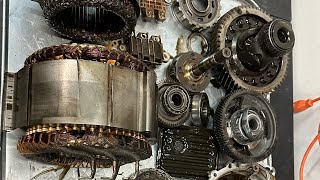
- An independent hybrid repair shop in Franklin, TN, has built a business around this specific failure, documenting their teardowns and rebuilds on YouTube. 🎬 Watch: A specialist's teardown and rebuild of the HF35 They often replace the original bearings with higher-quality Japanese bearings.
Mechanic-Grade Diagnostic Values
- Motor/Generator Speed Sensor (Resolver) Signal Waveform — expected: A pair of clean sine/cosine analog signals, phase-shifted approximately 90 degrees from each other. Amplitude typically 0.5–6 V peak-to-peak depending on excitation voltage.. Failure: Waveform is noisy, has incorrect amplitude, is not present, or the phase shift is incorrect. This indicates a problem with the sensor, wiring, or the mechanical components it measures (i.e., bearing failure causing rotor misalignment).
- Live Data PID Monitoring (using FORScan or IDS) — expected: Motor/generator speed sensor PIDs should show a smooth, corresponding increase/decrease in RPM proportional to vehicle speed. There should not be erratic jumps, dropouts, or significant deviation between the two main motor/generator speed readings.. Failure: Erratic or incorrect motor RPM readout in scan tool data. A significant, noisy deviation between the motor speed and generator speed PIDs under load is a strong indicator of internal mechanical failure (bearing-related speed mismatch).
Scan Tool Commands That Help
- Ford IDS: Transmission Characterization/Solenoid IDN — This procedure is required when a new or remanufactured transmission is installed. It programs the Powertrain Control Module (PCM) with the specific strategy and identification numbers of the new unit. For remanufactured units, the tool will prompt for an 11-digit ID instead of the original 13-digit strategy code.
- Ford IDS: Datalogger - Powertrain — To monitor live PIDs (Parameter IDs) for the motor and generator speed sensors. A technician will use this to look for discrepancies or noise in the speed signals while the vehicle is being driven, which can confirm an internal mechanical speed correlation fault (P0C2F).
- FORScan: Clear Transmission Adaptive Tables — This service procedure should be run after replacing the transmission or valve body. It clears the learned values the PCM has stored for clutch application times, forcing it to relearn with the new hardware.
- FORScan: Transmission Characterization Update — Similar to the IDS function, this is used to write the new solenoid body strategy and ID numbers from the replacement transmission's sticker to the PCM. This is critical for proper transmission operation.
Real Owner Repair Stories
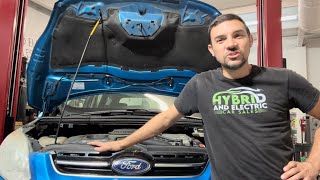
- YouTube video by Hybrid and Electric Car Sales (2014 Ford C-Max) — Typical squealing/milling sound from the transmission. No transmission-related warning lights were on at the time of service, but the customer caught it early based on the noise.
❌ Tried (didn't work) A previous owner or shop had changed the transmission fluid, but it was too late to prevent the failure.
✅ What actually fixed it A complete transmission rebuild. Teardown revealed a failed stator bearing, a completely 'toast' differential bearing, and pitting/damage to the bearing cups in the transmission case. The transmission was rebuilt, and the car was confirmed to be running quietly after the service. The cost for this C-Max rebuild service was quoted at $4,495. - Reddit user in r/cmaxhybrid (2013 C-Max, failed at ~170k miles. Now has a 2014 with 188k miles.) — The first car died from a full transmission failure. The second car is starting to make the 'stator whining noise'.
✅ What actually fixed it The user is planning a preventative repair on the second car by dropping the transmission and replacing the bearings and seals with a kit containing higher-quality Japanese bearings (NSK brand mentioned) to permanently solve the defect.
OEM Part Supersession History
JM5Z-7000-ARM→N/A— Remanufactured transmission assembly for 2013-2014 C-Max/Fusion FHEV (2.57 ratio).HG9Z-7000-BRM→N/A— Remanufactured transmission assembly for 2015-2016 C-Max/Fusion FHEV (2.57 ratio).JM5Z-7000-BRM→N/A— Remanufactured transmission assembly for 2013-2014 C-Max/Fusion PHEV (Energi) (2.91 ratio).HM5Z-7000-ARM→N/A— Remanufactured transmission assembly for 2015-2016 C-Max/Fusion PHEV (Energi) (2.91 ratio).
Model Year Variations Within This Range
- 2013-2018+: While part numbers for the complete assembly differ by year range and by Hybrid vs. Energi (plug-in) models due to different gear ratios, the core internal components and failure points are identical. A specialist mechanic confirmed that a 2018+ HF35 transmission can be successfully swapped into an earlier (e.g., 2014) C-Max or Fusion Hybrid without any reprogramming, as it is a plug-and-play replacement. The cases, wiring harnesses, and sensors are universal across the years.
Diagnostic Flowchart
Other Known Issues on This Vehicle
Issues unrelated to this code that are worth knowing about as an owner of this generation:
- 12V Battery Parasitic Drain 🟠 Medium — Common across all model years. Owners report a dead 12V battery intermittently, sometimes traced to a faulty Audio Control Module (ACM) or software glitches in the SYNC system that prevent modules from going to sleep.
- MyFord Touch / SYNC System Glitches 🟡 Low — Very common, especially on earlier models (2013-2015). Symptoms include a frozen/blank screen, Bluetooth connectivity problems, and unresponsiveness. Often temporarily fixed by a soft reset (Power + Seek Right) or pulling fuse #79.
- Power Liftgate Malfunctions 🟠 Medium — Frequently reported. Issues include the liftgate not opening/closing, opening on its own, or not staying open. Causes range from weak gas struts to faulty actuators or needing a recalibration after battery replacement. (Ref: TSB 12-12-6)
- Shifter Cable Bushing Failure 🔴 High — Affects 2013-2018 models. The bushing can detach, causing the shifter to feel like it's in a gear while the transmission is not, potentially leading to a rollaway. (Ref: Recall 22V-413 (NHTSA 16V643))
Used vs. New Parts: Buying Guide for This Vehicle
When a used part is the smart pick: Given the extremely high cost of a new or dealer-remanufactured transmission (often $7,000-$11,000), a used transmission from a donor vehicle is a very common and financially sensible repair path. However, it is critical to treat the used unit as a 'core' for a preventative rebuild.
Donor-vehicle mileage cap: roughly under 80000 miles for the part to have meaningful remaining life.
What to inspect on the donor part:
- Prioritize obtaining a unit from a vehicle with the lowest possible mileage.
- If possible, get history on the donor vehicle to see if it was wrecked for a non-transmission reason.
- Even with a low-mileage used unit, it is strongly recommended to crack it open and replace all 11 bearings with a high-quality kit before installation. The labor to install the transmission is significant, so it's not worth risking an immediate repeat failure.
- Check the main electrical connectors for any signs of corrosion, damage, or fluid intrusion.
OEM-only on this vehicle (don't cheap out):
- Complete Transmission Assembly (if not rebuilding). While aftermarket rebuilds are common, there are no complete aftermarket 'new' units; options are OEM remanufactured, specialist rebuilt, or used.
Aftermarket brands forum-validated for this vehicle:
- NSK Bearings: Forum users and specialist rebuilders specifically mention using Japanese-made NSK bearings as a higher-quality replacement for the original factory bearings to prevent repeat failures.
- FridayParts: Sells complete 11-piece bearing kits for the HF35 rebuild.
Brands owners have reported issues with on this vehicle:
- No specific brands are cited as 'bad', but the general advice is to avoid unbranded, no-name bearing kits from marketplaces in favor of known quality brands like NSK.
Real Owner Stories
Aggregated from forums and TSBs cited above. Mileages and costs reflect what owners reported in those sources.
2013 Ford C-Max — 117000 miles
Symptoms: Whine/whirring/gentle-grinding noise from the transmission area.
What fixed it: Dealer recommended a full transmission replacement due to internal failure.
Cost: $11,000
Source hint: Reddit r/cmaxhybrid thread titled '2013 cmax transmission 11k tsb no 14b07'
2013 Ford C-Max — 189000 miles
Symptoms: Internal transmission failure requiring multiple replacements over the life of the vehicle.
What fixed it: The transmission was replaced at 189k miles, and the replacement lasted until 300k miles.
Source hint: Reddit r/cmaxhybrid thread titled 'recent_transmission_replacements'
2013 Ford C-Max Energi — 90000 miles
Symptoms: Initial transmission failure at 90k, followed by a second failure of the replacement unit.
What fixed it: Transmission replaced under warranty at 90k; failed again at 135k miles.
Source hint: MaverickTruckClub.com forum post
2015 Ford C-Max — ~100000 miles
Symptoms: Internal transmission bearing failure common to the HF35 eCVT.
What fixed it: Transmission replacement.
Cost: $8,500
Source hint: MaverickTruckClub.com forum post
Related OBD-II Codes
Frequently Asked Questions
My 2013 C-Max is making a whirring noise that sounds like a bad power steering pump. Does TSB 22-2396 apply to this?
Why is my generic scanner showing P1715, but the dealership says the code is actually P0C2F?
Can I fix the HF35 transmission bearing failure without replacing the whole unit?
Is there a risk of my C-Max rolling away even if the shifter is in Park?
My dashboard says 'Stop Safely Now' and the car lost power. Is this related to the transmission?
How much should I expect to pay for a transmission replacement on a 2015 C-Max?
Helpful Videos
We Have This Part in Stock


The information in this article is provided for general reference and educational purposes only. Vehicle specifications, procedures, and part compatibility can vary by production date, trim level, and region. Always consult your vehicle's factory service manual and verify part numbers before purchasing or performing repairs. Safety-critical components such as airbags, seat belts, and braking systems should be installed by a qualified professional.
- Ford C-Max:
- 🧭 Diagnostic Flowchart
- 🎬 Helpful Videos
- 🛍️ Shop This Part
- What's Unique About the 2013-2018 Ford C-Max
- Symptoms You May Notice
- Most Likely Causes
- Diagnosis Steps
- Parts You'll Likely Need
- Related Codes That Often Appear With This One
- Technical Service Bulletins (TSBs) & Recalls
- Platform-Specific Known Issues
- Mechanic-Grade Diagnostic Values
- Scan Tool Commands That Help
- Real Owner Repair Stories
- OEM Part Supersession History
- Model Year Variations Within This Range
- Other Known Issues on This Vehicle
- Used vs. New Parts: Buying Guide for This Vehicle
- Real Owner Stories
- 2013 Ford C-Max — 117000 miles
- 2013 Ford C-Max — 189000 miles
- 2013 Ford C-Max Energi — 90000 miles
- 2015 Ford C-Max — ~100000 miles
- Related OBD-II Codes
- Frequently Asked Questions
- 🎟️ Get 5% Off