

P1715 on 2011-2016 Hyundai Elantra: Input Speed Sensor Failure Causes and Fixes
On a 2011-2016 Elantra with the A6GF1 6-speed automatic transmission, code P1715 almost always means the transmission's input speed sensor has failed. This causes harsh shifting, a Check Engine Light, and can force the car into 'limp mode,' stuck in 3rd gear. Replacing the sensor is the typical fix, with the part costing around $30-$80.
- P1715 on a 2011-2016 Elantra points to a problem with the transmission's Input Speed Sensor, not a major internal failure.
- Symptoms are serious and include the transmission getting stuck in 3rd gear ('limp mode'), making the car unsafe to drive normally.
- The most likely fix is replacing the sensor itself, which is a relatively affordable part.
- Always inspect the wiring harness for damage before replacing the sensor, as this is the second most common cause, especially if symptoms are worse in wet weather.
- Do not continue to drive with this issue, as it severely limits vehicle control and could potentially cause further transmission problems.
What's Unique About the 2011-2016 Hyundai Elantra
Unlike some other manufacturers, particularly Nissan, where a P1715 code often signals a catastrophic internal failure of the CVT (Continuously Variable Transmission), the issue on a 2011-2016 Elantra is much simpler. These Elantras use a conventional 6-speed automatic transmission (model A6GF1). For this platform, the code almost always points to a simple, inexpensive sensor failure or a wiring issue, not a doomed transmission.
Symptoms You May Notice
- Check Engine Light is on
- Transmission gets stuck in a single gear, typically 3rd gear ('limp mode').
- Harsh, erratic, or delayed gear shifts.
- Sluggish or slow acceleration from a stop.
- Inability to use cruise control
- Tachometer may rev high before a harsh shift occurs.
- Replacing the Output Speed Sensor (Pulse Generator 'B') instead of the Input Speed Sensor.
- Assuming the entire transmission has failed without first testing the sensor and wiring.
- Replacing the sensor without first inspecting the wiring harness for damage, leading to a repeat failure.
Most Likely Causes
- Failed Input Speed Sensor (Pulse Generator 'A') 🔴 High Probability This is a very common failure point for this component on many Hyundai and Kia models that use the A6GF1 6-speed automatic transmission.
How to confirm: After confirming the wiring is intact, replacing the sensor is the most direct way to confirm the diagnosis. The sensor's resistance can also be tested with a multimeter if specifications are available. A successful fix after replacement is the ultimate confirmation.
Typical fix: Replace the input speed sensor on the transmission housing. It is often recommended to replace the output speed sensor at the same time, as they are similar parts subjected to the same conditions.
Est. part cost: $30-$80 - Damaged Wiring or Corroded Connector 🟡 Medium Probability The sensor and wiring are located on the exterior of the transmission and are exposed to heat, vibration, and moisture, which can lead to degradation over time. Some owners report the problem is worse after rain, pointing to a moisture-related short in the harness.
How to confirm: Visually inspect the wiring harness leading to the input speed sensor for any signs of breaks, fraying, melting, or chafing. Check the connector pins for corrosion, moisture, or a loose fit. Use a multimeter to check for continuity between the sensor connector and the TCM.
Typical fix: Repair the damaged section of the wiring harness or clean/replace the electrical connector. In some cases, the entire transmission wiring harness may need replacement if damage is widespread.
Est. part cost: $5-$250 - Faulty Transmission Control Module (TCM) ⚪ Low Probability → Shop Transmission Assembly
How to confirm: This is a diagnosis of exclusion. If a new sensor and verified good wiring do not resolve the code, the TCM may be at fault. This requires advanced diagnostics by a professional, including checking for software updates and testing TCM power/grounds.
Typical fix: Replace and reprogram the Transmission Control Module.
Est. part cost: $400-$900
Diagnosis Steps
- Scan the vehicle's computer system to confirm P1715 is the primary code. Note any other codes present, especially P0720, P1529, or P0717.
- Disconnect the battery.
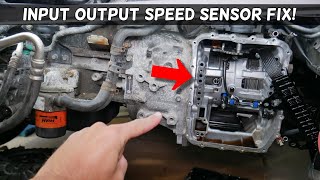
- Locate the Input Speed Sensor on the top or side of the transmission case. It is typically underneath the air filter housing and battery tray. 🎬 See this video to help locate the sensors on your transmission.
- Remove the air filter box, battery, and battery tray to gain access to the sensor.
- Thoroughly inspect the electrical connector and wiring harness going to the sensor. Look for any breaks, corrosion, loose pins, or signs of moisture intrusion. Follow the harness as far as possible to check for chafing.
- If wiring looks good, unbolt and remove the sensor (typically a single 10mm bolt).
- Install the new sensor, ensuring its O-ring is properly seated and lightly lubricated with transmission fluid.
- Reconnect the electrical connector and reassemble the battery tray, battery, and air filter housing.
- Reconnect the battery, clear the trouble codes with a scan tool, and perform a test drive to ensure the shifting issues are resolved and the Check Engine Light does not return.
Parts You'll Likely Need
- Transmission Input Speed Sensor (Pulse Generator A)
(OEM #42620-26010 (Verify with VIN, supersedes older numbers))— This sensor is the most common failure point for the P1715 code on this vehicle. Note: The pass 1 part number 42620-39200 appears to be for older 4-speed transmissions, not the 6-speed in this Elantra. Always verify the correct part number with the vehicle's VIN.
Trusted brands: Hyundai (OEM), Standard Motor Products, WVE, Dorman
OEM price range: $120-$170
Aftermarket price range: $30-$80
Related Codes That Often Appear With This One
- P0720 — This code is for the Output Speed Sensor. It may appear with P1715 if there is a shared wiring issue or if both sensors fail around the same time, as they are similar components in the same system.
- P1529 — This is a companion code that simply means the TCM has requested the Engine Control Module (ECM) to turn on the Check Engine Light. It confirms a transmission fault has been registered and is very common to see alongside P1715.
- P0717 — This is the generic SAE version of the P1715 code, meaning 'Input/Turbine Speed Sensor 'A' Circuit No Signal'. Some scan tools may show this code instead of or in addition to the Hyundai-specific P1715. Hyundai TSB 16-AT-003 addresses this code. 🎬 Watch: How to fix common input speed sensor circuit codes.
Technical Service Bulletins (TSBs) & Recalls
- TSB 20-AT-011H: While not for P1715 specifically, this TSB addresses related codes P0717 (Input Speed Sensor Circuit No Signal) and P0722 (Output Speed Sensor Circuit No Signal) on 2011-2016 Elantras, among other models. It provides a procedure for diagnosing the sensors and replacing the internal transmission wiring harness if necessary.
- TSB 20-AT-003H: This TSB for newer models also details diagnostic procedures for input/output speed sensor codes, showing a consistent pattern of diagnosis across Hyundai vehicles.
- TSB 16-AT-003: This TSB directly addresses DTCs P0717, P0721, and P0722 for 2011-2016 Elantras (among others). It advises against replacing the whole transmission and instead provides a procedure to check sensor output with a GDS scan tool and inspect wiring. If issues are found, it recommends replacing the input/output speed sensor and valve body harness.
Platform-Specific Known Issues
- Owner Experience: Intermittent Limp Mode in Rain: An owner of a 2013 Elantra GT reported the transmission would intermittently go into limp mode, but the issue was most likely to occur during or after heavy rain. After a day, the problem would resolve itself. This points strongly to a wiring harness issue where moisture is causing a short circuit.
- Owner Experience: Successful DIY Fix: A user on 2CarPros.com with a Hyundai experiencing limp mode and code P0715 confirmed their fix. After reading about the issue, they purchased an input speed sensor from a Hyundai dealer, replaced it, and the car returned to normal operation with the check engine light gone.
Mechanic-Grade Diagnostic Values
- Input Speed Sensor (ISS) internal resistance — expected: 3.8 MΩ (Megaohms). Failure: A reading significantly different from the specification, or an open/short circuit reading.
- Sensor reference voltage at harness connector — expected: 5.0V ± 0.5V. Failure: No voltage or voltage outside the specified range indicates a wiring or TCM issue, not a sensor failure.
Scan Tool Commands That Help
- Hyundai GDS (Global Diagnostic System): Data Analysis / Signal Wave Form Check — This dealer-level tool function allows a technician to view the live signal waveform from the input and output speed sensors. A noisy, intermittent, or flat-line signal when the vehicle is in gear and wheels are turning confirms a sensor or circuit fault, as recommended by TSB 16-AT-003.
- Hyundai GDS (Global Diagnostic System): Transmission Adaptation Reset — After replacing major transmission components or in some cases, after resolving chronic shifting issues, resetting the adaptive learning values in the TCM can be necessary. This forces the TCM to relearn shift points and clutch pressures with the new components.
Wiring & Ground Locations
- Input Speed Sensor Connector — On the top of the A6GF1 transaxle case, typically below the battery tray and air filter housing.. This is the primary connection point to inspect for corrosion, moisture, or damage. A poor connection here will cause a P1715 code even if the sensor itself is good.
- Transmission to Chassis Ground — Typically a black wire bolted from the transmission case directly to the vehicle's frame rail in the engine bay.. A corroded or loose transmission ground can cause a host of erratic electronic issues, including faulty sensor readings. While not the most common cause for P1715, it's a critical check for any transmission electrical fault.
Real Owner Repair Stories
- Hyundai Forum user (2001 Hyundai Elantra) — Sudden 'clunk' while driving, transmission defaults to 3rd gear (limp mode), Check Engine Light on. Resetting by turning the car off and on would temporarily fix it.
❌ Tried (didn't work) Continuously resetting the code by restarting the car.
✅ What actually fixed it Replaced the Input Speed Sensor. The user noted it was a 40-minute DIY job requiring removal of the airbox and a cable bracket to access the sensor, which was held by a single 10mm bolt. - Reddit user on r/Elantra (2016 Hyundai Elantra) — Car won't accelerate when put in Drive, throwing P0722 (Output Speed Sensor Malfunction).
❌ Tried (didn't work) Replacing the speed sensor three times., Replacing the entire transmission with a used unit (26k miles).
✅ What actually fixed it The issue persisted even after replacing the sensor and the entire transmission, strongly suggesting the root cause was not the sensor or internal transmission components. The user was left to investigate wiring or the TCM, highlighting that in rare cases, the common fix is not the solution.
When the Usual Fixes Don't Work
- In one documented case, a 2016 Elantra owner experienced a speed sensor code (P0722, for the output sensor) that was not resolved by replacing the sensor three times. The owner then replaced the entire transmission with a low-mileage used unit, but the code immediately returned. This strongly indicates that while sensor failure is the most common cause, the fault can also lie in the vehicle's main wiring harness or the Transmission Control Module (TCM), and simply replacing the sensor or even the whole transmission will not fix it.
OEM Part Supersession History
42620-26000, 42620-26001→42620-26010— Part revision and consolidation by Hyundai.
Heads up: The OEM part 42620-26010 was later superseded by 42620-26011. While they are functionally similar, it is always best to use the latest part number available and verify fitment with a VIN.
Model Year Variations Within This Range
- 2011-2012 vs 2013-2016: On model years 2009 through 2012, the A6GF1 transmission used a stand-alone temperature sensor. For 2013 and up, the temperature sensor became integrated into the internal wiring harness. The later, integrated harness is a recommended upgrade for earlier models if performing internal transmission work.
Diagnostic Flowchart
Other Known Issues on This Vehicle
Issues unrelated to this code that are worth knowing about as an owner of this generation:
- Engine Piston Slap / Oil Consumption (1.8L Nu Engine) 🔴 High — Widespread issue, often manifesting as a ticking or knocking noise, particularly when cold. Can lead to excessive oil consumption and eventual engine failure. (Ref: Subject of class-action lawsuit (Brown et al. v. Hyundai Motor America), resulting in an extended powertrain warranty (10 years/120,000 miles) for the issue.)
- Disintegrating Steering Coupler 🟠 Medium — Extremely common. The flexible rubber coupler in the electronic power steering motor wears out, causing a distinct clicking or clunking noise when turning the steering wheel. (Ref: Hyundai TSB 17-ST-001 provides a procedure for replacing the inexpensive coupler without replacing the entire steering column.)
- Peeling White Paint 🟡 Low — Very common on vehicles with white paint ('delamination'). The paint peels off in large sheets, often starting on the hood and roof, down to the primer. (Ref: Hyundai extended the paint warranty for some models/years, but many 2011-2016 owners report being denied coverage.)
- Faulty Brake Pedal Stopper Pad / Brake Light Switch 🟠 Medium — Common failure leading to a recall. The small plastic pad on the brake pedal arm disintegrates, causing the brake lights to stay on and allowing the vehicle to be shifted out of Park without pressing the brake. (Ref: NHTSA Recall 16V574000 (Hyundai recall 146) was issued for 2013 Elantras to replace the stopper pad. A wider recall for the switch itself affected 2007-2010 models.)
- Steering Rack Yoke Noise 🟡 Low — A noise may develop from the steering rack, separate from the coupler issue. It does not affect steering function. (Ref: Hyundai TSB 18-ST-001 provides a procedure to replace the steering rack support yoke assembly to resolve the noise.)
Used vs. New Parts: Buying Guide for This Vehicle
When a used part is the smart pick: For this specific repair, buying a used Input Speed Sensor is not recommended. The part is inexpensive new, a known common failure item, and the labor to access it makes it unwise to install a part with an unknown history. A used part only makes sense if it comes as part of a complete, low-mileage used transmission assembly being swapped in for other reasons.
Donor-vehicle mileage cap: roughly under 50000 miles for the part to have meaningful remaining life.
What to inspect on the donor part:
- Verify the donor vehicle was not in a front-end collision that could have damaged the transmission case or connectors.
- Ensure the connector pins on the used part are clean, straight, and free of corrosion.
- If possible, test the resistance of the used sensor before installation to ensure it is within the 3.8 MΩ specification.
OEM-only on this vehicle (don't cheap out):
- Transmission Control Module (TCM) - Due to programming and VIN-locking, a used TCM is often difficult or impossible to make work in a different vehicle.
Aftermarket brands forum-validated for this vehicle:
- Dorman
- Standard Motor Products (SMP)
- WVE
Brands owners have reported issues with on this vehicle:
- No-name, unbranded sensors from online marketplaces are a gamble. While they may work initially, failure rates can be higher, and a repeat repair due to a faulty cheap part costs more in the long run.
Real Owner Stories
Aggregated from forums and TSBs cited above. Mileages and costs reflect what owners reported in those sources.
2013 Elantra GT
Symptoms: The transmission would intermittently go into limp mode, specifically during or after heavy rain. The problem would resolve itself after a day of drying out.
What fixed it: The symptoms pointed to a moisture-related short in the wiring harness leading to the sensor.
Source hint: vehicle_specific_issues: 'Owner Experience: Intermittent Limp Mode in Rain'
2013 Elantra
Symptoms: Car stuck in 3rd gear with codes for both input and output speed sensors.
What fixed it: Replacing both the input and output speed sensors at the same time.
Source hint: Hyundai-Forums.com: '2013 Elantra Limp Mode P0715 P0721 P1529'
2003 Hyundai Elantra
Symptoms: Transmission problem with codes P0715 and P1529; car entering limp mode.
What fixed it: Purchased an input speed sensor from a Hyundai dealer and replaced it as a DIY repair.
Source hint: 2CarPros.com: 'Hyundai Transmission Problem Codes P0715 and P1529'
2007 Hyundai Elantra
Symptoms: Going into limp mode sporadically. Initially, topping off low transmission fluid helped, but the problem returned with a solenoid code.
What fixed it: The source highlights that while sensors are common, other transmission health issues like fluid levels and solenoids can be involved.
Source hint: Reddit r/MechanicAdvice: 'I have a 2007 Hyundai Elantra, it keeps going into limp mode sporadically, thoughts?'
Related OBD-II Codes
Frequently Asked Questions
Does TSB 16-AT-003 apply to my 2011-2016 Hyundai Elantra regarding transmission sensor codes?
Why does my Elantra's transmission seem to fix itself a day after it rains?
Should I replace both the input and output speed sensors at the same time on my Elantra?
Can low transmission fluid cause the same limp mode symptoms as a P1715 code?
Where is the input speed sensor located on the 2011-2016 Elantra transmission?
What is the 'limp mode' I'm experiencing with my Elantra?
Helpful Videos
We Have This Part in Stock


The information in this article is provided for general reference and educational purposes only. Vehicle specifications, procedures, and part compatibility can vary by production date, trim level, and region. Always consult your vehicle's factory service manual and verify part numbers before purchasing or performing repairs. Safety-critical components such as airbags, seat belts, and braking systems should be installed by a qualified professional.
- Hyundai Elantra:
- 🧭 Diagnostic Flowchart
- 🎬 Helpful Videos
- 🛍️ Shop This Part
- What's Unique About the 2011-2016 Hyundai Elantra
- Symptoms You May Notice
- Most Likely Causes
- Diagnosis Steps
- Parts You'll Likely Need
- Related Codes That Often Appear With This One
- Technical Service Bulletins (TSBs) & Recalls
- Platform-Specific Known Issues
- Mechanic-Grade Diagnostic Values
- Scan Tool Commands That Help
- Wiring & Ground Locations
- Real Owner Repair Stories
- When the Usual Fixes Don't Work
- OEM Part Supersession History
- Model Year Variations Within This Range
- Other Known Issues on This Vehicle
- Used vs. New Parts: Buying Guide for This Vehicle
- Real Owner Stories
- 2013 Elantra GT
- 2013 Elantra
- 2003 Hyundai Elantra
- 2007 Hyundai Elantra
- Related OBD-II Codes
- Frequently Asked Questions
- 🎟️ Get 5% Off