

P1715 on 2000-2010 Hyundai Sonata: Pulse Generator 'A' (Input Speed Sensor) Failure Causes and Fixes
On a 2000-2010 Hyundai Sonata, code P1715 almost always points to a failed transmission Input Speed Sensor, also known as Pulse Generator 'A'. This is a common and relatively inexpensive fix, with the part costing between $20 and $60 for an aftermarket replacement. The transmission may get stuck in 3rd gear (limp mode) but replacing the sensor usually resolves all symptoms.
- P1715 on a 2000-2010 Sonata means there's a problem with the transmission's Input Speed Sensor circuit, almost always a failed sensor.
- The most likely cause is a failed sensor, which is an affordable and accessible part to replace for a DIYer with basic tools.
- Symptoms are noticeable and include harsh shifting or getting stuck in 3rd gear, but the issue is rarely a sign of major internal transmission damage.
- Always inspect the wiring harness leading to the sensor for damage before or during replacement, as this is another possible cause.
- Consider replacing both the input and output speed sensors at the same time as a preventative measure, as they fail under similar conditions.
What's Unique About the 2000-2010 Hyundai Sonata
Unlike some other manufacturers (notably Nissan with their CVTs), where a P1715 code often signals a catastrophic internal failure, on the 2000-2010 Hyundai Sonata with its conventional automatic transmission (like the A5HF1), the issue is most often just what the code says: a problem with the sensor itself or its wiring. It's a common, well-documented failure point on these transmissions, but it's typically a simple and affordable component replacement rather than a sign of a doomed transmission.
Generation note: This guide covers the 4th generation (EF, 2000-2005) and 5th generation (NF, 2006-2010) Sonata. The cause and fix are consistent for both, involving the replacement of the input speed sensor. 🎬 See this walkthrough for replacing the sensor on older models The exact location and procedure to access the sensor may vary slightly between the different transmissions used (e.g., 4-speed vs 5-speed A5HF1) and engines (4-cyl vs V6).
Symptoms You May Notice
- Harsh, erratic, or delayed gear shifts
- Transmission getting stuck in a single gear, often 3rd gear ('limp mode' or 'fail-safe' mode).
- Check Engine Light is on
- Inability to use cruise control
- Very sluggish acceleration from a complete stop (due to starting in 3rd gear)
- In some cases, an inaccurate or non-functional speedometer (more common if the output sensor also fails)
- Reduced fuel economy
- Replacing the entire transmission. Many of the symptoms, like slipping or being stuck in gear, can mimic severe internal transmission failure, but for this specific code, the cause is almost always a simple electronic component.
- Replacing the Output Speed Sensor. There are two main speed sensors (input and output). P1715 specifically points to the input sensor (Pulse Generator 'A'). The output sensor is associated with code P0720. They look similar but are not interchangeable. On many Sonatas, the input sensor has a vertical electrical connector alignment, while the output sensor's is horizontal.
Most Likely Causes
- Failed Input Speed Sensor (Pulse Generator 'A') 🔴 High Probability This is a very common failure point on this generation of Hyundai transmissions due to age and heat cycles, as documented in owner forums and TSBs.
How to confirm: After confirming no wiring issues, replacing the sensor is the most direct diagnostic step. You can also test the sensor's resistance with a multimeter. While a specific resistance value is not officially published by Hyundai for this sensor, a reading of infinity (open circuit) confirms failure. Replacement is often simpler.
Typical fix: Replace the input speed sensor. It is typically located on the top of the transmission housing. On V6 models, it is often under the shift cable bracket, which must be unbolted (two 12mm bolts) for access.
Est. part cost: $20-$60 - Damaged Wiring Harness or Connectors 🟡 Medium Probability The wiring harness runs near the hot engine and transmission, and can become brittle, corroded, or damaged by rodents over time. TSB 09-AT-016 specifically calls for checking for a pinched harness at the PCM/TCM attachment bolts.
How to confirm: Visually inspect the wiring leading to the input speed sensor for any signs of chafing, breaks, corrosion in the connector, or rodent damage. Perform a continuity test on the wires between the sensor connector and the TCM connector.
Typical fix: Repair the broken or shorted section of wire. Clean or replace the corroded connector. Ensure the harness is properly secured away from moving parts or hot surfaces.
Est. part cost: $5-$25 for wiring repair supplies
Rare But Worth Checking
- Faulty Transmission Control Module (TCM): → Shop Transmission Assembly This is very rare. Before condemning the TCM, you must exhaustively rule out a bad sensor and any possible wiring faults. Hyundai TSBs suggest this as a final step only if a new sensor and confirmed good wiring do not resolve the code.
Diagnosis Steps
- Scan the vehicle for all stored trouble codes. Note if P1715 is accompanied by P0720 (output sensor) or P1529 (TCM request).
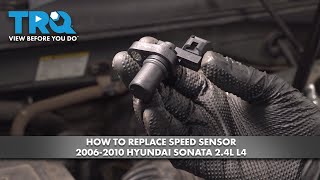
- Visually inspect the wiring harness and connector for the input speed sensor. Look for obvious damage, corrosion, or loose connections. The sensor is on the transmission case, often below the air filter box and battery. 🎬 Watch: How to replace the speed sensor on 2.4L engines
- On V6 models, you will likely need to remove the airbox and unbolt the two 12mm bolts holding the shift cable bracket to gain access to the input sensor. 🎬 Watch: Step-by-step sensor replacement on a V6 Sonata
- If wiring appears intact, the most common failure is the sensor itself. Given the low cost of the part, replacement is the most practical next step.
- To be more thorough, disconnect the sensor and use a multimeter to check for resistance across its terminals. An infinite reading (Open Loop) confirms a failed sensor. Compare this to the output sensor, which should show a resistance value.
- If a new sensor does not resolve the issue, perform a continuity check on the wiring between the sensor connector and the Transmission Control Module (TCM) to find any hidden breaks or shorts, paying attention to potential pinch points near the TCM.
- If both the sensor and wiring are confirmed to be good, the problem may lie within the TCM, but this is extremely unlikely and should be the last resort.
Parts You'll Likely Need
- Transmission Input Speed Sensor (Pulse Generator A)
(OEM #42620-39200 (for many NF Sonatas, Azera, etc.) or 42620-39051 (for many EF Sonatas). Always verify with VIN.)— This sensor is the most common cause of code P1715 on this vehicle. It is a frequent failure item due to age and heat exposure.
Trusted brands: Standard Motor Products, WVE, Delphi, Mando, Genuine Hyundai/Kia
OEM price range: $50-$90
Aftermarket price range: $20-$60 - Transmission Output Speed Sensor (Pulse Generator B)
(OEM #42621-39200 (for many NF Sonatas, Azera, etc.) or 42621-39052 (for many EF Sonatas). Always verify with VIN.)— Often replaced preventatively with the input sensor, as they are of the same age and subject to the same conditions. Required if code P0720 is also present.
Trusted brands: Standard Motor Products, WVE, Delphi, Mando, Genuine Hyundai/Kia
OEM price range: $50-$90
Aftermarket price range: $20-$60
Related Codes That Often Appear With This One
- P0720 — This code is for the Output Speed Sensor circuit (Pulse Generator 'B'). It's common for these sensors to fail around the same time due to similar age and operating conditions. If both are present, it is highly recommended to replace them as a pair.
- P0717 — This is a generic OBD-II code for 'Input/Turbine Speed Sensor 'A' Circuit No Signal,' which is a more specific version of the fault indicated by the manufacturer-specific P1715.
- P1529 — This is a generic Hyundai code indicating that the TCM has requested the Check Engine Light to be turned on and has stored its own codes. It will almost always be present alongside a more specific transmission code like P1715.
Technical Service Bulletins (TSBs) & Recalls
- TSB 09-AT-016: Hyundai issued this technical service bulletin in August 2009 for a wide range of models, including the 1999-2010 Sonata. It addresses DTCs P0715, P0716, P0717, P0720, P0721, & P0722. It confirms symptoms like 'Harsh P-R or P-D engagement,' 'Transaxle in 3rd gear fail-safe,' and a Check Engine Light. The TSB provides a diagnostic procedure that involves checking the sensor signal with a GDS tool, inspecting the wiring harness for damage (specifically for pinching at the TCM bolts), and ultimately replacing the input or output speed sensor as needed.
Platform-Specific Known Issues
- On many 2006-2010 Sonatas with the V6 engine and A5HF1 transmission, the input speed sensor is located directly underneath the transmission shift cable bracket. This bracket must be unbolted and moved aside to access the sensor's 10mm retaining bolt.
- The input and output sensors are visually distinct. On the NF Sonata, the input sensor's connector plug is oriented vertically, while the output sensor's is horizontal, preventing them from being installed in the wrong location.
Scan Tool Commands That Help
- Hyundai GDS (Global Diagnostic System): Live Data Monitoring (Input Speed Sensor RPM) — Use to monitor the signal from Pulse Generator 'A' in real-time while driving. A signal that is erratic, drops to zero, or does not correlate with engine RPM indicates a fault in the sensor or its circuit. This is the primary diagnostic function for this code.
- Hyundai GDS (Global Diagnostic System): Vehicle S/W Management - Reset Adaptive Values — This function can be used after replacing the sensor or performing other transmission repairs to reset the TCM's learned shift adaptations. While not always mandatory for a sensor replacement, it can help the transmission return to optimal shifting behavior more quickly.
Wiring & Ground Locations
- G09 — On the left front shock tower in the engine compartment (NF Sonata).. This is a primary engine compartment ground. A poor connection here could potentially cause electrical noise or voltage issues for various engine and transmission sensors.
- G14 — Under the right side of the dashboard (NF Sonata).. This is an interior ground point. As the TCM is located inside the cabin, a poor ground here could affect the module's operation and its ability to correctly interpret sensor signals.
- Input Speed Sensor Connector — On top of the transaxle, below the air intake system. On V6 models, it is typically under the shifter cable bracket.. This is the primary connection point to test the sensor and the harness. The connector itself can be a point of failure due to corrosion or damage.
Real Owner Repair Stories
- YouTube channel 'Nate S' (2006 Hyundai Sonata) — Implied transmission issues requiring sensor replacement.
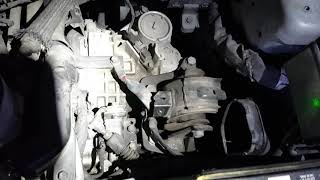
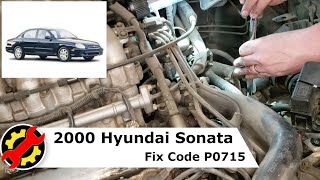
✅ What actually fixed it Replacing the input speed sensor. The video provides critical detail for the NF Sonata V6, showing that the shifter cable bracket (held by two 12mm bolts) must be unbolted and rotated up to access the 10mm bolt holding the input sensor. It also clearly shows the visual difference: the input sensor has a vertical connector plug, while the nearby output sensor has a horizontal one. - YouTube channel 'Eric Tennant' (2000 Hyundai Sonata) — Transmission felt like it was 'about ready to go to the junkyard'. The car was throwing code P0715 (the generic equivalent of P1715).
✅ What actually fixed it Replacing the input speed sensor. On this EF generation Sonata, the repair required removing the battery and the entire air filter box assembly to gain access to the sensor on top of the transmission. The owner confirmed a $12 aftermarket sensor from Amazon resolved all symptoms.
OEM Part Supersession History
42620-39050, 42620-39100→42620-39051— Part revision or manufacturer change.
Heads up: This part number is specified for models built up to March 6, 2007.42620-39210→42620-39200— Part revision or manufacturer change.
Heads up: This part number is specified for models built from March 7, 2007, onward. Using the wrong part across this date boundary may result in fitment or signal issues.
Model Year Variations Within This Range
- 2000-2005 (EF Generation): These models typically use a 4-speed automatic transmission (e.g., F4A42/F4A51). Access to the speed sensors generally requires removal of the battery and air filter housing to reach the top of the transaxle.
- 2006-2010 (NF Generation): These models often use a 5-speed A5HF1 automatic transmission, especially with the V6 engine. Access to the input sensor on the V6 requires removing the air intake and unbolting the shifter cable bracket that sits on top of the sensor.
- Mid-2007 (NF Generation): There was a part change for the input speed sensor around March 2007. Part number 42620-39051 is for models built before this date, and 42620-39200 is for models built after. Verifying the vehicle's production date or using the VIN is critical when ordering this part.
Diagnostic Flowchart
Used vs. New Parts: Buying Guide for This Vehicle
When a used part is the smart pick: For this specific repair, a used part from a junkyard is NOT recommended. The part is a relatively low-cost electronic sensor, and the labor involved in accessing it makes installing a part with unknown remaining lifespan poor value. The risk of premature failure outweighs the small cost savings.
OEM-only on this vehicle (don't cheap out):
- While not strictly 'OEM-only', using a Genuine Hyundai/Kia part or a part from the original equipment manufacturer (OEM), like Mando, is highly recommended for transmission electronics to ensure reliability and correct signaling.
Aftermarket brands forum-validated for this vehicle:
- Standard Motor Products (SMP)
- Delphi
- NTK
- Dorman
Brands owners have reported issues with on this vehicle:
- Unbranded, no-name sensors from online marketplaces should be treated with caution. While some may work, they have a higher reported incidence of out-of-box failures or short service life compared to reputable brands.
Real Owner Stories
Aggregated from forums and TSBs cited above. Mileages and costs reflect what owners reported in those sources.
2002 Hyundai Sonata V6
Symptoms: The vehicle got stuck in 3rd gear while driving on the highway. A scan revealed codes P1529 and P0715 (Input Speed Sensor Malfunction).
What fixed it: The provided summary details the symptoms and codes but does not state the specific repair that resolved the issue for this owner.
Source hint: Hyundai-Forums.com - 'Check Engine Light + Transmission Stuck in 3rd gear'
2008 Hyundai Sonata
Symptoms: Owner experienced harsh engagement when shifting from Park to Drive or Reverse, the transmission was stuck in 3rd gear (fail-safe mode), and the Check Engine Light was on.
What fixed it: The diagnostic procedure called for inspecting the wiring harness for damage (especially near the TCM bolts) and ultimately replacing the input or output speed sensor as needed.
Source hint: TSB 09-AT-016
Related OBD-II Codes
Frequently Asked Questions
Is there a Technical Service Bulletin (TSB) for my Sonata getting stuck in 3rd gear with a P1715 code?
Where is the input speed sensor located on my V6 Sonata? It seems hard to access.
How can I tell the difference between the input and output speed sensors on my Sonata to avoid mixing them up?
My mechanic suspects a pinched wire is causing the P1715 code. Is there a common spot for this on a Sonata?
Is it okay to use a cheap, unbranded speed sensor from an online marketplace for this repair?
My mechanic wants to replace the Transmission Control Module (TCM) for this code. Is that a common fix?
Helpful Videos
We Have This Part in Stock

The information in this article is provided for general reference and educational purposes only. Vehicle specifications, procedures, and part compatibility can vary by production date, trim level, and region. Always consult your vehicle's factory service manual and verify part numbers before purchasing or performing repairs. Safety-critical components such as airbags, seat belts, and braking systems should be installed by a qualified professional.
- Hyundai Sonata:
- 🧭 Diagnostic Flowchart
- 🎬 Helpful Videos
- 🛍️ Shop This Part
- What's Unique About the 2000-2010 Hyundai Sonata
- Symptoms You May Notice
- Most Likely Causes
- Rare But Worth Checking
- Diagnosis Steps
- Parts You'll Likely Need
- Related Codes That Often Appear With This One
- Technical Service Bulletins (TSBs) & Recalls
- Platform-Specific Known Issues
- Scan Tool Commands That Help
- Wiring & Ground Locations
- Real Owner Repair Stories
- OEM Part Supersession History
- Model Year Variations Within This Range
- Used vs. New Parts: Buying Guide for This Vehicle
- Real Owner Stories
- 2002 Hyundai Sonata V6
- 2008 Hyundai Sonata
- Related OBD-II Codes
- Frequently Asked Questions
- 🎟️ Get 5% Off