

P1715 on 2008-2017 Mitsubishi Lancer: CVT Input Speed Fault Causes and Fixes
On a 2008-2017 Lancer, P1715 indicates an illogical speed reading from the CVT's input pulley, often caused by a failing stepper motor. Do not just replace the sensor; the most common fix is replacing the stepper motor, which is part of the valve body, costing around $150-$400 for the part.
- P1715 on your Lancer means the CVT is having a mechanical or hydraulic problem; it is NOT just a bad sensor.
- The most likely cause is a failing stepper motor (ratio control motor) located inside the transmission.
- Do not drive the vehicle extensively. The transmission is in a fail-safe mode and continued use can lead to complete, unrepairable failure.
- The correct repair often involves replacing the stepper motor or the entire valve body, which requires dropping the transmission oil pan.
- Always check the CVT fluid for metal debris, as this can indicate a much more serious failure requiring a full transmission replacement.
What's Unique About the 2008-2017 Mitsubishi Lancer
The Mitsubishi Lancer of this era uses a Jatco JF011E (also known by the Mitsubishi code F1CJA) Continuously Variable Transmission. This specific CVT is known for issues with its ratio control motor, commonly called a 'stepper motor'. While other codes like P1777 directly point to the stepper motor circuit, a failing stepper motor is a primary cause of the speed discrepancies that trigger P1715. Owners often experience symptoms like limp mode or lack of power before the code appears, pointing directly to this well-documented failure pattern in the transmission's control system. This same transmission and its related problems are found in a wide array of vehicles from Nissan, Jeep, and Dodge.
Symptoms You May Notice
- Check Engine Light is on
- Vehicle enters 'limp mode' (fail-safe) with reduced power
- Sluggish or delayed acceleration
- Inability to accelerate past a certain speed (e.g., 60 mph)
- Feeling like the transmission is stuck in one gear
- Hesitation or shuddering from the transmission
- Whining or grinding noise from the transmission area that may increase with speed.
- Replacing only the input speed sensor. The P1715 code is almost always a symptom of a mechanical or hydraulic issue that the sensor is correctly detecting. Replacing the sensor will not fix the underlying problem.
Most Likely Causes
- Failing CVT Stepper Motor (Ratio Control Motor) 🔴 High Probability The Jatco JF011E CVT has a well-documented history of stepper motor failure. The motor becomes weak and can no longer accurately adjust or hold the pulley ratio under load, causing a mismatch in pulley speeds.
How to confirm: A mechanic can use a scan tool to monitor the commanded steps vs. actual ratio. Often, the motor fails to respond correctly. Physical inspection may show a worn-out pin on the motor that engages the valve body. The presence of code P1777 alongside P1715 strongly points to the stepper motor.
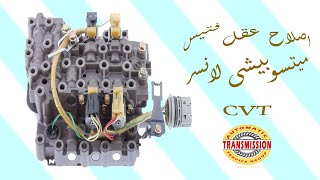
Typical fix: Replace the stepper motor. The motor is typically located on the valve body inside the transmission oil pan. It is often replaced as part of a valve body service. 🎬 Watch: A detailed look at repairing the CVT valve body.
Est. part cost: $50-$150 - Faulty CVT Control Valve Body 🟡 Medium Probability → Shop Transmission Valve Body Metallic debris from normal wear or a failing component can contaminate the CVT fluid and clog the small solenoids and passages in the valve body, leading to incorrect hydraulic pressure and belt slippage. Sticking valves within the body can also cause this issue.
How to confirm: Diagnosis involves checking CVT fluid for excessive metal shavings and testing solenoid pressures with a specialized scan tool. If other pressure-related codes (like P0776) are present, the valve body is highly suspect.
Typical fix: Replace the entire CVT valve body assembly. This assembly often includes a new stepper motor and solenoids. Remanufactured units are a common repair choice.
Est. part cost: $250-$500 - CVT Belt Slippage or Damage ⚪ Low Probability Over time, the steel push belt can wear, stretch, or begin to delaminate, causing it to slip on the pulleys. This is a severe failure often caused by overheating or fluid breakdown.
How to confirm: A significant amount of metallic debris in the transmission fluid is a strong indicator. A mechanic may use a borescope through the drain plug hole to visually inspect the belt for damage. A tell-tale sign is the combination of codes P1715 and P0776, which often points to serious belt slip.
Typical fix: Complete replacement of the CVT assembly is required. A slipping or damaged belt signifies the end of the transmission's life.
Est. part cost: $2000-$4000
Rare But Worth Checking
- Faulty Transmission Control Module (TCM): → Shop Transmission Assembly While rare, an internal TCM failure can cause incorrect signals or false codes. This should only be considered after all other mechanical and wiring issues have been ruled out. In some cases, a TCM reprogram may be required as part of a related repair.
- Wiring Harness Damage: Damage to the wiring between the TCM and the transmission sensors or stepper motor can cause an open or short circuit, triggering the code. This is uncommon but possible.
- Low Battery Voltage: In some specific interpretations, a P1715 code on Mitsubishi vehicles can be triggered if the system voltage drops below 9 volts while the engine is running, pointing to a charging system or battery issue rather than a transmission fault.
Diagnosis Steps
- Check the Check Engine Light and scan for all DTCs. Note if P1715 is present alone or with other codes like P1777 or P0776.
- Inspect the CVT fluid level and condition. Check for a burnt smell or excessive metallic particles on the dipstick or drain plug magnet. A large amount of debris suggests a severe internal failure.
- Using a capable scan tool, monitor live data from the primary and secondary pulley speed sensors while driving. Look for erratic readings or dropouts from the primary sensor.
- Monitor the commanded stepper motor steps versus the actual transmission ratio. If the ratio does not respond correctly to commands, the stepper motor is likely faulty.
- Check for related Technical Service Bulletins (TSBs). For example, Nissan TSB NTB18-077 discusses the combination of P1715 and P0776, pointing to valve body issues.
- If the fluid is clean and sensor readings are inconclusive, inspect the wiring harness to the transmission for any visible damage or corrosion.
- If the stepper motor is suspected, drop the transmission oil pan to access the valve body and inspect the stepper motor and its connector.
- If significant metal debris is found, the transmission is likely beyond simple repair and may require replacement.
Parts You'll Likely Need
- CVT Stepper Motor (Ratio Control Motor)
(OEM #2826A006 (often part of valve body assembly))— This is the most common failure point on the Jatco JF011E CVT that leads to the P1715 code. It is responsible for changing the gear ratio, and its failure causes the speed discrepancy detected by the sensor.
Trusted brands: Hitachi, Rostra, Beck/Arnley
OEM price range: $100-$200
Aftermarket price range: $45-$150 - CVT Valve Body
(OEM #2800A187 (supersedes 2800A149, 2800A163, 2800A184 for non-turbo models), 2800A135 (for turbo models))— If the valve body is clogged with debris or its solenoids have failed, it cannot maintain the hydraulic pressure needed to prevent belt slip. It is often replaced as a complete assembly with a new stepper motor.
Trusted brands: Mitsubishi (OEM), Rostra
OEM price range: $600-$1300
Aftermarket price range: $250-$500 (Remanufactured)
Related Codes That Often Appear With This One
- P0715 — P0715 is the generic SAE equivalent of the manufacturer-specific P1715 code, both pointing to the Input/Turbine Speed Sensor circuit.
- P1777 — This code specifically indicates a malfunction in the stepper motor circuit. A failing stepper motor is a primary cause of the ratio control problems that trigger P1715.
- P0776 — This code points to a pressure control solenoid 'B' performance issue, often related to a faulty valve body. Since valve body problems cause belt slip, P0776 and P1715 often appear together, indicating a potentially severe internal issue.
Technical Service Bulletins (TSBs) & Recalls
- Nissan TSB NTB18-077: While for Nissan vehicles, this TSB is highly relevant as it covers the same Jatco CVT. It details the diagnostic procedure when codes P1715 and P0776 appear together, often pointing to a needed valve body repair and TCM reprogram.
Platform-Specific Known Issues
- The Jatco JF011E (Mitsubishi F1CJA) transmission in the Lancer is known for overheating, which accelerates fluid degradation and wear on internal components like the stepper motor and belt.
Mechanic-Grade Diagnostic Values
- CVT Fluid Temperature Sensor Resistance — expected: Approx. 6.5 kΩ at 20°C (68°F), dropping to 0.9 kΩ at 80°C (176°F).. Failure: Readings significantly outside this range indicate a faulty sensor, which can affect pressure calculations.
- TCC Control Solenoid (Pulse Width Modulated) Resistance — expected: 3 to 9 Ω.. Failure: Resistance outside this range suggests a failed solenoid coil.
- Lockup Select Switch Solenoid (On/Off) Resistance — expected: 15 to 30 Ω.. Failure: An open or shorted reading indicates a faulty solenoid.
- Primary/Input Speed Sensor Signal (Live Data) — expected: Approximately 890 Hz at 12 mph (20 km/h).. Failure: An erratic or absent signal when the secondary speed sensor shows a reading points to a sensor or circuit fault. However, for P1715, the signal is often present but illogical compared to the secondary pulley speed.
Scan Tool Commands That Help
- Mitsubishi MUT-III: CVT oil degradation level reset — This must be performed after changing the CVT fluid to reset the fluid life monitor within the TCM. Failure to do so can result in incorrect line pressure calculations and premature wear.
- Mitsubishi MUT-III: Reset (item number 3: C/V initial & learned value) — This function is used to erase all learned values and initialize the control strategy. It is required after replacing the CVT assembly or the valve body to force the TCM to relearn adaptive parameters.
- Mitsubishi MUT-III: Write calibration value (Saved calibration value writing) — When replacing the CVT assembly or TCM, the unique calibration file for the transmission must be written to the TCM. This ensures the control module has the exact operational parameters for that specific unit.
Wiring & Ground Locations
- Transmission Control Module (TCM) — Located under the driver's side of the instrument panel, near the steering column and brake pedal.. This is the computer that receives the input speed sensor signal and controls all transmission functions. Verifying its connections and grounds is a key diagnostic step, especially if communication with the scan tool is intermittent.
- Transmission Pass-Through Connector — The main external electrical connector on the CVT case, which connects the internal transmission harness (sensors, solenoids, stepper motor) to the main vehicle harness going to the TCM.. This connector is a critical point for checking continuity and resistance of internal components like the input speed sensor and stepper motor without dropping the oil pan. A wiring diagram is needed to identify the correct pins.
- G301 Ground (Dodge/Jeep equivalent) — On related Dodge/Jeep vehicles using the JF011E, a critical ground point is located on the firewall in the engine compartment.. While specific to other brands, it highlights that Mitsubishi/Nissan models use an internal grounding scheme for the solenoids, meaning resistance checks should be made to the transmission case itself. A bad case ground could cause widespread issues.
Real Owner Repair Stories
- AliExpress User Review (2013 Nissan Altima, 142k+ miles (Uses related Jatco JF011E)) — Worsening shift shocks, harsh shifting, delayed engagement, and occasional limp mode activation.
❌ Tried (didn't work) The user specifically noted they did NOT try common misdiagnoses like aggressive fluid flushes or replacing sensors first.
✅ What actually fixed it The problem was resolved by replacing the entire CVT valve body assembly. The user reported that normal, smooth operation returned within two days of driving after the replacement.
OEM Part Supersession History
2800A149, 2800A163, 2800A184→2800A187— Revisions and updates to the valve body assembly for non-turbo Lancer models.
Heads up: The valve body for turbo models (2800A135) is different and not interchangeable with non-turbo models.
Model Year Variations Within This Range
- All years (2008-2017): The JF011E valve body came in two main versions: a 'one-sensor' and a 'two-sensor' design. The second sensor is for primary pressure. While a two-sensor valve body can reportedly be used in a one-sensor application (leaving one sensor unused), the reverse is not true. Chrysler/Dodge/Jeep versions typically use the two-sensor design, while Nissan/Mitsubishi could have either. It is critical to match the new valve body to the original's sensor configuration.
Diagnostic Flowchart
Other Known Issues on This Vehicle
Issues unrelated to this code that are worth knowing about as an owner of this generation:
- Clear Coat / Paint Failure 🟠 Medium — Widespread, especially on darker colors and cars exposed to high UV. Peeling and delamination of the clear coat can start after a few years.
- ETACS ECU Failure 🔴 High — Common on 2009-2010 models, leading to a recall. Can cause loss of headlights, wipers, and other electrical issues. (Ref: Safety Recall C1502T for certain 2009-2010 models.)
- Timing Chain Stretch (4B11/4B12 Engines) 🟠 Medium — More common on earlier models (pre-2010). Can cause rattling noises on startup and, if ignored, lead to engine damage. Typically occurs after 100,000 km.
- Radiator Fan Control Module Failure 🟠 Medium — A common cause of engine overheating, especially in traffic or at idle, as the module fails to activate the cooling fans.
- Excessive Oil Consumption (4B11 Engine) 🟡 Low — Some engines may consume oil due to piston ring or valve seal wear at higher mileage.
Used vs. New Parts: Buying Guide for This Vehicle
When a used part is the smart pick: A used valve body from a low-mileage, verified-running donor vehicle can be a cost-effective option, as the failure is often electronic (stepper motor, solenoids) or due to sludge, which a used part may not have. However, the risk of inheriting a different problem is moderate.
Donor-vehicle mileage cap: roughly under 80000 miles for the part to have meaningful remaining life.
What to inspect on the donor part:
- Verify the donor vehicle's mileage and ensure it was not in a severe front-end collision.
- Ask for the VIN to check for a history of transmission complaints.
- Inspect the fluid color from the donor transmission if possible; it should be reddish-green or light brown, not black or burnt-smelling.
- Ensure the valve body matches your vehicle's configuration (one vs. two pressure sensors).
OEM-only on this vehicle (don't cheap out):
- Transmission Control Module (TCM): Due to programming and calibration data being unique to the vehicle and transmission, a used TCM is very difficult to make work correctly and an OEM part is strongly advised.
Aftermarket brands forum-validated for this vehicle:
- Rostra (for stepper motors and solenoids)
- Sonnax (for valve body repair kits/components)
- Sunbelt Valve Body Builders (for remanufactured valve bodies)
Brands owners have reported issues with on this vehicle:
- Unbranded, no-name valve bodies or stepper motors from online marketplaces without significant positive reviews can be a high-risk purchase with high failure rates.
Real Owner Stories
Aggregated from forums and TSBs cited above. Mileages and costs reflect what owners reported in those sources.
2012 Mitsubishi Lancer
Symptoms: Owner reported having no power and the transmission feeling like it was stuck in one gear, accompanied by code P0715 (the generic equivalent of P1715).
What fixed it: The specific repair was not mentioned in the report.
Source hint: Reddit r/lancer
Related OBD-II Codes
Frequently Asked Questions
My Lancer has codes P1715 and P1777 together. What does that usually mean?
I found a Nissan TSB (NTB18-077) for P1715. Is this relevant to my Mitsubishi Lancer?
What is the most likely repair if a mechanic finds a lot of metal shavings in my Lancer's CVT fluid?
My Lancer is in 'limp mode' with P1715. What is happening to my car?
Are other cars like the Dodge Caliber or Jeep Patriot also known for this P1715 transmission issue?
What is the most common, high-probability cause for a P1715 code on a 2008-2017 Lancer?
Helpful Videos
We Have This Part in Stock

The information in this article is provided for general reference and educational purposes only. Vehicle specifications, procedures, and part compatibility can vary by production date, trim level, and region. Always consult your vehicle's factory service manual and verify part numbers before purchasing or performing repairs. Safety-critical components such as airbags, seat belts, and braking systems should be installed by a qualified professional.
- Mitsubishi Lancer:
- 🧭 Diagnostic Flowchart
- 🎬 Helpful Videos
- 🛍️ Shop This Part
- What's Unique About the 2008-2017 Mitsubishi Lancer
- Symptoms You May Notice
- Most Likely Causes
- Rare But Worth Checking
- Diagnosis Steps
- Parts You'll Likely Need
- Related Codes That Often Appear With This One
- Technical Service Bulletins (TSBs) & Recalls
- Platform-Specific Known Issues
- Mechanic-Grade Diagnostic Values
- Scan Tool Commands That Help
- Wiring & Ground Locations
- Real Owner Repair Stories
- OEM Part Supersession History
- Model Year Variations Within This Range
- Other Known Issues on This Vehicle
- Used vs. New Parts: Buying Guide for This Vehicle
- Real Owner Stories
- 2012 Mitsubishi Lancer
- Related OBD-II Codes
- Frequently Asked Questions
- 🎟️ Get 5% Off