

P1720 on 2016-2019 Ford Explorer 2.3L: Vehicle Speed Circuit Malfunction Causes and Fixes
On a 2016-2019 Ford Explorer, code P1720 most often indicates a failed Vehicle Speed Sensor (VSS) on the transmission. This can cause harsh shifting and an erratic speedometer. Expect to pay $40-$90 for a new sensor, which is a moderately easy DIY replacement.
- P1720 on your Explorer points directly to the speed sensor on the transmission, not the wheel speed sensors.
- The most likely fix is replacing the Vehicle Speed Sensor (VSS), a relatively inexpensive part.
- Before replacing parts, carefully inspect the wiring harness near the transmission for any signs of heat damage from the exhaust.
- Driving with this code can cause severe transmission shifting problems and is a safety concern; get it diagnosed promptly.
- If a new sensor doesn't fix it, the problem is likely in the wiring or, rarely, a module software issue.
What's Unique About the 2016-2019 Ford Explorer
The 2016-2019 Explorer with the 2.3L EcoBoost engine uses a 6F35 automatic transmission. A Ford technician on a forum noted that this transmission can feel underpowered for the heavy Explorer, potentially contributing to stress and premature wear. While the speed sensors themselves can fail, this platform's wiring harness routing is a key area to inspect. On a 2020 Explorer, an owner spent thousands on a new transmission for a speed sensor code, only to find the real issue was the transmission harness resting on the exhaust, causing heat damage. Furthermore, Ford issued Customer Satisfaction Program 20B27 🎬 Watch: Fix for Ford Explorer shifting and banging into gear, a PCM software update to prevent the torque converter from overheating, a known issue on this specific vehicle and transmission combination.
Symptoms You May Notice
- Erratic, harsh, or delayed transmission shifting
- Speedometer needle fluctuates wildly or drops to zero
- Check Engine Light is on
- Wrench light may be illuminated
- ABS or Traction Control warning lights may be illuminated
- Cruise control is inoperative
- Vehicle may enter 'limp mode', getting stuck in one gear
- Replacing ABS wheel speed sensors. While some manufacturers use ABS sensor data for vehicle speed, the Ford-specific P1720 code points to the transmission-mounted VSS.
- Condemning the entire transmission. This is an electronic fault; unless driven for an extended period with severe shifting, the internal mechanical parts of the transmission are likely fine. An owner on an Explorer forum replaced the entire transmission for $5,000 only to find the same codes returned because the actual issue was a wiring harness touching the exhaust.
- Replacing ignition coils. While failing ignition coils on some Ford engines can cause electrical interference and trigger communication codes (like U0101), it's not a direct cause of P1720, though it's a good example of how unrelated electrical faults can cause transmission symptoms.
Most Likely Causes
- Faulty Internal Molded Lead Frame (w/ Speed Sensors) 🔴 High Probability → Shop Transmission Valve Body The Output Shaft Speed (OSS) and Turbine Shaft Speed (TSS) sensors are often integrated into a molded lead frame inside the 6F35 transmission. This component is a notorious failure point due to heat and vibration causing fractures in the electrical conductors. Ford has issued warranty extensions (like 19N01 for the similar 6R80) for this exact issue on other transmissions, highlighting a pattern of this part failing.
How to confirm: This is a difficult diagnosis without a professional scan tool. Codes P0720 (Output Speed Sensor Circuit) or P0722 (Output Speed Sensor No Signal) are strong indicators. A technician would monitor sensor data while testing. Given the high failure rate, if wiring is confirmed good, the lead frame is the prime suspect.
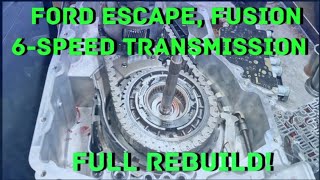
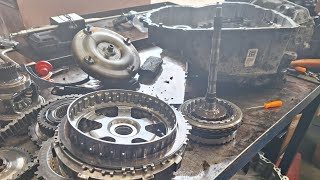
Typical fix: Replace the molded lead frame assembly inside the transmission. This is a complex job that involves draining the fluid, removing the transmission pan, and removing the valve body to access the lead frame. 🎬 See a complete 6F35 transmission rebuild walkthrough The valve body itself may also be replaced as a unit.
Est. part cost: $250-$500 for the lead frame/valve body assembly - Damaged Wiring Harness or Connectors 🟡 Medium Probability The transmission wiring harness can be exposed to high heat from the nearby exhaust system, potentially causing wires to melt or become brittle and break over time. There are owner accounts of the harness drooping onto the exhaust, causing intermittent speed sensor codes and shifting issues that mimic internal transmission failure.
How to confirm: Visually inspect the entire wiring harness from the transmission connector back towards the main harness. Look for any signs of melting, chafing, or contact with the exhaust system. Perform a wiggle test on the harness while monitoring the VSS signal with a scan tool to see if the fault is intermittent. Check the main connector for corrosion or pushed-out pins.
Typical fix: Repair the damaged section of the wiring harness or replace the connector pigtail. Crucially, secure the harness away from heat sources like the exhaust using zip ties or brackets to prevent a repeat failure.
Est. part cost: $20-$100 - Powertrain Control Module (PCM) Software Issue / Torque Converter Overheating 🟡 Medium Probability → Shop Engine Control Module (ECM)
How to confirm: Check with a Ford dealer if Customer Satisfaction Program 20B27 has been performed on your vehicle. This program involves a PCM software update specifically designed to prevent the torque converter from overheating, which can cause symptoms like rough idle, poor acceleration, and shudder.
Typical fix: Have a Ford dealer perform the PCM reprogram under TSB 20B27. If the torque converter has already been damaged by overheating, it may need to be replaced, a repair covered under the associated extended warranty program 20N07.
Est. part cost: $0 (for the software update) - $1500+ (for torque converter replacement if not under warranty)
Rare But Worth Checking
- Faulty Instrument Cluster: On some Fords, the instrument cluster itself is part of the vehicle speed circuit. A failure within the cluster can disrupt the signal and trigger a P1720 code, even if the sensor and wiring are good. This is uncommon but possible if the speedometer behaves erratically while other symptoms are not present.
- Fluid Contamination in External Module Connectors: On AWD models, the Power Transfer Unit (PTU) is located near the transmission. It is possible for fluid leaks to contaminate electrical connectors for the PTU or other nearby modules, causing unexpected communication codes and drivability issues.
Diagnosis Steps
- Scan for Codes: Use an OBD-II scanner to confirm P1720 is the primary code. Note any other transmission (P-prefix), communication (U-prefix), or chassis (C-prefix) codes. Codes P0720 or P0722 are highly significant.
- Check for TSBs: Contact a Ford dealer with your VIN to check for open recalls or customer satisfaction programs, specifically 20B27 (PCM Reprogram) and 20N07 (Torque Converter Warranty Extension).
- Inspect the Wiring: This is a critical step. Put the vehicle on a lift and meticulously inspect the transmission wiring harness for any signs of contact with the exhaust system. Look for melted plastic, chafing, or brittleness. Check the main connector for corrosion or loose pins.
- Monitor Live Data: Use a scan tool to observe the Vehicle Speed Sensor data while driving. Look for the speed to drop to zero, fluctuate erratically, or not register at all. This points towards a faulty sensor or wiring.
- Diagnose Internal Components: If wiring and software are ruled out, the issue is likely internal to the transmission. The next step is to drop the transmission pan and inspect the fluid and pan for excessive metal debris. Accessing and testing the molded lead frame requires removing the valve body, which is a job best left to a professional. 🎬 Watch: 6F35 transmission teardown and internal inspection
- Check for Module Updates: If a new sensor and verified wiring do not resolve the issue, the final step is to have a dealer or qualified shop check if the PCM requires a software update.
Parts You'll Likely Need
- Molded Lead Frame / Valve Body Assembly
(OEM #Varies by specific build, confirm with VIN. (e.g., 6R80 uses AL3Z-7G276-D))— This is the most common and significant point of failure for speed sensor codes on this transmission. The sensors are integrated into this internal component, which requires significant labor to replace.
Trusted brands: Motorcraft (OEM), Dorman
OEM price range: $300-$600
Aftermarket price range: $200-$400 - Transmission Wiring Harness Pigtail — If the harness is found to be melted or damaged from contact with the exhaust, replacing the connector pigtail is necessary.
Related Codes That Often Appear With This One
- P0720 — P0720 refers to the Output Shaft Speed (OSS) Sensor Circuit. The VSS and OSS are often the same sensor or work in tandem. If both codes are present, it strongly points to a failure of the sensor or its wiring, very likely the internal molded lead frame.
- P0722 — This code means 'Output Speed Sensor Circuit No Signal'. It is a more specific version of P0720 and often appears when the molded lead frame has completely failed.
- U0101 — This code indicates a loss of communication with the Transmission Control Module (TCM). A severe wiring issue or VSS failure could potentially disrupt communication, causing this code to appear alongside P1720.
Technical Service Bulletins (TSBs) & Recalls
- Ford Customer Satisfaction Program 20B27: PCM reprogram to protect the transmission torque converter from overheating in certain driving conditions.
- Ford Customer Satisfaction Program 20N07: Extends the warranty on the torque converter for vehicles that have had the 20B27 reprogram performed.
- Ford Customer Satisfaction Program 19N01: While for the 6R80 transmission, it shows a pattern of Ford extending the warranty on internal molded lead frames for failures causing codes P0720, P0722, and P1500.
Mechanic-Grade Diagnostic Values
- Resistance of Shift Solenoids A, B, C, D, TCC, and LPC solenoids in the 6F35 transmission. — expected: 4.00 - 5.89 Ohms at 68-86°F (20-30°C). The resistance increases with temperature.. Failure: A reading outside the specified range for a given temperature indicates a faulty solenoid.
- Resistance of Shift Solenoid E (On/Off type) in the 6F35 transmission. — expected: 19.05 - 27.95 Ohms at 68-86°F (20-30°C).. Failure: A reading outside this range points to a failure in the SSE solenoid.
- Continuity check on transmission wiring harness. — expected: Less than 5 ohms between the TCM connector and the transmission bulk-head connector for the respective sensor circuit.. Failure: Resistance greater than 5 ohms indicates an open or high-resistance in the wiring.
Hidden / Shadow Codes Worth Checking
- P1500: Vehicle Speed Sensor Intermittent. This is a Ford-specific code that can be stored along with P1720, P0720, and P0722, often pointing towards the same lead frame failure. (see via Professional scan tools like Ford IDS.)
Scan Tool Commands That Help
- Ford IDS (Integrated Diagnostic System): Self-Test > Retrieve CMDTs (Continuous Memory Diagnostic Trouble Codes) — To pull all stored codes from the PCM and other modules, which is the first step in any diagnosis.
- Ford IDS (Integrated Diagnostic System): Datalogger > PID Select (TSS_SRC, OSS_SRC, VSS) — To monitor the live data feeds from the Turbine Speed Sensor, Output Speed Sensor, and Vehicle Speed Sensor while driving. This helps identify intermittent dropouts or erratic signals that confirm a sensor or wiring issue.
- Ford IDS (Integrated Diagnostic System): Toolbox > Transmission > TCM Adaptive Learning — After replacing the molded lead frame or valve body, this function must be performed to clear the old adaptive shift strategy data and allow the TCM to learn the characteristics of the new components for proper shifting.
Wiring & Ground Locations
- C175B — One of the main connectors at the Powertrain Control Module (PCM).. Pin 5 (VT-OG wire) is the Vehicle Speed Output (VSOUT) circuit. Testing for a proper signal at this pin can help determine if the fault is in the PCM or downstream in the wiring/instrument cluster.
- G104 / G105 — Main engine compartment ground points, typically on the right or left side of the engine compartment near the firewall or shock tower.. A loose or corroded main engine or chassis ground can cause a variety of electrical issues, including erratic sensor readings and transmission problems. One owner of a 2.3L Explorer found a loose ground strap on the front of the engine was the root cause of transmission issues.
- Transmission Harness Bulkhead Connector (C1520A on some models) — The main external connector on the transmission case where the vehicle harness connects to the internal transmission wiring.. This is a primary point for checking for corrosion, pushed-out pins, or fluid intrusion. A diagnostic pinpoint test would involve checking for continuity and shorts to ground/power at this connector's pins.
Real Owner Repair Stories
- Ford Truck Enthusiasts Forum (2002 Ford Excursion V10 (Similar electrical principle)) — Codes P0720 and P0722, flashing O/D light, engine would die when put into Drive or Reverse.
❌ Tried (didn't work) Replacing the Output Speed Sensor (OSS), Testing the alternator (it tested good)
✅ What actually fixed it A failing Coil-On-Plug (COP) was causing electrical interference (AC voltage ripple) that disrupted the OSS signal. The owner diagnosed it by unplugging one COP at a time until the stalling symptom disappeared. Replacing the identified bad coil (Cylinder #5) resolved all symptoms. - Reddit r/FordExplorer (2016 Ford Explorer 2.3L) — General transmission problems and electrical gremlins.
❌ Tried (didn't work) Not specified
✅ What actually fixed it The owner was cleaning all grounding points as preventative maintenance and discovered the main ground strap going to a stud on the front of the engine was loose from the factory. Tightening this ground resolved intermittent issues.
OEM Part Supersession History
Varies by transmission build (6F35 vs 6R80)→Updated lead frame part numbers— Ford has issued multiple warranty extensions and customer satisfaction programs (e.g., 19N01 for the 6R80) due to high failure rates of the original molded lead frames. The updated parts are intended to have improved durability against heat and vibration that causes fractures in the internal conductors.
Heads up: It is critical to use the correct lead frame for the specific transmission (6F35) and vehicle year. While the failure is common across several Ford transmissions, the parts are not interchangeable.
Model Year Variations Within This Range
- 2013-2019 (Gen 2 6F35): The second generation of the 6F35 transmission (used in this Explorer) has a different and more complex fluid drain, fill, and level check procedure compared to the first generation (2009-2012). This is critical knowledge for anyone servicing the transmission fluid during a lead frame replacement.
Diagnostic Flowchart
Other Known Issues on This Vehicle
Issues unrelated to this code that are worth knowing about as an owner of this generation:
- 2.3L EcoBoost Coolant Intrusion 🔴 High — Widespread issue across multiple model years. Can occur at various mileages, often leading to misfires (especially on cold start), white exhaust smoke, and unexplained coolant loss. (Ref: TSB 22-2223 (and others that supersede it) address this known design flaw, which may require a new cylinder head or complete long block replacement.)
- 6F35 Transmission Shudder & Premature Failure 🔴 High → Shop Transmission Assembly — Common complaint, especially after 60,000 miles. Symptoms include shuddering during light acceleration, harsh shifts, and eventual failure. Some failures have been reported under 100,000 miles even with proper maintenance. (Ref: TSB 20B27 (PCM Reprogram) and 20N07 (Torque Converter Warranty) were issued to address an overheating torque converter, a major contributor to these symptoms.)
- Cracked Exhaust Flex Pipe 🟠 Medium — The flexible joint in the exhaust pipe after the turbo is known to crack and cause a loud exhaust leak. This can be caused by failed engine or transmission mounts putting stress on the pipe.
- Power Transfer Unit (PTU) Failure (AWD Models) 🔴 High → Shop Transfer Case Assembly — Common on AWD models, typically after 60,000 miles. The PTU is located near the hot exhaust, causing its 'lifetime' fluid to break down, leading to overheating and gear failure. Often results in a whining noise or complete loss of AWD.
- Detaching Roof Rail Covers 🟡 Low — The cosmetic roof rail covers can become loose and detach from the vehicle while driving. (Ref: Recall 20S62 / NHTSA 20V-692)
Used vs. New Parts: Buying Guide for This Vehicle
When a used part is the smart pick: A used wiring harness from a reputable salvage yard can be a cost-effective solution if the original is confirmed to be damaged, provided the donor vehicle has no signs of front-end or fire damage. A complete used transmission assembly could be considered if the cost is close to the repair of the original, but it carries the risk of inheriting the same lead frame problem.
Donor-vehicle mileage cap: roughly under 80000 miles for the part to have meaningful remaining life.
What to inspect on the donor part:
- For a wiring harness, inspect for any cuts, melted sections, or brittle conduit. Ensure all connector locking tabs are intact.
- For a complete transmission, ask for the donor vehicle's VIN to check its service history if possible.
- Check the color and smell of the transmission fluid on the donor unit's dipstick (if accessible) or from the cooler lines; dark, burnt-smelling fluid is a major red flag.
OEM-only on this vehicle (don't cheap out):
- Molded Lead Frame: Given the high failure rate of the original design and the significant labor involved, using a brand new OEM (Motorcraft) or a reputable aftermarket part with an updated design is strongly recommended to avoid a repeat failure.
Aftermarket brands forum-validated for this vehicle:
- Motorcraft (OEM)
- Dorman (Offers a replacement lead frame, but check for reviews specific to the 6F35 application)
Brands owners have reported issues with on this vehicle:
- Unnamed 'white-box' electronic parts from online marketplaces are a significant gamble and should be avoided for a labor-intensive job like this.
Real Owner Stories
Aggregated from forums and TSBs cited above. Mileages and costs reflect what owners reported in those sources.
2020 Ford Explorer
Symptoms: Speed sensor codes and shifting issues that persisted even after a costly transmission replacement.
What fixed it: The transmission wiring harness was found to be running on the exhaust, causing heat-related damage; securing and repairing the harness was the actual fix.
Source hint: Explorer ST Forum (https://www.explorerst.org/threads/new-transmission-same-problem-2020-help.6963/)
2017 Ford Explorer 2.3L — 99700 miles
Symptoms: Transmission failure despite meticulous fluid changes.
What fixed it: The owner discussed the 20B27 PCM reprogram to protect the torque converter from overheating as a preventative measure or part of the repair path.
Source hint: BobIsTheOilGuy.com Forums
Related OBD-II Codes
Frequently Asked Questions
Does Ford Customer Satisfaction Program 20B27 apply to my 2016-2019 Explorer 2.3L?
Is there a warranty extension for the torque converter if it fails on my Explorer?
My speedometer is dropping to zero and the wrench light is on; is this a known issue for the 6F35 transmission?
Can a damaged wiring harness cause P1720 symptoms on the 2.3L EcoBoost Explorer?
What is the estimated cost to replace the molded lead frame if it's not covered by a program?
Are there any other major engine issues I should watch for on my 2016-2019 2.3L Explorer?
Helpful Videos
![Ford Explorer Shift & Bang Into Gear Solved | 2016 Ford Shift And Bang Into Gear Solved [Easy Fix]](https://img.youtube.com/vi/rlSqh2shA_I/mqdefault.jpg)
We Have This Part in Stock




The information in this article is provided for general reference and educational purposes only. Vehicle specifications, procedures, and part compatibility can vary by production date, trim level, and region. Always consult your vehicle's factory service manual and verify part numbers before purchasing or performing repairs. Safety-critical components such as airbags, seat belts, and braking systems should be installed by a qualified professional.
- Ford Explorer:
- 🧭 Diagnostic Flowchart
- 🎬 Helpful Videos
- 🛍️ Shop This Part
- What's Unique About the 2016-2019 Ford Explorer
- Symptoms You May Notice
- Most Likely Causes
- Rare But Worth Checking
- Diagnosis Steps
- Parts You'll Likely Need
- Related Codes That Often Appear With This One
- Technical Service Bulletins (TSBs) & Recalls
- Mechanic-Grade Diagnostic Values
- Hidden / Shadow Codes Worth Checking
- Scan Tool Commands That Help
- Wiring & Ground Locations
- Real Owner Repair Stories
- OEM Part Supersession History
- Model Year Variations Within This Range
- Other Known Issues on This Vehicle
- Used vs. New Parts: Buying Guide for This Vehicle
- Real Owner Stories
- 2020 Ford Explorer
- 2017 Ford Explorer 2.3L — 99700 miles
- Related OBD-II Codes
- Frequently Asked Questions
- 🎟️ Get 5% Off