

P1738 on 2014-2021 Mazda CX-5: Automatic Transmission Malfunction Causes and Fixes
On a 2014-2021 Mazda CX-5, code P1738 almost always indicates an issue with sticking oil pressure switches inside the transmission valve body, a problem well-documented by Mazda in TSB 05-002-23. The official fix involves a TCM software update first, and if that fails, replacing two internal oil pressure switches (A and B).
- P1738 on a Mazda CX-5 is a known issue related to the SKYACTIV automatic transmission.
- The most common cause is not a major transmission failure, but rather sticking oil pressure switches inside the valve body, as documented by Mazda in TSB 05-002-23.
- The official repair is a two-step process: first, update the Transmission Control Module (TCM) software. If that doesn't fix it, replace the two internal oil pressure switches.
- Do not immediately assume the transmission needs to be replaced; this less-invasive repair is highly likely to solve the problem.
- This repair requires professional-level tools for TCM programming and internal transmission work, making it difficult for most DIY mechanics.
What's Unique About the 2014-2021 Mazda CX-5
The SKYACTIV-DRIVE 6-speed automatic transmission (FW6A-EL) used in this generation of CX-5 is known for this specific issue. Mazda has released multiple Technical Service Bulletins (TSBs) acknowledging that the problem is 'caused by the oil pressure switch A and/or B at the control valve body temporarily or permanently getting stuck due to contamination entering the passage.' This leads to a pattern of fault codes, including P1738. The manufacturer's response has been to first update the TCM software to be less sensitive to these switch fluctuations and, if the problem persists, to replace the switches themselves.
Diagnostic Flowchart
Tap your situation to follow the diagnostic path that matches what you're seeing on this vehicle.
Generation note: The 2014-2021 year range covers both the first generation (KE, 2014-2016) and the second generation (KF, 2017-2021) of the Mazda CX-5. Both generations use the SKYACTIV-DRIVE 6-speed automatic transmission and are covered by the relevant Technical Service Bulletins for this issue.
Symptoms You May Notice
- Check Engine Light illuminated
- Automatic Transaxle (AT) warning light illuminated.
- Harsh or erratic shifting.
- Transmission hesitation
- Transmission may enter a "limp mode" or fail-safe, limiting available gears and inhibiting manual mode.
- Replacing the entire transmission. While some official Mazda service manuals suggest replacing the transaxle if P1738 appears, this is often a drastic and unnecessary step that ignores the specific TSBs. A Reddit user reported being quoted almost $9,000 for a new transmission for a related code, when the TSB-prescribed fix of replacing the switches is a fraction of the cost.
Most Likely Causes
- Sticking Internal Oil Pressure Switches 🔴 High Probability → Shop Engine Oil Pressure Switch Mazda TSBs explicitly state this is the primary cause. Contamination in the transmission fluid can cause one or both of the oil pressure switches (A and B) on the control valve body to stick.
How to confirm: A professional technician will scan the TCM for P1738 and other related codes (like P0842, P0847, P0872, P0877, P0780) as listed in the TSB. The first step is often a TCM software update. If the code returns, the switches are confirmed as the hardware fault.
Typical fix: The official Mazda repair procedure starts with reprogramming the TCM with updated software. If the issue persists, the transmission pan is dropped, and both oil pressure switches (A and B) located on the valve body are replaced. The transmission filter and fluid should also be replaced at this time.
Est. part cost: $50-$150 for the pair of switches. - Outdated Transmission Control Module (TCM) Software 🟡 Medium Probability → Shop Transmission Assembly Mazda's own TSBs call for a software update as the first step. The original software logic is too sensitive to minor, temporary fluctuations from the oil pressure switches, causing it to set a fault code unnecessarily. The updated software improves the DTC diagnostic logic.
How to confirm: A Mazda dealer or a qualified shop with a J2534 pass-thru device can check the current software calibration version against the latest version specified in the TSBs.
Typical fix: Reprogramming the TCM to the latest software version using the Mazda Modular Diagnostic System (M-MDS) or equivalent. This is a dealer or specialty shop-level repair.
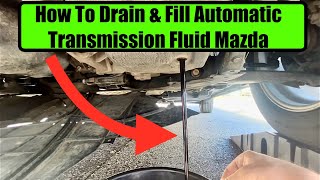
Est. part cost: $0 (parts), but labor for programming will apply. - Low or Degraded Automatic Transmission Fluid (ATF) ⚪ Low Probability → Shop Transmission Assembly While the TSB points to contamination as the root cause for sticking switches, extremely low or burnt fluid can cause a variety of pressure-related issues and shifting problems that could potentially trigger a general malfunction code. The official diagnostic procedure begins with checking the ATF level. 🎬 Watch: A quick guide to draining and filling Mazda ATF.
How to confirm: Check the automatic transmission fluid level and condition according to the manufacturer's procedure. The fluid should be at the correct level and should not be dark brown/black or have a burnt smell.
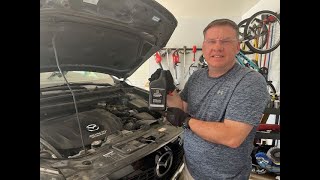
Typical fix: Perform a transmission fluid drain-and-fill or flush with the correct type of Mazda ATF (Type FZ). 🎬 Watch: How to change your transmission fluid and filter. If the fluid is severely degraded, it may indicate a more serious internal problem.
Est. part cost: $75-$200 for fluid.
Rare But Worth Checking
- Failed Control Valve Body: → Shop Transmission Valve Body In some earlier cases or more severe instances of contamination, Mazda's older repair procedures (e.g., TSB 05-003/14) called for replacing the entire valve body assembly, which contains the problematic switches and solenoids. This is less common now that the switches are identified as the specific point of failure and can be replaced separately.
- Internal Transmission Mechanical Failure: → Shop Transmission Assembly While the code is typically electronic or hydraulic in nature, a severe internal mechanical failure (like a damaged clutch pack) could lead to erratic operation that the TCM flags as a general malfunction. This is a worst-case scenario and usually presents with more severe symptoms like grinding noises or a complete loss of movement.
Diagnosis Steps
- Verify the complaint: Confirm the Check Engine Light and AT warning light are on.
- Scan for Codes: Use an OBD-II scanner to read codes from the Transmission Control Module (TCM). Confirm if P1738 is present, and note any other codes like P0780, P0842, P0847, P0872, or P0877.
- Check TSBs: Cross-reference the vehicle's year and stored codes with Mazda TSBs, primarily 05-002-23.
- Check ATF: Inspect the transmission fluid level and condition. If it is low, black, or smells burnt, address this first.
- Perform TCM Reprogramming: If indicated by the TSB, the first step is to have a dealer or qualified shop update the TCM software to the latest version.
- Re-evaluate: After the software update, clear codes and perform the 'Initial Learning Procedure'. If the code and symptoms return, proceed to hardware replacement.
- Replace Oil Pressure Switches: If the problem persists, the next step is to drop the transmission pan and replace both oil pressure switches (A and B) on the valve body. It is highly recommended to also replace the transmission filter (strainer) and oil pan bolts at this time.
- Perform Initial Learning Procedure: This is a critical final step. It recalibrates the transmission's shift points and clutch pressures. It can be done with a scan tool or manually. The manual procedure requires the transmission fluid to be between 140-230°F (60-110°C) and involves a specific sequence of starting the engine and moving the shifter between N, M+, and M- for set periods of time until the idle raises and then returns to normal, indicating the process is complete. 🎬 See a demonstration of the manual initial learning procedure.
- Final Verification: After parts replacement and the learning procedure, reassemble, fill with new ATF, and test drive to ensure the issue is resolved.
Parts You'll Likely Need
- Automatic Transmission Oil Pressure Switch Kit (A and B) — These switches are the most common point of failure, sticking due to contamination as identified in Mazda's TSBs. They must be replaced as a pair.
Trusted brands: Mazda OE
OEM price range: $50-$150
Aftermarket price range: $40-$100 - Automatic Transmission Filter (Strainer)
(OEM #FZ01-21-500)— Since the root cause is contamination, replacing the filter is critical when the oil pan is removed to prevent new debris from damaging the new switches.
Trusted brands: Mazda OE
OEM price range: $45-$60
Aftermarket price range: $20-$40 - Automatic Transmission Fluid (Mazda FZ)
(OEM #0000-FZ-113E-01 (quart))— The transmission fluid must be drained to access the valve body and switches, and it should be replaced with new, correct-specification fluid.
Trusted brands: Mazda OE
OEM price range: $15-$25 per quart
Aftermarket price range: $10-$20 per quart - Transmission Oil Pan Gasket / Pan Assembly
(OEM #FZ01-21-51XB (Pan with integrated gasket/seal))— The oil pan must be removed. While some aftermarket gaskets are sold, the OEM solution is often a new pan with an integrated seal. TSBs also recommend replacing the pan bolts.
Trusted brands: Mazda OE
OEM price range: $50-$70
Related Codes That Often Appear With This One
- P0780 — This code means 'Gear Shifting Malfunction' and is frequently stored with P1738 because the sticking pressure switches disrupt the TCM's ability to properly control shifts.
- P0842, P0847, P0872, P0877 — These are specific codes for the oil pressure switches (A and B) being stuck on or having a circuit low/high reading. P1738 is often set when the TCM sees an illogical combination of these switch faults and cannot isolate the problem to a single one.
Technical Service Bulletins (TSBs) & Recalls
- TSB 05-002-23 (Supersedes 05-004-19 and others): Covers multiple Mazda models and years, including the CX-5. Describes the check engine and AT warning lights with DTCs P0842, P0847, P0872, P0877, P0780, and P1738. It outlines the repair procedure of first reprogramming the TCM, and if the issue returns, replacing the oil pressure switches.
- TSB 05-004/18 (Superseded): An earlier version of the bulletin that explicitly states the cause: 'This is caused by the oil pressure switch A and/or B at the control valve body temporarily or permanently getting stuck due to contamination entering the passage.'
- TSB 05-003/14 (Superseded): An even earlier bulletin which, in some cases, recommended replacing the entire valve body assembly to correct the problem, before the issue was narrowed down to just the switches.
Platform-Specific Known Issues
- Mazda has issued multiple superseding Technical Service Bulletins for this exact issue, with the most recent being TSB 05-002-23. The bulletins describe a common failure path where contamination causes oil pressure switches to stick, triggering P1738 and a host of related codes.
Mechanic-Grade Diagnostic Values
- Pressure Control Solenoid Resistance — expected: 5-7 ohms. Failure: Reading outside of the expected range.
- On/Off Solenoid Resistance — expected: 11-14 ohms. Failure: Reading outside of the expected range.
- ATF Temperature for Initial Learning — expected: 40—110 °C {72—198 °F}. Failure: Performing the procedure outside this temperature range may cause it to fail.
Hidden / Shadow Codes Worth Checking
- P06B8:00: This DTC indicates that the 'Initial Learning' procedure has not been implemented or completed after replacing the control valve body or oil pressure switches. (see via This code is displayed using the Mazda M-MDS (or equivalent J2534 device) when retrieving CMDTCs from the TCM.)
Scan Tool Commands That Help
- Mazda M-MDS (or equivalent): Initial Learning Procedure — This procedure is mandatory after replacing the oil pressure switches or the control valve body. Failure to perform it can result in harsh shifting or engine rev-up, and will store a P06B8:00 DTC. The function guides the TCM to recalibrate clutch pressures and shift points.
- Mazda M-MDS (or equivalent): Module Reprogramming — This is the first step in the official TSB repair procedure. It updates the TCM's diagnostic logic to be less sensitive to minor fluctuations from the pressure switches, which can prevent the code from being set unnecessarily.
- Mazda M-MDS (or equivalent): Retrieve CMDTCs — Used to check for both active and hidden codes, like P06B8:00, which provides crucial context for whether a post-repair procedure was completed correctly.
Wiring & Ground Locations
- Transmission Main Ground — A ground cable from the negative battery terminal bolts to a bracket on top of the transmission.. A poor main ground for the transmission can cause a host of electrical issues, including erratic sensor readings and communication problems with the TCM, potentially leading to incorrect fault codes.
- Passenger Side Motor Mount Ground — There is a ground point located on the passenger side motor mount.. As part of the overall engine and transmission grounding scheme, ensuring this point is clean and secure is important for stable electrical performance of all related modules, including the TCM.
Real Owner Repair Stories
- Reddit user post in r/mazda (2017 Mazda CX-5 with 120k miles) — Check Engine Light, AT, TCS, and CBS warning lights illuminated. The only stored code was P0847 (Transmission Fluid Pressure Sensor/Switch B Circuit Low). Vehicle was running with no noticeable performance issues.
❌ Tried (didn't work) The dealership quoted to replace only the single failed pressure switch (Switch B) for $1,040.34., The dealership also claimed the transmission was likely 'contaminated' and would fail after the switch replacement, quoting $8,768.06 for a full transmission replacement as the ultimate fix.
✅ What actually fixed it The owner referenced the Mazda TSB and noted that the correct procedure is to replace BOTH pressure switches (A and B) together. They declined the dealer's partial and overpriced repair, recognizing it contradicted the manufacturer's own bulletin. The TSB-prescribed fix (replacing both switches and updating software) is the correct resolution.
OEM Part Supersession History
N/A→FZ01-21-2C0 (Switch A), FZ01-21-2J0 (Switch B)— Mazda has issued multiple TSBs over many years for this issue, starting as early as 2013. While specific early part numbers are not detailed, the current recommended parts are the result of production changes to improve durability and reduce contamination-related failures.
Heads up: TSBs consistently stress replacing these switches as a pair (A and B) along with a TCM software update. Using only one new switch or failing to update the software may lead to the problem recurring.
Model Year Variations Within This Range
- 2014-2016 (1st Gen 'KE') vs 2017-2021 (2nd Gen 'KF'): The second generation (2017+) CX-5 was a major redesign focused on reducing noise, vibration, and harshness (NVH) and improving interior features. While both generations use the same fundamental FW6A-EL SKYACTIV-DRIVE transmission and are susceptible to the P1738 issue, the TCM software and calibration files are different. TSBs provide different software file names depending on the model year, so it is critical for a technician to select the correct file when reprogramming the TCM.
Helpful Videos

We Have This Part in Stock





The information in this article is provided for general reference and educational purposes only. Vehicle specifications, procedures, and part compatibility can vary by production date, trim level, and region. Always consult your vehicle's factory service manual and verify part numbers before purchasing or performing repairs. Safety-critical components such as airbags, seat belts, and braking systems should be installed by a qualified professional.
- Mazda CX-5:
- 🧭 Diagnostic Flowchart
- 🎬 Helpful Videos
- 🛍️ Shop This Part
- What's Unique About the 2014-2021 Mazda CX-5
- Symptoms You May Notice
- Most Likely Causes
- Rare But Worth Checking
- Diagnosis Steps
- Parts You'll Likely Need
- Related Codes That Often Appear With This One
- Technical Service Bulletins (TSBs) & Recalls
- Platform-Specific Known Issues
- Mechanic-Grade Diagnostic Values
- Hidden / Shadow Codes Worth Checking
- Scan Tool Commands That Help
- Wiring & Ground Locations
- Real Owner Repair Stories
- OEM Part Supersession History
- Model Year Variations Within This Range
- 🎟️ Get 5% Off