

P1744 on 2013-2020 Ford Escape: Torque Converter Clutch Performance Issues & Fixes
On a 2013-2020 Ford Escape with the 6F35 automatic transmission, code P1744 almost always indicates a mechanical failure within the torque converter or a related hydraulic leak. This is a serious issue, often requiring torque converter replacement and sometimes a more extensive transmission repair. This is a major, expensive job and not a simple DIY fix.
- P1744 on a 2013-2020 Ford Escape is a serious transmission code indicating a mechanical failure of the torque converter clutch system.
- The most common cause is a failed torque converter, an issue acknowledged by Ford in technical service bulletins.
- This is not a DIY-friendly repair. It requires transmission removal and is best left to a professional shop.
- The code is almost always paired with P0741, reinforcing the diagnosis of a TCC performance failure.
- Do not ignore this code. Driving with a failing torque converter can lead to complete transmission failure.
What's Unique About the 2013-2020 Ford ESCAPE

The 2013-2020 Ford Escape, particularly models with the 6F35 transmission, is known for torque converter issues that trigger codes P1744 and P0741. Ford has issued multiple Technical Service Bulletins (TSBs) acknowledging that internal torque converter damage or related component leaks are the root cause. This isn't just a random part failure; it's a documented pattern for this specific vehicle platform and its shared transmission, which has even led to class-action lawsuits.
Diagnostic Flowchart

Tap your situation to follow the diagnostic path that matches what you're seeing on this vehicle.
Generation note: This range covers the third generation (2013-2019) and the start of the fourth generation (2020), both of which use variations of the 6F35 or the newer but similarly affected 8F35/8F40 transmission. TSB 19-2100 specifically addresses 2013-2015 models with the 1.6L engine. TSB SSM 49345 applies to vehicles with the 8F35/8F40 transmission built on or before September 30, 2020, covering both generations and pointing to a torque converter and pump stator bushing leak. [2, ⭐ MANUFACTURER TSB — highest authority]
Symptoms You May Notice
- Illuminated Malfunction Indicator Lamp (Check Engine Light)
- Illuminated powertrain malfunction (wrench) indicator. [⭐ MANUFACTURER TSB — highest authority]
- "Transmission Malfunction Service Now" warning on the dash. [4, ⭐ MANUFACTURER TSB — highest authority, OWNER COMPLAINT]
- Higher than normal RPM at highway speeds (e.g., 2600 RPM at 70 MPH instead of 2000 RPM).
- Transmission shudder or vibration, especially during light acceleration or between 30-45 mph.
- Poor fuel economy.
- Transmission overheating, which may trigger a P0218 code.
- Rough or delayed engagement into Drive or Reverse.
- Replacing only the TCC solenoid when the torque converter itself has failed internally or the pump stator bushing is leaking.
- Assuming it's an engine problem causing high RPMs, when it's the transmission's inability to lock the converter.
- Performing only a transmission fluid flush without addressing the root mechanical failure. This may temporarily help a shudder but will not fix a P1744 code. 🎬 See why a transmission flush won't fix these specific codes.
Most Likely Causes

- Internal Torque Converter Failure 🔴 High Probability → Shop Automatic Transmission Torque Converter This is a well-documented issue confirmed by Ford TSBs 19-2100 and SSM 49345. The clutch lining inside the converter can delaminate or the internal seals can fail, preventing lock-up. [1, 2, ⭐ MANUFACTURER TSB — highest authority]
How to confirm: Diagnosis involves monitoring TCC slip speed with a scan tool. 🎬 Watch: How to diagnose TCC lockup and slip issues. If the PCM commands lock-up (0 RPM slip) but the actual slip remains high, and other causes are ruled out, internal failure is confirmed.
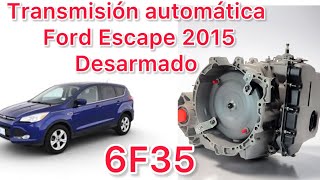
Typical fix: Replace the torque converter. This requires removing the transmission. 🎬 Watch: Step-by-step guide to removing the 6F35 transmission. Many owners report this as the final fix.
Est. part cost: $300-$800 - Leaking Pump Stator Bushing 🔴 High Probability Ford TSB SSM 49345 explicitly identifies this as a cause for P1744 on Escapes with the 8F35/8F40 transmission built before late 2020. The leak prevents sufficient hydraulic pressure from reaching the TCC. [2, ⭐ MANUFACTURER TSB — highest authority]
How to confirm: This can only be confirmed by removing and disassembling the transmission and front pump.
Typical fix: Per TSB 49345, the fix is extensive: replace the torque converter, fluid pump assembly, both fluid filters, main control, and input shaft, then flush the cooler.
Est. part cost: $50-$150 for the bushing/pump parts, but labor is the main cost. The full TSB repair involves significantly more parts. - Faulty Torque Converter Clutch (TCC) Solenoid 🟡 Medium Probability → Shop Automatic Transmission Torque Converter While TSBs point to the converter itself, a solenoid can fail mechanically (get stuck) without an electrical fault, causing a lack of hydraulic pressure to engage the clutch.
How to confirm: A technician can command the solenoid on and off with a high-level scan tool to check its response. However, a mechanical stick may not be obvious electronically. TSB 19-2100 recommends replacing the TCC solenoid as part of the larger repair.
Typical fix: Replace the TCC solenoid. This is typically located on the valve body inside the transmission. It is often replaced as a preventative measure during a torque converter job.
Est. part cost: $50-$150 - Low or Contaminated Transmission Fluid ⚪ Low Probability → Shop Transmission Assembly Low fluid affects hydraulic pressure needed to operate the TCC. While not specific to the Escape, it's a universal cause. Contaminated fluid from a failing converter can clog passages and solenoids, exacerbating the issue.
How to confirm: Check the transmission fluid level and condition according to the manufacturer's procedure. Fluid should be red and clear, not brown, black, or burnt-smelling.
Typical fix: Perform a transmission fluid drain-and-fill and repair any leaks. A fluid change alone will not fix a mechanical failure but is a first step.
Est. part cost: $100-$250 for fluid and filter
Rare But Worth Checking
- Worn Valve Body: → Shop Transmission Valve Body A worn valve body, specifically the TCC regulator valve bore, can cause pressure leaks that prevent the TCC from engaging properly. This is a known issue in the 6F35 transmission family and can be a root cause of repeated torque converter failure.
- Wiring Harness Damage: Damage to the wiring for the TCC solenoid can prevent it from operating, but this would typically set an electrical fault code (like P0740 or P0743) in addition to or instead of P1744.
- Cracked Flexplate: While less common, a cracked flexplate (the plate connecting the engine to the torque converter) can cause noises and potentially damage the torque converter hub or pump, leading to pressure loss and TCC issues.
Diagnosis Steps

- Verify the code with a quality OBD-II scanner.
- Check for other related DTCs, especially P0741.
- Check the transmission fluid level and condition. If the fluid is dark, burnt, or full of metallic debris, it indicates significant internal mechanical failure.
- Using an advanced scan tool (like FORScan), monitor PIDs for TCC Desired Slip and TCC Actual Slip while driving. The slip should drop to near zero when the PCM commands lock-up. If it doesn't, a mechanical/hydraulic issue is present.
- Monitor transmission fluid temperature (TFT). A rapid increase in temperature during highway driving points to excessive slipping.
- If possible, command the TCC solenoid on and off with the scan tool to check for a response, though this may not reveal a mechanical bind.
- Inspect the transmission wiring harness for any visible damage.
- If the above steps do not reveal a simple cause, the issue is almost certainly internal to the transmission, requiring removal for inspection of the torque converter, pump, and valve body, as outlined in Ford's TSBs.
Parts You'll Likely Need
- Torque Converter
(OEM #CV6Z-7902-G (1.6L), CV6Z-7902-FRM (Reman for 1.6L), BB5Z-7902-F (2.0L))— This is the most common point of failure for this code on this vehicle, as confirmed by multiple Ford TSBs. [1, 9, 17, 25, ⭐ MANUFACTURER TSB — highest authority]
Trusted brands: Motorcraft, LuK, Dacco
OEM price range: $450-$800
Aftermarket price range: $220-$500 - Automatic Transmission Fluid
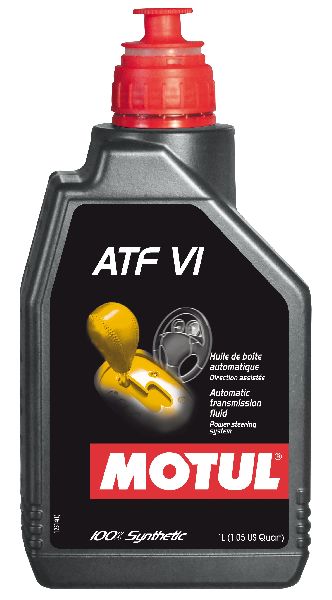
(OEM #Motorcraft Mercon LV (XT-10-QLVC))— The fluid must be replaced whenever the transmission is serviced or the torque converter is replaced. Using the correct fluid is critical.
Trusted brands: Motorcraft (Mercon LV)
OEM price range: $10-$15 per quart
Aftermarket price range: $8-$12 per quart - Torque Converter Clutch (TCC) Solenoid
(OEM #CV6Z-7G383-B (or C/D/E/F depending on band))— If diagnosis points to a solenoid or as a preventative measure during a larger repair, this part is replaced. TSB 19-2100 includes its replacement as part of the procedure.
Trusted brands: Motorcraft
OEM price range: $70-$120
Aftermarket price range: $40-$80
Related Codes That Often Appear With This One
- P0741 — P0741 (Torque Converter Clutch Circuit Performance/Stuck Off) is almost always seen with P1744. Both Ford TSBs and multiple owner complaints list these two codes together, as they both point to the TCC failing to engage. [1, 2, ⭐ MANUFACTURER TSB — highest authority, OWNER COMPLAINT]
- P0218 — P0218 (Transmission Over Temperature Condition) can accompany P1744 because a constantly slipping torque converter generates a massive amount of heat in the transmission fluid.
Technical Service Bulletins (TSBs) & Recalls

- SSM 49345: Notes that P1744 may be due to a torque converter and pump stator bushing leak on 2020 models with the 8-speed transmission, requiring extensive internal repairs.
- TSB 19-2100: States that P1744 on 2013-2015 1.6L models may be due to internal damage to the torque converter and outlines a detailed repair process including solenoid replacement.
Platform-Specific Known Issues
- TSB 19-2100: For 2013-2015 Escapes with the 1.6L EcoBoost, codes P0741 and/or P1744 are likely caused by internal torque converter damage. The TSB procedure involves removing the transmission, replacing the torque converter, inspecting the pump, and overhauling/replacing the solenoid body and main control. [26, 28, ⭐ MANUFACTURER TSB — highest authority]
- TSB SSM 49345: On 2020 Escapes (and other models) with the 8F35/8F40 transmission built on or before 30-Sep-2020, codes P0741 and/or P1744 may be due to a leak from the torque converter and a pump stator bushing. The fix is extensive, requiring replacement of the converter, pump, filters, main control, and input shaft. [18, ⭐ MANUFACTURER TSB — highest authority]
Mechanic-Grade Diagnostic Values
- TCC Solenoid Resistance (6F35 Transmission) — expected: 4.00 - 5.89 Ohms at 20-30°C (68-86°F). Failure: A reading outside the temperature-adjusted range indicates a faulty solenoid coil.
- TCC Actual Slip (Scan Tool PID: TCC_SLIP) — expected: Near 0 RPM when lock-up is commanded (PID: TCC_DSD = 3 for Lock-up). Failure: Sustained slip of more than 50-100 RPM when lock-up is commanded points to a mechanical or hydraulic failure.
- TCC Desired Slip (Scan Tool PID: TCCSLIP_D) — expected: Should match TCC Actual Slip during normal operation and drop to 0 when lock-up is commanded.. Failure: A large discrepancy between desired and actual slip is the primary trigger for P1744.
Scan Tool Commands That Help
- FORScan / Ford IDS: TCC Solenoid Duty Cycle Command — This bidirectional control allows a technician to manually command the TCC solenoid on and off while monitoring hydraulic pressure or slip speed to test solenoid and valve body response, isolating it from the PCM's automated commands.
- FORScan / Ford IDS: Transmission Adaptive Learning Reset — This function must be performed after replacing the torque converter, valve body, or entire transmission. It clears the learned shift strategies and forces the PCM to relearn the characteristics of the new components, preventing harsh shifts or future codes.
Wiring & Ground Locations
- C175T — The main large electrical connector on the Powertrain Control Module (PCM), often located in the engine bay near the firewall or battery.. This connector contains the pins for the TCC solenoid control circuit. Pin 48 (Circuit VDB10, GY-BN wire) is often the TCC control signal on 6F35-equipped models. Corrosion or a pushed-back pin here can cause intermittent or failed TCC operation, though it would more likely set an electrical code.
- Transmission Bulkhead Connector — The main round electrical connector on the transmission case itself.. This is the primary interface between the vehicle's wiring harness and the internal transmission components, including all solenoids. It's a critical point to check for corrosion, fluid intrusion, or bent pins.
- G108 / Bell Housing Grounds — A ground strap or wire typically bolted to one of the upper starter bolts or another bell housing bolt, connecting the engine/transmission assembly to the chassis.. A poor ground connection at this point can cause a host of electrical issues for the PCM and transmission control module, leading to erratic sensor readings and incorrect solenoid operation. It's often overlooked or forgotten during transmission replacement.
Real Owner Repair Stories
- Reddit user /u/Ford_Trans_Guy on r/Ford (2016 Ford Escape) — "Transmission Fault Service Now" message on the highway at speeds over 110km/h (approx. 68 mph). No other noticeable symptoms except for decreased fuel efficiency.
❌ Tried (didn't work) Continued driving while monitoring the issue.
✅ What actually fixed it The user, a transmission technician, diagnosed the issue remotely based on the symptoms. They stated, "I'm willing to bet you have DTCs P0741 and/or P1744... But knowing the 6F35, you'll probably need a torque converter." The owner confirmed the decreased fuel efficiency, aligning with the diagnosis. The implied fix is torque converter replacement.
OEM Part Supersession History
CV6Z-7902-C, D, E, F, G→CV6Z-7902-FRM (Remanufactured)— The original torque converters for the 1.6L engine were prone to internal failure. The part has been superseded multiple times, with the current recommended replacement being a remanufactured unit from Ford.
Heads up: While older new-stock parts may be available, it is highly recommended to use the latest remanufactured part number (CV6Z-7902-FRM) as it is expected to contain the most recent updates to address the original failure modes.
Model Year Variations Within This Range
- 2013-2019 (Primarily 6F35 Transmission): The primary failure mode, as identified in TSB 19-2100, is internal damage to the torque converter itself, such as delamination of the clutch material. The repair focuses on replacing the converter and inspecting/replacing the TCC and LPC solenoids.
- 2020 (Primarily 8F35/8F40 Transmission): The primary failure mode, as identified in SSM 49345, is a leak at the pump stator bushing, which causes a loss of hydraulic pressure. The repair is much more extensive, requiring replacement of the torque converter, fluid pump, filters, main control, and input shaft, as replacing only the converter will not fix the root cause.
Helpful Videos
We Have This Part in Stock


The information in this article is provided for general reference and educational purposes only. Vehicle specifications, procedures, and part compatibility can vary by production date, trim level, and region. Always consult your vehicle's factory service manual and verify part numbers before purchasing or performing repairs. Safety-critical components such as airbags, seat belts, and braking systems should be installed by a qualified professional.
- Ford ESCAPE:
- 🧭 Diagnostic Flowchart
- 🎬 Helpful Videos
- 🛍️ Shop This Part
- What's Unique About the 2013-2020 Ford ESCAPE
- Symptoms You May Notice
- Most Likely Causes
- Rare But Worth Checking
- Diagnosis Steps
- Parts You'll Likely Need
- Related Codes That Often Appear With This One
- Technical Service Bulletins (TSBs) & Recalls
- Platform-Specific Known Issues
- Mechanic-Grade Diagnostic Values
- Scan Tool Commands That Help
- Wiring & Ground Locations
- Real Owner Repair Stories
- OEM Part Supersession History
- Model Year Variations Within This Range
- 🎟️ Get 5% Off