

P1775 on 2006-2010 Dodge Charger: Solenoid Valve Stuck Causes and Fixes
This code means the transmission is stuck in 2nd gear ('limp mode') because a valve is jammed. The most common cause is a worn-out valve body, not just a bad solenoid. The best fix is replacing the entire valve body assembly, which can cost between $800 and $1,500 at a shop.
- P1775 means your Charger's transmission is in 'limp mode' because a critical shift valve is stuck.
- The problem is almost always a worn-out aluminum valve body, not just a bad electronic solenoid.
- Do not continue driving for extended periods. Limp mode can cause overheating and lead to a full transmission failure.
- The correct, long-term repair is to replace the entire valve body assembly, followed by a transmission 'relearn' procedure with a proper scan tool.
- This is not a beginner-friendly DIY job and is best handled by a qualified transmission shop.
What's Unique About the 2006-2010 Dodge Charger
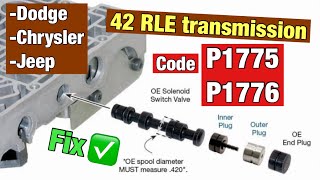
This issue is extremely common on Dodge, Chrysler, and Jeep vehicles from this era using the 42RLE transmission (V6 models). The core problem is a design flaw: the steel solenoid switch valve operates within a raw, softer aluminum bore in the valve body. Over many cycles, the valve wears the bore into an oval shape, causing the valve to stick or jam. This means that simply replacing the electronic solenoid pack often fails to fix the problem, as the mechanical bore itself is the root cause of the failure. V8 models use a different transmission (the Mercedes-Benz NAG1/W5A580) which does not use the same SSV design and is not prone to this specific P1775 fault.
Symptoms You May Notice
- Check Engine Light is on
- Transmission is in 'limp mode' (will not shift and starts from a stop in 2nd gear)
- Harsh clunk or jerk when slowing to a stop (failed 2-1 downshift)
- Vehicle feels very sluggish when accelerating from a standstill
- Inability to engage 1st gear
- Replacing only the solenoid pack when the valve body bore is worn. The code will often return shortly after this repair because the mechanical sticking issue was not resolved.
Most Likely Causes
- Worn Solenoid Switch Valve (SSV) Bore in Valve Body 🔴 High Probability → Shop Transmission Valve Body The aluminum valve body is soft and prone to wear from the steel valve, causing the valve to bind in its bore. This is a well-documented, primary root cause on 42RLE transmissions.
How to confirm: After removing the transmission pan and valve body, the solenoid switch valve can be manually removed from its bore. If it sticks, binds, or shows scuff marks, the bore is worn. Aftermarket companies like Sonnax sell tools to test the bore for excessive wear using a vacuum pump.
Typical fix: Replace the entire transmission valve body with a remanufactured unit that has an oversized, reamed-out, and often sleeved valve bore with a matched valve to prevent future wear. Alternatively, a specialty transmission shop can ream the original valve body and install an oversized valve kit like the Sonnax 92835-01K.
Est. part cost: $350-$600 - Failed Transmission Solenoid Pack 🟡 Medium Probability → Shop Transmission Assembly The solenoid pack itself can fail electrically or mechanically. However, it is often replaced mistakenly when the true cause is the valve body bore. This part is a common failure point on many Chrysler transmissions.
How to confirm: If a new solenoid pack is installed and the code returns quickly, the problem was almost certainly the valve body. A technician can also test the solenoid's resistance, but this won't detect an internal mechanical issue within the pack.
Typical fix: Replace the transmission solenoid/pressure switch assembly. This part is mounted to the valve body and is replaced during a valve body job.
Est. part cost: $200-$350 - Low or Dirty Transmission Fluid ⚪ Low Probability → Shop Transmission Assembly
How to confirm: Check the transmission fluid dipstick. Fluid should be at the correct level, pinkish-red, and not smell burnt. Dark, burnt, or glittery fluid indicates a more severe internal failure requiring a rebuild.
Typical fix: Perform a transmission fluid and filter change. If the fluid is very dirty or low, this is unlikely to solve a sticky valve but is critical for transmission health.
Est. part cost: $75-$150
Rare But Worth Checking
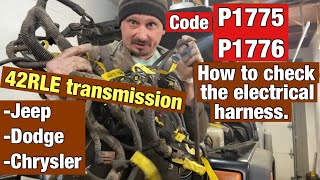
- Damaged Wiring or Connector: A damaged wire or fluid intrusion at the main transmission harness connector can interrupt the signal from the TCM, causing various codes including P1775. A thorough visual inspection of the harness and connectors for corrosion or damage should be performed before replacing internal parts. 🎬 See how to properly inspect the transmission electrical harness.
- Faulty Powertrain Control Module (PCM): → Shop Engine Control Module (ECM) In very rare cases, the driver circuit within the PCM can fail. This should only be considered after all other possibilities, especially the valve body and wiring, have been ruled out.
Diagnosis Steps
- Check and verify the transmission fluid level and condition.
- Use a scan tool to check for other related trouble codes, such as P0700, P1776, or P0841.
- Perform a thorough visual inspection of the transmission's main electrical connector and wiring harness for any signs of damage, corrosion, or fluid intrusion.
- If wiring is okay, the next step is to drain the transmission fluid and remove the oil pan.
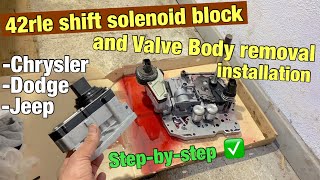
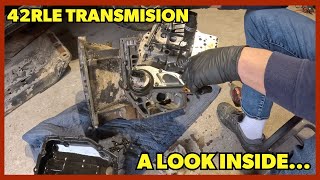
- Remove the transmission valve body. This is a complex step best left to a professional. 🎬 Watch: Step-by-step guide to removing the solenoid pack and valve body. A detailed video guide shows the process, including the need to disconnect multiple electrical plugs and the shift linkage.
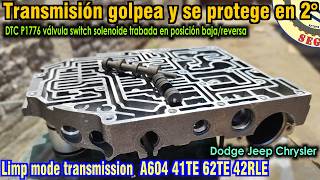
- With the valve body on a bench, manually inspect the solenoid switch valve. If it sticks or binds in its bore, the valve body is faulty and must be replaced 🎬 Watch: How to diagnose a latched solenoid switch valve. or re-sleeved.
- If the valve moves freely, the issue is likely the electronic solenoid pack itself.
Parts You'll Likely Need
- Transmission Valve Body — This is the most common fix because the original aluminum bore for the solenoid switch valve wears out, causing the valve to stick. A remanufactured valve body typically has an oversized, sleeved bore to correct this design flaw permanently.
Trusted brands: Mopar (Remanufactured), Rostra
OEM price range: $500-$700
Aftermarket price range: $350-$550 - Transmission Solenoid Pack / Block
(OEM #68002342AD (Mopar))— If the valve body is not worn, the electronic solenoid pack is the next most likely cause. It contains the solenoids that control shifting. For the 42RLE transmission, this is a single block assembly.
Trusted brands: Mopar, Dorman (609-043), Standard Motor Products (TCS209)
OEM price range: $300-$400
Aftermarket price range: $200-$300 - Sonnax Solenoid Switch Valve & Plug Kit
(OEM #92835-01K)— For DIYers or shops capable of advanced valve body repair, this kit allows for the repair of the original valve body. It requires specialized tools to ream the valve bore to accept the oversized valve, providing a permanent fix for the sticking issue.
Trusted brands: Sonnax
Aftermarket price range: $50-$80 - Transmission Filter and Pan Gasket Kit — This is required anytime the transmission pan is removed for service on the valve body or solenoid pack.
Trusted brands: Mopar, ATP, Pronto
OEM price range: $30-$50
Aftermarket price range: $15-$30 - Mopar ATF+4 Automatic Transmission Fluid — This is the required fluid type for the 42RLE transmission. A pan drop and valve body replacement will require approximately 5-7 quarts.
Trusted brands: Mopar
OEM price range: $12-$18 per quart
Aftermarket price range: $8-$12 per quart
Related Codes That Often Appear With This One
- P0700 — P0700 is a generic code that simply means the Transmission Control Module (TCM) has stored a fault. It acts as a 'check engine light' for the transmission and will almost always be present alongside a specific transmission code like P1775.
- P1776 — P1776 is 'Solenoid Switch Valve Latched in Low/Reverse Position'. It's the sister code to P1775 and indicates the same valve is stuck in the opposite position. Both codes point to the same root cause: a faulty solenoid switch valve or worn valve body.
- P0841 — P0841 is 'LR Pressure Switch Sense Circuit'. The computer uses this pressure switch to verify that the solenoid switch valve has moved correctly. A fault in this circuit can be a cause of P1775, and service manuals often recommend diagnosing P0841 first if it is present.
Platform-Specific Known Issues
- While some sources mention a PCM software update (TSB) for this code on other Chrysler/Dodge vehicles, extensive searches for TSBs like 18-043-17 show they apply to different models and years (e.g., 2017 Jeep Renegade, 2011 Dodge Caravan) and do not apply to the 2006-2010 Charger. Always diagnose the mechanical components (valve body) first on this platform, as it is the overwhelmingly common point of failure.
Mechanic-Grade Diagnostic Values
- Shift Solenoid Resistance (L/R, 2/4, OD, UD) — expected: 1.5 - 2.5 ohms (ATRA specifies 1.7 ohms). Failure: Readings outside this range, especially high resistance (e.g., >3.5 ohms) indicates a failing solenoid coil.
- Pressure Switch Resistance (L/R, 2/4, OD) — expected: 270 - 330 ohms (ATRA specifies 299 ohms). Failure: An open or shorted reading indicates a failed switch.
- Variable Line Pressure (VLP) Sensor Voltage (2007+ models) — expected: 0.35V - 4.75V. Failure: Voltage outside this range indicates a faulty sensor.
Hidden / Shadow Codes Worth Checking
- TRS Code: A data parameter within the P1775/P1776 event data that shows the Transmission Range Sensor (TRS) position at the time of the fault. If it reads 'TR2' instead of 'OD', it indicates the manual valve was not fully in the Overdrive position. (see via Dealer-level scan tool (like WiTech) or advanced aftermarket scanner capable of reading detailed freeze frame/event data.)
Scan Tool Commands That Help
- WiTech, Autel, Topdon, etc.: Quick Learn Procedure / Transmission Adaptation Reset — This is a mandatory procedure after replacing the valve body, solenoid pack, or entire transmission. It forces the TCM to relearn clutch volume indexes (CVIs) and adaptive shifting parameters to ensure smooth shifts and prevent damage.
- ATS Co-Pilot Controller (for 2007+ VLP models): Command and Monitor Line Pressure — Allows a technician to manually increase line pressure to diagnose if low pressure is contributing to clutch slip or shift issues. It can also monitor commanded vs. actual line pressure in real-time.
Wiring & Ground Locations
- Transmission Solenoid Connector (10-pin) — On the driver's side of the transmission case.. This is the main electrical interface to the solenoid pack. Pin 3 is the 12V power feed from the relay for all solenoids. Pins 1, 2, 4, and 7 are the control wires for the OD, UD, 2/4, and L/R solenoids, respectively. Testing resistance between pin 3 and the respective control pin can quickly validate the solenoid coils from outside the transmission.
- G300 — Below the driver's side 'B' pillar, behind the trim.. This is a major chassis ground point. While not exclusively for the TCM, poor grounding at this location can introduce electrical noise and intermittent issues for various modules, potentially affecting transmission control.
- Engine Block to Chassis Ground — A braided strap or heavy gauge wire running from the engine block to the vehicle's frame/unibody.. The TCM and its sensors rely on a stable ground reference. A corroded or loose main engine ground can cause floating voltages and erratic behavior from electronic components, including the transmission solenoids and sensors.
Real Owner Repair Stories
- Jeep KJ and KK Liberty Forum (Jeep Liberty with 42RLE (same transmission)) — Codes P1775 and P1776, vibration, loss of torque, transmission overheating light on hills.
❌ Tried (didn't work) Replaced solenoid pack, Serviced valve body (deep wash), Changed fluid and filter
✅ What actually fixed it The user's attempts did not fix the issue. Other experienced members advised that with those symptoms and codes, a full transmission rebuild (including a new torque converter) was necessary, indicating the problem was a mechanical failure beyond just the solenoid pack. - Jeepz.com Forum (2005 Jeep Liberty Sport with 42RLE) — Check engine light with code P1775, no noticeable driving or shifting problems initially.
❌ Tried (didn't work) The user was asking for advice before starting repairs.
✅ What actually fixed it A forum Super Moderator provided expert advice: 'DO NOT replace the solenoid assy due to a P1775... The 'Solenoid Switch Valve' is not in the solenoid, it is in the valve body.' The definitive fix pointed to diagnosing and repairing/replacing the valve body itself, not the solenoid pack. - YouTube Creator 'Fix it Angel' (2004 Jeep Wrangler TJ with 42RLE) — Limp mode with codes P1775 and P1776.
❌ Tried (didn't work) Complete inspection and testing of the entire engine and transmission wiring harness for shorts, opens, and corrosion. The harness was found to be in perfect condition.
✅ What actually fixed it After exhaustively ruling out any electrical issue with the harness, the creator concluded the fault must be mechanical and internal to the transmission, specifically the solenoid switch valve within the valve body. The final fix was to replace the internal solenoid switch valve, which required removing the valve body. - NHTSA ODI #10314835 (Dodge Dakota with similar transmission) — An owner reported that their vehicle displayed codes P1775, "Solenoid Switch Valve Latched in TCC Position," and P0218, "Trans-High Temp Activated." The diagnostic recommendation was to remove the transmission and break it down to find an internal failure or replace the transmission entirely.
"I Checked Everything" — The Actual Cause
- This code is hydraulic/mechanical/electrical, so a smoke test is not applicable. However, a common pattern is a 'wiring harness check clean, but the actual cause was internal.' One detailed case showed a technician meticulously testing every wire in the transmission harness for continuity and shorts, finding no faults. The P1775 code persisted, proving the issue was not electrical but mechanical—the stuck Solenoid Switch Valve inside the valve body.
OEM Part Supersession History
68002342AA (and AB, AC)→68002342AD (and subsequent AE, AF, AG)— Revisions to improve reliability and address failure points in the solenoid pack.
Heads up: Early solenoid packs used a black electrical connector, while later updated versions use a white connector. When replacing a black connector pack with a white one, a new TRS (Transmission Range Sensor) plate, often included with the new solenoid, may be required for proper fitment and function.
Model Year Variations Within This Range
- 2007-2010: Starting in 2007, the 42RLE transmission was updated to a Variable Line Pressure (VLP) system from the previous fixed line pressure design. This means 2007 and later models have a different valve body and an additional pressure sensor. Diagnostics can be different, as tools can monitor and command line pressure on VLP models. The valve bodies for pre-2007 and 2007+ models are not interchangeable.
Diagnostic Flowchart
Other Known Issues on This Vehicle
Issues unrelated to this code that are worth knowing about as an owner of this generation:
- Front Suspension Clunk/Rattle 🟠 Medium — Very common. Often caused by failed tension struts, sway bar links, or control arm bushings. Can occur at any mileage but is frequent on vehicles over 75,000 miles.
- Shifter Stuck in Park ('Pink Thingy' Failure) 🔴 High — Extremely common on 2005-2007 models with the floor shifter. A small plastic park interlock lever inside the shifter assembly breaks, immobilizing the vehicle.
- Alternator Failure 🔴 High — A recall (NHTSA 14V-634, 17V-435) was issued for 2011-2014 models, but earlier models can also experience alternator issues. Failure can lead to a sudden vehicle stall. (Ref: NHTSA 14V-634 / Chrysler P60 (applies to 2011-2014 models but highlights a known platform weakness))
- Premature Engine Failure (2006 model year) 🔴 High — The 2006 model year, particularly with the V8 engines, had a higher than average rate of complaints for catastrophic engine failure, sometimes without warning.
- Faulty Ignition Switch / Wireless Control Module (WCM) 🟠 Medium — The ignition key can be loose or the WCM can fail, causing the vehicle to stall while driving or fail to start.
Used vs. New Parts: Buying Guide for This Vehicle
When a used part is the smart pick: A used part is almost never a smart choice for the primary failure components related to P1775. The main cause is a wear-and-tear design flaw in the valve body, so a used valve body from a junkyard is highly likely to have the same worn bore issue or will develop it soon. A used solenoid pack is also risky due to the high failure rate of the electronics.
Donor-vehicle mileage cap: roughly under 50000 miles for the part to have meaningful remaining life.
What to inspect on the donor part:
- For a valve body, do not buy used unless it is certified remanufactured.
- Verify the donor vehicle was not in a major accident.
- Ask for the VIN to check the donor vehicle's service history if possible.
- Inspect the transmission fluid from the donor car if possible; it should be pink/red and not smell burnt or contain metal shavings.
Aftermarket brands forum-validated for this vehicle:
- Valve Body: Remanufactured units from reputable suppliers like Rostra, or performance-upgraded units from ATS Diesel Performance.
- Valve Body Repair Kit: Sonnax (for reaming/sleeving the original valve body).
- Solenoid Pack: Mopar (OEM), Dorman, Standard Motor Products (SMP).
Brands owners have reported issues with on this vehicle:
- Unbranded, no-name valve bodies and solenoid packs from online marketplaces are extremely high-risk and often fail quickly.
Related OBD-II Codes
Frequently Asked Questions
My 2007 Charger is in limp mode with code P1775. Is there a TSB or software update that fixes this?
I replaced the solenoid pack for P1775, but the Check Engine Light came back on. What's the actual problem?
What is the most likely reason my Dodge Charger has a P1775 code?
Is it a good idea to buy a used valve body from a junkyard to fix P1775?
My mechanic suggested reaming the original valve body. Is this a proper fix for P1775?
What other cars have the same P1775 transmission problem as my Charger?
Helpful Videos
We Have This Part in Stock


The information in this article is provided for general reference and educational purposes only. Vehicle specifications, procedures, and part compatibility can vary by production date, trim level, and region. Always consult your vehicle's factory service manual and verify part numbers before purchasing or performing repairs. Safety-critical components such as airbags, seat belts, and braking systems should be installed by a qualified professional.
- Dodge Charger:
- 🧭 Diagnostic Flowchart
- 🎬 Helpful Videos
- 🛍️ Shop This Part
- What's Unique About the 2006-2010 Dodge Charger
- Symptoms You May Notice
- Most Likely Causes
- Rare But Worth Checking
- Diagnosis Steps
- Parts You'll Likely Need
- Related Codes That Often Appear With This One
- Platform-Specific Known Issues
- Mechanic-Grade Diagnostic Values
- Hidden / Shadow Codes Worth Checking
- Scan Tool Commands That Help
- Wiring & Ground Locations
- Real Owner Repair Stories
- "I Checked Everything" — The Actual Cause
- OEM Part Supersession History
- Model Year Variations Within This Range
- Other Known Issues on This Vehicle
- Used vs. New Parts: Buying Guide for This Vehicle
- Related OBD-II Codes
- Frequently Asked Questions
- 🎟️ Get 5% Off