

P1775 on 2004-2009 Dodge Durango 4.7L: Solenoid Valve Stuck Fixes
This code means a critical shift valve in the transmission is stuck, preventing it from downshifting into 1st gear. The most common fix is replacing the transmission solenoid pack and often the entire valve body due to wear. Expect a shop cost of $800-$1,500.
- P1775 means your Durango's transmission is stuck in 'limp mode' because a valve cannot move to select 1st gear.
- Do not continue to drive the vehicle, as this can cause severe transmission damage from overheating.
- The most common cause is a worn-out bore in the aluminum valve body, which causes the valve to stick.
- The most reliable, long-term repair is to replace both the transmission solenoid pack and the entire valve body assembly.
- This is not a beginner-friendly DIY repair and requires specialized tools and procedures.
What's Unique About the 2004-2009 Dodge Durango
The 545RFE transmission in the 4.7L V8 Durango is known for this issue. The problem is less about a faulty electronic solenoid and more about a mechanical design weakness. The aluminum bore inside the valve body where the steel Solenoid Switch Valve slides can wear out over time, causing the valve to bind and stick. This wear pattern is a well-documented, primary root cause of P1775. This is a very common failure point on this and related Chrysler/Dodge/Jeep transmissions (45RFE, 545RFE, 68RFE).
Symptoms You May Notice
- Harsh clunk or jerk when slowing to a stop (under 5 mph)
- Vehicle is stuck in a single gear (usually 2nd or 3rd), known as 'limp mode'
- Poor or sluggish acceleration from a complete stop
- Check Engine Light is illuminated
- Hesitation when shifting from Park or Reverse into Drive
- Engine stalling when coming to a stop
- Transmission high temperature activation (overheating)
- Replacing only the solenoid pack when the valve body is worn. This may provide a temporary fix, but the code will likely return as the underlying mechanical issue in the valve body bore persists.
Most Likely Causes
- Worn Transmission Valve Body 🔴 High Probability → Shop Transmission Valve Body The aluminum bore for the Solenoid Switch Valve (SSV) wears down from the repeated movement of the steel valve, causing it to stick. This is a well-documented wear item on 545RFE transmissions.
How to confirm: This is typically confirmed after replacing the solenoid pack doesn't solve the issue, or by a transmission shop that can vacuum test the valve body bores. Physical inspection of the valve after removing the valve body will show scoring or sticking.
Typical fix: Replace the entire transmission valve body, usually with a remanufactured unit that has oversized, re-sleeved valves to correct the original design flaw. Companies like Sonnax specialize in these corrected valve bodies and repair kits.
Est. part cost: $400-$700 - Faulty Transmission Solenoid Pack 🔴 High Probability → Shop Transmission Assembly The solenoid pack is the electronic control center mounted to the valve body. While the root cause is often bore wear in the valve body, the solenoid pack itself can fail electronically or mechanically. It is almost always replaced during a valve body service.
How to confirm: Diagnosed by eliminating other causes (fluid, wiring). It's difficult to test independently without specialized equipment. Replacement is the most common diagnostic step.
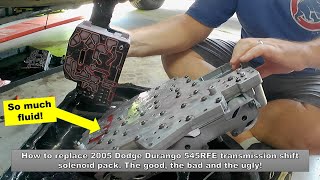
Typical fix: Replace the transmission solenoid pack. This is done by dropping the transmission pan and valve body. 🎬 Watch: Step-by-step 545RFE solenoid replacement on a Durango
Est. part cost: $250-$450 - Low or Degraded Transmission Fluid 🟡 Medium Probability → Shop Transmission Assembly
How to confirm: Check the transmission fluid dipstick with the engine warm and running in neutral. The fluid should be at the correct level and red in color, not brown, black, or burnt-smelling.
Typical fix: Perform a transmission fluid and filter change using the correct ATF+4 fluid. If the fluid is very dirty or contains metal, it indicates a more severe internal problem.
Est. part cost: $80-$150
Rare But Worth Checking
- Outdated Powertrain/Transmission Control Module (PCM/TCM) Software: → Shop Transmission Assembly Chrysler has issued software updates that can sometimes resolve erratic transmission behavior. TSB 18-043-17, for example, changes the P1775 fault from a one-trip to a two-trip failure to reduce false positives. It's worth checking with a dealer or capable shop if any updates are available before replacing expensive hardware.
- Damaged Wiring or Connectors: The wiring harness leading to the transmission can be damaged by road debris or heat, causing an intermittent connection to the solenoid pack. A visual inspection of the main round connector on the driver's side of the transmission is the first step.
Diagnosis Steps
- Check the transmission fluid level and condition. Ensure it is full and clean, using only ATF+4 fluid.
- Use a quality OBD-II scanner to confirm P1775 and check for other related codes like P0700 or P1776.
- Check for any available Technical Service Bulletins (TSBs) related to this code or transmission symptoms. A software update may be required.
- Visually inspect the transmission's main electrical connector and wiring harness for any signs of damage, corrosion, or loose connections.
- Drop the transmission oil pan and inspect for excessive metal shavings or clutch material, which would indicate a more severe internal failure.
- If the fluid is clean and wiring is intact, the most probable cause is the solenoid pack and/or the valve body itself.
- A transmission specialist may perform a pressure test or use a scan tool to monitor solenoid commands versus actual pressure readings to further isolate the fault.
- The standard professional repair is to replace both the solenoid pack and the valve body assembly, preferably with a remanufactured unit with updated/sleeved valve bores.
Parts You'll Likely Need
- Transmission Solenoid Pack
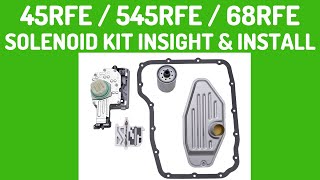
(OEM #68002342AD (superseded by 68002342AG))— This is the electronic control unit for the valve body and a primary failure point for this code. It is almost always replaced as part of the repair. The part number has been superseded multiple times, with the latest being 68002342AG. 🎬 See this basic RFE solenoid block service kit installation
Trusted brands: Mopar, Rostra, ATP Automotive
OEM price range: $390-$450
Aftermarket price range: $250-$350 - Transmission Valve Body — The root cause of the sticking valve is often wear within the valve body itself. Remanufactured units with fixes for this wear are the most reliable long-term solution.
Trusted brands: Sonnax (for remanufactured units and rebuild kits), Various remanufacturers
OEM price range: N/A (typically replaced with remanufactured)
Aftermarket price range: $400-$700 (for remanufactured assembly) - Transmission Filter Kit
(OEM #5013470AC)— The 545RFE transmission has two filters (a spin-on and a pan filter) that must be replaced whenever the valve body is serviced.
Trusted brands: Mopar, Wix, Fram
OEM price range: $40-$60
Aftermarket price range: $20-$40 - ATF+4 Automatic Transmission Fluid
(OEM #MS-9602)— This is the required fluid type for the 545RFE transmission. Using the wrong fluid can cause damage. A pan drop and valve body replacement will require approximately 7-8 quarts.
Trusted brands: Mopar, Valvoline, Castrol
OEM price range: $10-$15 per quart
Aftermarket price range: $7-$10 per quart
Related Codes That Often Appear With This One
- P0700 — This is a generic code that simply means the Transmission Control Module (TCM) has detected a fault and has requested the Check Engine Light. It will almost always be present with P1775.
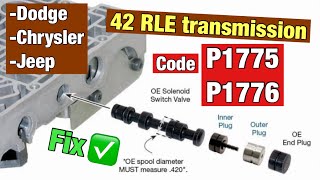
- P1776 — This is the sister code to P1775, indicating the same Solenoid Switch Valve is stuck in the opposite (Low/Reverse) position. Seeing both codes strongly points to a failure in the valve body or solenoid pack. 🎬 Watch: Diagnosing P1775 and P1776 solenoid switch valve issues
- P0218 — This code indicates a Transmission High Temperature condition, which has been reported by owners in conjunction with P1775 during internal transmission failures.
Technical Service Bulletins (TSBs) & Recalls
- TSB 18-043-17: Discusses changing the P1775 code from a one-trip to a two-trip fault to prevent premature or false Check Engine Lights. This highlights that a software update could be a relevant diagnostic step.
Mechanic-Grade Diagnostic Values
- Solenoid Resistance (most control solenoids) — expected: 1.3 Ohms. Failure: A reading significantly higher or lower than 1.3 Ohms, or an open circuit (infinite resistance), indicates a failed solenoid coil.
- Pressure Control Solenoid Resistance — expected: 4.9 Ohms. Failure: A reading significantly different from 4.9 Ohms points to a fault in the pressure control solenoid.
- Line Pressure at Idle (in Park/Neutral) — expected: 35-165 PSI. Failure: Pressure readings outside this range can indicate a faulty pressure sensor, a sticking main regulator valve, or a problem with the pressure control solenoid.
Scan Tool Commands That Help
- Professional Scan Tool (e.g., Autel, Snap-on, Launch, dealer WiTech/DRB III): Quick Learn Procedure — This is a mandatory procedure after replacing the valve body or solenoid pack. It resets all transmission adaptive values to factory presets and allows the TCM to learn the clutch volume indexes (CVIs) of the new components. Failing to perform this step will result in harsh or erratic shifting even with new parts.
Wiring & Ground Locations
- Transmission Solenoid / TRS Assembly Connector — The main round electrical connector is located on the driver's side of the transmission case.. This is the primary electrical interface between the Powertrain Control Module (PCM) and the entire solenoid pack. Damage, corrosion, or fluid intrusion in this connector or its wiring can interrupt signals to the solenoids, potentially causing P1775. Pin 2 of this connector is the Low/Reverse Solenoid Control, which is directly related to the function of the Solenoid Switch Valve.
- PCM/TCM Ground — A key ground point is G100, located on the right side of the engine compartment.. A poor ground connection for the Powertrain Control Module (which integrates the Transmission Control Module) can cause a wide range of erratic electronic behaviors, including faulty solenoid commands and incorrect sensor readings, which could lead to transmission codes like P1775.
Real Owner Repair Stories
- DodgeForum.com user, response by 'master' (2000 Dodge Grand Caravan (similar RFE transmission logic)) — Harsh 'clunking' 2-1 downshift when coming to a stop, hesitation when shifting from Reverse to Drive, Check Engine Light on.
❌ Tried (didn't work) Transmission fluid and filter change
✅ What actually fixed it The responding master technician stated that for P1775 (TCC in latch position), the correct fix is to replace the valve body and filters, assuming no significant metal is found in the pan. - NHTSA ODI #10314835 (Dodge Dakota with similar 545RFE transmission) — An owner reported that codes P1775 and P0218 (Transmission High Temp) appeared simultaneously. The diagnostic recommendation was to remove the transmission to find an internal failure or replace the transmission entirely.
OEM Part Supersession History
68002342AA, AB, AC, AD, AE, AF→68002342AG— Revisions to improve reliability and address known failure modes in the solenoid pack.
Heads up: The latest part number, 68002342AG, is the correct service replacement for all previous versions for this vehicle range.
Model Year Variations Within This Range
- 2006-2009: In 2006, Chrysler introduced a redesigned solenoid pack for the 545RFE intended to provide quieter operation and reduce 'solenoid clatter' during shifts. While functionally similar, parts for a 2004-2005 may differ slightly from a 2006-2009. Always verify the part number with the vehicle's VIN.
Diagnostic Flowchart
Other Known Issues on This Vehicle
Issues unrelated to this code that are worth knowing about as an owner of this generation:
- Dropped Valve Seats (4.7L V8) 🔴 High — More common on pre-2008 engines, especially those with a history of overheating. Can occur at any mileage but is more prevalent over 100k miles.
- Totally Integrated Power Module (TIPM) Failure 🔴 High — Common across many Chrysler/Dodge/Jeep products of this era. Symptoms are varied and electrical in nature, such as engine stalling, fuel pump not engaging or running continuously, horn honking randomly, and wipers activating on their own. (Ref: A recall existed for some models (e.g., 2011 Durango) but not typically for this generation. The common fix is replacing the TIPM or installing an external fuel pump relay bypass.)
- Power Window Regulator Failure 🟠 Medium — Very common. The plastic components within the regulator assembly break, causing the window to drop into the door, often suddenly. It can happen to any of the windows.
- Blown Head Gaskets 🔴 High — The 4.7L engine is susceptible to overheating, which often leads to blown head gaskets. This can be caused by cooling system failures (radiator, water pump, etc.).
Used vs. New Parts: Buying Guide for This Vehicle
When a used part is the smart pick: A used valve body from a low-mileage donor vehicle can be a cost-effective option, but it carries the risk of having the same inherent bore wear issue. It is only recommended if the donor vehicle's history is known and mileage is under 70,000 miles.
Donor-vehicle mileage cap: roughly under 70000 miles for the part to have meaningful remaining life.
What to inspect on the donor part:
- Verify the donor vehicle did not have transmission-related trouble codes.
- Inspect the fluid from the donor transmission; it should be bright red and not smell burnt.
- Look for any physical damage to the valve body or connectors.
OEM-only on this vehicle (don't cheap out):
- Transmission Solenoid Pack: While some aftermarket brands exist, the OEM Mopar solenoid pack is highly recommended for reliability and compatibility, given its critical role in transmission function.
Aftermarket brands forum-validated for this vehicle:
- Sonnax: For remanufactured valve bodies. They are widely respected in the transmission industry for re-engineering parts to fix original design flaws, such as by installing sleeves in the worn aluminum bores.
Brands owners have reported issues with on this vehicle:
- Unbranded, low-cost solenoid packs from online marketplaces. These often have high failure rates and can cause more diagnostic headaches than they solve.
Real Owner Stories
Aggregated from forums and TSBs cited above. Mileages and costs reflect what owners reported in those sources.
2007 Dodge Dakota 4.7L V8 Magnum — 159000 miles
Symptoms: Started driving rough and jerking; code P1775 indicated solenoid switch pack latched in TCC position.
What fixed it: The owner was advised by a specialist that the issue is a sensor built into the solenoid pack/valve body area, though a transmission shop initially quoted $5,000 for a full replacement.
Source hint: Reddit r/DodgeDakota
2004-2009 Dodge Ram Van (545RFE transmission)
Symptoms: 2-1 rough downshift and fault code P1775.
What fixed it: A master tech confirmed the primary fix is to replace the valve body rather than just the solenoid, after first checking the transmission pan for metal debris.
Source hint: DodgeForum.com thread titled '2-1 rough downshift, fault code P1775...'
2004-2009 Dodge Durango (545RFE transmission)
Symptoms: P1775 Solenoid switch problems.
What fixed it: Technical guidance clarified that the Solenoid Switch Valve is located in the valve body, not the solenoid assembly, requiring valve body attention.
Source hint: Jeepz.com thread titled 'p1775 Solenoid switch & p0456 EVAP leak problems'
Documented NHTSA Reports
NHTSA ODI #10314835
Symptoms: An owner reported that the vehicle displayed codes P1775 (Solenoid Switch Valve Latched in TCC Position) and P0218 (Transmission High Temp Activated).
What fixed it: The diagnostic findings suggested the need to remove the transmission and break it down to find an internal failure or replace the transmission entirely.
Related OBD-II Codes
Frequently Asked Questions
My 2004-2009 Durango is jerking when I slow down to a stop; is there a software update for this?
I've heard the 4.7L V8 has transmission issues; what is the specific part that usually fails for code P1775?
Can I just replace the solenoid pack on my Durango to fix the P1775 'TCC in latch position' error?
My Durango is stuck in 2nd or 3rd gear and won't accelerate well from a stop. What is happening?
What kind of transmission fluid should I use for my 2004-2009 Dodge Durango 4.7L?
Helpful Videos
We Have This Part in Stock


The information in this article is provided for general reference and educational purposes only. Vehicle specifications, procedures, and part compatibility can vary by production date, trim level, and region. Always consult your vehicle's factory service manual and verify part numbers before purchasing or performing repairs. Safety-critical components such as airbags, seat belts, and braking systems should be installed by a qualified professional.
- Dodge Durango:
- 🧭 Diagnostic Flowchart
- 🎬 Helpful Videos
- 🛍️ Shop This Part
- What's Unique About the 2004-2009 Dodge Durango
- Symptoms You May Notice
- Most Likely Causes
- Rare But Worth Checking
- Diagnosis Steps
- Parts You'll Likely Need
- Related Codes That Often Appear With This One
- Technical Service Bulletins (TSBs) & Recalls
- Mechanic-Grade Diagnostic Values
- Scan Tool Commands That Help
- Wiring & Ground Locations
- Real Owner Repair Stories
- OEM Part Supersession History
- Model Year Variations Within This Range
- Other Known Issues on This Vehicle
- Used vs. New Parts: Buying Guide for This Vehicle
- Real Owner Stories
- 2007 Dodge Dakota 4.7L V8 Magnum — 159000 miles
- 2004-2009 Dodge Ram Van (545RFE transmission)
- 2004-2009 Dodge Durango (545RFE transmission)
- Documented NHTSA Reports
- NHTSA ODI #10314835
- Related OBD-II Codes
- Frequently Asked Questions
- 🎟️ Get 5% Off