

P1775 on 2007-2011 Dodge Nitro 3.7L: Solenoid Valve and Limp Mode Fixes
This code usually means the transmission solenoid pack has failed or the valve body is worn, causing the truck to get stuck in 'limp mode' (2nd gear). The most common fix is to replace the transmission solenoid pack and inspect/repair the valve body, which is a 3/5 DIY difficulty job costing between $250-$500 in parts.
- P1775 on a Dodge Nitro means the transmission is stuck in 'limp mode' (2nd gear) because a key internal valve is jammed.
- The most probable cause is a worn valve body bore, a known issue with the 42RLE transmission. Simply replacing the solenoid pack may not be a permanent fix.
- Before replacing expensive hardware, have a dealer check if your vehicle's computer needs a software update, as this can sometimes resolve the issue.
- The correct parts for the job are a new solenoid pack (Mopar P/N 5143151AA), a remanufactured valve body, a new filter, and Mopar ATF+4 fluid.
- This is a complex DIY repair (4/5 difficulty). If you are not comfortable working inside a transmission, professional service is highly recommended.
What's Unique About the 2007-2011 Dodge Nitro
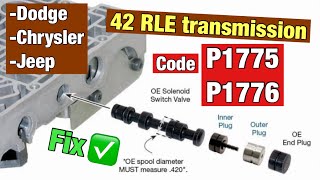
The 42RLE transmission used in the Dodge Nitro and many other Chrysler/Jeep products of this era is known for this specific issue. The root cause is often a worn-out bore in the aluminum valve body where the Solenoid Switch Valve (SSV) oscillates. This wear allows hydraulic pressure to leak, causing the valve to bind or 'latch' in position. Simply replacing the solenoid pack might only be a temporary fix if the underlying valve body wear is not addressed. Transmission specialists like Sonnax manufacture oversized valve and reaming kits specifically to correct this well-documented design flaw.
Symptoms You May Notice
- Vehicle is stuck in 2nd gear ('limp mode')
- Harsh clunk or jerk when slowing to a stop, particularly below 5 mph.
- Check Engine Light is on
- Engine may stall when stopping.
- Delayed or failed engagement when shifting from Park to Drive.
- Vehicle launches from a stop in 2nd gear instead of 1st.
- Replacing only the solenoid pack when the valve body bore is worn. The code will often return because the new solenoid valve will also stick in the worn bore.
Most Likely Causes
- Worn Transmission Valve Body 🔴 High Probability → Shop Transmission Valve Body The aluminum bore for the Solenoid Switch Valve (SSV) is known to wear over time, causing the valve to stick. This is considered the primary root cause in a majority of cases for this platform.
How to confirm: A visual inspection of the valve body is required 🎬 See how a latched solenoid switch valve causes these specific codes. after removal. Technicians can also use vacuum testing tools on the bench to check for leaks past the valve. It is critical to measure the diameter of the original valve's large spool, as they came in two sizes (.420" and .453"), to order the correct repair kit.
Typical fix: Replace the valve body with a remanufactured unit or have the original valve body reamed and fitted with an oversized sleeve and valve kit, such as the Sonnax 92835-21 (for .420" bores) or 92835-31K (for .453" bores).
Est. part cost: $200-$450 for a remanufactured valve body. $50-$150 for a Sonnax repair kit (plus specialized tool rental/purchase). - Faulty Transmission Solenoid Pack 🔴 High Probability → Shop Transmission Assembly The solenoid pack is a high-failure item due to constant heat cycles and electrical operation inside the transmission. It is often replaced as a unit.
How to confirm: Diagnosis typically involves testing the solenoid's resistance and checking for proper activation with a high-end scan tool. However, because it's internal and labor-intensive to access, it's often replaced preventatively during a valve body repair.
Typical fix: Replace the entire solenoid pack assembly. This part is located on the valve body inside the transmission pan.
Est. part cost: $250-$350 for an OEM Mopar part, $150-$250 for aftermarket brands. - Outdated PCM Software 🟡 Medium Probability Chrysler has released Technical Service Bulletins (TSBs) for similar transmission codes on other vehicles that update the PCM software. An update can change the fault logic to be less sensitive to minor, intermittent glitches, preventing a false code.
How to confirm: A Dodge dealership or a well-equipped independent shop can check your vehicle's VIN to see if any powertrain software updates are available.
Typical fix: Reprogram or 'flash' the Powertrain Control Module (PCM) with the latest software version. This should be done before replacing any hardware.
Est. part cost: $0-$200, depending on dealer labor rates. - Low or Degraded Transmission Fluid ⚪ Low Probability → Shop Transmission Assembly
How to confirm: Check the transmission fluid level and condition. The fluid should be at the correct level, red in color, and not smell burnt. The 42RLE transmission is sensitive to fluid type and condition.
Typical fix: Perform a transmission fluid and filter change using only Mopar ATF+4 fluid. This is unlikely to fix a persistent P1775 but is good maintenance.
Est. part cost: $70-$120 for fluid and a filter.
Rare But Worth Checking
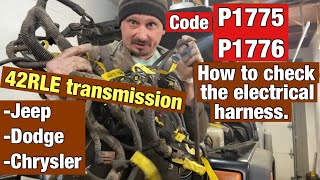
- Wiring Harness or Connector Issue: Corrosion or damage to the main transmission connector or the wiring harness leading to the PCM/TCM can cause erratic signals. It's worth inspecting the external harness for any visible damage or chafing before beginning internal transmission work. 🎬 Watch: How to properly inspect the external electrical wiring harness.
Diagnosis Steps
- Check for any available Technical Service Bulletins (TSBs) or software updates for your vehicle's VIN.
- Scan for other transmission codes to get a full picture. P0700 and P1776 are common companions.
- Check the transmission fluid level and condition. Ensure it is full and clean with ATF+4 fluid.
- Inspect the external transmission wiring harness and connectors for any signs of damage, corrosion, or fluid intrusion. Pay close attention to where the harness may rub against the engine or frame.
- If the above checks are clear, the next step is to drop the transmission pan to inspect for excessive metal debris. Heavy debris indicates a more severe internal failure.
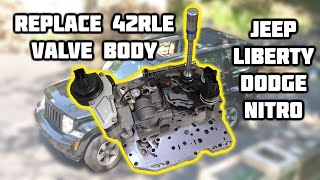
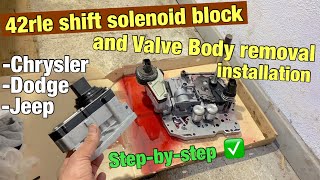
- Before removing the valve body, shift the transmission into the LOW gear position. This is critical to disengage the manual valve linkage properly. 🎬 Watch this step-by-step guide for removing and installing the valve body.
- Remove the valve body assembly from the transmission.
- Replace the solenoid pack, which is mounted to the valve body.
- Inspect the valve body itself for wear in the solenoid switch valve bore. Measure the valve to determine if you have the .420" or .453" version. If wear is suspected, replace the valve body or install an oversized valve kit.
- Reinstall the valve body, new filter, and pan, torquing all bolts to manufacturer specifications (Valve body bolts are typically torqued to 105 in-lbs).
- Refill the transmission with the correct amount of Mopar ATF+4 fluid (typically 4-5 quarts for a pan drop).
- Perform a 'quick learn' procedure with a capable scan tool to allow the TCM to adapt to the new components.
Parts You'll Likely Need
- Transmission Solenoid Pack
(OEM #5143151AA (supersedes 04800171AA))— This is the most commonly replaced part for P1775. It contains the electromechanical solenoids that control hydraulic fluid flow within the transmission.
Trusted brands: Mopar, Dorman, Standard Motor Products (SMP)
OEM price range: $280-$350
Aftermarket price range: $150-$250 - Transmission Valve Body (Remanufactured) — Often the true root cause due to wear in the solenoid valve bore. It's typically replaced with a remanufactured unit that has been repaired and tested.
Trusted brands: Mopar (Remanufactured), Rostra, Street Smart Transmission
OEM price range: $350-$500 (Reman)
Aftermarket price range: $250-$400 (Reman) - Oversized Solenoid Switch Valve Kit
(OEM #Sonnax 92835-21 or 92835-32K (for .420" bore), Sonnax 92835-31K (for .453" bore))— A more targeted and cost-effective fix for a worn valve body bore, but requires special tools (reamer) to install.
Trusted brands: Sonnax, TransGo
OEM price range: N/A
Aftermarket price range: $50-$150 - Transmission Filter and Pan Gasket — These must be replaced any time the transmission pan is removed for service.
Trusted brands: Mopar, ATP, Fel-Pro
OEM price range: $30-$50
Aftermarket price range: $15-$30 - Mopar ATF+4 Automatic Transmission Fluid — This is the required fluid for the 42RLE transmission. Using other fluid types can cause shifting problems. A pan drop and refill typically requires 4-5 quarts.
Related Codes That Often Appear With This One
- P0700 — P0700 is a generic code that simply means the Transmission Control Module (TCM) has requested the Check Engine Light to be turned on. It will almost always be present alongside a more specific transmission code like P1775.
- P1776 — This code is for 'Solenoid Switch Valve Latched in Low/Reverse Position'. It's the sister code to P1775 and points to the same Solenoid Switch Valve, just stuck in the opposite position. Both codes share the same root causes and are often fixed together.
Technical Service Bulletins (TSBs) & Recalls
- TSB 18-043-17: While not specific to the Nitro, this TSB for other Chrysler models addresses similar transmission codes with a PCM reflash, highlighting the importance of checking for software updates as a fir
Mechanic-Grade Diagnostic Values
- Solenoid resistance — expected: 1.5 to 2.5 ohms. Failure: A reading outside this range indicates a faulty solenoid coil.
- Pressure switch resistance — expected: 270 to 330 ohms. Failure: A reading outside this range indicates a faulty resistor in the solenoid pack.
- Voltage at Pin 3 (Red wire) of the 10-way transmission solenoid connector — expected: 12 Volts (Battery Voltage). Failure: No voltage indicates a problem with the EATX relay or the power supply circuit.
Scan Tool Commands That Help
- Chrysler WiTech or equivalent: Transmission Quick Learn — This procedure is mandatory after replacing the valve body or solenoid pack. It allows the TCM to learn the hydraulic and electrical characteristics of the new components to ensure proper shift timing and quality.
- Chrysler WiTech or equivalent: View Transmission Data — Monitor PIDs like 'Line Pressure,' 'Target Line Pressure,' and solenoid states while driving to see if the computer is commanding the correct actions and if the transmission is responding as expected. This can help differentiate between a control-side and a mechanical/hydraulic fault.
Wiring & Ground Locations
- 10-way Solenoid Connector — On the driver's side of the 42RLE transmission case.. This is the main electrical interface for the solenoid pack. Pin 3 (Red) is the 12V power feed, and pins 1, 2, 4, and 7 are the control grounds for the various solenoids. Corrosion or moisture in this connector is a common cause of erratic operation and codes.
- Engine Harness Chafe Point 1 — Against the black metal bracket for the ECM/TCM in the driver's side engine bay.. The harness can rub against the sharp edge of the computer bracket, potentially shorting out wires related to transmission control. A TSB exists for other GM vehicles with similar engine bay layouts, highlighting this as a known issue area.
- Engine Harness Chafe Point 2 — Near the driver's side upper control arm.. As the suspension moves, the harness can rub against the upper control arm, leading to intermittent shorts that are difficult to diagnose when the vehicle is stationary.
- Engine Harness Chafe Point 3 — Near the driver's side shock tower bolt.. Another potential point of friction and wear on the main engine harness that contains the transmission control wires.
Real Owner Repair Stories
- YouTube user 'Problem Solver Garage' (2004 Jeep Wrangler (TJ) with 42RLE) — Goes into limp mode, throwing codes P1775 and P1776.
❌ Tried (didn't work) The owner in the video had previously tried replacing parts without success, leading them to suspect a deeper issue.
✅ What actually fixed it The video demonstrates a complete repair focusing on the root cause: replacing the solenoid switch valve (SSV) inside the valve body. This involved dropping the pan, removing the entire valve body assembly, disassembling it on the bench to access and replace the sticky SSV, and then reinstalling everything. This confirms that simply replacing the external solenoid pack is often not enough. - YouTube user 'saneauto' (2009 Dodge Nitro) — Harsh shifting from 1-2 and 2-3, described by customer as 'brakes applying when driving'. Codes P0868 (Line Pressure Low) and P1790 (Fault Immediately After Shift) were stored.
❌ Tried (didn't work) Clearing codes and performing a relearn did not fix the harsh shift.
✅ What actually fixed it A visual inspection under the vehicle revealed rodent damage to the wiring harness going into the transmission. One wire was completely chewed through. Repairing the damaged wires resolved the shifting issues and fault codes. This highlights the importance of a thorough visual inspection of the harness before replacing internal components. - NHTSA ODI #10314835 (Dodge Dakota cross-reference) — An owner reported that their vehicle displayed codes P1775 (Solenoid Switch Valve Latched in TCC Position) and P0218 (Trans-High Temp Activated). The diagnostic recommendation was to remove the transmission and break it down to find an internal failure or replace the transmission entirely.
OEM Part Supersession History
04800171AA→5143151AA— Standard part revision and update by Mopar.
Heads up: While 5143151AA is the correct current part number, some vendor listings show 04800171AA as replacing 5143151AA, causing confusion. Always verify with a dealer using your VIN, but 5143151AA is the generally accepted replacement for this vehicle range.
Model Year Variations Within This Range
- 2007-2011: The 2007 and later 42RLE transmissions use a Variable Line Pressure (VLP) system. This means the PCM actively varies transmission fluid pressure based on load, unlike the fixed-pressure pre-2007 models. The valve bodies are different and not interchangeable. A VLP valve body can be identified by an extra electrical connector sticking out of the case.
Diagnostic Flowchart
Other Known Issues on This Vehicle
Issues unrelated to this code that are worth knowing about as an owner of this generation:
- Totally Integrated Power Module (TIPM) Failure 🔴 High — Common, typically appears after 80,000 miles. Can cause a wide range of erratic electrical problems. (Ref: While recalls existed for other years/models, many 2007-2011 Nitros experience this without a specific recall, leading to many owner complaints.)
- Dropped Valve Seats (3.7L Engine) 🔴 High — This is a known, though not universal, failure mode for the 3.7L PowerTech engine, especially after an overheating event. It causes a sudden loss of compression and misfires.
- Window Regulator Failure 🟠 Medium — Extremely common. Owners often report replacing multiple window regulators on the same vehicle. The window may get stuck, fall into the door, or make grinding noises.
- Engine Stalling / No-Start Condition 🔴 High — Often related to TIPM failure, but can also be caused by a faulty wireless control module or outdated PCM software.
- Thermostat Housing Leak 🟠 Medium — The plastic thermostat housing is prone to cracking, leading to coolant leaks and potential engine overheating, which can then lead to more severe issues like dropped valve seats.
Used vs. New Parts: Buying Guide for This Vehicle
When a used part is the smart pick: A used valve body from a low-mileage, verified-running donor vehicle can be a cost-effective option, especially if you plan to install a Sonnax kit to fix the known wear points yourself. However, given the high failure rate due to wear, a remanufactured unit is often a safer bet.
Donor-vehicle mileage cap: roughly under 80000 miles for the part to have meaningful remaining life.
What to inspect on the donor part:
- Ask for the VIN of the donor vehicle to verify its mileage and year (to ensure VLP compatibility).
- Inspect the fluid from the donor transmission if possible. Dark, burnt-smelling fluid is a major red flag.
- Upon removal, visually inspect the solenoid switch valve bore for any visible scoring or wear marks.
- Check the main electrical connector for any signs of corrosion, moisture, or bent pins.
OEM-only on this vehicle (don't cheap out):
- Mopar ATF+4 Fluid: This is non-negotiable. The 42RLE is notoriously sensitive to fluid type, and using a non-licensed fluid can cause shifting problems and premature failure. Valvoline ATF+4 is a licensed and acceptable alternative.
- Transmission Solenoid Pack: While aftermarket options exist, the OEM Mopar solenoid pack is widely recommended on forums for reliability and to avoid compatibility issues.
Aftermarket brands forum-validated for this vehicle:
- Sonnax: The go-to brand for valve body repair kits, including oversized valves and reaming tools to permanently fix the worn bore issue.
- TransGo: Another reputable brand that produces shift kits and valve body repair components for the 42RLE.
Brands owners have reported issues with on this vehicle:
- Unbranded/Generic Solenoid Packs: Many cheap, unbranded solenoid packs from online marketplaces have high failure rates. While the initial cost is low, the labor to replace it a second time makes it a poor value. Stick to OEM Mopar or a well-known aftermarket brand like Dorman or SMP.
Related OBD-II Codes
Frequently Asked Questions
My 2009 Nitro is stuck in 2nd gear with code P1775. What's the most likely part I need to replace?
Before I replace any parts for P1775, should I check for a software update?
I'm ordering a valve body repair kit. How do I know which one to get for my Dodge Nitro?
Is it a good idea to replace the transmission solenoid pack while I have the valve body out?
What type of transmission fluid should I use when refilling my Nitro's 42RLE transmission after this repair?
My friend's Jeep Liberty has the exact same P1775 code and symptoms. Is the fix the same?
I'm getting both P1775 and P1776 codes. Does this mean I have two separate problems?
Helpful Videos
We Have This Part in Stock




The information in this article is provided for general reference and educational purposes only. Vehicle specifications, procedures, and part compatibility can vary by production date, trim level, and region. Always consult your vehicle's factory service manual and verify part numbers before purchasing or performing repairs. Safety-critical components such as airbags, seat belts, and braking systems should be installed by a qualified professional.
- Dodge Nitro:
- 🧭 Diagnostic Flowchart
- 🎬 Helpful Videos
- 🛍️ Shop This Part
- What's Unique About the 2007-2011 Dodge Nitro
- Symptoms You May Notice
- Most Likely Causes
- Rare But Worth Checking
- Diagnosis Steps
- Parts You'll Likely Need
- Related Codes That Often Appear With This One
- Technical Service Bulletins (TSBs) & Recalls
- Mechanic-Grade Diagnostic Values
- Scan Tool Commands That Help
- Wiring & Ground Locations
- Real Owner Repair Stories
- OEM Part Supersession History
- Model Year Variations Within This Range
- Other Known Issues on This Vehicle
- Used vs. New Parts: Buying Guide for This Vehicle
- Related OBD-II Codes
- Frequently Asked Questions
- 🎟️ Get 5% Off