

P1775 on 2006-2010 Jeep Commander 5.7L HEMI: Solenoid and Valve Body Guide
On a 2006-2010 Jeep Commander with the 5.7L HEMI, code P1775 means the transmission is failing to downshift into 1st gear, causing limp mode and sluggish starts. The most common repair is replacing the transmission solenoid pack (~$250-$450), but the true cause is often a worn valve body, which is a more involved and expensive repair.
- P1775 on your Commander means the transmission is stuck in a higher gear, causing limp mode and sluggish starts from a stop.
- Do not continue to drive the vehicle, as you risk severe overheating and expensive damage to the transmission.
- The most common repair is replacing the solenoid pack, but the most common root cause is a worn valve body. Be prepared for the possibility that a solenoid-only fix may not be permanent.
- This is a complex, professional-level repair. It is not recommended for a novice DIYer.
- Always use Mopar ATF+4 fluid and replace both transmission filters when performing this service.
What's Unique About the 2006-2010 Jeep Commander
The Jeep Commander with the 5.7L HEMI uses the Chrysler 545RFE transmission, which is part of a family of transmissions (including the 45RFE and 68RFE) known for this specific issue across many Dodge, Jeep, and Chrysler vehicles. The core of the problem is a design choice: a steel Solenoid Switch Valve (SSV) operates within a softer aluminum valve body. Over many shift cycles, the steel valve wears the aluminum bore into an oval shape, causing the valve to bind, leak pressure, and trigger code P1775. This means that while replacing the more accessible solenoid pack might seem like the fix, the code often returns because the underlying mechanical wear in the valve body itself has not been addressed.
Symptoms You May Notice
- Transmission is in 'limp mode' (stuck in 2nd or 3rd gear)
- Sluggish or no acceleration from a complete stop
- Harsh clunk or jerk when slowing down to a stop (typically below 5 mph).
- Check Engine Light is on
- False 'Transmission Overtemp' warning on the dash, even when the transmission is not hot.
- Replacing only the solenoid pack when the valve body is worn. This is a very common scenario where the P1775 code returns shortly after the repair because the root cause (a sticking valve in the valve body bore) was not addressed.
Most Likely Causes
- Worn Transmission Valve Body 🔴 High Probability → Shop Transmission Valve Body The 545RFE transmission's aluminum valve body bore is known to wear out from the movement of the harder steel Solenoid Switch Valve (SSV), causing the valve to stick. This is a well-documented failure pattern for this transmission family.
How to confirm: A transmission specialist must remove the valve body and physically inspect the SSV and its bore for scoring, binding, or an out-of-round shape. A vacuum test can also be performed on the valve body to check for leaks in the SSV circuit.
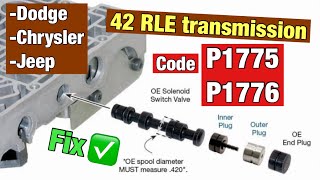
Typical fix: Replace the valve body with a quality remanufactured unit that has an oversized, reamed bore and updated valve. Alternatively, a specialist can install a repair kit like the Sonnax Oversized Solenoid Switch Valve & Plug Kit (92835-31K or 92835-32K, depending on the original valve size).
Est. part cost: $400-$800 - Failed Transmission Solenoid Pack 🟡 Medium Probability → Shop Transmission Assembly The solenoid pack (also called a solenoid block) controls the hydraulic pressure that moves the SSV. While often replaced, it can fail electrically or mechanically. It is frequently misdiagnosed when the valve body is the true culprit, but it can fail on its own. The integrated temperature sensor can also fail, causing false 'overtemp' warnings.
How to confirm: After confirming the valve body is not worn, the solenoid pack is the next logical point of failure. It can be tested for electrical resistance (1.3-1.9 Ohms is a typical spec), but internal mechanical failure is also possible and won't show up on an electrical test.
Typical fix: Replace the entire solenoid pack assembly, which is bolted to the valve body. This is done with the valve body removed from the transmission. A 'Quick Learn' procedure is required after replacement.
Est. part cost: $250-$450 - Low or Degraded Transmission Fluid ⚪ Low Probability → Shop Transmission Assembly Incorrect fluid level or fluid that has broken down can cause poor hydraulic pressure and accelerate wear on internal components like the valve body. One owner reported symptoms consistent with a clogged spin-on filter after a poor quality service.
How to confirm: Check the transmission fluid level and condition using the dipstick. The fluid should be at the correct level, red in color, and not smell burnt. The only approved fluid is Mopar ATF+4.
Typical fix: Perform a transmission fluid and filter change. The 545RFE has two filters (a pan filter and a spin-on cooler return filter) that should both be replaced.
Est. part cost: $80-$150
Rare But Worth Checking
- Misadjusted Shifter Cable: A forum source suggests that if the manual valve is not fully in the Overdrive position, it can trigger this code. A capable scan tool can check the 'TRS Code' in the event data; if it reads 'TR2' instead of 'OD', the shifter cable adjustment should be inspected before replacing internal parts.
- Outdated PCM/TCM Software: Chrysler has issued software updates to change the sensitivity for this code (e.g., TSB 18-043-17) and improve overall shift quality. It's a good practice to ensure the vehicle's software is up-to-date before performing expensive mechanical repairs.
- Wiring or Ground Issues: A poor connection at the main transmission connector (a large, round, 23-pin connector) or a bad ground at G108 (passenger side engine bay, behind headlight) can cause erratic TCM behavior and false codes.
Diagnosis Steps
- Check the transmission fluid level and condition. Ensure it is filled with Mopar ATF+4 fluid and is not burnt or low.
- Use an advanced scan tool to confirm P1775 and check for other codes like P0700 and P1776.
- Check for any available Technical Service Bulletins (TSBs) or software updates for the Powertrain or Transmission Control Module.
- Inspect the transmission wiring harness and connectors for any visible damage, corrosion, or loose connections, especially the main 23-pin connector on the driver's side of the case.
- If possible, use a scan tool to check the 'TRS Code' in the event data. If it does not read 'OD', inspect the shifter cable adjustment.
- Drop the transmission pan and inspect for excessive metal debris. A small amount of fine gray material on the magnet is normal, but large chunks indicate a more serious internal failure.
- Remove the valve body and have it inspected by a professional for wear in the solenoid switch valve bore. A vacuum test on the SSV bore is a definitive check.
- If the valve body is in good condition, the solenoid pack is the likely culprit.
- After repairs, perform a transmission 'Quick Learn' procedure with a compatible scan tool.
Parts You'll Likely Need
- Transmission Valve Body — This is often the true root cause. The original aluminum bore wears out, causing the valve to stick. A remanufactured unit with an updated, oversized valve is the most reliable fix.
Trusted brands: Mopar (Remanufactured), Sonnax (Valve Body Repair Kits, e.g., 92835-31K)
OEM price range: $800+
Aftermarket price range: $400-$800 - Transmission Solenoid Pack / Block
(OEM #52119435AF (superseded by 68353383AC))— This is the most commonly replaced part for P1775. It controls the hydraulic circuits and is replaced if the valve body is confirmed to be in good condition. The original part number 52119435AF has been superseded multiple times, with the latest being 68353383AC.
Trusted brands: Mopar, Rostra (e.g., 52-0500)
OEM price range: $350-$500
Aftermarket price range: $250-$400 - Transmission Filter Kit (Pan and Spin-on)
(OEM #5013470AC)— These must be replaced any time the transmission is serviced. The 545RFE uses two filters; both should be changed. A clogged spin-on filter can cause similar symptoms.
Trusted brands: Mopar, Wix, Fram
OEM price range: $40-$60
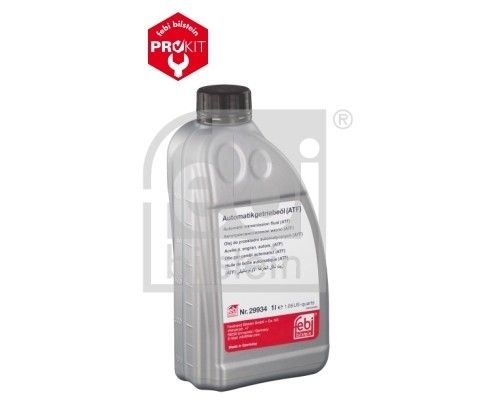
Aftermarket price range: $20-$40 - Mopar ATF+4 Automatic Transmission Fluid
(OEM #MS-9602)— This is the only fluid specified for the 545RFE transmission. Using other fluid types can cause shifting problems and damage. A pan drop service requires 7-8 quarts.
Trusted brands: Mopar, Valvoline ATF+4, Castrol ATF+4
OEM price range: $10-$15 per quart
Aftermarket price range: $8-$12 per quart
Related Codes That Often Appear With This One
- P0700 — This is a generic Transmission Control Module (TCM) fault code. It simply means the TCM has detected a problem and has requested the main Check Engine Light to be turned on. It will almost always be present with P1775.
- P1776 — This is the 'sister code' to P1775, indicating the same Solenoid Switch Valve is stuck in the opposite (Low/Reverse) position. Seeing both codes together strongly points to a mechanical issue with the SSV or its bore in the valve body.
Technical Service Bulletins (TSBs) & Recalls
- TSB 18-043-17 — Flash: P1775 Or P1776 Present — This TSB involves reprogramming the PCM with updated software to change the diagnostic thresholds for setting codes P1775 and P1776, potentially avoiding a hardware replacement for a borderline condition.
Mechanic-Grade Diagnostic Values
- Shift Solenoid Resistance (most) — expected: 1.3 Ohms. Failure: A reading significantly higher or lower than 1.3 Ohms, or an open/short circuit.
- Pressure Control Solenoid Resistance — expected: 4.9 Ohms. Failure: A reading significantly higher or lower than 4.9 Ohms.
- Line Pressure at Idle (in gear) — expected: Can be as low as 40 PSI. Failure: A pressure reading that does not match the desired pressure shown on a scan tool can indicate a faulty line pressure sensor or regulator valve issues, even without a specific line pressure code.
- Solenoid Switch Valve Bore Vacuum Test — expected: Holds a minimum of 16 in-Hg. Failure: Failure to hold a vacuum of at least 16 in-Hg indicates wear in the bore, causing pressure loss.
Scan Tool Commands That Help
- wiTECH or equivalent professional scanner: Quick Learn — This is mandatory after replacing the solenoid pack or valve body. It allows the TCM to learn the hydraulic and electrical characteristics of the new parts to ensure proper shift timing and pressure.
- wiTECH or equivalent professional scanner: Reset Adaptive Values — Used before a Quick Learn to clear the old learned clutch volume indexes (CVI) from the TCM's memory.
- wiTECH or equivalent professional scanner: Solenoid Actuation / Bi-Directional Control — Allows a technician to command the L/R solenoid on and off manually while monitoring pressure switches to see if the valve is responding electrically and hydraulically. This helps isolate a bad solenoid from a wiring or PCM issue.
Wiring & Ground Locations
- Transmission Main Connector (23-pin) — On the driver's side of the 545RFE transmission case, it is a large, round, black connector.. This is the single point of electrical connection for the entire valve body assembly. Pin 2 (Low/Reverse Solenoid Control) is the specific circuit the PCM uses to energize the solenoid related to the Solenoid Switch Valve. A corroded or pushed-out pin here can directly cause P1775.
- G108 — Located in the passenger side of the engine bay, directly behind the headlight assembly.. This is a major ground point for several components, including the TCM and transmission control relay. A loose or corroded connection at G108 can cause erratic voltage, leading to false codes and unpredictable transmission behavior.
Real Owner Repair Stories
- DodgeForum.com user (Similar Dodge vehicle with 545RFE transmission) — Harsh 2-1 downshift, hesitation from a stop, P1775 code present.
❌ Tried (didn't work) Transmission fluid and filter change
✅ What actually fixed it The issue returned shortly after the fluid service. The final recommendation from experienced forum members, confirming the classic failure pattern, was that the valve body itself was worn and required replacement.
OEM Part Supersession History
52119435AA, 5170877AA through 5170877AF→68353383AC— Revisions to improve reliability, address common failure modes, and consolidate parts.
Heads up: The latest part number, 68353383AC, is the current service replacement for a wide range of RFE transmissions. Early (pre-2004) solenoid packs with a black connector are physically different from later white or gray connector packs.
Model Year Variations Within This Range
- 1999-2008 vs 2009-Up: Valve bodies from 2009 and later eliminated the overdrive solenoid and one check ball (from 7 to 5). The solenoid pack connector color also changed from white (2004-2008) to gray (2009+). While some interchange is possible with modifications, it's critical to match the valve body and solenoid pack to the vehicle's year.
Diagnostic Flowchart
Other Known Issues on This Vehicle
Issues unrelated to this code that are worth knowing about as an owner of this generation:
- HEMI MDS Lifter Failure ('Hemi Tick') 🔴 High — Common issue, particularly on higher-mileage vehicles or those with poor oil change history. Can occur anytime but more frequent over 80,000 miles. (Ref: Multiple TSBs exist regarding diagnosis, but no recall. TSB 9002129 addresses misdiagnosis.)
- Leaking Sunroof Drains 🟠 Medium — Extremely common across all model years. Often appears after a few years as debris clogs the drain tubes.
- Electronic Shifter Module (ESM) / Rollaway Risk 🔴 High — Affected specific 2014-2015 models of the platform-mate Grand Cherokee, but the non-intuitive 'monostable' shifter design principle was a concern across related vehicles. (Ref: Safety Recall S27 / NHTSA 16V-240 for Grand Cherokee.)
- Broken Exhaust Manifold Bolts 🟠 Medium — Common on the 5.7L HEMI engine, especially after multiple heat cycles.
- Totally Integrated Power Module (TIPM) Failure 🔴 High — A widespread issue across many Chrysler/Jeep/Dodge products of this era.
Used vs. New Parts: Buying Guide for This Vehicle
When a used part is the smart pick: A used part for this repair is almost never a good idea. The primary failure is mechanical wear in the valve body bore. A used valve body from a junkyard will likely have the same wear or will develop it soon. A used solenoid pack is also risky as it may have significant internal wear or electronic fatigue.
Donor-vehicle mileage cap: roughly under 50000 miles for the part to have meaningful remaining life.
What to inspect on the donor part:
- For a valve body, only a professionally remanufactured unit with a warranty is acceptable. These have been reamed and fitted with oversized valves to correct the original design flaw.
- If considering a used solenoid, look for a clean part from a verified low-mileage vehicle, but understand the risk of premature failure is high.
OEM-only on this vehicle (don't cheap out):
- Transmission Solenoid Pack - While some aftermarket brands exist, the Mopar part has undergone multiple revisions to improve reliability. Given the labor involved, using the latest OEM part (68353383AC) is the safest bet.
Aftermarket brands forum-validated for this vehicle:
- Sonnax - For valve body repair kits and individual components. They are a highly respected industry leader in solving OEM transmission problems.
- Rostra - A known-good aftermarket manufacturer for complete solenoid pack assemblies.
Brands owners have reported issues with on this vehicle:
- Unnamed, low-cost solenoid packs from online marketplaces. These often use inferior materials and electronics, leading to a high rate of failure shortly after installation.
Real Owner Stories
Aggregated from forums and TSBs cited above. Mileages and costs reflect what owners reported in those sources.
2009 Jeep Commander 5.7L HEMI
Symptoms: The vehicle was throwing P1775 and the owner was investigating the Solenoid Switch Valve and TRS Code diagnostic steps.
What fixed it: The diagnosis confirmed the issue was related to the valve body/SSV circuit rather than just the solenoid pack.
Source hint: Jeepz.com - p1775 Solenoid switch & p0456 EVAP leak problems
2006-2010 Dodge Ram 1500 5.7L HEMI
Symptoms: Experienced P1775; a fluid and filter change was performed but failed to resolve the symptoms.
What fixed it: The consensus for this 545RFE transmission issue was that a worn valve body was the necessary repair after fluid service failed.
Source hint: DodgeForum.com - User experience with P1775
Related OBD-II Codes
Frequently Asked Questions
Is there a software update for my Jeep Commander to fix the P1775 code?
What specific transmission fluid should I use for my 5.7L HEMI Commander?
My dash is showing a 'Transmission Overtemp' warning but the car isn't hot; is this related to P1775?
Can I just replace the solenoid pack to fix the P1775 'limp mode'?
Are there specific repair kits for the 545RFE valve body issue?
What is a 'Quick Learn' procedure and do I need it for my Jeep?
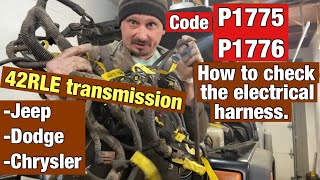
Helpful Videos
We Have This Part in Stock

The information in this article is provided for general reference and educational purposes only. Vehicle specifications, procedures, and part compatibility can vary by production date, trim level, and region. Always consult your vehicle's factory service manual and verify part numbers before purchasing or performing repairs. Safety-critical components such as airbags, seat belts, and braking systems should be installed by a qualified professional.
- Jeep Commander:
- 🧭 Diagnostic Flowchart
- 🎬 Helpful Videos
- 🛍️ Shop This Part
- What's Unique About the 2006-2010 Jeep Commander
- Symptoms You May Notice
- Most Likely Causes
- Rare But Worth Checking
- Diagnosis Steps
- Parts You'll Likely Need
- Related Codes That Often Appear With This One
- Technical Service Bulletins (TSBs) & Recalls
- Mechanic-Grade Diagnostic Values
- Scan Tool Commands That Help
- Wiring & Ground Locations
- Real Owner Repair Stories
- OEM Part Supersession History
- Model Year Variations Within This Range
- Other Known Issues on This Vehicle
- Used vs. New Parts: Buying Guide for This Vehicle
- Real Owner Stories
- 2009 Jeep Commander 5.7L HEMI
- 2006-2010 Dodge Ram 1500 5.7L HEMI
- Related OBD-II Codes
- Frequently Asked Questions
- 🎟️ Get 5% Off