

P1775 on 2013-2018 Ram 2500 6.7L Cummins: Solenoid Switch Valve Fixes
P1775 on a Ram 2500 with the 68RFE transmission indicates the Solenoid Switch Valve (SSV) is stuck in the Torque Converter Clutch (TCC) position. This is a very common and well-documented issue, primarily caused by wear in the aluminum valve body bore where the steel SSV resides. The most reliable fix is replacing the transmission valve body, often along with the solenoid pack. Before replacing hardware, verify the PCM software is up to date, as some TSBs address false triggers for this code. Ex
- P1775 on a 2013-2018 Ram 2500 almost always points to a mechanical problem inside the 68RFE transmission.
- The most common cause is a worn-out valve body bore causing the Solenoid Switch Valve to stick.
- Before replacing any parts, always check if the vehicle's computer (PCM) has the latest software, as updates have been released for this issue.
- This is not a DIY-friendly repair. It requires removing the transmission valve body and should be handled by a professional to avoid further damage.
- Simply replacing the solenoid pack without inspecting the valve body may not fix the problem.
What's Unique About the 2013-2018 Ram 2500
The 68RFE transmission, while capable, was developed from the lighter-duty 545RFE and is known to have weak points when paired with the high torque of the 6.7L Cummins. The root cause of P1775 is a widely recognized design issue: the steel Solenoid Switch Valve constantly moves within a softer aluminum valve body bore. Over time, this wears the bore, allowing the valve to tilt and jam. This is a well-documented weakness in the entire RFE transmission family (45RFE, 545RFE, 68RFE), making P1775 a common and predictable failure as these trucks accumulate mileage.
Symptoms You May Notice
- Check Engine Light is on
- Vehicle enters "limp mode" (stuck in 3rd or 4th gear)
- Engine stalls when coming to a stop
- Harsh or jerky shifting, especially when slowing down
- A noticeable clunk or jerk when slowing below 5 mph as the TCC fails to disengage.
- Replacing only the solenoid pack when the valve body bore is worn. This will not fix the problem as the new solenoid will still be trying to move a stuck valve, and the code will return quickly.
- Assuming any stalling issue is engine-related without checking for transmission codes first. The symptom of stalling when stopping is a classic sign of P1775.
Most Likely Causes
- Worn Valve Body / Sticking Solenoid Switch Valve (SSV) 🔴 High Probability → Shop Transmission Valve Body The 68RFE's aluminum valve body bore is known to wear from the movement of the harder steel SSV, causing the valve to stick. This is the most common root cause, as acknowledged by transmission specialists and aftermarket parts manufacturers.
How to confirm: Requires removing the valve body from the transmission and physically inspecting the SSV for smooth movement in its bore. The valve should slide freely without binding.
Typical fix: The valve body must be repaired or replaced. Repair involves reaming the bore and installing an oversized valve kit from a brand like Sonnax or TransGo. More commonly, the entire valve body is replaced with a quality remanufactured unit that has these weak points addressed.
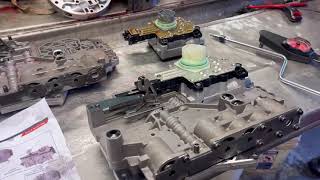
Est. part cost: $300-$1200 - Faulty Transmission Solenoid Pack 🔴 High Probability → Shop Transmission Assembly The solenoid pack is a complex electro-hydraulic part that is a frequent failure item on 68RFE transmissions. It is often replaced alongside the valve body as a preventative measure, 🎬 Watch: Upgrading the 68RFE valve body and solenoid pack or when the SSV itself moves freely, pointing to an issue within the solenoid assembly.
How to confirm: If the SSV moves freely upon inspection, the solenoid pack is the presumed cause. A professional can use a scan tool to monitor solenoid commands and performance, but given the high failure rate, it's often replaced based on the code and symptoms.
Typical fix: Replace the entire transmission solenoid/TRS assembly. This is often done at the same time as a valve body service.
Est. part cost: $350-$550 - Outdated Powertrain Control Module (PCM) Software 🟡 Medium Probability → Shop Engine Control Module (ECM) Ram has issued multiple software updates that change the diagnostic parameters for setting transmission codes. TSB 18-018-13 REV. D specifically lists P1775 as a code whose sensitivity can be reduced via a reflash, preventing false triggers. Another TSB, 18-043-17, changes P1775 from a one-trip to a two-trip fault.
How to confirm: A dealer or qualified shop must use a diagnostic tool (like wiTECH) to check the current software version against the latest available from the manufacturer for the vehicle's VIN.
Typical fix: Reprogram (flash) the PCM to the latest software version. This should always be checked before replacing hardware.
Est. part cost: $0-$200 - Contaminated or Low Transmission Fluid ⚪ Low Probability → Shop Transmission Assembly While not a primary cause, fluid that is low or contaminated with clutch material can contribute to the sticking of valves and solenoids. The 68RFE is sensitive to fluid condition and level.
How to confirm: Check the transmission fluid level and condition using the dipstick. The fluid should be at the correct level, red in color, and not smell burnt.
Typical fix: Perform a transmission fluid and filter change. However, if the P1775 code is already present, a fluid change alone is very unlikely to fix the underlying mechanical issue.
Est. part cost: $100-$250
Rare But Worth Checking
- Wiring Harness or Connector Issue: Damage to the wiring harness leading to the transmission or corrosion in the main connector can cause electrical faults that trigger this code. A visual inspection is always worthwhile.
- Faulty Powertrain Control Module (PCM): → Shop Engine Control Module (ECM) This is extremely rare. The PCM should only be considered for replacement after all other possibilities—mechanical, hydraulic, and electrical—have been exhaustively ruled out.
Diagnosis Steps
- Check for any available PCM software updates using a dealer-level scan tool. Reprogram if an update is available. This is a critical first step.
- Check the transmission fluid level and condition. Top off or replace if necessary, though this is unlikely to be the sole fix.
- Perform a thorough visual inspection of the transmission wiring harness and the main connector on the driver's side of the transmission case for any damage or corrosion.
- If the above steps do not resolve the issue, the transmission oil pan must be removed.
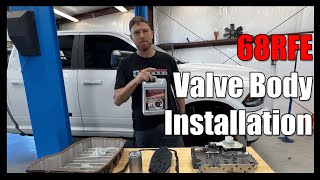
- Remove the valve body assembly from the transmission. 🎬 See this step-by-step DIY valve body installation guide
- Carefully inspect the Solenoid Switch Valve (SSV) and its plugs for free movement within the valve body bore. Use a small tool to gently push the valve; it should move smoothly without catching.
- If the SSV sticks or feels gritty, the valve body is worn. The valve body should be replaced or repaired with an aftermarket oversized valve kit.
- If the SSV moves freely, the problem is most likely the solenoid pack. Replace the solenoid/TRS assembly.
- Install new transmission filters (both spin-on and pan filter), reinstall the valve body and pan with a new gasket.
- Refill the transmission with the correct specification of ATF+4 fluid.
- Perform a transmission 'Quick Learn' or 'Adaptation Memory Clear' procedure with a capable scan tool to allow the PCM to adapt to the new components. Failure to do this can result in poor shift quality.
Parts You'll Likely Need
- Transmission Solenoid Block Pack
(OEM #68353383AC)— This is one of the two most common failure points for a P1775 code when the valve body itself is not worn. It is a known failure point on the 68RFE.
Trusted brands: Mopar (OEM)
OEM price range: $350-$550
Aftermarket price range: $250-$450 - Transmission Valve Body — Often the root cause of P1775 is a worn bore within the valve body. Replacing it with a quality remanufactured unit that has been updated to prevent this wear is the most robust repair.
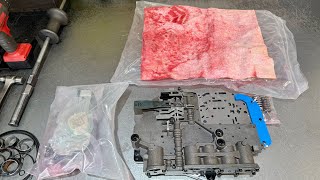
Trusted brands: Mopar (OEM), Sonnax, RevMax, BD Diesel 🎬 Watch: Essential preparation tips for Sonnax valve bodies
OEM price range: $800-$1200
Aftermarket price range: $500-$900 - Solenoid Switch Valve Repair Kit
(OEM #Sonnax 44954-01K)— For professional transmission shops, reaming the existing valve body and installing an oversized, improved valve from a kit is a common repair method instead of full replacement. This permanently addresses the wear issue.
Trusted brands: Sonnax, TransGo
Related Codes That Often Appear With This One
- P0871 — This code relates to the Overdrive Pressure Switch Sense Circuit. Hydraulic cross-leaks in the valve body caused by a worn SSV bore can trigger both P1775 and P0871.
- P1776 — This code means the Solenoid Switch Valve is latched in the Low/Reverse position, the opposite of P1775. Seeing either code points to a problem with the SSV's movement and often has the same root cause.
- P0841 — This code relates to the L/R Pressure Switch Sense Circuit. It often appears with P1775 as the PCM uses this switch to verify the position of the SSV.
- P0933 / P0934 / P0935 — These codes relate to hydraulic line pressure sensor performance and are often listed in the same TSBs as P1775, indicating a systemic pressure control issue within the 68RFE.
Technical Service Bulletins (TSBs) & Recalls
- TSB 18-018-13 REV. D: This bulletin addresses a PCM reflash to improve diagnostics for a long list of codes, including P1775 and P1776, to prevent unnecessary Malfunction Indicator Lamp (MIL) illumination.
- TSB 18-043-17: Mentioned as changing the P1775 fault from a one-trip to a two-trip fault, making it less likely to set the check engine light from a single, transient event.
Platform-Specific Known Issues
- Owner Repair Story: Solenoid-Only Swap Failure: A common story found on forums involves an owner experiencing P1775 symptoms, replacing only the solenoid pack (~$400 part), and having the code and symptoms return within a few hundred miles. They then have to pay for labor a second time to drop the pan and replace the valve body, which was the root cause all along.
- Towing and High-Load Onset: Some owners report that the first instance of the P1775 code appeared shortly after a heavy towing session or during high-load conditions, suggesting that the increased stress and heat may have been the final straw for a valve body bore that was already worn.
Mechanic-Grade Diagnostic Values
- Solenoid Coil Resistance (L/R, MS, UD, OD, 4C, 2C) — expected: ~1.3 Ohms at room temperature. Failure: An open circuit (infinite resistance) or a significant deviation from 1.3 Ohms indicates a failed coil.
- Pressure Control (PC) Solenoid Coil Resistance — expected: ~3.5 - 4.9 Ohms at room temperature. Failure: An open circuit or a reading outside this range points to a faulty PC solenoid within the pack.
- L/R Solenoid Full Circuit Resistance (at TCM connector) — expected: ~1.8 Ohms. Failure: An open circuit reading confirms a break in the wiring or the solenoid coil itself.
- Line Pressure Sensor (LPS) Voltage — expected: 0.35 to 4.75 volts. Failure: Voltage outside this range will set codes P0934 (low) or P0935 (high) and indicates a sensor or wiring problem, not necessarily a direct cause of P1775 but a related system fault.
Scan Tool Commands That Help
- wiTECH, Autel, Launch, Snap-On, AlfaOBD: Quick Learn / Transmission Relearn — This is a mandatory procedure after replacing the valve body or solenoid pack. It resets transmission adaptive memory and allows the TCM to learn the hydraulic characteristics of the new parts. Failure to perform this step will result in poor shift quality and can lead to premature wear of the new components.
- wiTECH or equivalent dealer-level tool: TCM/ECM Reset — This should be performed before the Quick Learn procedure to clear all adaptive values from the Transmission Control Module (TCM).
- Miller tool #8333 (Transmission Simulator): L/R Pressure Switch State Test — This is a professional diagnostic step to test the L/R pressure switch circuit independently of the transmission's hydraulics. It helps isolate whether the fault is electrical (wiring, PCM) or hydraulic/mechanical (stuck valve, bad switch).
Wiring & Ground Locations
- Main Transmission Connector (23-pin) — Driver's side of the 68RFE transmission case.. This is the primary electrical interface for the solenoid pack. Corrosion or damage here can interrupt signals and power, causing various codes including P1775.
- Pin 2 (L/R Solenoid Control) — In the 23-pin main transmission connector.. This pin carries the control signal from the TCM to the Low/Reverse solenoid, which is responsible for moving the Solenoid Switch Valve (SSV). A short or open on this circuit (T50) is a primary electrical fault to check.
- Pin 14 (L/R Pressure Switch Sense) — In the 23-pin main transmission connector.. The TCM monitors the voltage on this pin to confirm that the SSV has physically moved. If the valve sticks, the pressure switch won't close, and the TCM will detect the fault on this circuit, often triggering P0841 along with P1775.
- Pin 10 (Transmission Control Relay Output) — In the 23-pin main transmission connector.. This pin supplies the main power feed to the entire solenoid pack. A poor connection here can cause erratic solenoid operation.
Real Owner Repair Stories
- Cummins Forum user report (2013 Ram 2500 6.7L Cummins) — Check Engine Light on, transmission in limp mode, codes P1776 (opposite of P1775) and P0871 present.
❌ Tried (didn't work) Replaced the transmission solenoid pack.
✅ What actually fixed it The codes returned shortly after the solenoid pack replacement. The final fix was replacing the entire transmission valve body with a remanufactured unit, which resolved the codes and symptoms, indicating the root cause was a worn bore for the Solenoid Switch Valve.
OEM Part Supersession History
Various (e.g., 5170877AA, 52119435AF with grey connector)→68353383AC (White Connector)— Updates and revisions to address common failure points within the solenoid pack.
Heads up: The blue connector solenoid pack (e.g., 68456067AA) used on 2019 and newer Ram trucks is NOT compatible with 2013-2018 models.
Model Year Variations Within This Range
- 2011-2018: These models originally came with a grey connector solenoid pack. The updated Mopar replacement part is a white connector pack (68353383AC), which is backward compatible.
- 2019+: Starting in 2019, the 68RFE uses a blue connector solenoid pack which is physically and electronically incompatible with the earlier 2013-2018 trucks.
Diagnostic Flowchart
Other Known Issues on This Vehicle
Issues unrelated to this code that are worth knowing about as an owner of this generation:
- VGT Turbo Actuator Failure 🔴 High — Common, especially on trucks with high idle time. Can occur as early as 60,000-80,000 miles.
- "Death Wobble" Front Suspension Wear 🔴 High — Common on 4x4 models, especially after 75,000 miles or if larger tires are installed. Frequency increases with component wear.
- EGR System and Cooler Clogging 🟠 Medium — Very common, especially on trucks used for short trips where the engine doesn't reach full operating temperature for long periods. Can start causing issues around 100,000 miles.
- Emissions System Recalls (DEF/SCR System) 🟠 Medium — Affects all 2013-2018 models. A mandatory recall was issued. (Ref: Recall 67A / EPA Settlement)
- Water Pump Failure 🟠 Medium — A known potential failure point, often occurring between 100,000 and 150,000 miles.
Used vs. New Parts: Buying Guide for This Vehicle
When a used part is the smart pick: For this specific repair, using a used (junkyard) valve body or solenoid pack is NEVER recommended. The primary failure mode of P1775 is physical wear of the valve body bore, a condition that will be present or imminent in almost any used part. The cost of labor to install a used part that will likely fail again quickly makes it a very poor economic choice.
What to inspect on the donor part:
- Not applicable. Do not source these parts from a junkyard.
OEM-only on this vehicle (don't cheap out):
- Transmission Solenoid Pack: While some aftermarket solenoid packs exist, the OEM Mopar unit is widely considered the most reliable choice to avoid compatibility and early failure issues.
Aftermarket brands forum-validated for this vehicle:
- Valve Body: RevMax, Sonnax, BD Diesel, Tier One, SunCoast. These companies specialize in remanufacturing 68RFE valve bodies, addressing the factory weak points by reaming bores, installing oversized valves, and using improved components like billet accumulator pistons and thicker separator plates.
- Valve Body Repair Kits: Sonnax, TransGo. These kits are for professional machine shops to repair an existing valve body rather than for DIY installation.
Brands owners have reported issues with on this vehicle:
- Unbranded/white-box solenoid packs from online marketplaces are a significant gamble and often lead to repeat failures.
Real Owner Stories
Aggregated from forums and TSBs cited above. Mileages and costs reflect what owners reported in those sources.
2013-2018 Ram 2500 6.7L Cummins
Symptoms: The owner experienced P1775 symptoms and replaced only the solenoid pack. However, the code and symptoms returned within a few hundred miles, requiring a second repair to replace the valve body.
What fixed it: Replacing the valve body after the initial solenoid-only swap failed.
Cost: $1000-$2000
Source hint: vehicle_specific_issues: Owner Repair Story: Solenoid-Only Swap Failure
2013-2018 Ram 2500 6.7L Cummins
Symptoms: The P1775 code appeared immediately following a heavy towing session or during high-load conditions.
What fixed it: Repair or replacement of the valve body due to a worn SSV bore exacerbated by heat and stress.
Source hint: vehicle_specific_issues: Towing and High-Load Onset
2013-2018 Ram 2500 6.7L Cummins
Symptoms: Check engine light with P1775; members discussed the high cost of shop repairs and the technical difficulty of the fix.
What fixed it: Installing Sonnax kits or remanufactured valve bodies from RevMax.
Source hint: forum_citations: HDRAMS.com and Reddit (/r/Diesel and /r/Cummins)
Related OBD-II Codes
Frequently Asked Questions
I heard there is a software update for P1775 on my 2013 Ram 2500. What does TSB 18-018-13 REV. D actually do?
My 2017 Ram 2500 6.7L Cummins just threw a P1775 code once. Does this mean my transmission is definitely failing?
Can I just replace the solenoid pack on my 68RFE to fix the P1775 code?
What specific aftermarket parts are recommended for the 68RFE valve body wear issue?
Why does my Ram 2500 stall when I come to a stop with this code?
Is the P1775 issue unique to the 2013-2018 Ram 2500?
Helpful Videos
We Have This Part in Stock


The information in this article is provided for general reference and educational purposes only. Vehicle specifications, procedures, and part compatibility can vary by production date, trim level, and region. Always consult your vehicle's factory service manual and verify part numbers before purchasing or performing repairs. Safety-critical components such as airbags, seat belts, and braking systems should be installed by a qualified professional.
- Ram 2500:
- 🧭 Diagnostic Flowchart
- 🎬 Helpful Videos
- 🛍️ Shop This Part
- What's Unique About the 2013-2018 Ram 2500
- Symptoms You May Notice
- Most Likely Causes
- Rare But Worth Checking
- Diagnosis Steps
- Parts You'll Likely Need
- Related Codes That Often Appear With This One
- Technical Service Bulletins (TSBs) & Recalls
- Platform-Specific Known Issues
- Mechanic-Grade Diagnostic Values
- Scan Tool Commands That Help
- Wiring & Ground Locations
- Real Owner Repair Stories
- OEM Part Supersession History
- Model Year Variations Within This Range
- Other Known Issues on This Vehicle
- Used vs. New Parts: Buying Guide for This Vehicle
- Real Owner Stories
- 2013-2018 Ram 2500 6.7L Cummins
- 2013-2018 Ram 2500 6.7L Cummins
- 2013-2018 Ram 2500 6.7L Cummins
- Related OBD-II Codes
- Frequently Asked Questions
- 🎟️ Get 5% Off