

P1776 on 2007-2011 Dodge Nitro 3.7L: Solenoid Switch Valve Causes and Fixes
On a 2007-2011 Dodge Nitro, code P1776 is almost always caused by a sticking Solenoid Switch Valve (SSV) inside the transmission valve body, forcing the vehicle into 'limp mode'. The root cause is typically wear in the SSV bore within the aluminum valve body. The most reliable fix is to replace the valve body with a remanufactured unit or have the original reamed for an oversized valve kit. Simply replacing the solenoid pack often fails to solve the problem. Expect a shop repair to cost between
- P1776 on a Dodge Nitro means the transmission is in 'limp mode' because a critical valve is stuck.
- The most likely cause is a worn-out valve body, NOT just the electronic solenoid pack. Simply replacing the solenoid pack may not fix the issue long-term.
- A proper diagnosis involves checking the 'TRS Code' with a scan tool. A 'TR2' code points to the shifter cable, while an 'OD' code points to the valve body.
- Do not drive extensively in limp mode. The resulting heat can cause catastrophic transmission failure.
- This is not a beginner-friendly DIY repair. It requires dropping the valve body and is best left to a professional or a very experienced DIYer.
What's Unique About the 2007-2011 Dodge Nitro
The Dodge Nitro's 3.7L V6 is paired with the 42RLE automatic transmission, which is used across many Chrysler, Dodge, and Jeep products. This transmission has a known weakness where the bore for the Solenoid Switch Valve (SSV) inside the aluminum valve body can wear out over time. This wear allows the steel valve to stick or allows for cross-leakage of hydraulic fluid, leading directly to the P1776 code. Many people mistakenly replace the electronic solenoid pack, but the problem often returns because the root cause is the mechanical wear within the valve body itself, a fact highlighted in Chrysler technical documents.
Symptoms You May Notice
- Transmission is stuck in one gear ('limp mode' or 'fail-safe mode').
- Check Engine Light is on.
- Vehicle has very slow acceleration and won't shift into higher gears.
- Harsh or delayed transmission engagement.
- Erratic shifting before complete failure.
- Replacing only the transmission solenoid pack. While the pack can be the cause, it's often just a symptom of a worn valve body. A Chrysler technical document specifically warns against replacing the solenoid assembly for a P1776 code without first investigating the valve body and shifter adjustment.
Most Likely Causes
- Sticking Solenoid Switch Valve (SSV) in a Worn Valve Body 🔴 High Probability → Shop Transmission Valve Body The 42RLE's aluminum valve body bore is known to wear, allowing the steel SSV to bind or leak pressure. Debris in the fluid accelerates this wear. This is the most common cause.
How to confirm: A scan tool may show 'TRS Code: OD' in the event data, pointing to a sticky valve. Physical confirmation requires removing and inspecting the valve body; the valve should move freely in its bore. 🎬 Watch: How to diagnose a latched solenoid switch valve. A transmission shop can also vacuum test the bore to confirm wear.
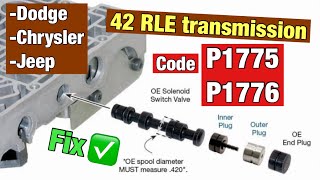
Typical fix: The best fix is to replace the valve body with a remanufactured unit that has an updated, sleeved SSV bore. A more advanced repair is for a transmission shop to ream the original bore and install an oversized valve kit from a company like Sonnax (e.g., kit 92835-21).
Est. part cost: $250-$500 for a remanufactured valve body. $50-$100 for a Sonnax oversized valve kit (requires special tools). - Defective Transmission Solenoid Pack 🟡 Medium Probability → Shop Transmission Assembly The solenoid pack, which contains the electronic solenoids and pressure switches, can fail electrically or mechanically. It is a common failure point on many automatic transmissions, but for P1776, it is often misdiagnosed as the root cause when the valve body is the real issue.
How to confirm: After confirming the SSV is not stuck and the shifter cable is adjusted, the solenoid pack is the next likely culprit. It can be tested with a multimeter for correct resistance (approx. 1-3 Ohms for the L/R solenoid) or by a transmission specialist.
Typical fix: Replace the transmission solenoid/pressure switch assembly. This part bolts directly to the valve body.
Est. part cost: $150-$300 for a Mopar or quality aftermarket part. - Misadjusted Shifter Cable ⚪ Low Probability Stretching or damage to the cable can cause the manual valve in the transmission to not fully align with the gear selected by the driver, confusing the TCM.
How to confirm: Use a scan tool to check the P1776 event data. If the 'TRS Code' displays 'TR2', it indicates the manual valve was not fully in the Overdrive position when the code was set. This points directly to a shifter cable/linkage issue per Chrysler TSBs.
Typical fix: Adjust or replace the shifter cable assembly.
Est. part cost: $50-$100 - Low or Contaminated Transmission Fluid ⚪ Low Probability → Shop Transmission Assembly Neglected fluid changes lead to fluid breakdown and the circulation of clutch material and metal shavings, which can cause valves to stick and accelerate bore wear.
How to confirm: Check the transmission fluid level and condition. The fluid should be at the correct level, red in color (ATF+4), and not smell burnt. Dark, brown, or gritty fluid is a sign of a problem.
Typical fix: Perform a transmission fluid and filter change. If the fluid is heavily contaminated, this may be a symptom of a larger internal failure and a simple fluid change will not fix the P1776 code.
Est. part cost: $75-$150 for fluid and filter.
Rare But Worth Checking
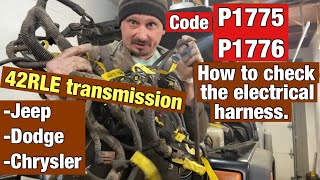
- Wiring Harness Issue: An intermittent short to ground on the Low/Reverse pressure switch signal wire can trick the computer into setting this code. This should be investigated if mechanical causes are ruled out. A detailed video shows how to check the harness for continuity and shorts. 🎬 Watch: How to check the electrical harness for these codes.
- Faulty Powertrain Control Module (PCM): In very rare cases, the PCM itself can fail. This should only be considered after all other possibilities have been exhausted.
Diagnosis Steps
- Check the transmission fluid level and condition. Ensure it is full and not burnt or contaminated with clutch material.
- Connect a capable scan tool and read the fault codes. Confirm P1776 is present and check for any other codes like P0700 or P1775.
- Using the scan tool, access the P1776 'Event Data' or 'Freeze Frame' data.
- Look for the 'TRS Code' within the event data. If it reads 'TR2', the problem is likely a misadjusted shifter cable. Inspect and adjust the cable as needed.
- If the 'TRS Code' reads 'OD', the problem is likely a sticking Solenoid Switch Valve (SSV) or a faulty solenoid pack.
- Drain the transmission fluid and remove the transmission oil pan.
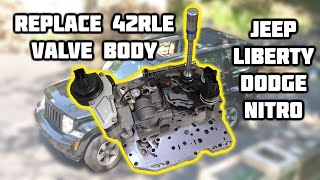
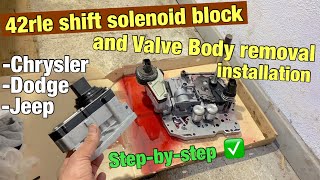
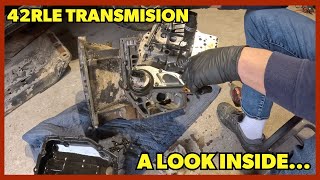
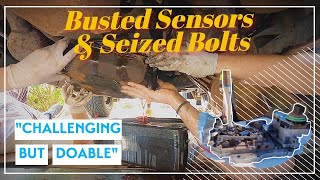
- Remove the transmission valve body assembly. This is required to access both the SSV and the solenoid pack. A detailed video guide for this process is available.
- Inspect the Solenoid Switch Valve. Remove it from its bore in the valve body and check for any scoring or binding. It should move smoothly. If it sticks or has visible wear, the valve body is the primary fault.
- If the SSV moves freely, the solenoid pack is the next most likely cause. It can be unbolted from the valve body and replaced.
- For a definitive repair, consider having the valve body bore reamed and an oversized valve kit from a brand like Sonnax installed.
- Reassemble with a new transmission filter and pan gasket, and refill with the correct type and amount of ATF+4 transmission fluid.
Parts You'll Likely Need
- Transmission Valve Body (Remanufactured) — This is the most common root cause, as wear in the valve body bore causes the Solenoid Switch Valve to stick. Replacing the entire unit with a remanufactured one that has a sleeved/repaired bore is the most durable repair.
Trusted brands: Mopar (OEM), Sonnax (offers repair kits), Rostra
OEM price range: $400-$600
Aftermarket price range: $250-$500 - Transmission Solenoid Pack / Assembly
(OEM #5143151AA)— This is the second most common cause and is often replaced during a valve body service. It contains all the electronic solenoids and pressure switches in a single block.
Trusted brands: Mopar (OEM), Standard Motor Products (SMP), ATP Automotive
OEM price range: $250-$350
Aftermarket price range: $150-$250 - Oversized Solenoid Switch Valve Kit
(OEM #Sonnax 92835-21)— For repairing a worn valve body instead of replacing it. This kit includes an oversized valve that restores hydraulic integrity after the original bore is reamed. This is a permanent fix but requires specialized tools.
Trusted brands: Sonnax, TransGo
OEM price range: N/A
Aftermarket price range: $40-$100 - Transmission Filter and Pan Gasket — These must be replaced any time the transmission pan is removed for service.
Trusted brands: Mopar (OEM), Wix, Fram
OEM price range: $30-$50
Aftermarket price range: $15-$30
Related Codes That Often Appear With This One
- P0700 — This is a generic Transmission Control System Malfunction code. It simply indicates that the Transmission Control Module (TCM) has stored a specific fault code, like P1776, and has requested the Check Engine Light to be turned on.
- P1775 — This is the sister code, 'Solenoid Switch Valve Latched in TCC Position'. It points to the exact same component (the SSV) being stuck in the opposite state. Both codes often share the same root cause of a worn valve body bore.
Technical Service Bulletins (TSBs) & Recalls
- Chrysler TSB 21-001-13 (supersedes 21-008-04): Provides the definitive diagnostic procedure for P1776. It instructs technicians to check the 'TRS Code' in the scan tool's event data. A 'TR2' code points to a misadjusted shifter cable, while an 'OD' code points to a sticking Solenoid Switch Valve in the valve body. It explicitly states the SSV is in the valve body, not the solenoid pack.
Platform-Specific Known Issues
- The 42RLE transmission in the Dodge Nitro is widely considered unreliable, with the valve body being a primary weak point.
- Owners on forums frequently report replacing the solenoid pack only to have the P1776 code return, confirming the root cause is often the valve body bore itself.
Mechanic-Grade Diagnostic Values
- Solenoid Coil Resistance — expected: 1-3 Ohms (when cold or hot). Failure: A reading outside this range indicates a faulty solenoid within the pack.
- Pressure Switch Resistor Resistance — expected: 270 to 330 Ohms. Failure: A reading outside this range indicates a failure in the pressure switch assembly within the solenoid pack.
- L/R Pressure Switch Signal Voltage (Scan Tool) — expected: 0V (Grounded) in Park, 1st Gear. 14V+ (Open) during 1-2 shift and higher gears.. Failure: If the voltage remains at 0V (grounded) when the transmission should be in 2nd gear or higher, it confirms the fault condition for P1776.
- LR/CC Solenoid Control Voltage (Scan Tool) — expected: Modulated to ~9.5V average DC in Park/1st. Modulated OFF (14.2V+) for 2nd gear and up (when not applying TCC).. Failure: Incorrect voltage readings can point to a PCM or wiring issue, but are often normal while the mechanical fault is occurring.
- L/R Clutch Volume Index (CVI) (Scan Tool) — expected: 35-85. Failure: A CVI value significantly higher than 85 indicates a hydraulic leak in the L/R clutch circuit, which is consistent with a worn SSV bore or other internal leaks.
Scan Tool Commands That Help
- wiTECH (or equivalent professional scanner): View Event Data / Freeze Frame — Crucial for checking the 'TRS Code' ('OD' vs 'TR2') which helps differentiate between a likely internal transmission fault and a simpler shifter cable adjustment issue, as noted in Chrysler TSBs.
- wiTECH (or equivalent professional scanner): Monitor L/R Pressure Switch Status — Use during a road test to watch the switch status change during shifts. If it stays 'Closed' or 'Active' after the 1-2 shift, it confirms the computer is seeing the fault that triggers P1776.
Wiring & Ground Locations
- Main Transmission Connector — On the driver's side of the 42RLE transmission case. It is a large, round connector.. This is the primary electrical interface between the PCM/TCM and the internal transmission components (solenoid pack). Corrosion, fluid intrusion, or damaged pins here can cause a wide range of codes, including P1776.
- Engine/Chassis Ground — A primary ground strap runs from the negative battery terminal to the side of the engine block. Another smaller ground wire often runs from the block to the chassis/firewall.. A poor ground connection can cause floating voltages and erratic sensor readings for the entire powertrain, potentially leading to false transmission codes. Ensure these connections are clean, tight, and free of corrosion.
Real Owner Repair Stories
- YouTube user 'Some Guy Outside' (2009 Jeep Wrangler JK (with 42RLE transmission)) — Intermittent limp mode (stuck in 2nd gear), especially after the vehicle was warm and then sat for a couple of hours. Also experienced stalling at low speeds.
❌ Tried (didn't work) The user went straight for the most likely cause based on symptoms.
✅ What actually fixed it Replacing the transmission solenoid pack. Although the video focuses on the solenoid pack, the user notes the 42RLE is notorious for this issue, which is often tied to the valve body itself. The solenoid replacement resolved the symptoms described. - YouTube user 'Problem Solver Garage' (Vehicle with 42RLE transmission (Jeep shown)) — Limp mode with codes P1775 and P1776.
❌ Tried (didn't work) Thoroughly checked the entire electrical harness for shorts or breaks and found no issues.
✅ What actually fixed it The electrical check ruled out wiring, confirming the problem was internal to the transmission. The final fix, shown in a subsequent video, was to remove the valve body and ream the worn Solenoid Switch Valve bore, installing a Sonnax oversized valve kit to permanently repair the hydraulic leak. - NHTSA ODI #10351889 (Chrysler/Dodge Platform) — An owner reported that the transmission may fail at any time, including on freeways and hillsides, with the computer returning P1776 and P0700 codes. While dealerships suggested a full transmission replacement, other repair stations recommended starting with a new solenoid pack.
OEM Part Supersession History
04800171AA→5143151AA— Part revision and update by Mopar for the 42RLE Solenoid Pack.
Heads up: While physically interchangeable, always use the latest part number (5143151AA) when replacing to ensure you have the most current revision.
Model Year Variations Within This Range
- 2007-2011: Dodge Nitros and other vehicles with the 42RLE from 2007 onwards use a Variable Line Pressure (VLP) system. This adds a line pressure sensor and solenoid to the valve body that were not present on pre-2007 non-VLP versions. While the P1776 fault is the same, the valve bodies are not interchangeable between VLP and non-VLP transmissions. Ensure you order the correct valve body for your specific model year.
Diagnostic Flowchart
Other Known Issues on This Vehicle
Issues unrelated to this code that are worth knowing about as an owner of this generation:
- Totally Integrated Power Module (TIPM) Failure 🔴 High — Widespread across 2007-2011 models. Can cause a host of bizarre electrical problems like the horn blaring, wipers activating randomly, fuel pump issues, or no-start conditions. (Ref: Multiple recalls and customer service campaigns exist, but not all years/issues are covered.)
- 3.7L V6 Engine Dropped Valve Seats 🔴 High — A known catastrophic failure mode for the 3.7L PowerTech engine. Overheating can cause valve seats to loosen and fall into the cylinder, destroying the piston, cylinder head, and engine block.
- EGR Valve Failure 🟠 Medium — Commonly occurs around 60,000-90,000 miles. A failing EGR valve can cause rough idling, stalling, and a decrease in fuel economy. It's a frequent source of Check Engine Lights on this platform.
- Power Door Lock Malfunction 🟡 Low — A very common annoyance where door lock actuators fail, causing doors to not lock or unlock with the remote or power switches.
- Steering Wheel Emblem / Airbag Cover 🟠 Medium — The emblem on the steering wheel can become loose or detach, potentially becoming a projectile during an airbag deployment. (Ref: Recall N10 (Chrysler #13V175000))
- Cooling System Problems (Radiator, Water Pump) 🟠 Medium — Leaks from the plastic radiator end tanks and water pump failures are common as the vehicle ages, which can lead to overheating and risk the more serious dropped valve seat issue.
Used vs. New Parts: Buying Guide for This Vehicle
When a used part is the smart pick: A used part is NOT recommended for this repair. The primary cause of P1776 is progressive wear in the aluminum valve body bore. A used valve body from a junkyard likely has similar wear or will develop it soon, leading to a repeat failure.
Donor-vehicle mileage cap: roughly under 50000 miles for the part to have meaningful remaining life.
What to inspect on the donor part:
- If considering a used part against advice, source it from a vehicle with the lowest possible mileage.
- Avoid parts from vehicles that show signs of poor maintenance or have dark, burnt transmission fluid.
- There are no reliable external cues to determine the condition of the internal valve body bore.
OEM-only on this vehicle (don't cheap out):
- Transmission Solenoid Pack
Aftermarket brands forum-validated for this vehicle:
- Sonnax (for oversized valve repair kits)
- Rostra (for remanufactured valve bodies and solenoids)
- Valvoline ATF+4 (Mopar-approved alternative fluid if OEM fluid is unavailable)
Brands owners have reported issues with on this vehicle:
- Unbranded, low-cost solenoid packs from online marketplaces are frequently reported to fail prematurely.
Real Owner Stories
Aggregated from forums and TSBs cited above. Mileages and costs reflect what owners reported in those sources.
2007-2011 Dodge Nitro 3.7L V6
Symptoms: Vehicle went into limp mode and triggered the P1776 'Solenoid Switch Valve Latched in LR Position' code.
What fixed it: The community identified the likely cause as the valve body, not the solenoid pack, and discussed replacing the valve body or using a Sonnax kit for a permanent repair.
Source hint: NitroForumZ: P1776 Solenoid Switch Valve Latched in LR Position
2010 Dodge Dakota 3.7L V6
Symptoms: Owner got code P1776 and was seeking help and advice.
What fixed it: The community discussion pointed towards the common failure of a stuck solenoid switch valve within the valve body as the root cause, steering the owner away from unnecessarily replacing the solenoid pack first.
Source hint: DodgeForum.com: P1776 code help/advice needed
Jeep Wrangler (TJ/JK) with 42RLE Transmission
Symptoms: Vehicle presented with codes P1775 and P1776.
What fixed it: A detailed repair involved removing the valve body to access and show how the solenoid switch valve gets stuck in its bore, confirming the valve body as the point of failure.
Source hint: YouTube: 42rle P1775 P1776 solenoid switch valve latched in the LR or TCC position.
2007-2011 Dodge Nitro 3.7L V6
Symptoms: The P1776 code returned shortly after replacing the transmission solenoid pack.
What fixed it: The recurring code confirmed that the root cause was not the solenoid pack, but rather the worn bore for the Solenoid Switch Valve within the valve body itself.
Source hint: Vehicle Specific Issues section of this article
Related OBD-II Codes
Frequently Asked Questions
My scan tool shows a 'TRS Code' with P1776 on my Dodge Nitro. What does that mean?
I have code P1776. Should I just replace the transmission solenoid pack on my Nitro?
What is the best long-term fix for the P1776 valve body issue on my 3.7L Nitro?
My Nitro is stuck in one gear with the Check Engine Light on. Is this related to P1776?
Is this P1776 problem unique to the Dodge Nitro?
Can simply changing the transmission fluid fix a P1776 code?
Helpful Videos
We Have This Part in Stock

The information in this article is provided for general reference and educational purposes only. Vehicle specifications, procedures, and part compatibility can vary by production date, trim level, and region. Always consult your vehicle's factory service manual and verify part numbers before purchasing or performing repairs. Safety-critical components such as airbags, seat belts, and braking systems should be installed by a qualified professional.
- Dodge Nitro:
- 🧭 Diagnostic Flowchart
- 🎬 Helpful Videos
- 🛍️ Shop This Part
- What's Unique About the 2007-2011 Dodge Nitro
- Symptoms You May Notice
- Most Likely Causes
- Rare But Worth Checking
- Diagnosis Steps
- Parts You'll Likely Need
- Related Codes That Often Appear With This One
- Technical Service Bulletins (TSBs) & Recalls
- Platform-Specific Known Issues
- Mechanic-Grade Diagnostic Values
- Scan Tool Commands That Help
- Wiring & Ground Locations
- Real Owner Repair Stories
- OEM Part Supersession History
- Model Year Variations Within This Range
- Other Known Issues on This Vehicle
- Used vs. New Parts: Buying Guide for This Vehicle
- Real Owner Stories
- 2007-2011 Dodge Nitro 3.7L V6
- 2010 Dodge Dakota 3.7L V6
- Jeep Wrangler (TJ/JK) with 42RLE Transmission
- 2007-2011 Dodge Nitro 3.7L V6
- Related OBD-II Codes
- Frequently Asked Questions
- 🎟️ Get 5% Off