

P1778 on 2012-2015 Kia RIO: Transmission Solenoid Causes and Fixes
On a 2012-2015 Kia RIO, code P1778 almost always means a specific transmission solenoid has failed. For this vehicle's 6-speed automatic, the code points to the Damper Clutch Control (DCC) solenoid. The fix is to replace the faulty solenoid inside the transmission, not the entire unit, a repair confirmed by Kia's own Technical Service Bulletin (TSBTRA051R1).
- P1778 on a 2012-2015 Kia RIO is a known issue with a transmission solenoid, not a CVT stepper motor.
- The official fix from Kia (TSB #TSBTRA051R1) is to replace the faulty solenoid, not the whole transmission.
- Symptoms typically include harsh shifting or the transmission getting stuck in gear.
- This is not a DIY-friendly repair for beginners; professional service is strongly recommended.
- When having the repair done, consider replacing the full set of solenoids to prevent future failures.
What's Unique About the 2012-2015 Kia RIO
The 2012-2015 Kia RIO uses a conventional 6-speed automatic transmission (A6GF1), not a CVT. Many generic code databases incorrectly define P1778 as a 'Stepper Motor' fault, which applies to brands like Nissan. For this specific Kia, the manufacturer has acknowledged a known issue with transmission solenoids and issued Technical Service Bulletin #TSBTRA051R1. This TSB explicitly directs technicians to replace the faulty solenoid(s) rather than the much more expensive transaxle assembly, confirming it's a known component-level weakness.
Diagnostic Flowchart
Tap your situation to follow the diagnostic path that matches what you're seeing on this vehicle.
Symptoms You May Notice
- Check Engine Light is on
- Harsh, erratic, or delayed shifting
- Transmission gets stuck in one gear (typically 3rd gear, known as 'limp mode')
- Vehicle shudders at certain speeds
- Poor acceleration and higher than normal engine RPM
- Delayed engagement when shifting from Park to Drive or Reverse
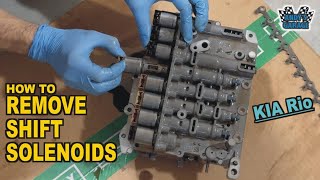
- Inability to shift into higher gears, like 4th gear. 🎬 Watch: Common symptoms of a bad Kia transmission solenoid
- Replacing the entire transmission assembly. The official Kia TSB #TSBTRA051R1 specifically advises against this, stating that only the solenoid(s) need replacement for this code.
- Diagnosing the issue as a 'stepper motor' failure. This is incorrect for the Kia RIO's 6-speed automatic transmission and applies to vehicles with CVTs, such as many Nissan models.
Most Likely Causes
- Failed Damper Clutch Control (DCC) Solenoid 🔴 High Probability This is a known issue acknowledged by Kia via TSB #TSBTRA051R1. The solenoids in the A6GF1 6-speed automatic transmission are a documented weak point across multiple Kia and Hyundai models.
How to confirm: A technician will test the resistance of the specific solenoid at the transmission connector or by accessing the valve body. An open (infinity ohms) or shorted (near zero ohms) reading confirms failure. A Reddit user 🎬 See how to test solenoid resistance with a multimeter with a similar transmission noted the spec for a good TCC solenoid was 3.5 ohms +/- 0.2 ohms, and their failed solenoid read 3.0 ohms. While P1778 points to the DCC solenoid, it is often tested alongside the TCC solenoid.
Typical fix: Replace the faulty solenoid. Many shops and experienced owners recommend replacing the entire set of 8 solenoids and the internal wiring harness at the same time due to the high labor overlap and tendency for other solenoids to fail.
Est. part cost: $80-$150 for a single OEM solenoid, $150-$300 for a complete aftermarket kit. - Low or Dirty Transmission Fluid 🟡 Medium Probability → Shop Transmission Assembly While not a specific prone issue, these sealed transmissions lack a dipstick, making fluid level checks less common for owners and potentially leading to low fluid conditions going unnoticed.
How to confirm: Check the transmission fluid level and condition via the fill/check plug on the side of the transmission case. The fluid should be at the correct level, pink/red in color, and not smell burnt. This check must be done at a specific temperature (typically 122°F-140°F).
Typical fix: Perform a transmission fluid drain and fill, or a full fluid exchange, using the correct Kia SP-IV specification fluid.
Est. part cost: $50-$120 for fluid, as multiple drain-and-fills may be needed to replace a significant portion of the old fluid. - Wiring or Connector Issue ⚪ Low Probability The internal transmission wiring harness is a known failure point that can become brittle from heat and fluid exposure over time.
How to confirm: Visually inspect the transmission's external wiring harness and connectors for damage, corrosion, or loose connections. Perform a continuity test on the wiring from the TCM to the transmission. The internal harness should also be inspected when the pan is removed.
Typical fix: Repair or replace the damaged section of the wiring harness or the connector. The internal harness (OEM part number sometimes cited as 46307-3B650) is often replaced with the solenoids.
Est. part cost: $20-$200 depending on the extent of the damage. - Faulty Transmission Control Module (TCM) ⚪ Low Probability → Shop Transmission Assembly
How to confirm: This is diagnosed last. If the solenoid, wiring, and fluid are all confirmed to be good, the TCM is the next suspect. A technician may use a GDS tool to perform an actuation test; a 'Failure' result on this test points towards a wiring or TCM issue.
Typical fix: Replace and reprogram the Transmission Control Module. TSB TSBTRA051R1 suggests this as a final step if replacing the solenoid and harness does not resolve the issue.
Est. part cost: $400-$800+
Diagnosis Steps
- Scan the vehicle for trouble codes to confirm P1778 and note any other codes present.
- Check the transmission fluid level and condition. This must be done with the vehicle level and the fluid at a specific temperature (122-140°F / 50-60°C). Note the color and smell; burnt fluid indicates a more serious issue.
- Inspect the external transmission wiring harness and connectors for any visible damage, corrosion, or loose pins.
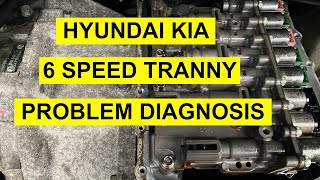
- If external checks are good, drain the transmission fluid and remove the transmission oil pan to access the valve body.
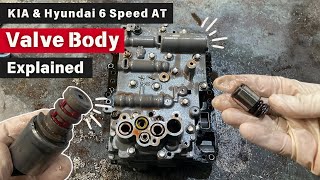
- Identify the suspect solenoid. For P1778, this is the Damper Clutch Control (DCC) solenoid. Refer to a service manual or solenoid diagram for the A6GF1 transmission for exact location. 🎬 Watch: A detailed breakdown of the Kia 6-speed valve body
- Test the solenoid's resistance using a multimeter. A reading of infinity (open) or near-zero (short) confirms failure. Compare the reading to the other solenoids; they should be similar.
- If the solenoid tests good, check the internal wiring harness for continuity and signs of degradation.
- If the solenoid is faulty, replace it. It is highly recommended to replace the entire solenoid pack and internal harness at this stage due to the high labor overlap.
- Reinstall the valve body (if removed), a new transmission pan gasket (or apply RTV sealant for steel pans), and the oil pan.
- Refill the transmission with new, manufacturer-specified fluid (Kia SP-IV). Ensure the correct level is achieved at the proper temperature.
- Clear the trouble codes and perform a test drive, including stop-and-go and highway speeds, to ensure the shifting issues are resolved.
Parts You'll Likely Need
- Transmission Solenoid
(OEM #46313-3B030)— This is the most common failure point for code P1778, as documented in Kia's service bulletin. This part number is a common VFS (Variable Force Solenoid) used for multiple functions in the valve body, including the DCC.
Trusted brands: Kia (OEM), Hyundai (OEM), Rostra, Standard Motor Products
OEM price range: $80-$150
Aftermarket price range: $40-$100 - Internal Transmission Wiring Harness
(OEM #46307-3B650)— This harness is a known secondary failure point that can become brittle. It is highly recommended to replace it when replacing the solenoids.
Trusted brands: Kia (OEM), Hyundai (OEM)
OEM price range: $70-$120
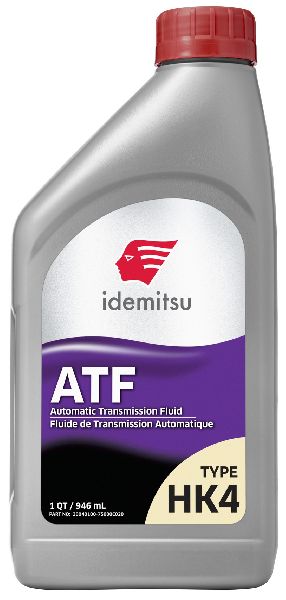
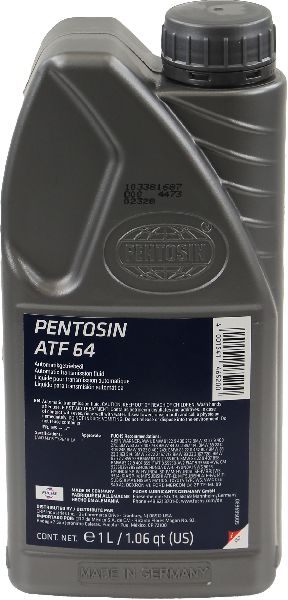
Aftermarket price range: $50-$90 - Automatic Transmission Fluid (SP-IV) — The fluid must be drained to access the solenoids and should be replaced with new, correct-specification fluid during the repair.
Trusted brands: Kia SP-IV (OEM), Idemitsu TLS-LV, Valvoline MaxLife ATF
OEM price range: $15-$25 per quart
Aftermarket price range: $10-$18 per quart
Related Codes That Often Appear With This One
- P0741 — All are related to solenoid circuit faults within the same 6-speed automatic transmission and are listed together in TSB #TSBTRA051R1.
- P0743 — All are related to solenoid circuit faults within the same 6-speed automatic transmission and are listed together in TSB #TSBTRA051R1.
- P0748 — All are related to solenoid circuit faults within the same 6-speed automatic transmission and are listed together in TSB #TSBTRA051R1.
- P0753 — All are related to solenoid circuit faults within the same 6-speed automatic transmission and are listed together in TSB #TSBTRA051R1.
- P0758 — All are related to solenoid circuit faults within the same 6-speed automatic transmission and are listed together in TSB #TSBTRA051R1.
- P0763 — All are related to solenoid circuit faults within the same 6-speed automatic transmission and are listed together in TSB #TSBTRA051R1.
- P0768 — All are related to solenoid circuit faults within the same 6-speed automatic transmission and are listed together in TSB #TSBTRA051R1.
- P0773 — All are related to solenoid circuit faults within the same 6-speed automatic transmission and are listed together in TSB #TSBTRA051R1.
- P2709 — All are related to solenoid circuit faults within the same 6-speed automatic transmission and are listed together in TSB #TSBTRA051R1.
Technical Service Bulletins (TSBs) & Recalls
- TSBTRA051R1 - This is the primary Kia Technical Service Bulletin that addresses P1778 along with a host of other solenoid-related DTCs for the 6-speed automatic transmission. It instructs technicians to replace the solenoids and not the entire transaxle.
Platform-Specific Known Issues
- The 6-speed automatic transmission (model family A6GF1/A6MF1) used in this vehicle is known to have a higher-than-average failure rate for its shift solenoids, which prompted Kia to issue TSB #TSBTRA051R1.
- Because the transmission does not have a dipstick, checking the fluid level is more involved than on older vehicles, requiring the car to be level and the fluid to be at a specific operating temperature.
Mechanic-Grade Diagnostic Values
- Resistance of Variable Force Solenoids (VFS), including DCC, TCC, 3-5-R, 2-6, OD, and UD solenoids. — expected: 5.1 - 5.3 ohms. Failure: A reading of infinity (open circuit), near-zero (short circuit), or a value significantly outside the expected range.
- Resistance of On/Off Shift Solenoids (SSA and SSB). — expected: 10 - 11 ohms. Failure: A reading of infinity (open circuit) or near-zero (short circuit).
- Resistance of the Transmission Control Module (TCM) ground circuit. — expected: Below 1.0 Ω. Failure: A reading higher than 1.0 Ω indicates a poor ground connection, which can cause various erratic electronic faults.
Scan Tool Commands That Help
- Kia GDS (Global Diagnostic System): Guided Troubleshooting Procedures / Full Component Activation — The dealer-level GDS tool can perform actuation tests to command a specific solenoid to turn on or off. This helps verify if the solenoid is mechanically stuck or if the wiring between the TCM and the solenoid is intact, bypassing the TCM's automated control. This is a critical step to isolate the fault between the solenoid, wiring, and TCM.
Wiring & Ground Locations
- TCM Ground Circuit — The Transmission Control Module (TCM) is often integrated with the Engine Control Module (ECM) into a single unit located behind the battery on many Kia models. The ground circuit is the wiring from the TCM's ground pin to the chassis.. A poor ground connection can cause a voltage drop in the TCM's circuits, leading to incorrect readings and false solenoid fault codes. Testing the resistance between the TCM ground pin and the chassis is a key step to rule out a bad ground before condemning the TCM itself.
Real Owner Repair Stories
- Forum report cited by Go-Parts (2011 Hyundai Sonata 2.4L (platform-mate with same transmission family)) — Harsh shifting and a P0741 code (TCC solenoid fault, often seen with P1778).
❌ Tried (didn't work) Not specified; diagnosis went directly to component testing.
✅ What actually fixed it After a resistance test confirmed the TCC solenoid was open, the owner replaced the entire block of 8 solenoids and the internal wiring harness. This resolved all shifting issues, with the owner reporting the transmission shifted 'like new' afterward.
OEM Part Supersession History
46313-3B020→46313-3B030— Standard part revision, likely for improved durability or manufacturing process.
Model Year Variations Within This Range
- 2012-2015: The A6GF1 transmission in this year range uses an 8-solenoid valve body. Be aware that later models (approx. 2016 and newer) may use a revised A6GF1-2 version with a 7-solenoid valve body, so it is crucial to order parts specific to the 2012-2015 model years.
Helpful Videos


We Have This Part in Stock




The information in this article is provided for general reference and educational purposes only. Vehicle specifications, procedures, and part compatibility can vary by production date, trim level, and region. Always consult your vehicle's factory service manual and verify part numbers before purchasing or performing repairs. Safety-critical components such as airbags, seat belts, and braking systems should be installed by a qualified professional.
- Kia RIO:
- 🧭 Diagnostic Flowchart
- 🎬 Helpful Videos
- 🛍️ Shop This Part
- What's Unique About the 2012-2015 Kia RIO
- Symptoms You May Notice
- Most Likely Causes
- Diagnosis Steps
- Parts You'll Likely Need
- Related Codes That Often Appear With This One
- Technical Service Bulletins (TSBs) & Recalls
- Platform-Specific Known Issues
- Mechanic-Grade Diagnostic Values
- Scan Tool Commands That Help
- Wiring & Ground Locations
- Real Owner Repair Stories
- OEM Part Supersession History
- Model Year Variations Within This Range
- 🎟️ Get 5% Off