

OBD-II Code P1855: A Manufacturer-Specific Fault with Diverse Meanings
The Ultimate Guide to Diagnosing and Fixing P1855 on GM, Ford, VW, Honda, and More
- Verify the exact P1855 definition for your vehicle brand, as it means a transfer case sensor fault on GM/Ford but a critical Transmission Control Module (TCM) failure on VW/Audi.
- On 1999-2007 GM trucks, inspect and clean the main frame ground (G103) and under-battery ground before replacing the $200 transfer case shift motor.
- For VW and Audi models with a CVT transmission, test the CAN bus resistance at the TCM; a reading outside the 58-62 ohm range confirms the module requires a $400+ replacement.
- Do not replace the dashboard 4WD selector switch to fix a P1855 code; blinking switch lights indicate a sensor or module fault, not a broken button.
What Does P1855 Mean?
P1855 is a manufacturer-specific code with different definitions depending on the brand. For common vehicles like Chevrolet and GMC, it means the 4WD control module detects a short circuit or faulty signal from the transfer case position sensor. This sensor tells the computer which gear the transfer case is in (2WD, 4WD High, or 4WD Low).
Technical definition: The official definition varies significantly by manufacturer. General Motors (GM) defines it as "Transfer Case Contact Plate 'B' Circuit Short to Ground." Ford defines it as "Transmission Transfer Case Contact Plate 'C' Open Circuit." Volkswagen/Audi uses it for "Data Bus Powertrain Missing Message from Transmission Control Module (TCM)." Honda points to an "Inclination Sensor Circuit Range/Performance" issue. Mitsubishi defines it as "Shift Fork 3 or 4 opposite direction movement." Always verify the code's exact meaning for your specific vehicle.
Can I Drive With P1855?
Yes, But With Caution. You can drive GM and Ford vehicles with a P1855 code, but the 4WD/AWD system is disabled, creating a safety risk in slippery conditions. Continued driving rarely causes immediate mechanical damage. However, for VW/Audi models, this code signals an impending Transmission Control Module (TCM) failure that causes sudden limp mode or a no-shift condition. Diagnose and repair the issue promptly to ensure safety.
Common Causes
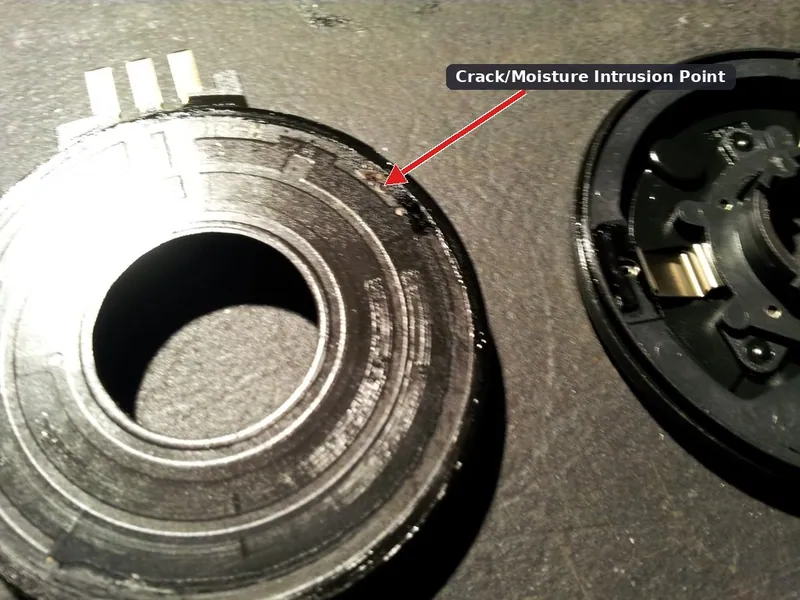
- Failed or Cracked Transfer Case Position Sensor (Encoder Ring) (Very Common) — The encoder ring (contact plate) is the most frequent failure point on GM and Ford trucks. 🎬 Watch: Ford F-150 transfer case motor diagnostics and replacement. Mounted on the transfer case shift motor, its plastic housing cracks, allowing moisture to short the internal contacts and send a bad signal to the control module.
- Internal Transmission Control Module (TCM) Failure (VW/Audi) (Very Common) — On VW and Audi models with CVT transmissions, P1855 is almost exclusively caused by internal circuit board corrosion within the Transmission Control Module (TCM), not an external sensor.
- Corroded or Damaged Wiring/Connectors (Very Common) — Exposed under-vehicle wiring harnesses and connectors suffer from water, road salt, and dirt intrusion. This causes corrosion, short circuits, or broken wires that interrupt the sensor signal.
- Faulty Transfer Case Shift Motor (Common) — The position sensor integrates into the transfer case shift motor assembly. Internal motor wear or electrical shorts trigger faults in the sensor's circuit.
- Poor Ground Connection at the TCCM or Frame (Less Common) — A corroded or loose ground wire at the Transfer Case Control Module (TCCM) or the main frame ground point causes erratic voltage and triggers this code. This is a notorious issue on GMT800 trucks. 🎬 See how to clean chassis grounds to fix 4WD errors.
- Defective Transfer Case Control Module (TCCM) (Less Common) — The TCCM acts as the computer brain for the 4WD system. The module fails internally, causing it to misinterpret sensor signals or set false codes.
Symptoms

- Service 4WD Light On — The most common indicator on GM and Ford vehicles. A dashboard message prompts you to service the four-wheel drive system.
- Unable to Shift Into or Out of 4WD — The system ignores inputs from the 2WD/4WD selector switch. The vehicle remains stuck in its current mode.
- Flashing PRNDS Indicator / Limp Mode (VW/Audi) — On VW/Audi models, the gear selector lights flash, and the transmission locks into a single gear (limp mode) to prevent damage.
- 4WD Selector Switch Lights Inoperative or Blinking — The lights on the 4WD switch fail to illuminate, or the current mode light blinks. This is a symptom of a module/sensor fault, not a broken switch.
- ABS Light On — On GM trucks, P1855 appears alongside an ABS warning light when a corroded main ground wire affects both the TCCM and the ABS module.
Diagnostic Flowchart
Tap your situation to follow the diagnostic path that matches what you're seeing on this code.
Common Fixes & Costs
- Replace the Transfer Case Shift Motor Assembly — Parts: $150-$280, Labor: $150-$250, ~1.2 hr book time (Intermediate)
- Replace the Transfer Case Position Sensor (Encoder Ring) — Parts: $60-$150, Labor: $100-$200, ~1.5 hr book time (Intermediate)
- Replace Transmission Control Module (TCM/Mechatronic Unit) - VW/Audi — Parts: $250-$600, Labor: $200-$500, ~3.5 hr book time (Advanced)
- Repair Damaged Wiring or Clean Connectors/Grounds — Parts: $10-$50, Labor: $100-$300, ~1.8 hr book time (Intermediate)
- Replace the Transfer Case Control Module (TCCM) — Parts: $150-$350, Labor: $50-$100, ~0.5 hr book time (DIY)
Used vs. New Parts: Buying Guide
When a used part is worth it: For GM/Ford, a used transfer case position sensor or shift motor from a low-mileage, non-corroded donor vehicle is cost-effective. For VW/Audi, a used TCM is a major risk; buy a professionally remanufactured unit with a warranty.
Donor-vehicle mileage cap: roughly under 75000 miles for the part to have meaningful remaining life.
Donor quality checklist:
- Verify the exact OEM part number matches your original part.
- Avoid under-vehicle parts from rust-belt states.
- Choose remanufactured modules from reputable suppliers offering warranties and pre-programming.
Decision logic:
- If The part is a simple sensor (encoder ring) and budget is the top priority → A used OEM part is acceptable, but new aftermarket is often inexpensive enough to be the better choice.
- If The part is a complex electronic module (TCCM, VW TCM) → Favor a new OEM part or a high-quality remanufactured unit with a warranty.
- If The vehicle is older (>15 years) and the repair is for a GM/Ford → Used parts (sensor, motor, TCCM) are a reasonable choice to keep repair costs down.
Warranty tradeoff: Used salvage parts offer 30-90 day warranties. New aftermarket parts offer 1-year to lifetime warranties. Remanufactured modules usually include a 1-year warranty.
Worst-case if a used part fails: $300-$600 if a used part fails after the warranty period, requiring repeat labor and replacement part costs.
What Happens If You Wait — Timeline
- 0-1 month: For GM/Ford, the 'Service 4WD' light appears and 4WD is disabled. For VW/Audi, PRNDS lights flash, and the car enters limp mode intermittently. (MPG impact: 0%% · Added cost: $0)
- 1-6 months: On GM/Ford, the fault becomes permanent. A wiring short puts a continuous drain on the battery. On VW/Audi, limp mode events become frequent and predictable. (MPG impact: 0-2% (due to potential engine drag from limp mode)% · Added cost: $0-$50 in wasted diagnostic time.)
- 6-12 months: An internal short in the GM/Ford shift motor overheats and damages the TCCM. Corrosion spreads into the copper wiring. For VW/Audi, the TCM fails completely, locking the vehicle in park or limp mode. (MPG impact: 5-10% (if stuck in limp mode)% · Added cost: $150-$350 (for a damaged TCCM on a GM) or $400-$1200 (for TCM replacement on a VW/Audi).)
- 12+ months: Corrosion spreads to other circuits sharing the same harness or ground point. The vehicle is rendered undrivable (VW/Audi) or permanently without 4WD (GM/Ford). (MPG impact: N/A (vehicle likely undrivable)% · Added cost: $500-$2000+ (for complex harness repair and multiple module replacements).)
Cost of Not Fixing It
- 0-6 months: For GM/Ford, you lose 4WD/AWD capability, creating a safety risk in adverse weather. For VW/Audi, ignoring the code causes sudden shifts into neutral or limp mode. (Added cost: Negligible)
- 6-12 months: On GM/Ford, an internal short in the shift motor drains the battery or damages the TCCM. The transfer case may become stuck in an undesirable mode. (Added cost: $150-$350 (if TCCM is damaged))
- 12+ months: Corrosion spreads to nearby connectors or modules, complicating repairs. On VW/Audi models, complete TCM failure renders the vehicle undrivable. (Added cost: $500-$1500+ (for complex wiring repair or complete TCM failure))
Diagnosis Steps

- Read All Trouble Codes and Check TSBs
Use a professional OBD-II scanner to access the ECU, TCCM, BCM, and ABS modules. Confirm P1855 is active. Codes like C0327 (sensor circuit) or U1000 (communication loss) provide critical clues. Check for manufacturer Technical Service Bulletins (TSBs) related to your specific vehicle.
Tools: Professional OBD-II Scanner, Internet Access (Beginner) - Inspect the Wiring and Connectors
Visually inspect the wiring harness routing to the transfer case shift motor and position sensor. Look for corrosion on connector pins, melted wires, or loose connections, especially where the harness clips to the frame.
Tools: Flashlight, Safety Glasses (Beginner) - PRO TIP: Inspect Critical Ground Locations (GM)
Before replacing modules on GMT800 trucks, locate the main TCCM ground (on the frame rail near the module) and the primary ground under the driver's side battery tray. Remove the bolts, clean contact surfaces to bare metal, and re-secure tightly.
Tools: Socket Set, Wire Brush, Dielectric Grease (Intermediate) - Monitor Live Sensor Data (GM/Ford)
Use a scanner's live data function to monitor the transfer case position sensor output. Press the 4WD selector switch and watch the PID value. The value must change distinctly for each position (2HI, 4HI, 4LO). A stuck or erratic value confirms a faulty sensor or wiring.
Tools: Professional OBD-II Scanner (Intermediate) - PRO TIP: Test CAN Bus Resistance at the TCM (VW/Audi)
For VW/Audi CVT models, disconnect the battery and unplug the large connector at the TCM. Measure resistance between the CAN High and CAN Low pins (typically pins 12 and 13). A healthy reading is 58-62 ohms. Readings near 120 ohms or 0 ohms indicate a broken wire, short circuit, or internal TCM failure.
Tools: Multimeter, Vehicle Service Manual/Wiring Diagram (Advanced) - Test the Position Sensor Circuit (GM/Ford)
Back-probe the connector at the position sensor. Verify the 5V reference voltage and a solid ground. Test the specific signal wire (e.g., 'Contact Plate B' for GM) for a short to ground or an open circuit.
Tools: Multimeter, Vehicle Service Manual/Wiring Diagram (Advanced) - Test Shift Motor for Internal Short (GM/Ford)
Disconnect the shift motor electrical connector. Measure resistance between the motor's power/ground pin and the bare metal case of the transfer case. The reading must be infinite (Open Line). Any continuity indicates an internal short to ground, requiring motor replacement.
Tools: Multimeter, Vehicle Service Manual/Wiring Diagram (Advanced) - Test the Transfer Case Control Module (TCCM)
If the sensor, wiring, and grounds test good, check for proper power and ground at the TCCM connector. If power and ground are present but the module fails to communicate or control the system, replace the TCCM.
Tools: Multimeter, Vehicle Service Manual/Wiring Diagram (Advanced) - Test Inclination Sensor Voltage Fluctuation (Honda)
For Honda models, use an HDS scanner to monitor inclination sensor output voltage. Elevate the front of the vehicle by more than 11.8 inches (300mm). If the voltage fluctuation is less than 0.03 volts, the sensor (integrated into the VSA modulator) has failed.
Tools: Honda Diagnostic System (HDS), Jack and Jack Stands (Advanced)
When This Code Triggers (Freeze-Frame Conditions)
- Engine Coolant Temp: 180-200°F (82-93°C) (The fault logs when the engine is fully warmed up and running.)
- Engine RPM: 1200-2500 RPM (Appears during steady-state driving or light acceleration, rarely under heavy load.)
- Vehicle Speed: 0-55 mph (0-89 km/h) (Sets under a wide range of speeds as the control module continuously monitors the circuit.)
- System Voltage: 13.5-14.5 V (Sets reliably when the charging system operates normally.)
Related Codes
- C0327 — Translates to 'Transfer Case Encoder/Position Sensor Circuit.' If present with P1855, the problem is almost certainly the encoder sensor or its wiring.
- U1000 — Indicates a loss of communication on the data bus. If present with P1855, it strongly suggests the TCCM is faulty, has lost power/ground, or there is a major wiring issue.
- P0700 — A generic code stating the TCM requested the check engine light be turned on. You must scan the TCCM/TCM to find the underlying code, such as P1855.
- P0606 — Means 'Control Module Processor Performance.' If seen with P1855, the control module (likely the TCCM) has an internal processing failure and requires replacement.
Climate & Environmental Factors
- Road Salt / High Humidity: Accelerates corrosion of under-vehicle wiring harnesses, connectors, and ground points on GM/Ford vehicles. On VW/Audi models, moisture enters poorly sealed connectors and corrodes the internal TCM circuit board.
- Cold Weather: Temperatures below 30°F (-1°C) congeal grease in the front axle actuator on GM trucks, slowing engagement. Cold also makes plastic sensor housings brittle and prone to cracking.
How to Talk to a Mechanic About This Code
Say this: "I have a P1855 code and a 'Service 4WD' light on my [GM/Ford vehicle]. I need a diagnostic that tests the transfer case position sensor circuit, the wiring harness, and the TCCM grounds before replacing parts. For a [VW/Audi vehicle]: I have a P1855 code and flashing PRNDS lights. I need to diagnose a communication failure with the Transmission Control Module, including a CAN bus resistance check."
This directs the technician to perform a logical diagnostic sequence instead of replacing the most expensive part. It proves you understand common failure points (wiring/grounds for GM, TCM for VW) and prevents unnecessary parts replacement.
Avoid saying:
- My 4WD isn't working, just fix it.
- My check engine light is on, can you look at it?
- I think I need a new transfer case module.
Questions to ask before authorizing the repair:
- For GM/Ford: Did you test the sensor signal, reference voltage, and ground at the sensor connector?
- For GM/Ford: Did you inspect the main TCCM ground on the frame and under the battery?
- For VW/Audi: What was the resistance reading between the CAN high and CAN low pins at the TCM?
- Can you provide a written estimate breaking down parts and labor?
- What is the warranty on the recommended parts and labor?
Where to Take It: Dealer vs Independent vs Chain
- Dealer:
Recommended for VW/Audi TCM issues if you prefer a new OEM part with a full warranty. Not cost-effective for out-of-warranty GM/Ford vehicles.
Best for: Vehicles under powertrain warranty., Complex VW/Audi TCM replacements requiring online programming., When you require an OEM part guarantee.
Downsides: Highest labor rates., Defaults to replacing entire assemblies rather than individual sensors. (Typical cost: +50% vs. baseline) - Independent Shop:
Best overall fit. Experienced independent mechanics fix this common GM/Ford issue frequently and offer cost-effective repair options like wiring repair.
Best for: Out-of-warranty GM and Ford trucks., Diagnosing common wiring, ground, and sensor issues., VW/Audi owners using a remanufactured TCM.
Downsides: Diagnostic capabilities vary. Require ASE-certified technicians with electrical repair experience. (Typical cost: +0% vs. baseline) - Chain Shop:
AVOID. This code requires specific diagnostic procedures (testing circuits, grounds, modules) beyond the scope of most chain shops.
Best for: Simple maintenance like oil changes or tires.
Downsides: Technicians lack specialized diagnostic training for complex electrical codes., High risk of misdiagnosis and unnecessary part replacements. (Typical cost: -10% vs. baseline)
When to Walk Away From the Repair
If the estimated repair cost exceeds 40-50% of the car's private-party value, seriously consider selling the vehicle as-is.
- Car worth $8000, fix is $450: Fix it. This is a common repair on a GM truck and the cost is well below the threshold.
- Car worth $3500, fix is $1800: Walk away. The repair cost for a new TCM on an older Audi A4 exceeds 50% of the car's value.
- Car worth $4000, fix is $600: Fix it. A remanufactured TCM for a VW/Audi makes this repair economically viable.
What Scan Tool You Need for This Code
Minimum: A scanner that reads manufacturer-specific codes and live data from the Transfer Case Control Module (TCCM) or Transmission Control Module (TCM).
A basic $20 code reader only shows generic powertrain codes and cannot access the TCCM, TCM, or ABS modules. You cannot view live position sensor data or check communication status, leading to expensive guesswork.
Budget: BlueDriver Pro Scan Tool (~$100) — Reads manufacturer-specific codes from the TCCM/TCM and displays live data streams for the transfer case position sensor.
Mid-range: Foxwell NT510 Elite (~$180) — Provides OE-level diagnostics for specific brands. Accesses the TCCM, reads live data, performs active tests, and communicates directly with VW/Audi TCMs.
Professional: Autel MaxiCOM MK808BT Pro (~$550) — Offers full bidirectional control to command the transfer case shift motor and verify operation. Accesses all vehicle modules for professional-level troubleshooting.
Rent vs buy: AutoZone's 'Loan-A-Tool' program allows you to borrow a quality OBD-II scanner for free with a refundable deposit. Rent for a one-time repair; buy if you perform regular diagnostics.
How to Clear the Code After You Fix It
- Reconnect the battery if disconnected.
- Use an OBD-II scan tool to clear all DTCs from the ECU, TCM, and TCCM.
- Perform the GM Transfer Case Relearn Procedure if a new motor or TCCM was installed.
- Complete a full drive cycle to run all readiness monitors.
Drive cycle (~20 minutes): Start the engine and idle for 2-3 minutes. Drive in mixed city/highway conditions. On GM trucks, cycle the 4WD switch through all positions (2HI, 4HI, 4LO, Auto) following the owner's manual procedure. Allow the vehicle to cool down completely.
Readiness monitors affected: Comprehensive Component Monitor, CAN Bus Communication
Before emissions retest: drive at least 50 miles to fully set monitors.
Watch out for:
- Clearing the code without fixing the hardware fault causes the code to return immediately.
- Skipping the transfer case motor relearn procedure prevents the system from working and sets new codes.
- Testing emissions immediately after clearing codes results in a 'Not Ready' failure.
Will This Fail Emissions / State Inspection?
Yes — this code typically fails an OBD-II emissions inspection.
- California: An illuminated Check Engine Light results in an automatic failure. A drive cycle of 50-100 miles is required to set readiness monitors after repairs.
- New York: A vehicle automatically fails if the Check Engine Light is on. Clearing codes just before the test results in a 'Not Ready' failure.
- Texas: In emissions-testing counties, an active P1855 code with the Check Engine Light on is an automatic failure. Only one 'Not Ready' monitor is allowed.
Most Commonly Affected Vehicles
- Chevrolet / GMC Silverado / Sierra 1500/2500/3500 (1999-2007) — Extremely common issue on the GMT800 platform. Known for ground wire issues under the battery tray and failing transfer case encoder motors.
- Chevrolet / GMC / Cadillac Tahoe, Suburban, Yukon, Escalade (2000-2006) — These SUVs use the same transfer case, control system, and wiring as the trucks, making them equally prone to P1855.
- Volkswagen / Audi A4, A6, Passat with CVT (2001-2006) — P1855 indicates a critical internal failure of the Transmission Control Module (TCM), not a sensor. The TCM fails due to internal corrosion.
- Ford Explorer, F-150, Expedition (1997-2008) — P1855 refers to 'Transmission Transfer Case Contact Plate C Open Circuit', pointing to the transfer case position sensor circuit.
- Honda Fit, Civic (2015-2021) — P1855 points to a fault in the 'Inclination Sensor Circuit,' part of the Vehicle Stability Assist (VSA) system, not the 4WD system.
Manufacturer-Specific Notes

- General Motors (Chevy/GMC): Almost always points to a fault in the transfer case position sensor circuit. Bad grounds and faulty instrument clusters are common related issues.
- Ford: Means 'Transmission Transfer Case Contact Plate C Open Circuit,' pointing to a specific circuit within the position sensor system.
- Volkswagen / Audi: Indicates a 'Data Bus Powertrain Missing Message from Transmission Control Module (TCM),' a communication problem requiring TCM repair or replacement.
- Honda: Refers to an 'Inclination Sensor Circuit Range/Performance' issue related to the Vehicle Stability Assist (VSA) system, not the transmission.
- Suzuki: Indicates a 'Driver-Side Side Air Bag Module Circuit Short To Power Supply,' a critical safety system fault unrelated to the powertrain.
- Mitsubishi: Defined as 'Shift Fork 3 or 4 opposite direction movement,' indicating an internal transmission mechanical or control fault.
Real Owner Stories
2005 GMC Sierra 1500 at 175K miles - The Classic GM Fix
Service 4WD light came on, 4WD switch lights were out, and the truck would not shift out of 2HI.
What they tried:
- Replaced the 4WD selector switch in the dash with no change.
- Scanned codes and found P1855 and C0327.
- Inspected wiring under the truck and found the connector to the transfer case encoder motor green with corrosion.
Outcome: Replaced the transfer case encoder motor assembly (Dorman 600-901), which included a new sensor. Cleaned the harness-side connector pins and applied dielectric grease. Cleared codes, and 4WD function was restored.
Lesson: Do not replace the dash switch first. The combination of P1855 and C0327 on a GM truck strongly points to the encoder motor/sensor or its wiring. Always inspect the under-vehicle connector for corrosion before ordering parts.
2004 Audi A4 1.8T CVT at 126K miles - The Inevitable TCM Failure
Car went into limp mode (PRNDS lights flashing on dash), started normally, but refused to shift out of Park once warm.
What they tried:
- Shop scanned and found P1855 - 'Data Bus Powertrain Missing Message from TCM'.
- Replaced the battery based on a mechanic's suggestion, which had no effect.
- A specialist confirmed TCM failure is extremely common on the 01J CVT due to internal corrosion.
Outcome: Purchased a remanufactured TCM (part # 01J927156JG) from an online specialist for $400. An independent shop installed the pre-programmed unit, resolving all symptoms immediately.
Lesson: On a VW/Audi with a CVT transmission, P1855 is an internal failure of the Transmission Control Module. Do not waste money on external diagnostics; repair or replace the TCM.
2006 Chevy Silverado 2500HD - The Bad Ground Wild Goose Chase
Intermittent 'Service 4WD' light for months. The ABS light occasionally illuminated at the same time.
What they tried:
- Replaced the transfer case position sensor; the code returned a week later.
- Replaced the TCCM; the code returned the next day.
- Researched the notorious GMT800 ground issue.
Outcome: Located the main ground block on the frame under the driver's side door (G103). Removed the corroded 10mm bolt, wire-brushed the frame and wire terminals to bare metal, applied dielectric grease, and reassembled. This permanently fixed both the P1855 and the intermittent ABS light.
Lesson: On GM trucks, intermittent electrical issues affecting multiple systems are frequently caused by a bad ground. Always clean the main frame and battery grounds before replacing expensive modules.
How to Prevent This Code From Triggering
- Clean Key Chassis Grounds Annually (Once per year, especially before winter) — On GM trucks, corroded grounds cause P1855. Removing the 10mm bolts, cleaning contact surfaces to bare metal, and reapplying dielectric grease prevents voltage drops.
- Apply Dielectric Grease to Connectors (Anytime a relevant connector is disconnected) — Applying dielectric grease to the weather-pack seal of the transfer case sensor connector prevents moisture and road salt from corroding the pins.
- Regularly Inspect Under-Vehicle Wiring (During every oil change) — Visual inspection of the transfer case harness spots physical damage from road debris or exhaust melting before a wire breaks.
- Change Transfer Case Fluid (Every 30,000 - 50,000 miles) — Old fluid leads to transfer case overheating and mechanical stress, causing internal parts to bind and damage the shift motor housing the sensor.
- Avoid High-Pressure Washing of Undercarriage Connectors (During every wash) — Directly spraying high-pressure water at electrical connectors forces water past seals, leading to corrosion and faults.
Frequently Asked Questions
Can I fix a P1855 code myself?
If the cause is a bad transfer case position sensor or a damaged connector on a GM vehicle, it is a manageable DIY repair for someone with intermediate mechanical skills. However, diagnosing the exact cause requires electrical testing. On other makes like VW or Honda, it involves completely different and more complex systems.
What is a transfer case contact plate?
It is another name for the transfer case position sensor. It features electrical contacts that tell the vehicle's computer which gear the transfer case is in. The P1855 code refers to a specific contact, labeled 'B' in GM vehicles or 'C' in Ford vehicles.
Will clearing the code fix the problem?
No. Clearing the code only turns the light off temporarily. Because P1855 is caused by a hard fault like a bad sensor, broken wire, or failed module, the code returns immediately during the computer's next self-test.
Is the transfer case position sensor the same as the shift motor?
They are two separate parts, but manufacturers often sell them together as a single assembly. The sensor (encoder ring) mounts directly onto the shift motor.
Can a bad ground cause a P1855 code on my Chevy/GMC truck?
Absolutely. GM trucks from 1999-2007 have notoriously poor ground locations prone to heavy corrosion. A bad ground creates electrical noise and voltage drops that cause the TCCM to set a P1855 code, even with a perfect sensor.
What are common misdiagnosis mistakes for P1855?
A frequent mistake is replacing the dashboard 4WD selector switch when its lights blink; this is almost never the root cause. Another pitfall is replacing the expensive Transfer Case Control Module (TCCM) before testing the encoder sensor and wiring. On a VW/Audi, replacing any 4WD parts is a misdiagnosis, as the code points strictly to the TCM.
I replaced the sensor but the P1855 code came back. Now what?
If a new sensor fails to fix the issue, the problem lies elsewhere in the circuit. Inspect the wiring harness between the sensor and the TCCM for breaks or corrosion, then clean all related ground wires. In rare cases, the replacement sensor is faulty or the TCCM itself has failed.
Key Takeaways
- Verify the exact P1855 definition for your vehicle brand, as it means a transfer case sensor fault on GM/Ford but a critical Transmission Control Module (TCM) failure on VW/Audi.
- On 1999-2007 GM trucks, inspect and clean the main frame ground (G103) and under-battery ground before replacing the $200 transfer case shift motor.
- For VW and Audi models with a CVT transmission, test the CAN bus resistance at the TCM; a reading outside the 58-62 ohm range confirms the module requires a $400+ replacement.
- Do not replace the dashboard 4WD selector switch to fix a P1855 code; blinking switch lights indicate a sensor or module fault, not a broken button.
Helpful Videos
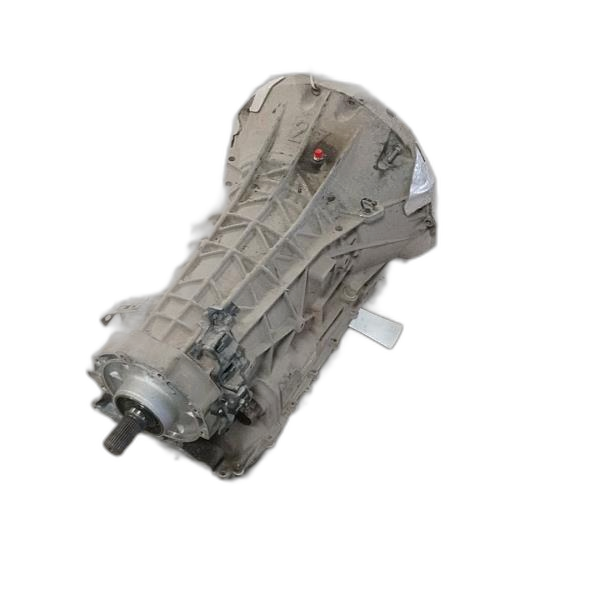
Shop the Parts Behind P1855
Below are the parts most often responsible for code P1855, ranked by how frequently each one is the actual culprit (per the diagnosis above). Tap any to see what we have for your vehicle.


The information in this article is provided for general reference and educational purposes only. Vehicle specifications, procedures, and part compatibility can vary by production date, trim level, and region. Always consult your vehicle's factory service manual and verify part numbers before purchasing or performing repairs. Safety-critical components such as airbags, seat belts, and braking systems should be installed by a qualified professional.
- 🧭 Diagnostic Flowchart
- 🎬 Helpful Videos
- 🛍️ Shop This Part
- What Does P1855 Mean?
- Can I Drive With P1855?
- Common Causes
- Symptoms
- Common Fixes & Costs
- Used vs. New Parts: Buying Guide
- What Happens If You Wait — Timeline
- Cost of Not Fixing It
- Diagnosis Steps
- When This Code Triggers (Freeze-Frame Conditions)
- Related Codes
- Climate & Environmental Factors
- How to Talk to a Mechanic About This Code
- Where to Take It: Dealer vs Independent vs Chain
- When to Walk Away From the Repair
- What Scan Tool You Need for This Code
- How to Clear the Code After You Fix It
- Will This Fail Emissions / State Inspection?
- Most Commonly Affected Vehicles
- Manufacturer-Specific Notes
- Real Owner Stories
- 2005 GMC Sierra 1500 at 175K miles - The Classic GM Fix
- 2004 Audi A4 1.8T CVT at 126K miles - The Inevitable TCM Failure
- 2006 Chevy Silverado 2500HD - The Bad Ground Wild Goose Chase
- How to Prevent This Code From Triggering
- Frequently Asked Questions
- Can I fix a P1855 code myself?
- What is a transfer case contact plate?
- Will clearing the code fix the problem?
- Is the transfer case position sensor the same as the shift motor?
- Can a bad ground cause a P1855 code on my Chevy/GMC truck?
- What are common misdiagnosis mistakes for P1855?
- I replaced the sensor but the P1855 code came back. Now what?
- Key Takeaways
- 🎟️ Get 5% Off