

P1890 on 2015-2016 Honda Accord: CVT Speed Control System Failure Guide
On a 2015-2016 Honda Accord, code P1890 indicates a serious problem with the Continuously Variable Transmission (CVT), usually caused by a known software issue. The primary symptom is an RPM surge at highway speeds. The fix is either a simple software update if caught early or a complete, and very expensive, transmission replacement if the unit is already damaged.
- P1890 on a 2015-2016 Accord is a critical code pointing to a known CVT transmission issue, also affecting 2015-2016 CR-Vs.
- The key symptom to watch for is an engine RPM surge at highway speeds without a corresponding increase in vehicle speed, sometimes accompanied by a screeching noise.
- This is not a DIY fix. It requires a Honda dealer or specialized shop with proprietary software.
- If you experience the symptoms but have no check engine light, a software update may prevent a catastrophic failure. Get it checked immediately.
- If the Check Engine Light is on with code P1890, expect to replace the entire transmission, a very costly repair.
What's Unique About the 2015-2016 Honda ACCORD

This issue is very specific to 2015-2016 Accords (and some CR-Vs) with the CVT. Honda identified that an "incorrect learning value in the PCM" could cause low hydraulic pressure within the transmission. This pressure issue is what allows the CVT's steel belt to slip, especially at highway speeds. Honda acknowledged this with a product update campaign and Technical Service Bulletin (TSB) 16-053, which provides a clear diagnostic path to either update the software or replace the entire transmission. The campaign was announced on August 3, 2016, and owners of affected vehicles were sent notification letters.
Diagnostic Flowchart

Tap your situation to follow the diagnostic path that matches what you're seeing on this vehicle.
Symptoms You May Notice

- Sudden surge in engine RPM without an increase in speed, especially at highway speeds.
- A screeching or whining noise from the transmission, similar to a wet fan belt, during the RPM surge.
- Check Engine Light (Malfunction Indicator Lamp) is on.
- Blinking gear position indicator (e.g., 'D' light).
- Vehicle hesitates, shudders, or fails to accelerate properly.
- In some cases, multiple warning lights may appear simultaneously, such as power steering and traction control lights.
- Complete loss of movement.
- Replacing transmission fluid without addressing the root cause. While old fluid can cause issues, in this specific case, the problem is a design and software flaw that a fluid change alone will not fix. The correct fluid (Honda HCF-2) is critical, but not the root cause.
- Replacing individual transmission sensors or solenoids. The TSBs from Honda are very clear that the issue is either software or a complete mechanical failure, not typically an individual sensor.
- Installing a used transmission without updating the PCM software. As one owner on driveaccord.net found, a secondhand transmission may already be damaged or will quickly fail if the PCM software is not updated, leading to a repeat of the P1890 code and failure.
Most Likely Causes

- Faulty Powertrain Control Module (PCM) Software 🔴 High Probability → Shop Engine Control Module (ECM) Honda issued a product update (TSB 16-053) specifically to address an "incorrect learning value in the PCM" that causes low hydraulic pressure in the CVT, leading to belt slip.
How to confirm: A Honda dealer or a shop with a J2534 pass-thru device and Honda's i-HDS software can check the current software version and determine if the update is needed. The TSB directs this as the first step if code P1890 is NOT currently set.
Typical fix: Update the PGM-FI (Programmed Fuel Injection) software to the latest version. This was often done free of charge under the product update campaign.
Est. part cost: $0 - Internal CVT Failure (Slipping Belt / Damaged Pulleys) 🔴 High Probability This is the direct mechanical consequence of the PCM software issue. Prolonged belt slippage due to low hydraulic pressure physically damages the belt and pulley surfaces, requiring replacement.
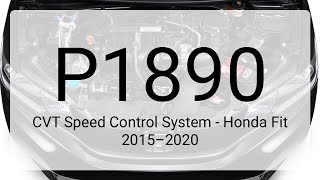
How to confirm: The primary diagnostic indicator, according to Honda's TSB, is the presence of a stored DTC P1890. 🎬 Watch: Understanding the P1890 code and CVT speed control system. If the code is set, the transmission is considered internally damaged and must be replaced.
Typical fix: Replace the entire CVT assembly, followed by a mandatory PGM-FI software update to prevent the new transmission from suffering the same fate.
Est. part cost: $3000-$8000
Diagnosis Steps
- Scan the vehicle for Diagnostic Trouble Codes (DTCs) using a Honda-compatible scan tool (i-HDS).
- Confirm if DTC P1890 is actively stored in the PCM.
- Check the vehicle's VIN against Honda's database to see if it is eligible for the product update campaign detailed in TSB 16-053.
- Follow the TSB's diagnostic flow chart precisely:
- - IF DTC P1890 IS NOT SET (but symptoms like RPM surging are reported): Update the PGM-FI software. Do not replace the transmission.
- - IF DTC P1890 IS SET: The transmission is considered internally damaged. Replace the entire CVT assembly.
- After replacing the CVT, it is mandatory to update the PGM-FI software to the latest version to prevent a repeat failure.
- Ensure the transmission is filled with the correct fluid, Honda Genuine HCF-2, to the proper level.
- After repair, clear all DTCs and perform a thorough test drive, including at highway speeds, to confirm the RPM surging is resolved.
Parts You'll Likely Need
- Continuously Variable Transmission (CVT) Assembly
(OEM #20021-5A2-A10 (Note: Part numbers can be superseded; always verify with VIN))— This is the required fix if code P1890 is stored, as it indicates irreversible internal damage from the belt slipping.
Trusted brands: Honda (OEM New or Remanufactured)
OEM price range: $4000-$8000
Aftermarket price range: $2500-$4500 (Remanufactured or Used)
Technical Service Bulletins (TSBs) & Recalls
- A16053 / 16-053: Product Update: 2015-16 Accord and 2015-16 CR-V DTC P1890. Details the cause (incorrect PCM learning value) and the two-path repair (software update or transmission replacement). This TSB was updated on Sept 9, 2016 (Version 2).
- 16-057: A related TSB for certain 2015 CR-V vehicles that had a previous, unrelated software update and required a special procedure to accept the P1890 fix.
- PUD - 2015-16 AC: Explains that belt slip leads to RPM surge and, if it continues, damages the transmission and sets P1890.
- ACA08032016902: Announcement of the product update for 2015-16 Accords to address incorrect CVT operation and DTC P1890.
Platform-Specific Known Issues
- Honda initiated a product update campaign (announced August 3, 2016) for 2015-16 Accord and CR-V models to fix this specific problem. The campaign addressed a software flaw in the PCM that could cause a pressure drop in the CVT, leading to belt slippage, RPM surging at highway speeds, and the eventual setting of code P1890. The official repair procedure depends entirely on whether the P1890 code has already been triggered, which dictates a software update versus a full transmission replacement. For California owners, completion of this update was required for DMV registration renewal.
Mechanic-Grade Diagnostic Values
- Difference between target drive pulley speed and actual drive pulley speed — expected: < 500 RPM. Failure: A difference of 500 RPM or more for at least 18 seconds.
- Transmission Stall Speed Test (in D, S, L, and R positions) — expected: 2,000-3,500 RPM. Failure: Over 3,500 RPM may indicate internal CVT failure. Below 2,000 RPM may indicate a control valve body issue.
Scan Tool Commands That Help
- Honda i-HDS with J2534 Rewrite PC application: PGM-FI Software Update — This is the primary repair step. It must be performed either as a standalone fix (if P1890 is not set) or after transmission replacement (if P1890 is set). The TSB requires HDS software version 1.001.004 or later and J2534 PC application version 1.0.0.3 or later.
- Honda i-HDS or compatible advanced scan tool: PCM/TCM Reset / CVT Start Clutch Calibration — This procedure is required after replacing the transmission assembly, control valve body, or start clutch. It forces the PCM to relearn the clutch engagement points and wear characteristics of the new components to ensure smooth operation.
- Manual (Jumper Wire): CVT Start Clutch Calibration (During Halts) — As an alternative to a scan tool, this procedure can be performed after a repair by shorting terminals 4 and 9 of the Data Link Connector (DLC) and following a specific sequence of shifting and waiting for the 'D' indicator light to respond.
Wiring & Ground Locations
- G101 — Main engine harness ground, typically located on the driver's side of the engine bay, often bolted to the intake manifold or cylinder head.. This is a critical ground point for the engine and transmission electronics, including sensors. A poor connection at G101 can cause a wide range of erratic electronic behavior and DTCs. While not the primary documented cause for P1890, verifying this ground is a fundamental step in diagnosing any complex electronic issue.
- PCM Connector — The Powertrain Control Module (PCM) is located in the engine bay. Specific pinouts are required for advanced diagnostics.. For deep diagnostics beyond the TSB, a technician might need to test sensor inputs directly at the PCM. For example, one diagnostic tree for a P1890-related issue suggests monitoring throttle position sensor voltage between PCM connector terminals A15 and A23 or A24.
Real Owner Repair Stories
- driveaccord.net user 'Casper Young' (2016 Honda Accord, ~15k miles) — RPM surging and jerking at highway speeds (>70 km/h), accompanied by a screeching noise. Code P1890 was stored.
❌ Tried (didn't work) Replacing the CVT with a secondhand (used) transmission.
✅ What actually fixed it The problem persisted after installing the used CVT. A Honda dealer confirmed the replacement transmission was also faulty and that the required PGM-FI software update could not be performed on a defective unit. The final resolution required installing a known-good (new or remanufactured) transmission and then successfully updating the software. - 2CarPros user 'GRS14613' (2015 Honda Accord, 41,000 miles) — Owner received the product update notice from Honda. No code was set, but they felt the transmission was slipping slightly.
✅ What actually fixed it The owner had the dealer perform the preventative PGM-FI software update as per the TSB before code P1890 was ever stored. They noted the transmission behaved differently afterward, suggesting the update successfully corrected the underlying pressure control issue. This confirms the validity of the 'software update only' path.
Model Year Variations Within This Range
- 2015-2016: The TSB (16-053) covering this issue was revised on September 9, 2016. The revision summary notes that some program part numbers within the PGM-FI software were changed. This means a vehicle serviced after this date would have received a different software version than one serviced before, although both versions address the P1890 issue.
Helpful Videos
We Have This Part in Stock


The information in this article is provided for general reference and educational purposes only. Vehicle specifications, procedures, and part compatibility can vary by production date, trim level, and region. Always consult your vehicle's factory service manual and verify part numbers before purchasing or performing repairs. Safety-critical components such as airbags, seat belts, and braking systems should be installed by a qualified professional.
- Honda ACCORD:
- 🧭 Diagnostic Flowchart
- 🎬 Helpful Videos
- 🛍️ Shop This Part
- What's Unique About the 2015-2016 Honda ACCORD
- Symptoms You May Notice
- Most Likely Causes
- Diagnosis Steps
- Parts You'll Likely Need
- Technical Service Bulletins (TSBs) & Recalls
- Platform-Specific Known Issues
- Mechanic-Grade Diagnostic Values
- Scan Tool Commands That Help
- Wiring & Ground Locations
- Real Owner Repair Stories
- Model Year Variations Within This Range
- 🎟️ Get 5% Off