

OBD-II Code P1891: Transfer Case Ground Return Circuit Fault
What P1891 means, why it triggers, and how to fix it for good
- Code P1891 disables your 4WD system because the Transfer Case Control Module (TCCM) detects a broken ground wire or failed position sensor.
- Inspect the wiring harness near the exhaust and frame rails first, as chafed wires cause over 50% of P1891 codes on Ford and GM trucks.
- Perform the 'Tap Test' by hitting the shift motor with a screwdriver handle while a helper engages 4WD; if it shifts, replace the $150 motor.
- Never drive on dry pavement if the system fails while stuck in 4H or 4L, as drivetrain binding causes upwards of $3,000 in mechanical damage.
What Does P1891 Mean?

P1891 means your vehicle's main computer detects an open circuit in the electrical ground path for the transfer case position sensor. The transfer case switches your vehicle into 4WD. It contains a sensor (contact plate or encoder) that reports the current mode (2WD, 4H, 4L). An open ground circuit breaks the signal loop, forcing the computer to disable 4WD as a failsafe.
Technical definition: The SAE/OBD-II definition is "Transmission Transfer Case Contact Plate Ground Return Open Circuit". The Transfer Case Control Module (TCCM) lost the ground signal from the position sensor, preventing it from reading the shift position.
Can I Drive With P1891?
Yes, But With Caution. Yes, but your 4WD system is disabled. If the system failed while engaged in 4WD, driving on dry pavement causes severe drivetrain binding. This destroys the transfer case, differentials, and tires. Ignoring this turns a $100 electrical fix into a $3,000 mechanical repair.
Common Causes

- Corroded or broken wiring/connectors (Very Common) — The transfer case wiring harness is exposed to road salt, moisture, and debris. Vibrations cause wires to chafe against the frame or exhaust, breaking the ground connection internally or at the connector pins. This is the most frequent cause, especially when a new shift motor fails to solve the problem.
- Faulty Transfer Case Shift Motor / Contact Plate (Common) — The shift motor assembly houses the position sensor (contact plate). Internal corrosion builds up on the sensor's contacts if the 4WD system is used infrequently. The motor itself also fails electrically, causing an internal open circuit.
- Poor chassis ground connection (Less Common) — The 4WD control circuit relies on a solid ground connection to the vehicle's frame. A loose, rusted, or corroded main ground strap creates high resistance and triggers P1891.
- Failed Transfer Case Control Module (TCCM) (Less Common) — The TCCM is the dedicated computer for the 4WD system. It fails internally from water intrusion or voltage spikes, causing it to erroneously report a ground fault.
- Incorrectly Configured Smart Junction Box (SJB) (Ford specific) (Rare) — On certain Ford models, code P1891-00 is defined as '3rd Row Power Fold Circuit Failure'. This is a misconfigured SJB falsely reporting the code, requiring a module reconfiguration, not a transfer case repair.
- Low Transfer Case Fluid (Rare) — Extremely low or contaminated fluid causes mechanical binding, preventing the shift motor from moving. The resulting error state is sometimes misinterpreted by the TCCM as an electrical fault.
Symptoms

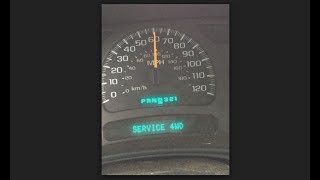
- "Check 4x4" or "Service 4WD" warning light — A specific warning light illuminates on the instrument cluster indicating a fault in the four-wheel-drive system. 🎬 Watch: A professional walkthrough of the Service 4WD diagnostic process.
- 4WD system will not engage or disengage — The vehicle is stuck in its current mode (usually 2WD) and ignores commands from the 4WD selector switch.
- 4WD mode indicator lights are off or flashing — The lights on the selector switch (2H, 4H, 4L) fail to illuminate or flash continuously.
- Check Engine Light is on — The general Malfunction Indicator Lamp illuminates to signal a stored diagnostic trouble code.
- Grinding or clicking noise from under the vehicle — A failing shift motor makes clicking sounds as it attempts to move but fails.
Diagnostic Flowchart

Tap your situation to follow the diagnostic path that matches what you're seeing on this code.
Common Fixes & Costs
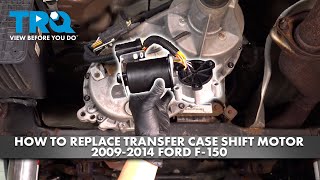
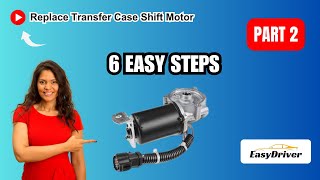
- Replacing the Transfer Case Shift Motor
— Parts: $100-$300, Labor: $100-$200, ~1.2 hr book time
(DIY)
Ford F-150 (2004-2008): OEM 8L3Z-7G360-A (Alt: {'Dorman': '600-928', 'SKP': 'SK600928'})
Chevrolet Silverado 1500 (2003-2007): OEM 88962315 (Alt: {'Dorman': '600-910', 'ACDelco': '88962315'}) - Repairing Damaged Wiring or Connector — Parts: $10-$50, Labor: $150-$450, ~2.5 hr book time (Intermediate)
- Cleaning and Securing Chassis Ground Connections — Parts: $5-$10, Labor: $75-$150, ~0.8 hr book time (DIY)
- Replacing the Transfer Case Control Module (TCCM)
— Parts: $200-$500, Labor: $150-$300, ~1.5 hr book time
(Professional)
Ford F-150 (2004-2008): OEM 4L3Z-14B247-BA (Alt: {'Dorman': '599-255'})
Chevrolet Silverado 1500 (2003-2007): OEM 24232949 (Alt: {'Dorman': '599-114'})
Used vs. New Parts: Buying Guide
When a used part is worth it: A used shift motor makes sense for older, high-mileage vehicles where a new OEM part is too expensive and you are performing the labor yourself.
Donor-vehicle mileage cap: roughly under 100000 miles for the part to have meaningful remaining life.
Donor quality checklist:
- Verify the part number matches exactly; connectors vary even within the same model year.
- Inspect the electrical connector for corrosion, bent pins, or heat damage.
- Check the fluid from the donor transfer case; burnt fluid or metal shavings suggest internal damage.
Decision logic:
- If The fault is the shift motor and the vehicle is less than 10 years old. → Buy a new OEM or high-quality aftermarket part (e.g., Dorman) for reliability and warranty.
- If The vehicle is over 15 years old and you are performing the repair yourself. → A used motor from a reputable salvage yard is a cost-effective option.
- If You are paying a shop for labor. → Favor a new part. The cost of repeat labor to replace a faulty used part erases any initial savings.
Warranty tradeoff: Used parts offer a 30-90 day warranty on the part only. New aftermarket parts come with a 1-year to limited lifetime warranty.
Worst-case if a used part fails: 400-600. If a used motor fails, you pay for labor a second time plus another replacement part.
What Happens If You Wait — Timeline
- Immediate: Code P1891 sets, 'Check 4x4' light illuminates. The 4WD system is disabled as a failsafe. Vehicle remains in 2WD. (MPG impact: 0%% · Added cost: $0)
- If failure occurs while in 4WD: The system gets stuck in 4H or 4L. Driving on dry pavement causes drivetrain binding, leading to tire skipping during turns and excessive component stress. (MPG impact: 5-10%% · Added cost: $200-$800)
- Weeks to months of driving stuck in 4WD: Sustained binding stretches the transfer case chain, causing loud clunking noises and damaging differential gears. (MPG impact: 10-15%% · Added cost: $1,200-$2,500)
- 6+ months of driving stuck in 4WD: Catastrophic failure. The stretched chain breaks inside the transfer case, cracking the case and causing a total loss of power. (MPG impact: N/A% · Added cost: $3,000-$8,000)
Cost of Not Fixing It
- Immediate: No functional 4WD. This is a safety issue if you rely on 4WD for traction in hazardous weather. (Added cost: 0)
- 1-6 months: If stuck in 4WD, driving on dry pavement causes severe drivetrain binding, accelerating wear on tires, U-joints, and differential gears. (Added cost: 200-1500)
- 6+ months: Prolonged drivetrain binding leads to catastrophic failure of the transfer case or differentials. (Added cost: 2000-5000)
Diagnosis Steps
- Verify the Code and Check for TSBs
Use an OBD-II scanner to confirm P1891. Check for related codes like P1867 or contact plate codes (P1849, P1857). Search for Technical Service Bulletins (TSBs) for your specific year and model.
Tools: OBD-II Scanner (Beginner) - The "Tap Test"
If 4WD is used infrequently, the shift motor seizes. Have a helper try to engage 4WD while you firmly tap the transfer case shift motor body with a screwdriver handle. If it suddenly works, the motor is sticking internally and requires replacement.
Tools: Hammer or Screwdriver Handle (Beginner) - Visual Inspection of Wiring and Connectors
Inspect the wiring harness running to the transfer case shift motor. Look for wires rubbing on the driveshaft or frame, melted sections near the exhaust, and green corrosion on the connector pins.
Tools: Flashlight, Safety Glasses (Beginner) - Test the Ground Circuit at the Connector
Disconnect the shift motor connector. Set a multimeter to Ohms (Ω). Place one probe on the ground pin in the harness-side connector and the other on a clean chassis ground. A good ground reads less than 1 ohm. 'OL' (Open Loop) confirms the open ground circuit.
Tools: Digital Multimeter, Vehicle-Specific Wiring Diagram (Intermediate) - Shift Motor Resistance Test
With the motor disconnected, measure the resistance between the two thickest pins on the motor side. An 'OL' reading means the motor's internal circuit is open. Zero resistance indicates a short circuit.
Tools: Digital Multimeter (Intermediate) - Check for Voltage Drop on the Ground Wire
Reconnect the harness. Back-probe the ground wire at the shift motor connector. Set the multimeter to DC Volts. Command a 4WD shift. While the motor tries to run, measure voltage between the ground probe and the negative battery terminal. A reading above 0.5 volts indicates excessive resistance.
Tools: Digital Multimeter with T-pins, Scan Tool (Advanced) - Scan Tool Live Data Analysis
Access TCCM live data with a professional scan tool. Monitor 'Transfer Case Position'. Command a shift from 2H to 4H. If the actual position PID does not change or shows 'Fault', the TCCM is not receiving a valid signal from the encoder motor.
Tools: Professional Scan Tool (Advanced) - Test the TCCM and Manually Shift Transfer Case
If wiring and the motor test good, remove the shift motor and use a wrench to manually turn the transfer case's shift shaft. If you feel distinct detents for 2H, 4H, and 4L and it shifts smoothly, the transfer case is mechanically sound, confirming a failed TCCM.
Tools: Wrench, Basic Hand Tools (Intermediate)
When This Code Triggers (Freeze-Frame Conditions)
- Event Trigger: Attempting to shift 4WD mode (The code sets the moment the driver turns the selector switch to engage or disengage 4WD.)
- Vehicle Speed: 0-10 mph (The fault logs at low speeds or when stopped, matching typical 4WD engagement conditions.)
- Engine State: Running (The engine must be running for the TCCM to actively attempt a shift.)
- System Voltage: 11.5-14.5V (The fault occurs under normal voltage. P1891 isolates a specific ground circuit break, not a general low-voltage module failure.)
Related Codes
- P1867 — Indicates a general electrical fault in the contact plate. Seeing P1867 alongside P1891 strongly suggests the problem is the shift motor assembly or its connector.
- P1849, P1853, P1857, P1861 — Ford-specific codes for contact plate circuits A, B, C, and D. They confirm the fault is within the encoder assembly.
- C0327 — The GM equivalent of the Ford P18xx contact plate codes, pointing directly to a faulty transfer case encoder motor or its wiring.
Climate & Environmental Factors
- Road Salt / High Humidity: Salt spray from treated winter roads drastically accelerates corrosion of wiring, connector pins, and chassis ground points. The transfer case wiring harness is located under the vehicle, making it highly susceptible.
- Cold Weather: Cold temperatures make old plastic wire insulation brittle and prone to cracking. It also thickens the grease inside the shift motor, increasing electrical load and exposing weak ground connections.
- Infrequent 4WD Use: In areas where 4WD is rarely needed, lack of use causes the shift motor's internal contacts to corrode and mechanical parts to seize.
How to Talk to a Mechanic About This Code
Say this: "I have a 'Service 4WD' light and my scanner shows code P1891. Based on my research, this is often a wiring or shift motor issue. Please start by inspecting the wiring harness and connector for corrosion or damage before recommending a new transfer case motor or control module."
This directs the shop to check the cheapest-to-fix causes first, preventing them from immediately quoting an expensive TCCM when a simple wiring repair solves it.
Avoid saying:
- 'My 4-wheel drive is broken, can you fix it?'
- 'The 4x4 light is on, just do whatever it takes.'
- 'I think I need a new transfer case.'
Questions to ask before authorizing the repair:
- Did you perform a continuity and voltage drop test on the ground circuit? What were the readings?
- Can you show me the damaged section of the wiring or the corroded connector pins?
- If you are recommending a shift motor, did you confirm the old one was sticking or electrically failed?
- Before replacing the TCCM, are you 100% certain that all wiring, connectors, and the shift motor are good?
Where to Take It: Dealer vs Independent vs Chain
- Dealer:
A good, but expensive, choice. Necessary if a new TCCM or SJB needs to be programmed.
Best for: Vehicles under warranty., Complex jobs requiring module reprogramming (TCCM/SJB replacement)., Diagnosing rare manufacturer-specific quirks like the Ford P1891-00 issue.
Downsides: Highest labor rates, often 1.5-2x an independent shop., More likely to replace an entire wiring harness than repair a single wire. (Typical cost: +50% vs. baseline) - Independent Shop:
Best fit for most P1891 repairs. An experienced independent technician knows to check the wiring first.
Best for: Out-of-warranty vehicles where cost is a factor., Diagnosing and repairing common wiring issues., Most P1891 scenarios involving shift motor replacement or chassis ground cleaning.
Downsides: Quality varies. Look for shops with ASE-certified technicians., May not have the expensive tools to reprogram a new TCCM. (Typical cost: +0% vs. baseline) - Chain Shop:
Use with caution. They are not the right choice for diagnosing the intermittent electrical faults that often cause P1891.
Best for: Simple, clear-cut part replacements like brakes or batteries.
Downsides: Business model encourages replacing parts over performing detailed electrical diagnostics., Lacks specific diagnostic tools for drivetrain control module issues. (Typical cost: -10% vs. baseline)
When to Walk Away From the Repair
If the estimated repair cost for the 4WD system exceeds 40-50% of the vehicle's private-party value, and you don't strictly need 4WD, consider selling the vehicle as-is.
- Car worth $4000, fix is $600: Fix it. The repair cost is a reasonable 15% of the vehicle's value and restores a key feature.
- Car worth $5000, fix is $2500: Walk away. The repair cost is 50% of the vehicle's value. Unless 4WD is absolutely essential, it's not an economic repair.
- Car worth $15000, fix is $950: Fix it. The repair is well below the threshold and maintains the vehicle's resale value.
What Scan Tool You Need for This Code
Minimum: A scanner that reads codes from non-engine modules like the Transmission Control Module (TCM) or Body Control Module (BCM).
A basic $20 code reader only pulls powertrain (P-codes) from the main engine computer. It will not see the P1891 code if it's stored in the TCCM.
Budget: BlueDriver Pro (~$99) — Confirms the code is present and reads live data from the TCCM on many supported vehicles, allowing you to see position sensor data in real-time.
Mid-range: Foxwell NT510 Elite / Autel MaxiCOM MK808S (~$150-350) — Provides full bidirectional control. Allows you to command the transfer case to shift from 2H to 4H directly from the tool, confirming if the motor and TCCM respond.
Professional: Autel MaxiCOM MK906BT / LAUNCH X431 Series (~$600-1200) — Offers full bidirectional control, advanced live data graphing, and module programming capabilities necessary if a failed TCCM needs replacement.
Rent vs buy: Auto parts stores offer loaner scanners for a refundable deposit. This is great for a one-time diagnosis, but loaner scanners lack the bidirectional capabilities needed for advanced testing.
How to Clear the Code After You Fix It
- Use an OBD-II scan tool to clear all Diagnostic Trouble Codes (DTCs).
- Perform the specific 4WD relearn procedure if required by the manufacturer (common on GM vehicles).
- Complete a full drive cycle to allow the vehicle's readiness monitors to reset.
Drive cycle (~25 minutes): A general drive cycle involves: a cold start, idle for 2-3 minutes, 10 minutes of mixed city driving including several stops, followed by 10 minutes of steady highway speed (55-60 mph).
Readiness monitors affected: Comprehensive Component Monitor (CCM)
Before emissions retest: drive at least 50 miles to fully set monitors.
Watch out for:
- Disconnecting the battery clears the code but resets all readiness monitors, causing an automatic emissions test failure.
- The code returns immediately if the underlying electrical fault has not been properly repaired.
Will This Fail Emissions / State Inspection?
Yes — this code typically fails an OBD-II emissions inspection.
- California: A P1891 code is an automatic failure. The stored code in a non-powertrain module is flagged by the BAR-OIS system.
- New York: An illuminated Check Engine Light or Service 4WD light results in an automatic failure. The code must be cleared and monitors set before a re-test.
- Texas: In emissions-testing counties, an active P1891 code with an illuminated MIL fails the OBD-II inspection.
Most Commonly Affected Vehicles
- Ford F-150 (2004-2018) — Extremely common. 2004-2008 models are notorious for shift motor failure, while later models suffer from wiring harness chafing near the exhaust.
- Ford Explorer (2002-2010) — Wiring harness chafing and connector corrosion are very common culprits, especially on the 2006-2010 models.
- Ford Expedition (1999-2006) — Prone to faulty transfer case motors, especially if 4WD is infrequently used.
- Chevrolet Silverado 1500 (2003-2014) — Issues often stem from a faulty TCCM or the dash selector switch, in addition to shift motor and wiring faults.
- Dodge Ram 1500 (2006-2018) — Commonly affected by transfer case shift motor failures and related wiring issues.
- Honda Civic (2001-2005) — CRITICAL DISTINCTION: On CVT models, P1891 means 'Problem in Start Clutch Control System'. It is a serious transmission issue, completely unrelated to 4WD.
Manufacturer-Specific Notes
- Ford: Primary causes are wiring harness damage from rubbing against the frame/exhaust and corrosion in the shift motor connector. Beware of the misleading P1891-00 code, which relates to the Smart Junction Box, not the 4WD system.
- Honda: On CVT vehicles like the 2001-2005 Civic, P1891 is defined as 'Start Clutch Control System Malfunction'. This is a critical transmission fault with no connection to a transfer case.
- Porsche: On the Cayenne, P1891 means 'Selector Lever Position Information Implausible'. This relates to a faulty microswitch in the center console gear shifter, not the transfer case.
- General Motors (Chevy/GMC): GM trucks are known for failures of the TCCM and the 4WD dash selector switch. Pulling the TCCM fuse for several minutes sometimes resets a confused module and temporarily restores function.
Real Owner Stories
2008 Ford F-150 with intermittent 4x4
Owner tried to engage 4H in wet grass. The system failed, and the 'Check 4x4' light illuminated.
What they tried:
- Scanned codes, found P1867 and P1891.
- Tapped the transfer case shift motor with a hammer, temporarily unsticking it.
Outcome: The owner confirmed the motor was mechanically sticking from infrequent use and replaced it permanently.
Lesson: The 'tap test' is a valid, zero-cost diagnostic step to confirm a seized shift motor before buying parts.
2018 Ford F-150 with recurring code
Vehicle randomly displayed 'Check 4x4' and logged P1891 when shifting into 4-Hi.
What they tried:
- Dealer replaced the transfer case shift motor, but the code returned immediately.
Outcome: A second diagnostic pass revealed a bad connector in the wiring harness. It was an intermittent electrical fault, not a component failure.
Lesson: If replacing the shift motor doesn't fix the code, the problem is almost certainly in the wiring harness. Do not replace the TCCM until the harness is meticulously tested.
Ford vehicle with P1891-00 and no 4x4 symptoms
A Ford logged code P1891-00, defined as '3rd Row Power Fold Circuit Failure', but the 4x4 system worked perfectly.
What they tried:
- Clearing the code, but it returned.
Outcome: This specific code variant is caused by an incorrectly configured Smart Junction Box (SJB). The dealer reconfigured the SJB module.
Lesson: Pay close attention to code suffixes like '-00'. On specific Fords, P1891-00 is a known 'ghost' code unrelated to the 4WD system.
How to Prevent This Code From Triggering
- Engage and disengage the 4WD system monthly. (Once per month) — Cycling the system from 2H to 4H prevents internal gears and electrical contacts from seizing or corroding due to lack of use.
- Change the transfer case fluid. (Every 30,000-50,000 miles.) — Clean fluid lubricates internal gears, reducing wear and preventing mechanical binding that stresses the shift motor.
- Apply a corrosion inhibitor to underbody wiring and connectors. (Annually, before winter.) — Dielectric grease on connector seals creates a barrier that repels moisture and road salt, preventing open circuits.
Frequently Asked Questions
Can I fix P1891 myself?
Yes, for many common causes. If the issue is a corroded connector, a bad chassis ground, or a faulty transfer case shift motor, it is a very manageable DIY repair. The shift motor is typically held on by only three bolts.
I replaced the transfer case shift motor, but the P1891 code came back. What now?
This almost always indicates the fault is in the wiring harness or connector, not the motor. You must meticulously inspect the harness for breaks, chafing, or corrosion. Pay special attention to where it passes over the frame and near the exhaust.
My scanner shows P1867 and P1891 together. What does that mean?
Seeing both codes confirms the fault lies within the transfer case shift motor assembly or its immediate wiring. P1867 is a general circuit failure, and P1891 pinpoints the ground side. This combination makes a wiring or motor issue far more likely than a control module problem.
I never use 4WD. Why did this part fail?
Lack of use is a primary cause of failure for the shift motor. The internal electrical contacts and mechanical gears seize or develop corrosion from sitting in one position. Engage your 4WD system at least once a month to keep components lubricated and contacts clean.
Will clearing the code fix the problem?
No. Clearing the code only erases the fault from the computer's memory. The moment the TCCM runs its self-test and detects the open ground circuit again, the warning lights and code return.
Can I get stuck in 4WD if this part fails?
Yes. While it most commonly fails in 2WD, the shift motor can fail at any point, leaving your vehicle stuck in 4H or 4L. This destroys the drivetrain if driven on dry, high-traction surfaces.
How do I manually shift the transfer case if I'm stuck?
If stranded, unbolt and remove the shift motor (usually 3 bolts) to expose the transfer case's shift shaft. Use a wrench to manually turn the shaft to the 2H position. This allows you to drive the vehicle safely until repairs are made.
What is a 'contact plate' and what does it do?
The contact plate is a position sensor inside the transfer case shift motor assembly. It consists of metallic traces and a wiper that moves as the motor turns. By reading electrical continuity, the TCCM knows exactly whether the transfer case is in 2H, 4H, or 4L.
Key Takeaways
- Code P1891 disables your 4WD system because the Transfer Case Control Module (TCCM) detects a broken ground wire or failed position sensor.
- Inspect the wiring harness near the exhaust and frame rails first, as chafed wires cause over 50% of P1891 codes on Ford and GM trucks.
- Perform the 'Tap Test' by hitting the shift motor with a screwdriver handle while a helper engages 4WD; if it shifts, replace the $150 motor.
- Never drive on dry pavement if the system fails while stuck in 4H or 4L, as drivetrain binding causes upwards of $3,000 in mechanical damage.
Helpful Videos
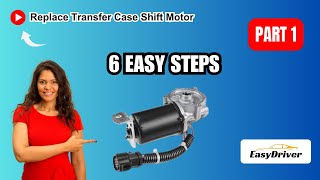
Shop the Parts Behind P1891
Below are the parts most often responsible for code P1891, ranked by how frequently each one is the actual culprit (per the diagnosis above). Tap any to see what we have for your vehicle.


The information in this article is provided for general reference and educational purposes only. Vehicle specifications, procedures, and part compatibility can vary by production date, trim level, and region. Always consult your vehicle's factory service manual and verify part numbers before purchasing or performing repairs. Safety-critical components such as airbags, seat belts, and braking systems should be installed by a qualified professional.
- 🧭 Diagnostic Flowchart
- 🎬 Helpful Videos
- 🛍️ Shop This Part
- What Does P1891 Mean?
- Can I Drive With P1891?
- Common Causes
- Symptoms
- Common Fixes & Costs
- Used vs. New Parts: Buying Guide
- What Happens If You Wait — Timeline
- Cost of Not Fixing It
- Diagnosis Steps
- When This Code Triggers (Freeze-Frame Conditions)
- Related Codes
- Climate & Environmental Factors
- How to Talk to a Mechanic About This Code
- Where to Take It: Dealer vs Independent vs Chain
- When to Walk Away From the Repair
- What Scan Tool You Need for This Code
- How to Clear the Code After You Fix It
- Will This Fail Emissions / State Inspection?
- Most Commonly Affected Vehicles
- Manufacturer-Specific Notes
- Real Owner Stories
- 2008 Ford F-150 with intermittent 4x4
- 2018 Ford F-150 with recurring code
- Ford vehicle with P1891-00 and no 4x4 symptoms
- How to Prevent This Code From Triggering
- Frequently Asked Questions
- Can I fix P1891 myself?
- I replaced the transfer case shift motor, but the P1891 code came back. What now?
- My scanner shows P1867 and P1891 together. What does that mean?
- I never use 4WD. Why did this part fail?
- Will clearing the code fix the problem?
- Can I get stuck in 4WD if this part fails?
- How do I manually shift the transfer case if I'm stuck?
- What is a 'contact plate' and what does it do?
- Key Takeaways
- 🎟️ Get 5% Off