

OBD-II Code P1935: Brake Switch/Sensor Signal Malfunction
The Ultimate Guide to What P1935 Means, Why It Triggers, and How to Fix It for Good
- Code P1935 flags a brake pedal position sensor failure, which disables cruise control, locks the transmission in Park, and leaves brake lights stuck on or completely dead.
- Replacing the brake pedal switch costs $100 to $210 and takes under an hour, but 2018+ GM and Ford vehicles require a bidirectional scan tool for mandatory post-install calibration.
- On 2017 Ford Escapes, P1935 paired with P061E is a known software bug requiring a 0.3-hour dealer PCM reprogram (TSB 18-2193), not a new switch.
- For Ford and Mazda diesel models (2010-2018), P1935 actually means 'Fuel Additive Level Low,' requiring a $150-$300 DPF fluid refill rather than any brake system repairs.
What Does P1935 Mean?

Code P1935 indicates the Powertrain Control Module (PCM) receives an irrational signal from the brake pedal position sensor. This sensor tells the PCM, ABS, and Body Control Module exactly when you press the brake. This data operates the brake lights, deactivates cruise control, enables push-button start, and manages stability control.
Technical definition: P1935 is a manufacturer-specific code. For Ford, Volvo, Mazda, and GM, it means 'Brake Switch / Sensor Signal Malfunction'. However, on Ford and Mazda diesel models (like the Transit or Fusion), it means 'Fuel Additive Level Low', indicating an empty diesel particulate filter (DPF) additive tank. You must use a scanner that provides the manufacturer-specific definition to avoid misdiagnosis.
Can I Drive With P1935?
Yes, But With Caution. Yes, but it poses a severe safety risk. Your brake lights fail to illuminate or stick on, creating a collision hazard. The vehicle also enters a 45-mph limp mode, or prevents you from starting the engine and shifting out of Park.
Common Causes

- Faulty or Misaligned Brake Pedal Switch (Very Common) — The sensor physically wears out, breaks, or falls out of alignment from constant use, leading to an intermittent or complete loss of signal.
- Damaged Wiring or Corroded Connector (Common) — Wires leading to the sensor fray, break, or short due to stress. The connector suffers from moisture corrosion or backed-out pins.
- Weak or Failing Battery (Common) — Low system voltage causes a cascade of communication errors between modules, triggering false P1935 codes alongside other warning lights.
- Blown Stop Lamp Fuse (Less Common) — A short circuit blows the brake switch fuse, cutting power to the sensor and immediately triggering the code.
- Software Glitch (PCM/BCM) (Less Common) — Specific vehicles, like the 2017 Ford Escape, have a known PCM software bug that falsely triggers this code, requiring a dealer update.
- Improperly Performed Brake Service (Less Common) — Failing to put electronic parking brakes into 'Service Mode' before compressing calipers causes pressure faults and triggers limp mode.
- Leaking Brake Master Cylinder (Rare) — On 2014-2017 Ford F-150s, a leaking master cylinder contaminates nearby wiring, leading to electrical shorts that trigger this code.
- Failing Control Module (PCM, BCM, or ABS) (Rare) — The computer fails and misinterprets a perfectly good signal from the sensor. This is a last-resort diagnosis.
Symptoms

- Brake Lights Malfunction (Inoperative or Stuck On) — Brake lights fail to illuminate when pressing the pedal, or stay on continuously when the car is off, draining the battery.
- Engine Will Not Start or Vehicle Stuck in Park — Push-button start systems and automatic transmissions require a valid brake signal to start the engine or shift out of Park.
- Cruise Control Inoperative — Cruise control relies on the brake signal to disengage safely. If the signal is unreliable, the system disables itself.
- Reduced Engine Power ('Limp Mode') — The PCM reduces engine power or limits speed to 45 mph if it detects conflicting brake and accelerator signals.
- Hesitation or Jerking During Gear Shifts — The transmission control module uses the brake signal for shift logic. A faulty signal causes harsh shifting or hesitation.
- Check Engine Light and Warning Messages (also visible on scanner) — The Check Engine Light illuminates, often accompanied by 'Service Brake Assist', ABS, or Traction Control warnings.
Diagnostic Flowchart
Tap your situation to follow the diagnostic path that matches what you're seeing on this code.
Common Fixes & Costs
- Replace Brake Pedal Position/Light Switch
— Parts: $20-$80, Labor: $80-$130, ~0.8 hr book time
(DIY)
2017 Ford Escape: OEM Motorcraft SW-7602 (Alt: Duralast CR4834)
2019 Chevrolet Silverado: OEM ACDelco 13597420 (Alt: Dorman 926-064) - Repair Damaged Wiring or Connector — Parts: $10-$50, Labor: $120-$350, ~1.5 hr book time (Intermediate)
- Replace Blown Fuse — Parts: $1-$5, Labor: $0-$50, ~0.2 hr book time (DIY)
- Reprogram Powertrain Control Module (PCM) — Parts: $0, Labor: $150-$300, ~1.2 hr book time (Professional)
- Refill Diesel Fuel Additive Tank — Parts: $100-$200, Labor: $50-$100, ~0.7 hr book time (Intermediate)
- Replace Powertrain Control Module (PCM) — Parts: $800-$1500, Labor: $150-$250, ~1.5 hr book time (Professional)
DIY vs Professional
- Replace Brake Pedal Position/Light Switch 🟢 Beginner
Tools: Flashlight, basic hand tools, bidirectional scan tool (for 2018+ GM/Ford calibration). - Repair Damaged Wiring or Connector 🟢 Beginner
Tools: Multimeter, wire strippers, crimpers, heat shrink, vehicle-specific wiring diagrams. - Reprogram Powertrain Control Module (PCM) 🟢 Beginner
Tools: Manufacturer-specific diagnostic scan tool, stable power supply, software subscription. - Replace Blown Fuse 🟢 Beginner
Tools: Fuse puller or small pliers.
Used vs. New Parts: Buying Guide
When a used part is worth it: Buying a used brake pedal position switch is never recommended. It is a high-wear electronic component with a low replacement cost.
Donor-vehicle mileage cap: roughly under 20000 miles for the part to have meaningful remaining life.
Donor quality checklist:
- Match the part number exactly, including superseded numbers, as internal circuitry varies for cruise control or ABS functions.
- Avoid parts from flood-damaged or rust-belt vehicles.
Decision logic:
- If The part costs less than $100 new. → Always buy new. The labor to replace a failed used part costs more than the part itself.
- If The vehicle requires a specific OEM part that is on backorder. → Use a reputable recycler as a temporary solution, but replace it with a new OEM unit when available.
Warranty tradeoff: Used parts carry a 30-day warranty. New aftermarket parts include a 1-year to lifetime warranty. New OEM parts carry a 1-2 year warranty.
Worst-case if a used part fails: $100-$250 if a used part fails, covering repeat labor and the price of the new part you should have bought initially.
What Happens If You Wait — Timeline
- 0-2 weeks: Check Engine Light illuminates. Cruise control is disabled. Brake lights flicker or have a delayed response. (MPG impact: 0%% · Added cost: $0)
- 2 weeks - 2 months: Vehicle refuses to start or shift from Park. If the switch fails 'on', brake lights stay illuminated, draining the battery overnight. (MPG impact: 0-5%% · Added cost: $150-$300 for a new battery or emergency tow.)
- 2-6 months: The ECU prioritizes the false brake signal over the throttle, causing sluggish acceleration or limp mode. Confused shift logic prematurely wears transmission clutches. (MPG impact: 5-10%% · Added cost: $200-$800 in transmission or ABS module diagnostics.)
- 6+ months: Non-functional brake lights lead to a rear-end collision. Unexpected limp mode on a highway creates a major hazard. (MPG impact: 5-10%% · Added cost: $500+ (insurance deductible to total loss).)
Cost of Not Fixing It
- Immediate: Significant safety hazard. Brake lights fail, increasing rear-end collision risk. The vehicle refuses to start or shift out of Park. (Added cost: $0)
- 0-1 month: A switch stuck in the 'on' position drains the battery overnight, requiring a jump-start or a replacement battery. The ECU limits engine power. (Added cost: $150-$350)
- 1-6 months: Erratic brake signals cause premature transmission wear due to confused shift logic and disable ABS/traction control systems. (Added cost: $200-$1000+)
Diagnosis Steps

- Verify the Code and Manufacturer Definition
Read the code and its manufacturer-specific definition. For a Ford diesel, P1935 means 'Fuel Additive Level Low', requiring DPF fluid, not a brake switch. Note any communication (U-codes) or ABS codes.
Tools: OBD-II Scan Tool (Beginner) - Check Brake Light and Cruise Control Function
Have a helper confirm if the brake lights activate correctly when you press the pedal. Attempt to engage the cruise control while driving to confirm the symptoms.
Tools: A helper (Beginner) - Inspect the Brake Pedal Switch, Wiring, and Fuse
Visually inspect the switch on the brake pedal assembly for physical damage. Ensure the connector is secure and wiring is intact. Locate the stop lamp fuse in the owner's manual and verify it is not blown.
Tools: Flashlight, Owner's Manual, Fuse Puller (Beginner) - Check for Technical Service Bulletins (TSBs)
Search online for your vehicle's year, make, model, and 'P1935 TSB'. For the 2017 Ford Escape, this code is a known software issue fixed by a dealer reprogram (TSB 18-2193).
Tools: Internet access (Beginner) - Test the Switch with a Multimeter
Disconnect the switch. Using a multimeter on the continuity setting, test the brake light pins; they should show continuity only when the plunger is out (pedal pressed). The cruise control pins operate in reverse.
Tools: Multimeter (Intermediate) - Test for Voltage and Ground at the Connector
Using a wiring diagram, identify the power, ground, and signal wires. With the key on, verify 12V+ battery power and a solid ground (less than 0.1V). The signal wire voltage must change smoothly when the pedal is pressed.
Tools: Multimeter, Vehicle-specific wiring diagram (Advanced) - Analyze Live Data with a Scan Tool
View live data for 'Brake Pedal Position Sensor Voltage'. The status must change from 'Off' to 'On' instantly when touching the pedal. If data is erratic but the switch and wiring tested good, the control module is failing.
Tools: Advanced Scan Tool (Advanced)
When This Code Triggers (Freeze-Frame Conditions)
- Engine Coolant Temp: 170-210°F (The engine is at full operating temperature.)
- RPM: 1500-2500 (The code sets during steady-state cruising when systems like cruise control are active.)
- Vehicle Speed: 40-65 mph (Highway driving is the most common condition, as the PCM actively monitors for brake pedal input to disengage cruise control.)
- Calculated Load: 20-50% (The engine is under a moderate, steady load.)
Related Codes
- P0571 — The generic OBD-II code for 'Brake Switch A Circuit Malfunction.' P1935 is the manufacturer-specific equivalent. Diagnose based on P1935 for accurate TSBs.
- U0121 — 'Lost Communication With ABS Module.' Diagnose U0121 FIRST. P1935 is a symptom triggered because the PCM cannot get the brake signal from an offline ABS module.
- P061E — 'Internal Control Module Brake Signal Performance.' When paired with P1935 on a 2017 Ford Escape, it guarantees a software glitch requiring a PCM reprogram (TSB 18-2193).
- P0504 — 'Brake Switch A/B Correlation.' Sets when the PCM receives conflicting signals from a dual-circuit brake switch, pointing directly to a faulty switch or wiring.
Climate & Environmental Factors
- Humidity and Moisture: Water ingress from a leaking windshield or cowl corrodes the brake switch's electrical connector pins, destroying the signal.
- Road Salt (Cold Climates): Salt spray penetrates the engine bay and under-dash area, accelerating corrosion on wiring harnesses and ground points.
- Extreme Cold: Freezing temperatures make plastic switch components and wiring insulation brittle, causing physical failure from pedal stress.
How to Talk to a Mechanic About This Code
Say this: "I have a P1935 code. Please check for any related TSBs, especially for software updates, and verify the live data from the brake pedal position sensor before recommending a part replacement."
This directs the technician to perform a proper diagnosis rather than blindly replacing the switch, saving you money on unnecessary repairs.
Avoid saying:
- 'My check engine light is on, can you look at it?'
- 'Just fix the P1935 code.'
- 'I think I need a new brake light switch.'
Questions to ask before authorizing the repair:
- Did you check for any Technical Service Bulletins for my vehicle and this code?
- What did the live data for the Brake Pedal Position sensor show when you pressed the pedal?
- Does my vehicle require a calibration or relearn procedure after replacing the switch?
- Did you test for power and ground at the sensor connector?
- Will you provide a written estimate with a breakdown of parts and labor costs?
Where to Take It: Dealer vs Independent vs Chain
- Dealer:
Recommended if you suspect a software issue (TSB) or if your vehicle requires a special calibration after sensor replacement.
Best for: Vehicles under warranty., Known software issues requiring a PCM reprogram (e.g., 2017 Ford Escape)., Complex jobs requiring manufacturer-specific calibration (e.g., newer GM vehicles).
Downsides: Highest labor rates., Less willing to perform simple wiring repairs versus replacing a whole harness. (Typical cost: +50% vs. baseline) - Independent Shop:
Best fit for most P1935 scenarios. Choose a well-reviewed shop with ASE-certified technicians and modern scan tools.
Best for: Out-of-warranty vehicles., Straightforward brake switch replacement., Diagnosing wiring or connector issues.
Downsides: Diagnostic equipment varies greatly; ensure they have modern bidirectional scan tools., May lack access to the latest manufacturer software. (Typical cost: +0% vs. baseline) - Chain Shop:
AVOID for initial diagnosis, wiring issues, or any vehicle requiring software updates or calibration.
Best for: Simple part replacement if the diagnosis is already certain.
Downsides: Technician skill varies dramatically., High pressure to upsell services., Lack the advanced diagnostic tools to handle manufacturer-specific definitions or calibration procedures. (Typical cost: -10% vs. baseline)
When to Walk Away From the Repair
If the estimated repair cost exceeds 50% of the car's private-party value, consider selling or trading it in.
- Car worth $4000, fix is $170: Fix it. This is a common, low-cost repair well below the threshold.
- Car worth $5000, fix is $1800: Borderline. This suggests a rare, complex issue like a PCM failure. Get a second opinion before authorizing.
- Car worth $2000, fix is $1500: Walk away. The repair cost is 75% of the car's value; it is not a sound investment.
What Scan Tool You Need for This Code

Minimum: A scanner that reads manufacturer-specific trouble codes and displays live sensor data.
A $20 reader only gives the generic P-code. It cannot tell you if P1935 means 'Fuel Additive Low,' view live brake switch status, or access ABS/BCM modules.
Budget: BlueDriver Pro (~$100) — Reads manufacturer-specific codes, views freeze frame data, and graphs live data for the brake pedal position sensor.
Mid-range: Foxwell NT510 Elite (~$180) — Supports bidirectional controls and special functions like 'Brake Pedal Position Sensor Calibration' required for modern GM and Ford vehicles.
Professional: Autel MaxiCOM MK808Z (~$500) — Provides complete bidirectional control, access to all modules, and includes EPB service modes and sensor calibrations for nearly all makes.
Rent vs buy: AutoZone's Loan-A-Tool program allows you to borrow a basic scanner for free. However, rentals cannot perform calibrations. If your car requires calibration, buying a mid-range tool is mandatory.
How to Clear the Code After You Fix It
- Use an OBD-II scan tool to clear the diagnostic trouble codes.
- Perform a complete drive cycle to allow the vehicle's readiness monitors to run.
- Check readiness monitor status with the scan tool before seeking an emissions test.
Drive cycle (~20 minutes): Start with a cold engine (below 122°F). Idle for 3 minutes with the A/C and rear defrost on. Accelerate to 55 mph and hold a steady speed for 5 minutes. Decelerate to 20 mph without using the brakes, then accelerate back to 60 mph at 3/4 throttle and hold for 5 minutes. Decelerate and come to a complete stop.
Readiness monitors affected: Catalyst Monitor, EVAP System Monitor, O2 Sensor Monitor
Before emissions retest: drive at least 50 miles to fully set monitors.
Watch out for:
- Clearing the code and immediately going for an emissions test results in an automatic failure because the monitors read 'Not Ready'.
- If the underlying fault remains, the code returns within minutes of driving.
Will This Fail Emissions / State Inspection?
Yes — this code typically fails an OBD-II emissions inspection.
- California: An active Check Engine Light is an automatic failure. A full drive cycle must be completed to set readiness monitors before a re-test.
- New York: Fails inspection if the Check Engine Light is on. For 2001+ vehicles, only one readiness monitor can be 'not ready'.
- Texas: An illuminated Check Engine Light is an automatic failure. You are allowed only one 'not ready' monitor to pass.
Most Commonly Affected Vehicles
- Ford Escape (2017) — Covered by TSB 18-2193. A false P1935 code, often paired with P061E, is fixed by a PCM reprogram, not a hardware replacement.
- Ford F-150 (2015-2020) — Often appears with U0121 ('Lost Communication with ABS'). Recalls for leaking master cylinders (NHTSA 16V-345, 20V-332) cause fluid to damage wiring, triggering this code.
- Chevrolet / GMC Silverado / Sierra / Equinox (2018-2024) — Replacing the brake pedal position sensor requires a mandatory calibration ('relearn') procedure using a bidirectional scan tool.
- Nissan Versa / Sentra / Altima (2009-2019) — A faulty brake switch or disintegrated plastic pedal stopper grommet causes a no-start condition and prevents acceleration past idle.
- Volvo S40 / V50 / C30 (2004-2011) — Directly linked to an 'Anti-Skid Service Required' message. The twist-and-lock style brake pedal sensor is a known failure point.
- Honda Civic / Accord (2016-2021) — On models with electronic parking brakes, a weak battery triggers a cluster of brake warnings and a no-start condition.
- Ford / Mazda Transit / Fusion / 3 (Diesel) (2010-2018) — P1935 is defined as 'Fuel Additive Level Low'. Requires refilling the Eolys fluid/DPF additive tank and resetting the system, not replacing the brake switch.
Manufacturer-Specific Notes
- Ford: Ford uses P1935 for three unrelated faults: brake switch signal, diesel fuel additive level, and multi-axis acceleration sensor. TSB 18-2193 dictates a software update for 2017 Escapes.
- Chevrolet / GM: Replacing the brake pedal position sensor requires a 'Brake Pedal Position Sensor Calibration' using a scan tool to teach the new sensor's values to the ECM and BCM.
- Volvo: A faulty brake pedal sensor on P1 platform cars triggers the 'Anti-Skid Service Required' message. Use Genuine Volvo parts for longevity.
- Honda: On 10th generation Civics with electronic parking brakes, a weak battery mimics brake pedal sensor issues, triggering identical warning lights.
Real Owner Stories
2017 Ford Escape 1.5L - Check Engine Light On
Check engine light appeared with codes P1935 and P061E. No other symptoms were noticeable.
What they tried:
- Initially suspected a faulty brake switch.
- Researched the codes and found Ford TSB 18-2193.
Outcome: Took the vehicle to a Ford dealership. They confirmed the TSB applied and performed a PCM reprogram. The labor time was 0.3 hours. The codes were cleared and did not return.
Lesson: Always check for TSBs before replacing parts. For a 2017 Ford Escape with P1935 and P061E, a software update is the official fix, saving time and money.
2015 Ford F-150 - Multiple Warning Lights After Rain
After heavy rain, the dashboard lit up with 'Service AdvanceTrac', ABS, and parking brake warnings. Codes P1935, U0121, and U1012 were present.
What they tried:
- Noted water pooling on the passenger side floor.
- Diagnosed the primary U0121 code (loss of communication with ABS).
Outcome: Water ingress corroded the ABS module wiring harness. P1935 was merely a symptom of the ABS module being offline. Repairing the harness resolved all codes.
Lesson: If P1935 is accompanied by 'U' (communication) codes like U0121, diagnose the communication failure first. Check for water leaks or damaged wiring before assuming the brake switch is bad.
2010 Nissan Versa - No Start, Stuck in Park
The car refused to start, the gear shifter was locked in Park, and the brake lights were dead.
What they tried:
- Checked the battery.
- Found broken plastic pieces on the driver's side floor mat.
Outcome: The broken plastic was the brake pedal stopper grommet. Without it, the switch plunger passes through the pedal arm hole, never registering a press. Replacing the $5 rubber stopper restored full function.
Lesson: For a no-start or stuck-in-park issue, check the floor mat. A disintegrated plastic stopper is a cheap, common fix easily mistaken for a major component failure.
2006 Volvo S40 - 'Anti-Skid Service Required' Message
The 'Anti-Skid Service Required' message appeared, and a scan revealed code P1935.
What they tried:
- Checked ABS sensors and wiring.
Outcome: Replaced the twist-and-lock brake pedal position sensor on the pedal assembly, resolving the code and warning message.
Lesson: On Volvo P1 platforms, the 'Anti-Skid Service Required' message points directly to the brake pedal sensor as the primary culprit.
How to Prevent This Code From Triggering
- Maintain a Healthy Battery (Test annually after 3 years) — Low system voltage causes false communication codes between modules. Replacing the battery every 3-5 years prevents electrical glitches.
- Inspect for Cabin Water Leaks (Every 6-12 months) — Moisture leaking from a bad windshield seal drips onto under-dash electronics, causing corrosion and signal failure at the brake switch connector.
- Perform Brake Fluid Flushes (Every 2-3 years) — Old fluid causes hydraulic corrosion. On some vehicles, master cylinder leaks damage nearby wiring, leading to electrical faults.
- Use 'Brake Service Mode' for Repairs (During any rear brake service on EPB-equipped cars) — Forcing the rear caliper piston back manually destroys the caliper motor and sets brake system fault codes. Always retract the piston electronically.
- Visually Inspect Under-Dash Wiring (As needed) — Kicking or snagging wires with your feet stresses the brake switch connector, leading to intermittent connections.
Frequently Asked Questions
How much does it cost to fix code P1935?
For the most common fix—replacing the brake light switch—parts cost $20-$80 and labor runs $80-$130. The total repair usually falls between $100 and $210. Wiring repairs cost $120-$350, while a dealer software update costs $150-$300.
Can I replace the brake light switch myself?
Yes, replacing the switch is a straightforward DIY task on older vehicles, requiring basic hand tools and under an hour of time. However, modern GM and Ford vehicles require a bidirectional scan tool to perform a mandatory sensor calibration after installation. If you lack this tool, you must take the vehicle to a professional shop.
What are the most common misdiagnosis mistakes for P1935?
The biggest mistake is replacing the brake switch without testing it or checking for a blown fuse. Another common error is ignoring communication (U-codes); if present, the network is the problem, not the switch. Finally, on Ford/Mazda diesels, misinterpreting P1935 leads to replacing brake parts when the vehicle actually needs DPF fuel additive.
Why did P1935 appear after a brake job or battery replacement?
Disconnecting the battery causes modules to store temporary fault codes. On vehicles with electronic parking brakes, failing to put the system into 'Brake Service Mode' before compressing the rear caliper pistons sets a fault code. This triggers dashboard warnings and limits vehicle speed.
Will clearing the code fix the problem?
No. Clearing the code only erases the stored fault temporarily. As soon as the control module runs its self-test and detects the signal fault again, the light and symptoms return immediately.
My brake lights work fine, so why do I have this code?
Modern brake pedal sensors use dual or triple circuits. One circuit operates the brake lights, while a separate circuit sends a signal to the PCM, ABS, and transmission. The computer's circuit frequently fails while the brake light circuit continues working perfectly.
What is 'Brake Service Mode' and why is it important?
On cars with an electronic parking brake (EPB), you cannot manually push the rear caliper piston back to install new pads. You must use a scan tool or specific button sequence to put the system in 'Service Mode,' which electronically retracts the piston. Forcing it manually destroys the caliper motor and sets fault codes.
Can a bad P1935 sensor drain my battery?
Yes. If the brake light switch fails in the closed position, it keeps your brake lights illuminated even when the car is turned off. This constant power draw drains the battery overnight.
Key Takeaways
- Code P1935 flags a brake pedal position sensor failure, which disables cruise control, locks the transmission in Park, and leaves brake lights stuck on or completely dead.
- Replacing the brake pedal switch costs $100 to $210 and takes under an hour, but 2018+ GM and Ford vehicles require a bidirectional scan tool for mandatory post-install calibration.
- On 2017 Ford Escapes, P1935 paired with P061E is a known software bug requiring a 0.3-hour dealer PCM reprogram (TSB 18-2193), not a new switch.
- For Ford and Mazda diesel models (2010-2018), P1935 actually means 'Fuel Additive Level Low,' requiring a $150-$300 DPF fluid refill rather than any brake system repairs.
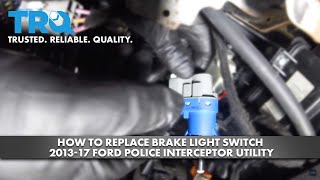
Helpful Videos


Shop the Parts Behind P1935
Below are the parts most often responsible for code P1935, ranked by how frequently each one is the actual culprit (per the diagnosis above). Tap any to see what we have for your vehicle.



The information in this article is provided for general reference and educational purposes only. Vehicle specifications, procedures, and part compatibility can vary by production date, trim level, and region. Always consult your vehicle's factory service manual and verify part numbers before purchasing or performing repairs. Safety-critical components such as airbags, seat belts, and braking systems should be installed by a qualified professional.
- 🧭 Diagnostic Flowchart
- 🎬 Helpful Videos
- 🛍️ Shop This Part
- What Does P1935 Mean?
- Can I Drive With P1935?
- Common Causes
- Symptoms
- Common Fixes & Costs
- DIY vs Professional
- Used vs. New Parts: Buying Guide
- What Happens If You Wait — Timeline
- Cost of Not Fixing It
- Diagnosis Steps
- When This Code Triggers (Freeze-Frame Conditions)
- Related Codes
- Climate & Environmental Factors
- How to Talk to a Mechanic About This Code
- Where to Take It: Dealer vs Independent vs Chain
- When to Walk Away From the Repair
- What Scan Tool You Need for This Code
- How to Clear the Code After You Fix It
- Will This Fail Emissions / State Inspection?
- Most Commonly Affected Vehicles
- Manufacturer-Specific Notes
- Real Owner Stories
- 2017 Ford Escape 1.5L - Check Engine Light On
- 2015 Ford F-150 - Multiple Warning Lights After Rain
- 2010 Nissan Versa - No Start, Stuck in Park
- 2006 Volvo S40 - 'Anti-Skid Service Required' Message
- How to Prevent This Code From Triggering
- Frequently Asked Questions
- How much does it cost to fix code P1935?
- Can I replace the brake light switch myself?
- What are the most common misdiagnosis mistakes for P1935?
- Why did P1935 appear after a brake job or battery replacement?
- Will clearing the code fix the problem?
- My brake lights work fine, so why do I have this code?
- What is 'Brake Service Mode' and why is it important?
- Can a bad P1935 sensor drain my battery?
- Key Takeaways
- 🎟️ Get 5% Off