

P2008 on 2009-2012 Ford Escape 2.5L: Intake Manifold Runner Control Fixes
On the 2009-2012 Ford Escape with the 2.5L engine, code P2008 almost always points to a failed intake manifold runner control (IMRC) solenoid. This is a common failure, but it's an inexpensive and easy part to replace, typically costing under $50 for the part. The solenoid's internal coil fails, creating an open circuit. The correct OEM part number is often cross-referenced with Mazda parts.
- P2008 is an electrical circuit code, not a mechanical problem. Your first suspect should be the IMRC solenoid itself.
- The most common symptoms are a significant loss of power at low speeds and poor fuel economy.
- The fix is usually simple and inexpensive, involving the replacement of the IMRC solenoid located on the intake manifold.
What's Unique About the 2009-2012 Ford Escape
The 2.5L Duratec I4 engine, used widely across Ford's lineup (including the Fusion and Focus), relies on a vacuum-actuated IMRC system. The control solenoid is mounted directly to the intake manifold, where it's exposed to significant heat and vibration. This environment makes the solenoid the most common failure point for the P2008 code on this platform. While the internal manifold flaps can also fail, the P2008 code specifically points to the electrical control circuit, making the solenoid the primary suspect.
Symptoms You May Notice
- Check Engine Light is on
- Reduced power and sluggish acceleration, especially at low RPMs
- Rough or uneven idle
- Poor fuel economy
- Engine may surge at times
- A slight ticking or rattling noise from the intake manifold area may be heard if the flaps themselves are worn, though this is a separate issue from the P2008 electrical code.
- Replacing the entire intake manifold. While the internal flaps can fail, P2008 is an electrical code pointing to the control circuit, not the mechanical parts. A different code, like P2004 or P2006, would indicate stuck flaps.
- Replacing the Mass Airflow (MAF) sensor. While MAF issues can cause performance problems, they will not set a P2008 code.
Most Likely Causes
- Failed Intake Manifold Runner Control (IMRC) Solenoid 🔴 High Probability → Shop Engine Intake Manifold The solenoid is mounted in a high-heat, high-vibration area on the intake manifold, leading to premature failure of its internal coil. This is the most common cause for an open circuit fault.
How to confirm: With the engine off, unplug the solenoid's electrical connector. Use a multimeter set to Ohms (Ω) to test the resistance between the two pins on the solenoid itself. A good solenoid will show a resistance of approximately 32.3 Ohms. A failed one will show infinite resistance or 'OL' (Open Loop), confirming an open circuit. 🎬 Watch: A quick guide on testing the solenoid with a multimeter. Some may fail with a higher-than-normal reading before going fully open.
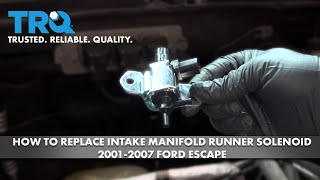
Typical fix: Replace the IMRC solenoid assembly. It is typically mounted to the intake manifold with two bolts and has vacuum lines and an electrical connector attached. On many Ford/Mazda 2.0L/2.5L applications, two identical solenoids are mounted on one bracket; it is common to replace the entire assembly. 🎬 See this video for a step-by-step solenoid removal and installation.
Est. part cost: $25-$75 - Damaged Wiring or Connector 🟡 Medium Probability Engine heat and vibrations can make wires brittle and cause corrosion in the connector pins. Rodent damage is also a possibility.
How to confirm: Visually inspect the wiring harness leading to the IMRC solenoid for any signs of breaks, chafing, or rodent damage. Check the inside of the electrical connector for corrosion or backed-out pins. With the key on and engine off, use a multimeter to confirm that one of the pins in the connector has battery voltage.
Typical fix: Repair the damaged section of wire or replace the connector pigtail. Pigtail connectors are available from auto parts stores or online marketplaces. The pins can often be removed from the connector housing for repair without cutting wires.
Est. part cost: $10-$30 - Cracked or Disconnected Vacuum Lines ⚪ Low Probability Rubber vacuum lines become brittle and crack over time due to heat and age.
How to confirm: Visually inspect all vacuum lines connected to the IMRC solenoid and the intake manifold for cracks, splits, or loose connections. A handheld vacuum pump can be used to test the integrity of the lines and the actuator diaphragm. A leak here may also set lean codes like P0171.
Typical fix: Replace the damaged vacuum hose(s).
Est. part cost: $5-$20
Rare But Worth Checking
- Powertrain Control Module (PCM) Fault: → Shop Engine Control Module (ECM) This is extremely rare. The PCM's internal driver for the IMRC circuit can fail, but all other possibilities should be exhausted before considering PCM replacement.
Diagnosis Steps
- Retrieve the stored trouble code(s) with an OBD-II scanner to confirm P2008 is present.
- Visually inspect the IMRC solenoid, which is located on the side of the plastic intake manifold. Check that its electrical connector is plugged in securely.
- Inspect the wiring harness leading to the solenoid for any obvious damage, such as cuts, burns, or signs of rodent activity.
- Inspect the rubber vacuum lines attached to the solenoid for any cracks, splits, or disconnections.
- If the visual inspection reveals no issues, perform a resistance test on the solenoid. Disconnect the electrical plug and use a multimeter set to Ohms to measure across the two pins of the solenoid. A good part should read around 32.3 Ohms. An open circuit ('OL') or a significantly different reading indicates a failed solenoid.
- If the solenoid tests good, check for power at the connector. Turn the ignition to 'ON' (engine off). Use a multimeter to check for battery voltage at one of the pins in the harness-side connector. The other pin is the ground, which is controlled by the PCM.
- If there is no voltage, the problem is in the wiring or the PCM. If there is voltage and the solenoid tested good, the issue may be an intermittent connection or a problem with the ground side of the circuit.
Parts You'll Likely Need
- Intake Manifold Runner Control Solenoid / Valve
(OEM #L30118741, 1S7Z9J559BA, 3S4Z9J559AA, BS7E-9J559-AA, LF82-18-741)— This is the most frequent failure point for a P2008 code due to its location and function. The internal coil winding breaks, creating the 'open circuit' detected by the PCM.
Trusted brands: Motorcraft, Dorman, Standard Motor Products (SMP), Aftermarket (e.g., K5T46597)
OEM price range: $50-$90
Aftermarket price range: $25-$50
Related Codes That Often Appear With This One
- P2004 — Intake Manifold Runner Control Stuck Open. If the electrical circuit is faulty (P2008), the PCM may lose its ability to know the position of the flaps, sometimes leading to a secondary code indicating they are stuck open.
- P2006 — Intake Manifold Runner Control Stuck Closed. This is a very common companion code. If the P2008 electrical fault prevents the solenoid from activating, the flaps will fail to open, causing the PCM to log them as stuck closed.
- P0171 — System Too Lean (Bank 1). If the vacuum line that operates the IMRC actuator is cracked or broken, it creates a vacuum leak. This unmetered air entering the engine can cause a lean condition and trigger a P0171 code alongside the P2008.
Platform-Specific Known Issues
- On the 2.5L Duratec, the IMRC solenoid is often sold as a single unit or as a pair with an identical solenoid for another function, mounted on the same bracket. It is often easiest to replace the entire bracketed assembly.
- The plastic intake manifold itself can develop issues with the internal 'swirl flaps' wearing out and causing a rattling noise, but this is a separate mechanical problem from the P2008 electrical code.
Mechanic-Grade Diagnostic Values
- IMRC Solenoid Coil Resistance — expected: Approximately 32.3 Ohms. Failure: Infinite resistance ('OL' or open loop) or a significantly higher reading. The coil winding has broken.
- IMRC Solenoid Connector Voltage (Key On, Engine Off) — expected: One pin should have 12V+ (battery voltage). The other pin is the control, which the PCM will ground to activate the solenoid.. Failure: No voltage on either pin indicates a wiring issue, blown fuse, or PCM fault upstream of the connector.
Scan Tool Commands That Help
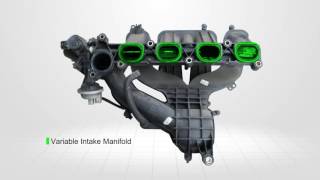
- Ford IDS (or equivalent high-end scan tool): Active Command / Bidirectional Control for IMRC — After verifying the solenoid's resistance is good but it still doesn't seem to activate. This command allows you to manually cycle the solenoid on and off from the scan tool. You should hear an audible click from the solenoid 🎬 Watch: How the solenoid type intake runner control system operates. each time it's commanded. If you can command it on and off and it clicks, the solenoid and its wiring are likely good, pointing towards an intermittent issue or a problem with the PCM's trigger under normal driving conditions.
Wiring & Ground Locations
- Engine Block Ground — On the engine block, near the oil filter housing. A black cable with a purple stripe connects from the battery negative terminal to this point.. A poor engine ground can cause a host of intermittent and difficult-to-diagnose electrical issues, including faults in sensor and actuator circuits. While not a direct cause of P2008, ensuring this primary ground connection is clean and tight is a crucial step in ruling out underlying electrical problems.
Real Owner Repair Stories
- Ford Focus Club forum post (Ford Focus Mk2.5 1.8L Duratec (uses the same IMRC system)) — Intermittent loss of power in the low RPM range (below 3000 RPM), followed by a sudden surge of power. Check Engine Light was on.
❌ Tried (didn't work) Initial diagnosis was difficult due to the intermittent nature of the fault.
✅ What actually fixed it The user identified the code as P2008. Replacing the IMRC solenoid and cleaning the throttle body resolved all symptoms, restoring performance and fuel economy. - YouTube video by 'Down the shed with Byron' (2009 Ford Focus with P2008) — Check Engine Light with code P2008.
✅ What actually fixed it The video demonstrates a diagnostic trick: since there are two identical solenoids on the bracket, you can unplug both, swap their electrical connectors, clear the codes, and run the engine. If the fault code changes to a different system, it confirms the solenoid itself is bad. The creator replaced the faulty solenoid, which fixed the issue.
OEM Part Supersession History
1S7Z-9J559-BA→3S4Z-9J559-AA— Part revision or manufacturer change.
Heads up: These parts are generally interchangeable for this application. The 2.5L Duratec engine shares many components with the 2.0L and 2.3L versions, including this solenoid.3S4Z-9J559-AA→BS7E-9J559-AA— Part revision for newer models, but remains backward compatible.
Heads up: BS7E-9J559-AA is a common replacement part number that fits a wide range of Ford, Mazda, and Volvo vehicles with similar IMRC systems.
Diagnostic Flowchart
Other Known Issues on This Vehicle
Issues unrelated to this code that are worth knowing about as an owner of this generation:
- Electronic Throttle Body (ETB) Failure 🔴 High — Extremely common. Can occur at any mileage, often leading to sudden 'limp mode' where the vehicle loses power. The issue was widespread enough to prompt an NHTSA investigation (PE13003) and a Ford Customer Satisfaction Program (13N03) extending the warranty, which has since expired. (Ref: Ford Customer Satisfaction Program 13N03 (Expired))
- Electric Power Steering (EPS) Failure 🔴 High — Very common and dangerous. The system can fail suddenly, making the vehicle extremely difficult to steer, especially at low speeds. This prompted a major safety recall. (Ref: Ford Recall 14S05 / NHTSA #14V284)
- 6F35 Transmission Fluid Leak from Axle Seal 🟠 Medium — A well-documented issue where the left-side (driver's side) transaxle seal leaks, potentially leading to transmission damage from fluid loss. Ford released a TSB with a revised service kit. (Ref: TSB 16-0043)
- Rear Wheel Arch and Liftgate Rust 🟡 Low — Common in regions that use road salt. Rust forms prematurely in the rear wheel wells/arches and around the liftgate handle assembly.
- Minor Coolant Consumption 🟡 Low — The 2.5L Duratec engine family is known to consume small amounts of coolant over time, sometimes attributed to engine block porosity. It typically does not cause immediate issues but requires owners to monitor coolant levels periodically.
Used vs. New Parts: Buying Guide for This Vehicle
When a used part is the smart pick: A used IMRC solenoid is generally not recommended. The part is inexpensive to buy new (typically under $50 for an aftermarket version), and it is a known common failure item. The risk of a used part failing soon after installation is high, making the labor of replacing it twice not worth the small cost savings.
Donor-vehicle mileage cap: roughly under 50000 miles for the part to have meaningful remaining life.
What to inspect on the donor part:
- If buying used is the only option, source it from the newest, lowest-mileage vehicle possible.
- Before purchasing, test the resistance of the used solenoid with a multimeter. It should read approximately 32-35 Ohms.
- Visually inspect the plastic housing for cracks and the vacuum nipples for any damage.
OEM-only on this vehicle (don't cheap out):
- No parts in this specific repair require OEM-only sourcing. Aftermarket solenoids are widely available and generally considered reliable.
Aftermarket brands forum-validated for this vehicle:
- Dorman (e.g., part number 911-908)
- Standard Motor Products (SMP)
Brands owners have reported issues with on this vehicle:
- No-name, unbranded parts from online marketplaces may have lower quality control and are best avoided, though many owners use them successfully due to the low cost.
Real Owner Stories
Aggregated from forums and TSBs cited above. Mileages and costs reflect what owners reported in those sources.
2010 Ford Focus 2.0L (Same IMRC System)
Symptoms: The owner experienced a P2008 code and found the solenoid was failing.
What fixed it: Replaced the IMRC solenoid. The failed part read 60 Ohms before eventually going open circuit, while the new part read ~32 Ohms.
Source hint: aliexpress.com product review for a replacement solenoid
2009-2012 Ford Escape 2.5L
Symptoms: Sluggish performance and an open circuit fault code.
What fixed it: Replacement of the IMRC solenoid assembly, which is frequently mounted as a pair on a single bracket.
Source hint: fordownersclub.com/forums/topic/7103-p2008-intake-manifold-runner-control-circuit/
2009-2012 Ford Escape 2.5L
Symptoms: Loss of low-end power and a Check Engine Light.
What fixed it: Replacing the IMRC solenoid, though the owner noted that if the code persists, the wiring harness should be inspected for heat-related damage.
Source hint: reddit.com/r/FordFocus real-world owner experiences
Related OBD-II Codes
Frequently Asked Questions
Is there a recall for the P2008 code on my 2009-2012 Ford Escape?
Can I just replace one solenoid, or do I need the whole bracket assembly for my 2.5L Duratec?
My Escape has a rattling noise from the intake; is that causing the P2008 code?
What resistance should I look for when testing the IMRC solenoid on my 2010 Escape?
Could a vacuum leak cause the P2008 code on this specific Ford engine?
Helpful Videos


We Have This Part in Stock


The information in this article is provided for general reference and educational purposes only. Vehicle specifications, procedures, and part compatibility can vary by production date, trim level, and region. Always consult your vehicle's factory service manual and verify part numbers before purchasing or performing repairs. Safety-critical components such as airbags, seat belts, and braking systems should be installed by a qualified professional.
- Ford Escape:
- 🧭 Diagnostic Flowchart
- 🎬 Helpful Videos
- 🛍️ Shop This Part
- What's Unique About the 2009-2012 Ford Escape
- Symptoms You May Notice
- Most Likely Causes
- Rare But Worth Checking
- Diagnosis Steps
- Parts You'll Likely Need
- Related Codes That Often Appear With This One
- Platform-Specific Known Issues
- Mechanic-Grade Diagnostic Values
- Scan Tool Commands That Help
- Wiring & Ground Locations
- Real Owner Repair Stories
- OEM Part Supersession History
- Other Known Issues on This Vehicle
- Used vs. New Parts: Buying Guide for This Vehicle
- Real Owner Stories
- 2010 Ford Focus 2.0L (Same IMRC System)
- 2009-2012 Ford Escape 2.5L
- 2009-2012 Ford Escape 2.5L
- Related OBD-II Codes
- Frequently Asked Questions
- 🎟️ Get 5% Off