

P2008 on 2011-2019 Ford Explorer 3.5L: Intake Manifold Runner Control Fixes
On the 3.5L V6, code P2008 almost always points to a failed Intake Manifold Runner Control (IMRC) solenoid, also called an actuator. It's an electrical failure within the part, not a mechanical one. The solenoid is located on the intake manifold and is a common failure item due to heat and vibration. Bank 1 is the firewall side of the engine, which is more difficult to access.
- P2008 indicates an electrical failure in the Intake Manifold Runner Control (IMRC) circuit for Bank 1.
- The most likely cause is a failed IMRC solenoid, a common issue on the 3.5L V6 due to heat and vibration.
- Symptoms include a Check Engine Light, reduced power, and poor fuel economy.
- Diagnosis involves testing the solenoid's resistance (expect 30-50 Ohms) and checking for power at the connector.
- The Bank 1 solenoid is on the firewall side and is difficult to access.
What's Unique About the 2011-2019 Ford Explorer
The 3.5L Cyclone V6, used across many Ford models like the Edge, Flex, and Taurus, commonly experiences this P2008 code. The frequent point of failure is the IMRC control solenoid itself. Its location on the engine subjects it to constant heat and vibration, which eventually leads to the failure of its internal electronics. While it's a well-documented issue among owners and mechanics, it has not resulted in a specific recall for the 2011-2019 Explorer.
Generation note: The 2011-2019 year range covers the entire fifth generation of the Ford Explorer (U502). The 3.5L Cyclone V6 was the standard engine for most of this generation, and the IMRC system design remained consistent, making this guide applicable to all models within this range.
Symptoms You May Notice
- Check Engine Light is on
- Reduced power and sluggish acceleration, especially at low RPMs
- Rough or uneven idle
- Decreased fuel economy
- Engine hesitation or surging
- Replacing the intake manifold when only the external solenoid has failed.
- Replacing spark plugs or ignition coils to fix the rough idle without addressing the IMRC code.
- Confusing the Bank 1 (firewall side) and Bank 2 (radiator side) solenoids and replacing the wrong one.
Most Likely Causes
- Failed Intake Manifold Runner Control (IMRC) Solenoid 🔴 High Probability → Shop Engine Intake Manifold The solenoid is mounted directly to the intake manifold, where it is exposed to significant engine heat and vibration, causing its internal coil windings to fail and create an open circuit.
How to confirm: Test the solenoid's resistance with a multimeter. A good solenoid should have a resistance of approximately 30-50 Ohms. An open circuit (infinite resistance or 'OL') confirms failure. You can also swap the Bank 1 (firewall side) and Bank 2 (radiator side) solenoids and see if the code changes to P2010 (IMRC Circuit Open Bank 2), which would confirm the solenoid is the faulty part.
Typical fix: Replace the faulty IMRC solenoid for Bank 1.
Est. part cost: $40-$100 - Wiring Harness or Connector Issue 🟡 Medium Probability Engine vibrations can cause wires to chafe, and heat can make connectors brittle. The connector can also be knocked loose during other engine service, such as spark plug changes.
How to confirm: Visually inspect the wiring going to the IMRC solenoid for any signs of damage, melting, or corrosion. Check that the electrical connector is securely plugged into the solenoid. Test for 12V power at the connector with the key on, engine off.
Typical fix: Repair the damaged section of the wiring harness or clean/replace the connector. The Motorcraft pigtail connector is part number WPT-1716 if replacement is needed.
Est. part cost: $10-$50 - Stuck or Binding Intake Runner Flaps ⚪ Low Probability Carbon buildup over many miles can cause the mechanical flaps inside the plastic intake manifold to stick, which can overwork and burn out the control solenoid's motor. This is less common for a P2008 'circuit open' code but can be a related failure.
How to confirm: With the IMRC actuator removed, try to manually move the runner linkage. If it is stiff or will not move, the flaps are binding. This often requires intake manifold removal to inspect and clean.
Typical fix: Clean the intake manifold and runner flaps. If the flaps or linkage are broken, the entire intake manifold assembly must be replaced.
Est. part cost: $300-$600
Rare But Worth Checking
- Faulty Powertrain Control Module (PCM): → Shop Engine Control Module (ECM) This is extremely rare. The PCM's driver circuit for the IMRC can fail, but all other potential causes should be exhaustively ruled out before considering PCM replacement.
Diagnosis Steps
- Confirm the presence of code P2008 with an OBD-II scanner.
- Locate the IMRC solenoids on the intake manifold. The 3.5L V6 has two; one for each bank. Bank 1 is the cylinder bank closer to the firewall. Bank 2 is closer to the radiator.
- Check the electrical connector on the Bank 1 solenoid. Ensure it is clean, free of corrosion, and securely plugged in.
- Inspect the wiring leading to the connector for any visible signs of damage, chafing, or melting.
- If wiring looks good, disconnect the solenoid and test its two pins with a multimeter set to Ohms. A good solenoid will show a resistance between 30-50 Ohms. A failed one will often show an open circuit (infinite resistance or 'OL').
- If the solenoid tests bad, replace it. The Bank 1 solenoid is difficult to access and may require shifting or removing other components for clearance.
- If the solenoid tests good, check for 12V power at the harness connector with the ignition on. If there is no power, the issue is further up the harness or potentially with the PCM power relay or fuse.
- After repair, clear the codes with the scanner and perform a test drive to ensure the issue is resolved.
Parts You'll Likely Need
- Intake Manifold Runner Control Solenoid / Actuator
(OEM #9L8Z-9E928-A)— This is the most common failure point for a P2008 code on this engine due to its location and the electrical stress it endures.
Trusted brands: Motorcraft, Dorman (Part # 911-906), Standard Motor Products
OEM price range: $70-$120
Aftermarket price range: $40-$80
Related Codes That Often Appear With This One
- P2006 — P2006 means 'Intake Manifold Runner Control Stuck Closed'. If the P2008 electrical fault prevents the solenoid from activating, the flaps will remain in their default closed position, often triggering P2006 as well.
- P2010 — P2010 is 'Intake Manifold Runner Control Circuit Open, Bank 2'. Seeing this code would point to an issue with the other solenoid, on the radiator side of the engine.
Technical Service Bulletins (TSBs) & Recalls
- No specific TSB for P2008 on the 2011-2019 Explorer 3.5L was found. The issue is typically resolved by following standard diagnostic procedures for an open circuit.
Platform-Specific Known Issues
- The IMRC solenoid for Bank 1 (firewall side) is significantly more difficult to access than Bank 2 (radiator side). While some mechanics can replace it without removing the upper intake manifold, it is a very tight fit. Many procedures for platform mates like the Ford Edge suggest intake removal is necessary for this job, which would dramatically increase labor time.
Mechanic-Grade Diagnostic Values
- IMRC Solenoid Coil Resistance — expected: 30-50 Ohms (some sources cite 32-35 Ohms as a perfect reading). Failure: A reading of 'OL' (Over Limit) or infinite resistance, indicating an open circuit. A reading near zero indicates a short.
- IMRC Solenoid Connector Pin 1 (Power Supply) — expected: 12V+ (Battery Voltage) with Key On, Engine Off (KOEO).. Failure: 0V or significantly low voltage points to an issue in the power supply circuit (fuse, PCM Power Relay, or wiring).
- IMRC Solenoid Connector Pin 2 (PCM Control) — expected: This is a ground-side switched circuit. The PCM pulls this pin to ground (0V) to energize the solenoid.. Failure: If 12V is present on Pin 1, and a bidirectional command to activate the solenoid does not result in this pin going to ground, it may indicate a wiring break to the PCM or a faulty PCM driver.
Hidden / Shadow Codes Worth Checking
- Mode $06, Test ID for IMRC: Mode $06 is a diagnostic mode that shows the results of the PCM's self-tests for various components before a full-blown Diagnostic Trouble Code (DTC) is set. A failing result for the IMRC monitor test can indicate an intermittent problem even if the Check Engine Light is not currently on. (see via Requires a scan tool with Mode $06 viewing capability, such as FORScan or professional-grade scanners.)
Scan Tool Commands That Help
- Ford IDS, FORScan: IMRC Output State Control / Active Command — This is a primary bidirectional test used to verify the solenoid's function and wiring. The command cycles the solenoid on and off, and the technician should listen for an audible 'click' from the solenoid. If a click is heard, the solenoid and its wiring are likely good. If no click is heard, it confirms a fault in the solenoid or its circuit, prompting electrical testing.
Wiring & Ground Locations
- IMRC Solenoid Connector (Bank 1) — On the IMRC solenoid itself, located on the rear of the upper intake manifold, closer to the firewall.. This is the primary point for electrical testing. Pin 1 is the 12V power feed (often a Red wire) from the PCM Power Relay, and Pin 2 is the control wire that the PCM grounds to activate the solenoid.
- IMRC Wiring Harness Chafe Point — The section of the harness running to the rear (Bank 1) IMRC solenoid can potentially rub against the back of the cylinder head or intake manifold linkage.. Vibrations can cause the wire's insulation to wear through, creating an open or short in the circuit, which directly causes a P2008 code.
- PCM Power Relay — Located in the engine compartment Power Distribution Box (fuse box).. This relay supplies the 12V power to the IMRC solenoid circuit. A failure of this relay will result in no power at the solenoid connector, causing a P2008 code.
Real Owner Repair Stories
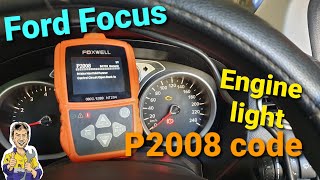
- YouTube channel 'MiracleMAX' (Ford Focus with Duratec engine (similar IMRC solenoid design and failure mode)) — Intermittent P2008 code, check engine light would come on and go off. No noticeable performance issue when cold.
❌ Tried (didn't work) A standard resistance test on the solenoid when the engine was cold showed a normal reading (35.5 Ohms).
✅ What actually fixed it The technician suspected a heat-related failure. He used a heat gun to warm up the solenoid while monitoring its resistance with a multimeter. As the solenoid heated up, the resistance reading suddenly went to 'OL' (open circuit), confirming the internal coil winding was breaking only when hot. Replacing the solenoid fixed the issue. This demonstrates the value of testing under the conditions of the fault (i.e., when the engine bay is hot).
When the Usual Fixes Don't Work
- While replacing the IMRC solenoid is the most common fix, it is not a guaranteed solution. There are documented cases on forums and Reddit where owners replace the solenoid for Bank 1, clear the code, and have it return. This underscores that a P2008 code indicates a 'circuit' problem, which can also mean a break in the wiring harness between the PCM and the solenoid, a corroded connector pin making poor contact, or a lack of power from the PCM relay. Always confirm 12V power at the connector before condemning the solenoid.
OEM Part Supersession History
9L8Z-9E928-A→No supersession found.— N/A
Heads up: The part number 9L8Z-9E928-A appears to be the consistent part for this application. Be cautious of similar-looking parts for other Ford engines, as they may have different resistance values or vacuum port configurations.
Model Year Variations Within This Range
- 2011-2019: No significant variations have been documented regarding the IMRC system, its components, or the causes of code P2008 for the 3.5L V6 engine within this generation. The 2016 model year facelift was primarily cosmetic and did not alter the IMRC design.
Diagnostic Flowchart
Other Known Issues on This Vehicle
Issues unrelated to this code that are worth knowing about as an owner of this generation:
- Internal Water Pump Failure 🔴 High — Commonly occurs around or after 100,000 miles. Failure can cause coolant to mix with engine oil, leading to catastrophic engine damage.
- Power Transfer Unit (PTU) Failure (AWD Models) 🔴 High — The PTU fluid is considered 'lifetime' by Ford but gets cooked by heat from the nearby exhaust, turning to sludge and causing failure. Symptoms include grinding noises or a propane-like smell. Regular fluid changes (every 30k miles) are recommended as a preventative measure.
- Exhaust Odor In Cabin 🟠 Medium — Widespread issue on 2011-2017 models where exhaust fumes can enter the cabin, particularly under heavy acceleration. Linked to unsealed body seams in the rear of the vehicle. (Ref: TSB 16-0166, TSB 17-0029, TSB 17-0044)
- Electronic Power Steering Rack Failure 🟠 Medium — Failures of the electronic power steering rack are a common complaint, leading to loss of power assist. (Ref: Multiple recalls for various steering components exist across these model years.)
- Electronic Throttle Body Malfunction 🟠 Medium — Can cause sudden power loss, hesitation, and the vehicle entering 'limp mode'. Often triggers codes P2111 or P2112.
Used vs. New Parts: Buying Guide for This Vehicle
When a used part is the smart pick: For a P2008 code, buying a used IMRC solenoid is NOT recommended. It is a common failure item due to heat and vibration, and a used part has an unknown history and is likely to fail soon. A used part only makes sense for the larger intake manifold assembly if it needs to be replaced due to physically broken flaps or linkage (which typically sets codes like P2006/P2007, not P2008).
Donor-vehicle mileage cap: roughly under 50000 miles for the part to have meaningful remaining life.
What to inspect on the donor part:
- For a full intake manifold: ensure the donor vehicle was not in a front-end collision.
- Inspect the plastic housing for any cracks or signs of heat damage.
- Manually actuate the runner linkage (the part the solenoid connects to) to ensure it moves freely without binding or sticking.
- Check that all vacuum ports are intact and not broken.
OEM-only on this vehicle (don't cheap out):
- While not strictly OEM-only, the Motorcraft solenoid is highly recommended for fit and longevity. Some aftermarket parts may have slightly different resistance values that could cause issues.
Aftermarket brands forum-validated for this vehicle:
- Dorman (Part # 911-906)
- Standard Motor Products (SMP)
Brands owners have reported issues with on this vehicle:
- No-name, unbranded parts from online marketplaces should be avoided as their quality control and material specifications are unknown.
Real Owner Stories
Aggregated from forums and TSBs cited above. Mileages and costs reflect what owners reported in those sources.
Ford Explorer 3.5L V6
Symptoms: Owner experienced both P2008 and P2006 IMRC codes simultaneously and noted the difficulty of accessing the part located near the firewall.
What fixed it: Confirmed the Bank 1 solenoid was the culprit and replaced it.
Source hint: explorerforum.com: 'P2008 and P2006 IMRC codes' - https://www.explorerforum.com/forums/index.php?threads/p2008-and-p2006-imrc-codes.491234/
Ford Flex 3.5L V6
Symptoms: Owner reported a P2008 failure on the 3.5L engine, corroborating that this platform shares the same IMRC solenoid failure mode as the Explorer.
What fixed it: Replacement of the IMRC solenoid.
Source hint: fordflex.net: Multiple threads discuss P2008 on the 3.5L engine
Related OBD-II Codes
Frequently Asked Questions
Is there a specific TSB for the P2008 code on my 2011-2019 Ford Explorer 3.5L?
Which IMRC solenoid is responsible for the P2008 code on the Cyclone 3.5L V6?
Can I swap parts to confirm the solenoid is bad before buying a new one?
If I need to replace the wiring connector for the IMRC solenoid, what part do I need?
Do I have to remove the upper intake manifold to fix P2008 on my Explorer?
Should I buy a used IMRC solenoid from a salvage yard to save money?
Helpful Videos
We Have This Part in Stock


The information in this article is provided for general reference and educational purposes only. Vehicle specifications, procedures, and part compatibility can vary by production date, trim level, and region. Always consult your vehicle's factory service manual and verify part numbers before purchasing or performing repairs. Safety-critical components such as airbags, seat belts, and braking systems should be installed by a qualified professional.
- Ford Explorer:
- 🧭 Diagnostic Flowchart
- 🎬 Helpful Videos
- 🛍️ Shop This Part
- What's Unique About the 2011-2019 Ford Explorer
- Symptoms You May Notice
- Most Likely Causes
- Rare But Worth Checking
- Diagnosis Steps
- Parts You'll Likely Need
- Related Codes That Often Appear With This One
- Technical Service Bulletins (TSBs) & Recalls
- Platform-Specific Known Issues
- Mechanic-Grade Diagnostic Values
- Hidden / Shadow Codes Worth Checking
- Scan Tool Commands That Help
- Wiring & Ground Locations
- Real Owner Repair Stories
- When the Usual Fixes Don't Work
- OEM Part Supersession History
- Model Year Variations Within This Range
- Other Known Issues on This Vehicle
- Used vs. New Parts: Buying Guide for This Vehicle
- Real Owner Stories
- Ford Explorer 3.5L V6
- Ford Flex 3.5L V6
- Related OBD-II Codes
- Frequently Asked Questions
- 🎟️ Get 5% Off