

P2008 on 2009-2012 Ford Flex 3.5L: Intake Manifold Runner Control Circuit Open (Bank 1) Causes and Fixes
This code indicates an electrical problem with the intake manifold runner control (IMRC) solenoid for Bank 1. The most common fix is replacing the IMRC solenoid itself, which fails from heat and vibration. The OEM part number is often cited as 9L8Z-9E928-A or a variant. Expect the part to cost between $40 and $100 for an aftermarket replacement.
- P2008 is an electrical fault, not a mechanical one. Your focus should be on the IMRC solenoid, wiring, and connector for Bank 1.
- The most likely culprit is a failed IMRC solenoid (OEM Part # 9L8Z-9E928-A) due to heat and vibration. This is a relatively inexpensive part and is accessible for DIY replacement on the front of the intake manifold.
- Before buying parts, check that the solenoid's electrical connector is securely plugged in, as it can be knocked loose during other engine work.
- If you ignore P2008, you will likely get a P2006 (Stuck Closed) code soon after, as the dead electrical circuit prevents the flaps from opening.
What's Unique About the 2009-2012 Ford Flex
The 3.5L Cyclone V6 engine used in the Flex is also found in many other Ford and Lincoln vehicles from this era, including the Edge, Taurus, and Lincoln MKS. The P2008 code is a relatively common issue across these platforms. The cause is frequently the IMRC control solenoid, which is mounted on the intake manifold where it is exposed to significant engine heat and vibration, leading to a finite lifespan and internal coil failure. While a common repair, it did not prompt a specific recall or widespread Technical Service Bulletin (TSB) for this particular model and code.
Symptoms You May Notice
- Check Engine Light is on
- Rough or uneven idle.
- Hesitation or stumbling during acceleration.
- Noticeable loss of power and torque, especially at low speeds.
- Reduced fuel economy.
- Engine may surge at times.
- Replacing the entire intake manifold when only the external solenoid has failed.
- Replacing spark plugs or ignition coils hoping to fix the rough idle without diagnosing the specific code.
- Confusing the Bank 1 solenoid with the Bank 2 solenoid. On the transverse 3.5L, Bank 1 (P2008) is the firewall side, and Bank 2 (P2009) is the radiator side.
Most Likely Causes
- Failed Intake Manifold Runner Control (IMRC) Solenoid 🔴 High Probability → Shop Engine Intake Manifold The solenoid is located on the engine where it is exposed to constant heat and vibration, which can cause the internal coil windings to break over time, creating an 'open' circuit. This is the most frequent point of failure for this code.
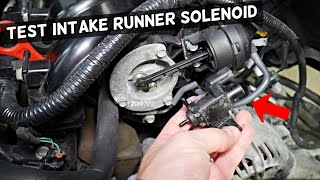
How to confirm: Use a scan tool's active test function to command the solenoid to click. 🎬 Watch: How to test the intake runner solenoid on your car If it doesn't click, test for power and ground at the connector with a multimeter. If 12V power is present but it doesn't activate, the solenoid has failed. A resistance test across the two pins of the solenoid should yield a specific reading (e.g., 30-50 ohms); an open circuit (infinite resistance) confirms failure.
Typical fix: Replace the IMRC solenoid for Bank 1. The OEM part is often listed as Motorcraft, with part number 9L8Z-9E928-A or similar.
Est. part cost: $40-$100 - Damaged Wiring or Loose Connector 🟡 Medium Probability The wiring harness is in a hot engine bay and can become brittle. It's also common for the connector to be accidentally unplugged or not seated properly during other maintenance like spark plug changes. Rodent damage is also a possible cause.
How to confirm: Visually inspect the wiring harness leading to the IMRC solenoid for any signs of breaks, melting, or rodent damage. Ensure the electrical connector is securely plugged in and the pins are clean and not corroded. Wiggle the connector and harness with the engine running to see if it affects idle.
Typical fix: Repair the broken wire or replace the connector pigtail. A common replacement connector part is Standard Motor Products S-1415. For more severe damage, a junkyard pigtail can be spliced in.
Est. part cost: $15-$30 - Cracked or Disconnected Vacuum Lines ⚪ Low Probability Rubber vacuum hoses can become brittle and crack with age and heat cycles, leading to a loss of vacuum needed to actuate the runner flaps.
How to confirm: Visually inspect all vacuum lines connected to the IMRC actuator and intake manifold for cracks, splits, or loose connections. Listen for a hissing sound at idle. A smoke test can definitively identify leaks.
Typical fix: Replace the damaged vacuum line(s).
Est. part cost: $5-$20
Rare But Worth Checking
- Stuck Intake Manifold Runner Flaps: → Shop Engine Intake Manifold This usually triggers a different code (like P2006 for stuck closed), but severe carbon buildup could cause related electrical faults or appear alongside P2008.
- Faulty Powertrain Control Module (PCM): → Shop Engine Control Module (ECM) This is very rare, but if the solenoid and wiring are confirmed to be good, the driver circuit within the PCM could have failed. This should be the last item to check.
Diagnosis Steps
- Read the code with an OBD-II scanner to confirm P2008 is present.
- Perform a visual inspection of the Bank 1 IMRC solenoid, its electrical connector, and all associated vacuum lines. On the transverse 3.5L V6, Bank 1 is the cylinder bank closer to the firewall. The solenoid for Bank 1 is on the rear of the intake manifold.
- If you have a capable bidirectional scanner (like FORScan for Fords), perform an 'active test' to command the solenoid on and off. Listen for an audible click from the solenoid.
- If no click is heard, unplug the solenoid connector. Use a multimeter to check for 12V power on one wire with the key on, engine off. The other wire is the ground/control from the PCM.
- If voltage is present, test the solenoid's internal resistance. A reading of 'OL' or infinite resistance indicates an open coil and a failed solenoid. If voltage is not present, the problem is in the wiring harness, fuse, or the PCM.
- Check for continuity on the ground wire and the signal wire back to the PCM. Repair any open circuits found in the wiring. Check for a blown fuse related to the IMRC circuit in the engine bay fuse box.
- If wiring and power are good but the solenoid does not activate (and its coil resistance is out of spec), replace the IMRC solenoid (Part # 9L8Z-9E928-A or equivalent).
- After the repair, clear the codes and perform a test drive to ensure the issue is resolved.
Parts You'll Likely Need
- Intake Manifold Runner Control Solenoid
(OEM #9L8Z-9E928-A)— This is the most common failure point for a P2008 code, as the solenoid's internal coil fails from heat and vibration.
Trusted brands: Motorcraft, Dorman, Standard Motor Products (SMP)
OEM price range: $70-$120
Aftermarket price range: $40-$100 - Intake Manifold Runner Solenoid Connector
(OEM #WPT-1074 (pigtail kit, check application))— If the wiring is damaged right at the connector, or the connector itself is broken, replacing the pigtail is the required fix.
Trusted brands: Standard Motor Products (S-1415), Dorman, Motorcraft
OEM price range: $25-$40
Aftermarket price range: $15-$30
Related Codes That Often Appear With This One
- P2006 — If the P2008 electrical fault prevents the solenoid from activating, the runner flaps will remain in their default (closed) position, which can then trigger the P2006 'Intake Manifold Runner Control Stuck Closed' code.
- P2004 — Similar to P2006, this code indicates 'Intake Manifold Runner Control Stuck Open'. While less common to see with P2008, a system fault could potentially lead to a variety of IMRC codes.
Platform-Specific Known Issues
- Solenoid Location: On the 3.5L Cyclone V6, there are two IMRC solenoids. For P2008 (Bank 1), you are looking for the solenoid located on the rear of the upper intake manifold, closer to the firewall. Bank 2 (P2009) is on the front, closer to the radiator. Misdiagnosing the bank is a common mistake.
Mechanic-Grade Diagnostic Values
- IMRC Solenoid Coil Resistance — expected: 30 - 50 Ohms (approximate, varies by manufacturer). Failure: A reading of 'OL' (Over Limit) or infinite resistance indicates an open circuit inside the solenoid, which is the direct cause of a P2008 code.
- IMRC Solenoid Connector Voltage (Power Pin) — expected: 12V (Battery Voltage) with Key On, Engine Off. Failure: 0V or significantly less than battery voltage indicates a problem with the power supply wire, fuse, or relay, not the solenoid itself.
Hidden / Shadow Codes Worth Checking
- Mode $06, TID $81, CID $11: While not a separate code, advanced scan tools can access Mode $06 data. For Ford, this may relate to IMRC monitor tests. A failure in Test ID (TID) related to the IMRC system can provide confirmation of the fault before the PCM has completed enough drive cycles to illuminate the MIL for a recurring P2008. (see via Professional scan tool or advanced DIY tools like FORScan with Mode $06 viewing capability.)
Scan Tool Commands That Help
- FORScan / Ford IDS: IMRC Output State Control (or similar name) — This is a bidirectional test that allows the technician to command the IMRC solenoid on and off directly from the scan tool. It is the fastest way to confirm if the solenoid is capable of functioning. If the command is sent and no 'click' is heard from the solenoid, it strongly points to a failed solenoid or a break in the wiring.
Wiring & Ground Locations
- G104 — Right rear of the engine.. This is a primary engine ground. While not exclusive to the IMRC circuit, a poor connection here can cause a variety of erratic sensor and actuator behaviors, including intermittent faults that are hard to trace.
- G101 / G100 — Left/Right front of the engine compartment.. These are main chassis grounds in the engine bay. Verifying they are clean and tight is a crucial step when diagnosing any electrical fault, as a poor ground can cause voltage drops and open circuit codes.
- IMRC Solenoid Connector (C1651 for Bank 1) — On the IMRC solenoid body, rear of the intake manifold.. This is the primary test point. Pin 1 (typically a Yellow/Green wire) should have 12V with key on. Pin 2 (wire color varies) is the control wire from the PCM. Testing for power and continuity happens at this connector.
Real Owner Repair Stories
- YouTube channel 'MiracleMAX' (Ford Focus (demonstrates same P2008 diagnostic principle)) — Check Engine Light on, code P2008 present. The fault was intermittent, with the light sometimes taking over a week to return after being cleared.
❌ Tried (didn't work) Initial visual inspection and clearing the code. The code returned after 8 days.
✅ What actually fixed it The technician tested the resistance of the IMRC solenoids when cold and they tested good. However, knowing they are prone to heat-related failure, he replaced the solenoid pack. The video explains that the internal coil windings can develop breaks that only manifest as an open circuit when the engine bay gets hot, causing the intermittent code. The final fix was replacing the IMRC solenoid assembly.
Model Year Variations Within This Range
- 2009-2012: The base 3.5L V6 in the 2009-2012 Ford Flex produced 262 hp. For the 2013 model year facelift, this was increased to 287 hp. While the core IMRC system function is the same, there could be minor variations in PCM software or part numbers post-facelift. However, for the specified 2009-2012 range, the components and diagnosis are consistent.
Diagnostic Flowchart
Other Known Issues on This Vehicle
Issues unrelated to this code that are worth knowing about as an owner of this generation:
- Internal Water Pump Failure 🔴 High — Common after 80,000-150,000 miles. Failure can cause coolant to mix with engine oil, leading to catastrophic engine failure.
- Power Transfer Unit (PTU) Failure (AWD Models) 🔴 High — Fluid can overheat and degrade due to proximity to the exhaust, leading to bearing/gear failure often before 100,000 miles. Ford considered it a 'lifetime' fluid, but frequent changes (every 30k miles) are recommended by owners.
- Electronic Throttle Body (ETB) Failure 🟠 Medium — Widespread issue causing sudden 'limp mode' where the vehicle loses power. So common that Ford issued a Customer Satisfaction Program (13N03) extending the warranty, which has since expired. (Ref: Customer Satisfaction Program 13N03 (Expired))
- Cracked Rear D-Pillar Trim Panels 🟡 Low — The black plastic trim panels on the D-pillars (rearmost pillars) are known to crack from sun exposure and age. This is a cosmetic issue.
- Electric Power Steering Assist Failure 🔴 High — Can cause a sudden loss of power steering, making the vehicle difficult to steer at low speeds. This was subject to a safety recall. (Ref: Ford Recall 15S18)
Used vs. New Parts: Buying Guide for This Vehicle
When a used part is the smart pick: A used wiring harness pigtail from a junkyard is a perfectly acceptable and cost-effective repair if only the connector is broken. The IMRC solenoid itself is not a good candidate for a used part.
Donor-vehicle mileage cap: roughly under 80000 miles for the part to have meaningful remaining life.
What to inspect on the donor part:
- For a wiring pigtail, ensure the plastic is not brittle and the locking tab is intact.
- Inspect for any signs of corrosion on the pins or melting on the connector body.
- Cut the pigtail with plenty of wire length to make splicing easier.
OEM-only on this vehicle (don't cheap out):
- No parts for this specific repair are strictly 'OEM-only'. Reputable aftermarket brands offer reliable replacements.
Aftermarket brands forum-validated for this vehicle:
- Dorman
- Standard Motor Products (SMP)
Brands owners have reported issues with on this vehicle:
- Avoid no-name, unbranded solenoids from online marketplaces, as their coil winding quality and durability can be highly suspect, leading to a repeat failure.
Related OBD-II Codes
Frequently Asked Questions
Where is the Bank 1 IMRC solenoid located on my 2009-2012 Ford Flex 3.5L V6?
Is there a specific replacement part number for the IMRC solenoid on the Ford Flex?
Could my P2008 code be caused by a recent spark plug change on my Flex?
Is there a recall for the IMRC solenoid issue on the 2009-2012 Ford Flex?
What should the resistance be if I test the IMRC solenoid with a multimeter?
Can I use a generic wiring connector if the harness is damaged?
Helpful Videos
We Have This Part in Stock


The information in this article is provided for general reference and educational purposes only. Vehicle specifications, procedures, and part compatibility can vary by production date, trim level, and region. Always consult your vehicle's factory service manual and verify part numbers before purchasing or performing repairs. Safety-critical components such as airbags, seat belts, and braking systems should be installed by a qualified professional.
- Ford Flex:
- 🧭 Diagnostic Flowchart
- 🎬 Helpful Videos
- 🛍️ Shop This Part
- What's Unique About the 2009-2012 Ford Flex
- Symptoms You May Notice
- Most Likely Causes
- Rare But Worth Checking
- Diagnosis Steps
- Parts You'll Likely Need
- Related Codes That Often Appear With This One
- Platform-Specific Known Issues
- Mechanic-Grade Diagnostic Values
- Hidden / Shadow Codes Worth Checking
- Scan Tool Commands That Help
- Wiring & Ground Locations
- Real Owner Repair Stories
- Model Year Variations Within This Range
- Other Known Issues on This Vehicle
- Used vs. New Parts: Buying Guide for This Vehicle
- Related OBD-II Codes
- Frequently Asked Questions
- 🎟️ Get 5% Off