

P2008 on 2007-2012 Lincoln MKZ 3.5L: Intake Manifold Runner Control Circuit Causes and Fixes
On the 2007-2012 Lincoln MKZ with the 3.5L V6, code P2008 almost always points to a failed Intake Manifold Runner Control (IMRC) solenoid for Bank 1. This is an electrical fault, and the most common fix is replacing the solenoid, which costs about $40-$100 for the part. Bank 1 is the cylinder bank at the rear of the engine, near the firewall, which can make access slightly more difficult than the front solenoid.
- P2008 on your MKZ specifically points to an electrical 'open circuit' fault in the Intake Manifold Runner Control for Bank 1.
- The most likely culprit by a large margin is a failed IMRC solenoid, which is a common issue on the 3.5L V6 due to heat and vibration.
- Bank 1 is the cylinder bank at the rear of the engine bay (firewall side). Make sure you are diagnosing and replacing the correct solenoid.
- Diagnosis is straightforward with a multimeter to check for power at the connector and test the resistance of the solenoid itself; a good one reads 30-50 ohms, a bad one reads open ('OL').
- This is a DIY-friendly repair for most home mechanics, though access to the rear solenoid can be tight.
What's Unique About the 2007-2012 Lincoln MKZ
The 3.5L Cyclone V6 engine is used across a wide range of Ford and Lincoln vehicles from this era, including the Ford Edge, Flex, Taurus, and Lincoln MKS/MKT. The P2008 code is a common issue on all these platforms. The primary reason is the location of the IMRC solenoid; it's mounted directly on the intake manifold where it's exposed to constant, intense engine heat and vibration. This harsh environment leads to the eventual failure of the solenoid's internal coil windings, creating the 'open circuit' condition that triggers the code.
Symptoms You May Notice
- Check Engine Light is on
- Reduced engine power and torque, especially at lower RPMs
- Poor acceleration or hesitation
- Rough, fluctuating, or surging idle
- Decreased fuel economy
- Hard starting or, rarely, a no-start condition
- Replacing the Bank 2 (front) solenoid when the code is for Bank 1 (rear).
- Replacing the intake manifold when the problem is just the bolt-on solenoid.
- Replacing the solenoid without first testing the wiring harness for power and ground at the connector.
Most Likely Causes
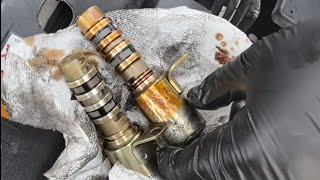
- Failed Intake Manifold Runner Control (IMRC) Solenoid 🔴 High Probability → Shop Engine Intake Manifold The solenoid is mounted directly on the intake manifold, where constant exposure to high engine heat and vibration causes the internal coil windings to break over time, creating an open circuit. This is the most common point of failure for this code on this engine.
How to confirm: Disconnect the solenoid's electrical connector and test the resistance across its two pins with a multimeter. A reading of 'OL' (Over Limit) or infinite resistance indicates an open circuit and a failed solenoid. A good solenoid should have a resistance of roughly 30-50 Ohms. 🎬 Watch: How to test the solenoid with a multimeter
Typical fix: Replace the failed IMRC solenoid for Bank 1. On the transverse 3.5L V6, Bank 1 is the cylinder bank closer to the firewall, so the corresponding solenoid is on the rear of the intake manifold.
Est. part cost: $40-$100 - Damaged Wiring or Connector 🟡 Medium Probability The wiring harness in the engine bay can become brittle from heat cycles. Wires can also be damaged during other maintenance, like a spark plug change. The connector pins can also corrode, leading to a poor connection. On platform mates like the Ford Edge, the Bank 1 connector is C1651, and damage to it or the harness chafing near the cylinder head is a known cause.
How to confirm: Visually inspect the wiring harness leading to the Bank 1 IMRC solenoid for any signs of cracking, melting, or chafing. Check the electrical connector for corrosion or loose pins. Use a multimeter to check for 12V power at the connector with the key on, engine off. Lack of voltage points to a wiring issue upstream, not the solenoid itself.
Typical fix: Repair the damaged section of the wiring harness or replace the connector pigtail if it is corroded or broken. The Motorcraft pigtail is often listed as part number WPT-1074 for similar applications.
Est. part cost: $20-$50 - Cracked or Disconnected Vacuum Lines ⚪ Low Probability While P2008 is an electrical code, the IMRC flaps are vacuum-actuated. The rubber vacuum hoses that supply the solenoid can become brittle and crack with age, causing a vacuum leak that prevents proper operation.
How to confirm: Visually inspect all vacuum lines connected to and around the IMRC solenoids and intake manifold for cracks, splits, or loose connections. A smoke test can help identify hard-to-see leaks.
Typical fix: Replace the cracked or broken vacuum hoses.
Est. part cost: $5-$20
Rare But Worth Checking
- Faulty Powertrain Control Module (PCM): → Shop Engine Control Module (ECM) This is extremely rare. The PCM's internal driver for the IMRC circuit can fail, but this should only be considered after all other possibilities (solenoid, wiring, vacuum) have been exhaustively tested and ruled out. Failed ignition coils can sometimes damage the PCM on these vehicles, making this a slightly higher possibility than on other cars.
Diagnosis Steps
- Verify the code P2008 with an OBD-II scanner. 🎬 Watch: Understanding the P2008 circuit open code
- Check for any other stored codes that could be related, such as P2006 or P2009.
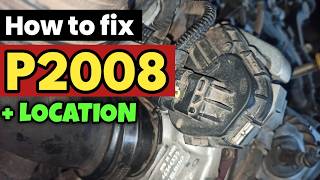
- Locate the IMRC solenoid for Bank 1. On the 3.5L V6, this is on the rear of the intake manifold, near the firewall.
- Visually inspect the wiring harness and connector going to the solenoid for any obvious damage, melting, or corrosion.
- With the ignition on (engine off), disconnect the solenoid connector and test for battery voltage (approx. 12V) on one of the pins using a multimeter. If voltage is absent, the problem is in the wiring or fuse, not the solenoid.
- Test the solenoid itself. Measure the resistance between the two pins on the solenoid. A healthy solenoid will have a low resistance (e.g., 30-50 ohms), while a failed one will show infinite resistance (Open Line or 'OL').
- If the solenoid and wiring seem good, inspect the vacuum lines connected to the solenoid for cracks or leaks.
- If the solenoid is confirmed bad, replace it. If the solenoid is good but power is not present at the connector, trace the wiring back to find the open circuit, checking fuses first.
- After repair, clear the code and perform a drive cycle to ensure the fix was successful.
Parts You'll Likely Need
- Intake Manifold Runner Control Solenoid (Bank 1)
(OEM #9L8Z-9E928-A)— This is the most common failure point for the P2008 code on this engine due to heat and vibration causing an internal open circuit.
Trusted brands: Motorcraft (OEM), Dorman (e.g., 911-906, though fitment should be verified), Standard Motor Products (SMP)
OEM price range: $70-$120
Aftermarket price range: $40-$70
Related Codes That Often Appear With This One
- P2009 — P2009 is 'IMRC Circuit Low Bank 1'. If there's an intermittent short or wiring issue, both codes could appear.
- P2006 — P2006 is 'IMRC Stuck Closed Bank 1'. If the P2008 electrical fault prevents the solenoid from activating, the runner flaps will remain in their default (closed) position, which can then trigger the P2006 code.
- P2004 — P2004 is 'IMRC Stuck Open Bank 1'. While less common to see with an open circuit fault, a complex system failure could potentially trigger a variety of IMRC codes.
Mechanic-Grade Diagnostic Values
- IMRC Solenoid Coil Resistance — expected: 30 - 50 Ohms. Failure: A reading of 'OL' (Over Limit / infinite resistance) indicates an open circuit. A reading near 0 Ohms indicates a short circuit.
- IMRC Solenoid Connector - Power Pin Voltage (KOEO) — expected: 12V+ (Battery Voltage). Failure: 0V or significantly low voltage points to a problem in the power supply circuit (fuse, relay, or wiring), not the solenoid itself.
- IMRC Solenoid Connector - PCM Control Pin Voltage — expected: This is a ground-side switched circuit. Voltage should be ~12V when inactive and drop to ~0V when the PCM commands the solenoid ON.. Failure: Voltage that does not drop to ~0V during a scan tool active test (when power is confirmed on the other pin) points to a break in the control wire or a faulty PCM driver.
Scan Tool Commands That Help
- Ford IDS, FORScan, or other professional bidirectional scanner: Active Test / Output State Control for IMRC — Use this command with Key On, Engine Off to cycle the IMRC solenoid. Listen for an audible 'click'. If it clicks, the solenoid, wiring, and PCM driver are likely functional, pointing to an intermittent issue. If it does not click, it helps confirm a hard failure in the circuit, which can then be pinpointed with a multimeter.
Wiring & Ground Locations
- C1651 — The electrical connector for the Bank 1 IMRC solenoid, located on the rear (firewall side) of the intake manifold.. This is the primary test point for checking voltage, ground, and solenoid resistance. Damage or corrosion at this connector is a common cause of the P2008 open circuit.
- C1651 Pin 1 (Power) — Typically a Yellow/Green wire on the Bank 1 IMRC connector.. This pin should have 12V+ with the key on. No voltage here indicates a problem upstream in the power supply, not with the solenoid or PCM control.
- C1651 Pin 2 (Control) — The second wire on the Bank 1 IMRC connector (color varies).. This is the control wire that the PCM pulls to ground to activate the solenoid. Testing this wire during a scan tool command confirms if the PCM is attempting to control the circuit.
- G100 / G101 — Main chassis grounds located at the left and right front of the engine compartment.. A poor or corroded main ground can cause a variety of erratic electrical issues and voltage drops, potentially leading to false open-circuit codes. Verifying these are clean and tight is a good practice when diagnosing any electrical fault.
Real Owner Repair Stories
- Ford Owners Club forum user 'ashmicro' (Ford Focus (platform with similar IMRC solenoid design)) — P2008 code, poor performance when taking off from rest and accelerating from low RPM.
❌ Tried (didn't work) Cleaning throttle body and intake with carb cleaner., Checking for vacuum leaks with carb cleaner.
✅ What actually fixed it Replaced the 'air shut off controls' (the IMRC solenoid pack). The code was eliminated and the car ran 'WAY better'.
OEM Part Supersession History
9L8Z-9E928-A→Motorcraft CX-2281— Standard part number update and consolidation.
Heads up: This part (under various numbers like CX-2248) is often physically identical to the EVAP Canister Purge Valve. It is critical to ensure you are replacing the correct part by its location on the intake manifold, not just by its appearance.
Diagnostic Flowchart
Other Known Issues on This Vehicle
Issues unrelated to this code that are worth knowing about as an owner of this generation:
- Internal Water Pump Failure 🔴 High — Common failure point, often between 60,000 and 150,000 miles. Can occur with little warning. (Ref: No recall, but it is a widely known design flaw. The pump is internal and driven by the timing chain. Failure can cause coolant to mix with engine oil, leading to catastrophic engine failure. A weep hole is designed to leak coolant externally near the alternator as an early warning sign.)
- Electronic Throttle Body (ETB) Failure 🟠 Medium — Very common across the 3.5L Cyclone engine family. Can cause sudden 'limp mode' where the vehicle has no acceleration. (Ref: Ford issued Customer Satisfaction Program 13N03 for many vehicles with this engine, extending the ETB warranty to 10 years/150,000 miles. This program has likely expired for the 2007-2012 MKZ, but confirms the high failure rate.)
- Harsh Shifting / Transmission Problems 🟠 Medium — A significant number of owners report harsh or delayed shifting, particularly between 1st and 3rd gears.
- Power Steering Fluid Leaks 🟡 Low — Leaks can develop from hoses in the power steering system, often due to insufficient clamping from the factory.
Used vs. New Parts: Buying Guide for This Vehicle
When a used part is the smart pick: For the IMRC solenoid, buying a used part is generally not recommended. The failure is caused by cumulative heat cycles and vibration. A used part has an unknown history and may fail soon after installation. Given the low cost of new aftermarket parts ($40-$70), a new part offers much better value and reliability.
Donor-vehicle mileage cap: roughly under 50000 miles for the part to have meaningful remaining life.
What to inspect on the donor part:
- If buying used is unavoidable, choose a part from the lowest-mileage vehicle possible.
- Test the part with a multimeter before purchase. The resistance across the two pins must be within the 30-50 Ohm range.
- Visually inspect the plastic housing for any cracks or signs of extreme heat stress.
- Ensure the electrical pins in the connector are clean, straight, and free of corrosion.
OEM-only on this vehicle (don't cheap out):
- While not strictly 'OEM-only', using the Ford/Motorcraft part (9L8Z-9E928-A or CX-2281) provides the highest confidence for a first-time fix without compatibility issues.
Aftermarket brands forum-validated for this vehicle:
- Dorman (e.g., 911-906)
- Standard Motor Products (SMP)
Brands owners have reported issues with on this vehicle:
- Unbranded, no-name solenoids from online marketplaces are a significant risk and have been reported by forum users on similar platforms to fail quickly or be dead-on-arrival.
Real Owner Stories
Aggregated from forums and TSBs cited above. Mileages and costs reflect what owners reported in those sources.
2007-2014 Ford Edge 3.5L V6
Symptoms: P2008 and P2006 codes present simultaneously.
What fixed it: Replacing both IMRC actuators and the intake gaskets.
Source hint: fordedgeforum.com: 'P2008 and P2006 codes'
Related OBD-II Codes
Frequently Asked Questions
Where is the Bank 1 IMRC solenoid located on my Lincoln MKZ 3.5L?
Can I use a used IMRC solenoid from a salvage yard to fix my P2008 code?
Is there a specific replacement connector for the IMRC solenoid if mine is corroded?
Does the Lincoln MKZ 3.5L have a known issue with the throttle body that might cause similar symptoms?
Are there any major engine concerns I should look for while fixing the P2008 code on my MKZ?
What is the correct resistance for a healthy IMRC solenoid on the 3.5L Cyclone engine?
Helpful Videos

We Have This Part in Stock


The information in this article is provided for general reference and educational purposes only. Vehicle specifications, procedures, and part compatibility can vary by production date, trim level, and region. Always consult your vehicle's factory service manual and verify part numbers before purchasing or performing repairs. Safety-critical components such as airbags, seat belts, and braking systems should be installed by a qualified professional.
- Lincoln MKZ:
- 🧭 Diagnostic Flowchart
- 🎬 Helpful Videos
- 🛍️ Shop This Part
- What's Unique About the 2007-2012 Lincoln MKZ
- Symptoms You May Notice
- Most Likely Causes
- Rare But Worth Checking
- Diagnosis Steps
- Parts You'll Likely Need
- Related Codes That Often Appear With This One
- Mechanic-Grade Diagnostic Values
- Scan Tool Commands That Help
- Wiring & Ground Locations
- Real Owner Repair Stories
- OEM Part Supersession History
- Other Known Issues on This Vehicle
- Used vs. New Parts: Buying Guide for This Vehicle
- Real Owner Stories
- 2007-2014 Ford Edge 3.5L V6
- Related OBD-II Codes
- Frequently Asked Questions
- 🎟️ Get 5% Off