

P2015 on 2006-2013 Audi A3 2.0L TFSI & TDI: Intake Manifold Runner Sensor Causes and Fixes
For TDI engines (CBEA, CJAA), this code is almost always caused by a worn actuator motor (V157) stop on the aluminum intake manifold, fixable with an inexpensive aftermarket bracket. For TFSI engines (CCTA, CBFA), it's typically a failed position sensor or a broken plastic linkage on the plastic intake manifold, often requiring manifold replacement, though an extended warranty may apply.
- For the 2.0L TDI engine, P2015 is almost certainly a worn actuator motor stop. Buy the inexpensive metal repair bracket before considering a costly manifold replacement.
- For the 2.0L TFSI engine, the problem is more likely the intake manifold itself (sensor, linkage, or flaps). A full manifold replacement is the most common fix.
- Before replacing any parts, always perform a thorough visual inspection of all linkages and vacuum hoses for obvious breaks or leaks.
- Carbon buildup can be a contributing factor on both engines, so if the manifold is removed, it should be thoroughly cleaned.
- Check with an Audi dealer about potential warranty extensions covering the intake manifold, especially for TFSI models.
What's Unique About the 2006-2013 Audi A3
On the Audi A3 8P platform, the cause of P2015 is distinctly different between the two available 2.0L engines. The TDI diesel engine's issue is famously due to the actuator motor's (V157) plastic stop on the aluminum manifold wearing down, allowing it to over-rotate. This is so common that multiple companies sell a simple, cheap metal bracket to fix it, avoiding a $900+ dealer repair. In contrast, the TFSI gasoline engine's problem usually stems from a failed position sensor, a broken plastic actuator arm on the plastic manifold, or a complete internal failure of the manifold flaps. This often necessitates replacing the entire intake manifold, though Volkswagen Group issued an extended warranty (10 years/120,000 miles) for many affected vehicles that may cover the repair.
Symptoms You May Notice
- Check Engine Light is on
- Reduced engine power, especially at low RPMs
- Rough or poor idle, sometimes surging at a stop
- Decreased fuel economy
- Engine may enter 'limp mode', limiting RPMs
- On TDI models, the DPF warning light may illuminate due to failed regeneration cycles
- Noticeable 'rev hang' between shifts on manual transmission cars
- Replacing only the position sensor on a TFSI engine when the internal manifold linkage is actually broken or the flaps are seized with carbon.
- Replacing the entire intake manifold on a TDI engine (a $900+ repair) when only the inexpensive ($60) repair bracket is needed to fix the actuator over-travel.
Most Likely Causes
- Worn Intake Flap Motor Actuator Stop (2.0L TDI) 🔴 High Probability The V157 actuator motor on the TDI engine's aluminum manifold has an internal plastic stop that wears out over time, allowing the linkage arm to travel past its intended range. This causes the position sensor to send an out-of-range signal (e.g., reading -10% instead of 0%) to the ECM, triggering the P2015 fault.
How to confirm: Visually inspect the actuator motor (V157) on the front of the intake manifold. With the engine off, observe the linkage arm. If you can manually push the actuator arm past its stop point with little resistance, the stop has failed. A scan tool may show the sensor voltage dropping below its specified lower limit of ~0.5V. The fix is to install a repair bracket.
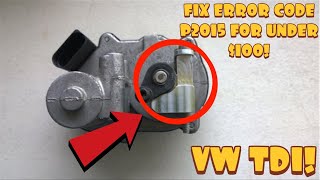
Typical fix: Install an aftermarket repair bracket that bolts onto the actuator assembly, creating a new, durable stop for the linkage arm. This is a well-known, permanent fix that prevents the need to replace the entire manifold or actuator. The installation can typically be done in under 30 minutes. 🎬 Watch: How to install the Dieselgeek bracket on your TDI.
Est. part cost: $40-$80 - Failed Intake Manifold Runner Position Sensor or Linkage (2.0L TFSI) 🔴 High Probability → Shop Engine Intake Manifold The plastic components of the intake manifold, including the runner control arm and the position sensor itself, are common failure points due to heat and vibration. The sensor is often not sold separately from the manifold by the dealer, and the linkage can break, causing a loss of control over the flaps. VW issued an extended warranty for this part on many vehicles.
How to confirm: Visually inspect the actuator and linkage at the end of the intake manifold. Look for a broken or disconnected plastic arm; try to wiggle it to check for excessive play. If the linkage is intact, the sensor itself may have failed. A scan tool can be used to monitor the sensor's reported position while attempting to actuate the flaps; erratic jumps in value or values outside the expected voltage range (approx. 1.2V open to 4.5V closed) indicate a bad sensor.
Typical fix: If the linkage is broken or the sensor has failed, the entire intake manifold assembly typically needs to be replaced with an updated part (e.g., 06J133201BH). While replacing the manifold, it is highly recommended to perform a carbon cleaning of the intake ports. Some aftermarket sensors are available, but replacement still requires removing the manifold for access.
Est. part cost: $200-$500 for a new manifold, ~$70 for a repair bracket as a potential alternative. - Carbon Buildup on Intake Flaps 🟡 Medium Probability Direct-injection engines like the TFSI and TDI are prone to carbon accumulation in the intake tract because fuel is no longer washing over the intake valves. This buildup can physically restrict or seize the movement of the intake runner flaps, preventing them from reaching their commanded positions.
How to confirm: This requires removing the intake manifold to visually inspect the intake ports and flaps for heavy, sticky carbon deposits. This is often diagnosed after other, more common causes are ruled out.
Typical fix: The intake manifold must be removed and the ports and flaps must be manually cleaned (walnut blasting is a common and effective method) to restore free movement. This is often done preventatively when replacing a failed TFSI manifold.
Est. part cost: $10-$30 in cleaning supplies, or $400-$600 for a professional walnut blasting service. - Faulty Wiring or Electrical Connector ⚪ Low Probability Wiring to the position sensor or actuator motor can become damaged from engine heat and vibration over time, leading to a short or open circuit. The connector itself can also become corroded or have loose pins.
How to confirm: Inspect the wiring harness and 5-pin connector going to the intake manifold runner position sensor (TFSI) or V157 actuator motor (TDI) for any signs of damage, corrosion, or loose pins. Check for 5V reference, ground, and signal continuity back to the ECU.
Typical fix: Repair or replace the damaged section of the wiring harness or the connector itself.
Est. part cost: $10-$50
Rare But Worth Checking
- Faulty Changeover Valve (Solenoid) N316 (2.0L TFSI): A TSB was issued for corrosion in this vacuum control solenoid, which can prevent the vacuum-actuated flaps from moving correctly. Checking vacuum lines for leaks or blockages with a vacuum pump is a worthwhile step before replacing the entire manifold.
Diagnosis Steps
- Read the fault codes with an OBD-II scanner to confirm P2015 and note any other codes. Clear the code and see if it returns immediately.
- For 2.0L TDI (Aluminum Manifold): Visually inspect the intake flap actuator motor (V157) located on the front of the engine. Check if the actuator arm moves past its natural stop. If it does, the internal stop is worn. The definitive fix is the Dieselgeek (or similar) repair bracket.
- For 2.0L TFSI (Plastic Manifold): Visually inspect the vacuum-operated actuator and linkage on the driver's side of the intake manifold. Check for a broken black plastic arm or disconnected linkage. If it's broken, the manifold needs replacement. Before replacing, call a dealer with your VIN to check for extended warranty coverage.
- For 2.0L TFSI: Inspect all vacuum lines connected to the intake manifold actuator/solenoid for cracks, brittleness, or disconnection. Use a vacuum tester to check the solenoid (N316) and actuator diaphragm for leaks.
- Using a capable scan tool (like VCDS), perform an output test on the intake manifold runner. Observe the sensor's reported position values (e.g., in Measuring Block 142) to see if they change smoothly and if the actuator moves through its full range.
- Check the electrical connector and wiring for the position sensor (TFSI) or actuator motor (TDI) for damage, corrosion, or loose connections.
- If the actuator, linkage, and wiring appear functional, the cause is likely internal to the manifold (stuck flaps due to carbon buildup or broken internal mechanism). This requires removing the manifold for inspection and cleaning/replacement.
Parts You'll Likely Need
- Intake Manifold Repair Bracket (TDI)
(OEM #N/A (Aftermarket only))— This is the most common and cost-effective fix for the P2015 code on 2.0L TDI engines with the aluminum manifold (Part No. 03L129711E), as it corrects the over-rotation of the V157 actuator motor.
Trusted brands: Dieselgeek, ECS Tuning, URO Parts
OEM price range: N/A
Aftermarket price range: $50-$80
Related Codes That Often Appear With This One
- P2004 — Intake Manifold Runner Control Stuck Open. This code is often a precursor to P2015 or appears alongside it, indicating a mechanical issue with the flaps being stuck.
- P2006 — Intake Manifold Runner Control Stuck Closed. Similar to P2004, this points to a mechanical jam of the runner flaps, often due to carbon buildup or a broken linkage.
- P2009 — Intake Manifold Runner Control Circuit Low. This may accompany P2015, suggesting an electrical fault in the actuator motor circuit.
Technical Service Bulletins (TSBs) & Recalls
- V241501 / 2038161 - A VW TSB discussing diagnosis for P2014 and P2015 faults on TSI engines.
- Audi TSB for N316 Solenoid - A TSB was reportedly issued for corrosion in the vacuum control solenoid (N316) on TFSI engines, which can mimic manifold failure.
- TSB Bulletin #A0124312072273_2 - This manufacturer bulletin provides information for cases where the MIL is on specifically regarding the electric changeover valve N316 and codes P2004, P2006, P2014, and P2015.
Platform-Specific Known Issues
- The 2.0L TDI engine has a well-documented design flaw in the intake manifold flap motor (V157) where a plastic stop wears out, causing over-travel. The community-accepted fix is an inexpensive metal bracket.
- The 2.0L TFSI engine has a known issue with the plastic intake manifold, leading to an extended warranty from VW/Audi for many vehicles (10 years/120,000 miles) to cover replacement for this P2015 code.
- On TDI models, failure to address P2015 can prevent DPF regeneration, leading to a cascading failure of the emissions system and a much more costly repair.
Mechanic-Grade Diagnostic Values
- TDI V157 Actuator Position Sensor Signal Voltage — expected: Normal operating range is between ~0.5V and ~4.5V.. Failure: A reading below 0.3V indicates the actuator has traveled past its lower limit due to a worn internal stop, triggering P2015.
- TFSI G336 Position Sensor Signal Voltage — expected: Approximately 4.5V when flaps are closed (idle) and decreases to approximately 1.2V when flaps are fully open (high RPM).. Failure: Values that are out of this range, do not change smoothly, or are erratic indicate a faulty sensor. This can be observed in VCDS Measuring Block 142.
- Wiring Harness Continuity to ECU — expected: Less than 1.5 Ohms.. Failure: Resistance higher than 1.5 Ohms indicates an open circuit or excessive resistance in the wiring between the sensor/actuator connector and the ECU.
Scan Tool Commands That Help
- VCDS (VAG-COM): Engine -> Measuring Blocks -> Group 142 — To live-monitor the 'Actual' vs 'Specified' position of the intake runner flaps on TFSI engines. This helps determine if the flap is physically stuck or if the sensor is providing erratic readings. Smooth, corresponding movement is expected.
- VCDS (VAG-COM): Engine -> Basic Settings -> Group 142 (for TFSI) or Group for V157 Adaptation (for TDI) — To run the adaptation procedure after replacing an intake manifold or sensor. The system cycles the flaps to relearn the end stops. An 'ERROR' message at the end of the adaptation can indicate a faulty new part or a persistent wiring issue.
- VCDS (VAG-COM): Engine -> Output Tests — To command the intake manifold flap motor/solenoid to activate, allowing a technician to verify mechanical movement and listen for actuator operation. This can help differentiate a mechanical failure from a sensor or wiring issue.
Wiring & Ground Locations
- TDI V157 Actuator 5-Pin Connector — On the V157 actuator motor, front of the aluminum intake manifold.. This connector provides power, ground, and signal paths for the TDI's integrated flap motor and position sensor. A bad connection here will cause P2015. Pin 2 is the signal wire, Pin 3 is sensor ground, and Pin 1 is the 5V reference.
- TFSI G336 Sensor Connector — On the end of the plastic intake manifold, driver's side of the engine bay.. This connector carries the position signal from the sensor to the ECU. A bad connection or damaged wire will cause an implausible signal. The center pin is the signal wire, which should show voltage changes as the flap moves.
- Engine Block Ground Points (e.g., 12, 640) — Multiple locations in the engine compartment, typically on the left side near the battery and on the longitudinal member.. A poor engine ground can cause floating voltages and implausible signals for various sensors, including the intake runner position sensor. Cleaning these main ground points is a crucial step when diagnosing persistent, hard-to-trace electrical faults.
Real Owner Repair Stories
- YouTube user Diego Arias (VW Jetta TDI (with same CBEA/CJAA engine and manifold as A3)) — Check Engine Light would come on and off, throwing code P2015.
❌ Tried (didn't work) Resetting the code would only work temporarily; the light would return immediately after cycling the ignition.
✅ What actually fixed it Installing the Dieselgeek repair bracket. The user confirmed that after a 15-20 minute installation, the P2015 code was cleared and did not return after multiple ignition cycles and driving. - Reddit user on r/tdi (Audi A3 TDI with DSG) — Car was very sluggish off the line and generally unresponsive.
✅ What actually fixed it The user installed the Dieselgeek repair kit and cleared the code. They reported the car felt completely different, with snappy off-idle throttle response, resolving the sluggishness. - Ross-Tech Forums user (VW 2.0 TSI (CCTA engine, same as A3)) — P2015 code present, unable to complete Basic Settings adaptation (Group 142) after installing a new aftermarket intake manifold, receiving an 'ERROR' message.
❌ Tried (didn't work) Replacing the entire intake manifold with a new aftermarket unit., Verifying vacuum actuator movement during the test.
✅ What actually fixed it The new position sensor (G336) that came with the aftermarket manifold was faulty out of the box. The user measured the sensor's output voltage and found it was out of spec. Replacing only the sensor with another new one allowed the adaptation to complete successfully and fixed the issue. - Owner Report (NHTSA ODI #11542990) — An owner reported receiving an emissions failure report with the CEL code P2015 and noted that a technical service bulletin exists detailing the repair and how it should be covered under an extended warranty.
When the Usual Fixes Don't Work
- In some TFSI cases, replacing the entire intake manifold does not resolve the P2015 code. One owner on a forum replaced the manifold and sensor, but the code persisted. The ultimate cause was found to be a faulty aftermarket position sensor that was bad out of the box, which was only diagnosed by manually checking its voltage output. Another owner reported the code returning after replacement, suspecting a vacuum leak or wiring issue as the next logical step. This highlights that while manifold replacement is the most common fix, it is not a guaranteed solution, and follow-up electrical diagnosis may be required.
OEM Part Supersession History
06J133201G, 06J133201AD, 06J133201AL, 06J133201AS, 06J133201BD, 06J133201BE→06J133201BH— Revisions were made to improve the durability of the internal flap mechanism and the position sensor to prevent premature failure.
Heads up: All previous versions are replaced by 06J133201BH. Using an older revision part is not recommended as it is prone to the original failure mode.03L129711E (Aluminum Manifold)→03L129711AG (Plastic Manifold)— A design change from an aluminum to a plastic intake manifold for TDI engines.
Heads up: The P2015 repair bracket for the aluminum manifold (03L129711E) will NOT fit the plastic manifold (03L129711AG), and vice-versa. Visual identification is required before ordering a repair bracket.
Model Year Variations Within This Range
- 2009-2014 (TDI): North American TDI models (CBEA, CJAA) were equipped with an aluminum intake manifold (03L129711E) which fails by the actuator over-rotating. Some international market TDIs used a black plastic manifold (03L129711AG) which has a different failure mode and requires a different repair bracket.
Diagnostic Flowchart
Used vs. New Parts: Buying Guide for This Vehicle
When a used part is the smart pick: For the TDI engine, neither a used actuator nor a used manifold is a good choice, as the failure is due to wear. The correct fix is a new aftermarket repair bracket. For the TFSI engine, a used intake manifold is a high-risk purchase. The internal plastic components fail from heat and age, so a used part from a donor vehicle is likely to have the same issue or fail soon. It only makes sense if it's extremely low-cost and intended as a temporary fix.
Donor-vehicle mileage cap: roughly under 50000 miles for the part to have meaningful remaining life.
What to inspect on the donor part:
- For a TFSI manifold, visually inspect the pivot point for the runner arm on the end of the manifold for any cracks or stress marks.
- Ask for the VIN of the donor car to check its mileage and confirm it's from a low-mileage vehicle.
- Ensure all vacuum nipples are intact and not brittle or broken.
- If possible, look inside the ports for signs of extreme carbon buildup, which indicates a hard life.
OEM-only on this vehicle (don't cheap out):
- Intake Manifold Assembly (TFSI): While aftermarket versions exist, the Genuine VW/Audi part (latest revision 06J133201BH) is the most reliable choice to ensure compatibility and durability, especially given the extended warranty history which points to a known design flaw addressed in later OEM parts.
Aftermarket brands forum-validated for this vehicle:
- Dieselgeek: Widely cited as the go-to, high-quality brand for the TDI P2015 repair bracket.
- Integrated Engineering (IE): Offers a high-performance cast aluminum replacement manifold for TFSI engines, which eliminates the failure-prone plastic components entirely, though at a higher cost.
Brands owners have reported issues with on this vehicle:
- Unbranded/generic TFSI intake manifolds and sensors: As evidenced by repair stories, these can be faulty out of the box, leading to repeat work and difficult diagnosis. One user on a forum used a manifold from 'autodoc' (a distributor, not a brand) and the problem persisted, highlighting the risk of non-OEM parts for this specific issue.
Real Owner Stories
Aggregated from forums and TSBs cited above. Mileages and costs reflect what owners reported in those sources.
2012 VW Jetta 2.0L TDI
Symptoms: The Check Engine Light came on with code P2015, and was soon followed by the DPF warning light.
What fixed it: Forum users confirmed the correct fix is installing a Dieselgeek repair bracket on the intake manifold actuator, which is necessary to resolve the P2015 code and allow the DPF to regenerate.
Source hint: Reddit: 2012 VW Jetta TDI Error P2015 and DPF Light
VW Golf GTI 2.0L TFSI
Symptoms: Check Engine Light illuminated with a P2015 code.
What fixed it: The issue was identified as a common intake manifold failure. The owner was advised to check for coverage under the VW/Audi extended warranty for this specific part.
Source hint: Reddit: P2015 code on Golf GTI
Related OBD-II Codes
Frequently Asked Questions
Is the P2015 code on my 2.0L TFSI engine covered by a warranty?
For my 2.0L TDI, do I have to replace the entire expensive intake manifold for a P2015 code?
My TDI has a DPF warning light on at the same time as the P2015 Check Engine Light. Are these related?
If I have to replace the intake manifold on my TFSI, is there any other service I should perform at the same time?
Are there any Technical Service Bulletins (TSBs) for the P2015 code on my Audi A3?
How can I tell if my TFSI has a broken manifold linkage versus a bad sensor?
Helpful Videos
We Have This Part in Stock



The information in this article is provided for general reference and educational purposes only. Vehicle specifications, procedures, and part compatibility can vary by production date, trim level, and region. Always consult your vehicle's factory service manual and verify part numbers before purchasing or performing repairs. Safety-critical components such as airbags, seat belts, and braking systems should be installed by a qualified professional.
- Audi A3:
- 🧭 Diagnostic Flowchart
- 🎬 Helpful Videos
- 🛍️ Shop This Part
- What's Unique About the 2006-2013 Audi A3
- Symptoms You May Notice
- Most Likely Causes
- Rare But Worth Checking
- Diagnosis Steps
- Parts You'll Likely Need
- Related Codes That Often Appear With This One
- Technical Service Bulletins (TSBs) & Recalls
- Platform-Specific Known Issues
- Mechanic-Grade Diagnostic Values
- Scan Tool Commands That Help
- Wiring & Ground Locations
- Real Owner Repair Stories
- When the Usual Fixes Don't Work
- OEM Part Supersession History
- Model Year Variations Within This Range
- Used vs. New Parts: Buying Guide for This Vehicle
- Real Owner Stories
- 2012 VW Jetta 2.0L TDI
- VW Golf GTI 2.0L TFSI
- Related OBD-II Codes
- Frequently Asked Questions
- 🎟️ Get 5% Off