

P2015 on 2005-2009 Mercedes E-Class OM642: Swirl Flap Linkage and Motor Fixes
On the OM642 diesel engine, P2015 almost always means the intake manifold's plastic swirl flap linkage has broken or the actuator motor has failed. The most common fix is an upgraded metal linkage kit, which costs under $100. A failed motor is often caused by an oil leak from the turbo inlet seal (A6420940080) directly above it, which drips onto the motor's electronics and causes it to short out.
- P2015 on an E-Class with the OM642 engine is almost always a mechanical failure of the swirl flap system, not a bad sensor.
- Before buying any parts, visually inspect the plastic linkage rods on the front of the intake manifolds for breakage. This is the most common and cheapest fix.
- If the swirl motor has failed, it's almost certainly because of an oil leak from the turbo inlet seal. You must replace this inexpensive seal to protect the new motor.
- Do not let a shop replace the entire intake manifold assembly if only the external plastic linkage is broken. An aftermarket metal repair kit is a more durable and far more cost-effective solution.
What's Unique About the 2005-2009 Mercedes-Benz E-Class
The OM642 V6 diesel engine, used extensively across Mercedes, Jeep, and Chrysler vehicles, has a well-documented weakness in its swirl flap system. The original design uses plastic actuator rods to connect the swirl motor to the flaps; these rods become brittle from engine heat and eventually break. A compounding issue is that the swirl flap motor (M55) is located deep in the 'V' of the engine, directly beneath the turbocharger's intake pipe. The inexpensive orange/red seal on this pipe frequently fails, allowing oil to drip directly onto the motor's electronics, causing a short circuit.
Symptoms You May Notice
- Check Engine Light illuminated
- Significantly reduced engine power (Limp Mode)
- Slow or sluggish acceleration
- Jerky or hesitant acceleration
- Engine may not rev past 3,000 RPM
- Reduced fuel economy
- Rough or unstable idle
- Replacing the entire intake manifold assembly when only the external plastic linkage is broken. An aftermarket metal kit is a superior and much cheaper repair.
- Replacing the position sensor itself. The P2015 code on this engine almost always points to a mechanical failure of the linkage or motor, not a faulty sensor.
Most Likely Causes
- Broken Intake Manifold Swirl Flap Linkage 🔴 High Probability → Shop Engine Intake Manifold The original linkage rods are made of a plastic that becomes brittle from constant engine heat cycles and eventually snaps. The connection points also wear into an oval shape, causing the linkage to pop off. This is a widely recognized failure point across all OM642 applications.
How to confirm: Remove the engine cover and visually inspect the plastic rods connecting the swirl flap motor to the intake manifolds. A broken or disconnected rod is a definitive sign of failure. Excess play in the linkage is also a clear indicator of wear.
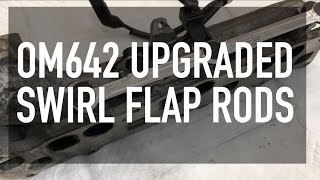
Typical fix: Install an aftermarket metal repair linkage kit. This is a permanent solution that replaces the weak plastic part with a more durable billet aluminum one. Mercedes does not sell this part alone, requiring a full manifold replacement at the dealer.
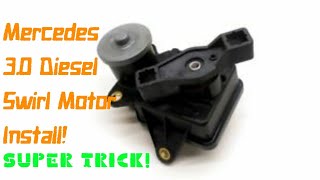
Est. part cost: $50-$150 - Failed Intake Port Shutoff Motor (Swirl Motor / M55) 🟡 Medium Probability The motor is located in the engine valley, directly under the turbo intake pipe. The seal on this pipe (A6420940080) frequently leaks oil, which drips onto the motor's electronics, causing it to short out and fail.
How to confirm: Visually inspect the swirl motor for signs of oil saturation. A diagnostic scanner (like STAR/Xentry) can be used to actuate the motor and check for a response to a 141 Hz PWM signal. If the motor does not respond, it has failed.
Typical fix: Replace the swirl flap actuator motor (OEM Pierburg). This is a labor-intensive job due to its location under the turbocharger. It is critical to also replace the leaking turbo intake seal (the inexpensive orange/red ring) to prevent the new motor from failing.
Est. part cost: $150-$250 - Carbon Buildup on Swirl Flaps ⚪ Low Probability As a diesel engine with an EGR system, the OM642 is prone to heavy carbon and oil deposits building up inside the intake manifold. This gunk can cause the swirl flaps to become sticky or completely seized, putting excessive stress on the linkage and motor, leading to their failure.
How to confirm: With the engine off, attempt to move the swirl flap linkage by hand. If it feels stiff or won't move, the flaps are likely jammed with carbon.
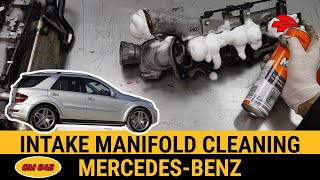
Typical fix: The intake manifolds must be removed from the engine and manually cleaned. In severe cases, some owners opt to perform a 'swirl flap delete' by removing the flaps entirely and welding the shaft holes shut.
Est. part cost: $0 (if cleaning), $20-$40 for gaskets
Rare But Worth Checking
- Failed Resistor Mod: If the vehicle was acquired used, a previous owner may have installed a 4.7k Ohm resistor to bypass a failed motor. These resistors can fail or the connection can become loose, causing the P2015 code to reappear.
- Blown Fuse: In some cases, after other repairs, a blown fuse that powers the swirl motor, turbo actuator, and MAF sensors can be the underlying issue preventing the vehicle from exiting limp mode. On a W211, this is often fuse F44 (15A) in the engine bay fuse box.
Diagnosis Steps
- Scan the ECU for trouble codes. Note any other codes that appear alongside P2015, such as P2004 or P2006.
- Remove the plastic engine cover and perform a visual inspection. Look at the front of the engine where the intake manifolds are located.
- Check the swirl flap linkage rods. Look for obvious breaks or if the rods have become disconnected from the swirl flap levers. This is the most common cause.
- Inspect the area around and below the turbocharger for oil leaks. Look down into the 'V' of the engine to see if the swirl motor (M55) is covered in oil. This strongly suggests a failed turbo inlet seal and a shorted motor.
- With the engine off, gently try to move the linkage by hand to feel if the flaps are moving freely or if they are stuck.
- If the linkage is intact and the motor is not oil-soaked, a diagnostic scanner can be used to command the motor to actuate. If there is no movement, the motor has likely failed internally.
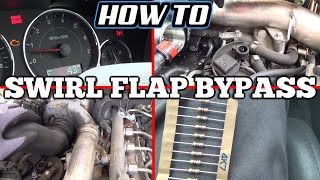
- A common DIY diagnostic is the 'resistor fix'. Unplug the motor and insert a 4.7k Ohm, 0.5W (or higher) resistor between pins 2 and 3 of the harness-side connector. If this clears the code and limp mode, it confirms a failed motor. This is a bypass, not a repair, and the flaps should be secured in the open position.
Parts You'll Likely Need
- Intake Manifold Swirl Flap Repair Kit (Metal)
(OEM #N/A (Aftermarket only))— This replaces the failure-prone original plastic linkage with a durable aluminum version, permanently fixing the most common cause of P2015. Mercedes only sells the full manifold (e.g., A6420905037, A6420907737).
Trusted brands: IDParts, Febi Bilstein, X8R Ltd, Various unbranded kits
OEM price range: N/A (Mercedes sells the full manifold for $500+)
Aftermarket price range: $50-$150 - Intake Port Shutoff Motor (Swirl Motor)
(OEM #A6421500494)— This motor actuates the swirl flaps. It commonly fails due to oil contamination from a leaky turbo inlet seal.
Trusted brands: Pierburg (OEM, P/N: 7.01132.11.0), Bosch
OEM price range: $200-$250
Aftermarket price range: $150-$200 - Turbocharger Intake Seal
(OEM #A6420940080)— This inexpensive orange or red seal is the primary cause of the oil leak that destroys the swirl motor. It MUST be replaced whenever the swirl motor is replaced to prevent a repeat failure.
Trusted brands: Mercedes-Benz Genuine, Elring
OEM price range: $10-$20
Aftermarket price range: $5-$15 - Intake Manifold Gaskets
(OEM #A6420980080 (Set))— These should be replaced any time the intake manifolds are removed for cleaning or for swirl motor replacement to prevent vacuum leaks.
Trusted brands: Victor Reinz, Elring
OEM price range: $40-$60
Aftermarket price range: $20-$40
Related Codes That Often Appear With This One
- P2004 — Stands for 'Intake Manifold Runner Control Stuck Open'. This code is frequently seen with P2015 as it points to the same swirl flap system failure.
- P2006 — Stands for 'Intake Manifold Runner Control Stuck Closed'. This is a direct companion to P2015, indicating the flaps are jammed, often due to a broken linkage or carbon buildup.
- 2513-001 — This is a Mercedes-specific fault code visible on dealer-level scanners like Xentry. It translates to 'Check component M55 (Inlet port shutoff motor). Positioner signals fault,' directly indicating a problem with the swirl motor's internal feedback.
Platform-Specific Known Issues
- The OM642 engine has two separate intake manifolds (one for each cylinder bank), but a single swirl motor and linkage system actuates the flaps on both. A failure in the central linkage or motor will affect both banks and trigger the code.
- A popular but controversial DIY workaround is the 'resistor mod', where a 4.7k Ohm resistor is plugged into the swirl motor's electrical connector to trick the ECU. This takes the car out of limp mode but does not fix the underlying mechanical problem and leaves the swirl flaps inoperative.
- For heavily carbonized manifolds, some owners and independent shops perform a 'swirl flap delete', which involves removing the flap assemblies entirely and welding the pivot holes in the manifolds shut, providing a permanent, albeit non-standard, solution.
Mechanic-Grade Diagnostic Values
- M55 Swirl Motor PWM Control Signal — expected: Frequency: 141 Hz; Duty Cycle: 5% (flaps open) to 95% (flaps closed).. Failure: The motor will not respond to common PWM frequencies in the 1-5 kHz range, which can cause it to fail a bench test if the wrong frequency is used. When the motor detects a jam, it pulls the signal pin to ground, which the ECU interprets as a fault.
- M55 Swirl Motor Connector Pinout Voltages (Key On) — expected: Pin 1: Ground; Pin 2: +12V Supply; Pin 3: PWM Signal from ECU; Pin 4: Unused.. Failure: No +12V on Pin 2 indicates a power supply issue, potentially a blown fuse (F44). No PWM signal on Pin 3 during an actuation test points to an ECU or wiring fault.
- Engine Ground Strap Voltage Drop (Cranking) — expected: Less than 0.5 Volts between the negative battery terminal and a clean point on the engine block.. Failure: A voltage reading higher than 0.5V during cranking suggests a high-resistance, corroded, or broken main engine ground strap, which can cause various ECU and sensor faults.
Hidden / Shadow Codes Worth Checking
- 2513-001: Check component M55 (Inlet port shutoff motor). Positioner signals fault. This is a manufacturer-specific code that directly confirms the ECU has received a fault signal from the swirl motor's internal position sensor, often because it is jammed or has failed electronically. (see via Mercedes-Benz STAR/Xentry diagnostic system.)
- 2510: Check component Y77/1 (Boost pressure regulator). Positioner signals fault. This code for the turbo actuator often appears with M55 motor faults because they share a power supply fuse. (see via Mercedes-Benz STAR/Xentry or advanced OBD-II scanners.)
Scan Tool Commands That Help
- Mercedes-Benz Xentry / STAR Diagnosis: Actuation of component M55 (Inlet port shutoff motor) — Use this bidirectional test to command the swirl motor to move. If the linkage is intact but does not move during this test, it confirms the motor itself has failed electrically or mechanically. This isolates the motor as the failure point.
- Mercedes-Benz Xentry / STAR Diagnosis: Control Unit/Software must be trained/updated — After replacing the M55 swirl motor with a new OEM Pierburg unit, this adaptation or 'teach-in' process may be required for the ECU to recognize the new component and its position range.
Wiring & Ground Locations
- M55 Motor Connector — Deep in the 'V' of the engine, below the turbocharger air intake pipe.. This is where voltage tests are performed and where the 'resistor mod' is installed. It is highly susceptible to oil contamination from the seal directly above it, which is the primary cause of motor failure.
- W11 (Combustion engine ground point) — A bare, braided strap running from a lower bell housing bolt on the driver's side to a mounting point on the chassis, near the steering box.. While not a direct cause of P2015, a corroded or broken main engine ground can cause a multitude of bizarre, seemingly unrelated electrical faults and ECU behavior. If electrical tests on the M55 motor give strange readings, verifying this ground is essential.
Real Owner Repair Stories
- MBWorld.org forum user (2007 E320 Bluetec (OM642)) — Check engine light, limp mode, burning smell.
✅ What actually fixed it The user diagnosed Mercedes-specific codes 2530-001 (Short circuit) and 2513-001 (Positioner fault) for the M55 motor. The fix was to replace the oil-soaked M55 swirl motor and the broken plastic operating levers/linkages for the swirl flaps. This confirms the two most common causes often fail in conjunction.
OEM Part Supersession History
A6421500094, A6421500194, A6421500294, A6421500394→A6421500494— Progressive updates and consolidation of the part number for the M55 swirl motor across various Chrysler and Mercedes applications.
Heads up: The latest part number, A6421500494, is the correct service replacement. Using old stock or a used motor with an earlier part number may not have the latest internal revisions.
Diagnostic Flowchart
Other Known Issues on This Vehicle
Issues unrelated to this code that are worth knowing about as an owner of this generation:
- Oil Cooler Seal Leak 🔴 High — Extremely common, often occurs between 60k-120k miles. A major design flaw where seals degrade, causing oil to pool in the engine valley and leak down the back of the engine. (Ref: No official recall, but it is a widely known issue. The repair is very labor-intensive (8-12+ hours) as the turbo and intake manifolds must be removed.)
- 7G-Tronic (722.9) Conductor Plate Failure 🔴 High — Common failure item causing harsh shifting, getting stuck in gear, or entering limp mode. Can occur at various mileages, often after 70k miles. (Ref: No recall, but a well-documented failure. Fault codes often include 0717, 0718 for speed sensor failure. The conductor plate is the transmission's control module.)
- Timing Chain Stretch 🟠 Medium — Becomes a concern at higher mileage (typically 100k+ miles). Indicated by a 1-3 second rattle on cold starts. If left unaddressed, it can lead to jumped timing and engine damage. (Ref: No recall, but TSBs have been issued for related tensioners. Visual inspection of the tensioner through the oil filler cap can indicate chain stretch.)
- 'Black Death' - Injector Seal Failure 🟠 Medium — A common issue on this era of CDI engines. The copper injector seals fail, allowing combustion gases to leak past, forming a hard, black tar-like substance around the injectors. (Ref: null)
Used vs. New Parts: Buying Guide for This Vehicle
When a used part is the smart pick: A used intake manifold assembly can be a cost-effective choice IF, and only IF, it can be thoroughly inspected off the vehicle. The swirl flaps must move freely with no binding, and the plastic linkage attachment points must be perfectly round and show no signs of stress or cracking. Given the high labor cost, a new manifold is often a safer bet.
Donor-vehicle mileage cap: roughly under 50000 miles for the part to have meaningful remaining life.
What to inspect on the donor part:
- For manifolds: Manually actuate the swirl flap levers. They should move smoothly from stop to stop with no grittiness or binding, which indicates low carbon buildup.
- For manifolds: Inspect the plastic ball-studs where the linkage connects. They must be perfectly round, not worn into an oval shape.
- For swirl motor (M55): Avoid ANY motor that shows signs of oil contamination. The electronics are likely compromised, even if it currently works.
- For swirl motor (M55): Ask for a photo of the connector pins. Any corrosion or oil residue is a red flag.
OEM-only on this vehicle (don't cheap out):
- Turbocharger Intake Seal (A6420940080): This part is extremely inexpensive and is the root cause of most swirl motor failures. There is no reason to use anything but a genuine or OEM Elring seal to ensure a proper fit and prevent a repeat, expensive failure.
- Intake Port Shutoff Motor (M55): While aftermarket motors exist, the OEM Pierburg unit (A6421500494) is the most reliable choice. Cheap unbranded motors are known to have a high failure rate, and given the 8+ hours of labor to access it, using a low-quality part is a significant risk.
Aftermarket brands forum-validated for this vehicle:
- Swirl Flap Linkage Repair Kit: IDParts, Febi Bilstein, X8R. These companies offer billet aluminum linkages that are a permanent upgrade over the OEM plastic design.
- Gaskets: Victor Reinz, Elring. Both are OEM suppliers and provide high-quality gaskets essential for the repair.
Brands owners have reported issues with on this vehicle:
- Unbranded Swirl Motors: Avoid generic, no-name swirl motors from online marketplaces. Forum discussions frequently mention these failing shortly after installation, forcing a repeat of a very labor-intensive job.
Real Owner Stories
Aggregated from forums and TSBs cited above. Mileages and costs reflect what owners reported in those sources.
2006 Mercedes-Benz E320 CDI (OM642) — ~125000 miles
Symptoms: Intermittent power loss and limp mode on a high-mileage W211 CDI.
What fixed it: The owner discussed the issue on MBWorld.org, noting the long history of this failure on the W211 platform.
Source hint: MBWorld.org Forums - 2006 E320 CDI problem
2007 Mercedes-Benz E320 CDI (OM642) — ~100000 miles
Symptoms: The car entered limp mode; diagnostic scanning showed Mercedes-specific fault code 2513-001 alongside the P2015 code.
What fixed it: Replacement of the intake port shutoff motor (M55) which was confirmed as the source of the fault.
Source hint: MBWorld.org Forums - OM642 intake port shutoff motor
2006 Mercedes-Benz E320 CDI (OM642)
Symptoms: Vehicle stuck in limp mode due to a failed M55 swirl motor.
What fixed it: Applied a 4.7k Ohm resistor bypass to the M55 motor connector to clear the limp mode and trick the ECU.
Source hint: MBClub UK - W211 4.7kOhm resistor 'fix' for M55 motor
Related OBD-II Codes
Frequently Asked Questions
Mercedes-Benz wants to replace my entire intake manifold for a P2015 code. Is there a cheaper way to fix the broken plastic linkage?
My E320 CDI is in limp mode and won't rev past 3,000 RPM. Could this be caused by an oil leak?
What is the 'resistor fix' I see mentioned for the OM642 swirl motor, and should I use it on my E-Class?
Can carbon buildup cause the P2015 code on my high-mileage E280 CDI?
Is the P2015 code related to the common oil cooler seal leak on the OM642 engine?
If I choose to do a 'swirl flap delete' to fix P2015, what does that involve?
Helpful Videos
We Have This Part in Stock


The information in this article is provided for general reference and educational purposes only. Vehicle specifications, procedures, and part compatibility can vary by production date, trim level, and region. Always consult your vehicle's factory service manual and verify part numbers before purchasing or performing repairs. Safety-critical components such as airbags, seat belts, and braking systems should be installed by a qualified professional.
- Mercedes-Benz E-Class:
- 🧭 Diagnostic Flowchart
- 🎬 Helpful Videos
- 🛍️ Shop This Part
- What's Unique About the 2005-2009 Mercedes-Benz E-Class
- Symptoms You May Notice
- Most Likely Causes
- Rare But Worth Checking
- Diagnosis Steps
- Parts You'll Likely Need
- Related Codes That Often Appear With This One
- Platform-Specific Known Issues
- Mechanic-Grade Diagnostic Values
- Hidden / Shadow Codes Worth Checking
- Scan Tool Commands That Help
- Wiring & Ground Locations
- Real Owner Repair Stories
- OEM Part Supersession History
- Other Known Issues on This Vehicle
- Used vs. New Parts: Buying Guide for This Vehicle
- Real Owner Stories
- 2006 Mercedes-Benz E320 CDI (OM642) — ~125000 miles
- 2007 Mercedes-Benz E320 CDI (OM642) — ~100000 miles
- 2006 Mercedes-Benz E320 CDI (OM642)
- Related OBD-II Codes
- Frequently Asked Questions
- 🎟️ Get 5% Off