

P2096 on 2008-2016 Audi A4 2.0T: Post-Catalyst Lean Causes and Fixes
On a 2008-2016 Audi A4 2.0T, code P2096 is most often caused by an exhaust leak before the rear O2 sensor or a faulty rear O2 sensor itself. The flexible pipe section of the downpipe is a notorious leak point. Always inspect for exhaust leaks before replacing any parts to avoid a misdiagnosis.
- P2096 on your Audi A4 almost always points to an exhaust leak or a bad rear O2 sensor.
- ALWAYS check for exhaust leaks before buying parts. A smoke test is the best diagnostic method.
- Do not immediately assume you need a new catalytic converter; it is a common misdiagnosis and a very expensive repair.
- Replacing the rear O2 sensor is a common fix, but only after confirming there are no leaks in the exhaust system.
- Driving with the light on is possible in the short term, but it will cause you to fail an emissions test and can lead to more expensive repairs down the line.
What's Unique About the 2008-2016 Audi A4
For the B8 generation Audi A4 with the 2.0L TFSI engine, the P2096 code is frequently a straightforward emissions system issue rather than a complex engine problem. Owner forums and mechanic experiences show that the two most common culprits are simple exhaust leaks (especially from the flexible pipe section of the downpipe) or a failing rear oxygen sensor. While vacuum leaks or fuel delivery problems can cause this code, they are significantly less common on this platform for this specific fault when it appears by itself. An isolated P2096 strongly points to 🎬 Watch: A quick breakdown of what this code really means. an exhaust leak or the rear O2 sensor.
Symptoms You May Notice
- Check Engine Light is on
- Reduced fuel economy
- Failed emissions test
- Possible hesitation during acceleration
- Potential for a rough idle
- Audible hissing or ticking sound from the engine bay or under the car, especially when cold
- Replacing the rear oxygen sensor without first checking for exhaust leaks. A leak will cause the new sensor to give the same lean reading, and the code will return.
- Replacing the catalytic converter when the actual problem is a much cheaper exhaust leak or a faulty O2 sensor.
- Replacing the front (pre-catalyst) O2 sensor, which has no bearing on the P2096 code.
Most Likely Causes
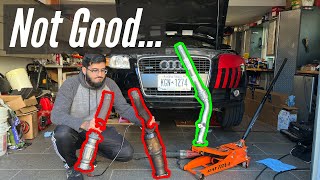
- Exhaust Leak 🔴 High Probability The flexible exhaust pipe section (flex pipe) on the factory downpipe is a well-known weak point. It is designed to absorb engine movement, but over time, heat cycles and corrosion cause it to crack and leak. This allows unmetered oxygen to be sucked into the exhaust stream before the rear O2 sensor, causing a false lean reading.
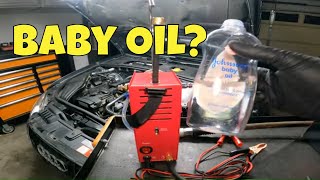
How to confirm: Perform a visual inspection of the exhaust system from the engine to the rear O2 sensor. Look for black soot marks, cracks, or rust holes, paying close attention to gaskets and the woven metal flex pipe. Listen for hissing or ticking sounds with the engine running. The most reliable method is to have a smoke test performed, which will make any leaks obvious.
Typical fix: The leaking section of the exhaust must be repaired or replaced. This often involves a shop cutting out the old flex pipe and welding in a new universal flex pipe 🎬 See this walkthrough on how to replace a leaking flex pipe. section. Replacing failed gaskets at the turbo or downpipe connection is also common.
Est. part cost: $20-$150 - Faulty Rear (Post-Catalyst) Oxygen Sensor 🔴 High Probability → Shop Oxygen Sensor Oxygen sensors are wear items that degrade over time, typically lasting 60,000 to 90,000 miles. Contamination from oil (common on EA888 engines with oil consumption issues) or coolant can also cause premature failure. There is also a TSB (2046611/5) for related models that notes a contaminated rear O2 sensor can trigger this code.
How to confirm: Use an OBD-II scanner (like VCDS for VW/Audi) to view live data. A healthy post-catalyst O2 sensor should show a relatively steady voltage (e.g., ~0.6-0.8V). If the voltage is stuck low (near 0.1V), is unresponsive, or fluctuates rapidly like the front (pre-cat) sensor, it has likely failed.
Typical fix: Replace the rear oxygen sensor. It is located on the exhaust pipe after the catalytic converter. Access is typically from underneath 🎬 Watch: 10 easy steps to replace your rear oxygen sensor. the vehicle.
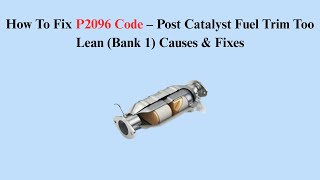
Est. part cost: $80-$200 - Inefficient or Failing Catalytic Converter 🟡 Medium Probability → Shop Catalytic Converter While robust, the catalytic converter can become clogged or chemically inefficient at high mileage, especially if other engine issues like misfires, oil consumption, or a rich/lean condition have been ignored. A failing converter may not be able to properly store and use oxygen, leading to lean readings downstream.
How to confirm: This is usually diagnosed after ruling out exhaust leaks and O2 sensor failure. A temperature gun can be used to measure the inlet and outlet temperatures of the converter; the outlet should be significantly hotter. A rattling noise from the exhaust can indicate a physically broken converter. Often, a P0420 code will accompany P2096 if the converter is the root cause.
Typical fix: Replace the catalytic converter. This is an expensive repair, often involving the entire downpipe assembly.
Est. part cost: $500-$2500 - Intake / Vacuum Leak ⚪ Low Probability Hoses and gaskets in the PCV (Positive Crankcase Ventilation) system can become brittle and crack, allowing unmetered air into the engine. The PCV valve diaphragm itself is a very common failure item on the EA888 engine. While this creates a true lean condition, it will typically throw a P0171 (System Too Lean Bank 1 from pre-cat sensor) code first, or alongside P2096. An isolated P2096 is less likely to be a vacuum leak.
How to confirm: A smoke test of the intake manifold and vacuum lines is the most effective way to find a leak. A failed PCV can often be diagnosed by a loud whistling noise at idle or a large amount of suction when trying to remove the oil cap with the engine running.
Typical fix: Replace the failed hose, gasket, or PCV valve assembly.
Est. part cost: $30-$250
Rare But Worth Checking
- Low Fuel Pressure: A weak fuel pump or clogged filter can create a true lean condition, but this would typically trigger other codes (like P0171) before or alongside P2096.
- PCM/ECM Software Issues: In some cases, particularly on certain manufacturers, outdated powertrain control module software can cause false P2096 codes. It's worth checking if any Technical Service Bulletins (TSBs) for a software update apply to your vehicle's VIN.
Diagnosis Steps
- Scan the ECM for any other stored trouble codes to get a complete picture. Note if P0171 or P0420 are also present.
- Perform a thorough visual inspection of the exhaust system from the turbocharger outlet to the rear O2 sensor. Look for black soot marks, cracks, or rust holes, paying close attention to the downpipe-to-turbo gasket and the woven metal flex pipe section.
- With the engine running (ideally when cold), carefully listen and feel for any hissing or puffing sounds from the exhaust that would indicate a leak.
- For best results, perform an exhaust smoke test. This will force smoke through the system and make even small leaks easy to spot. This is the definitive test for exhaust leaks.
- If no leaks are found, use a scan tool to monitor the live voltage data from the rear (post-catalyst, Bank 1 Sensor 2) O2 sensor. It should be relatively stable, typically between 0.6V and 0.8V on a warm, running engine. If it reads very low (stuck near 0.1V) or is fluctuating wildly like the front sensor, the sensor is the likely culprit.
- If P0171 is also present, shift focus to the intake system. Perform an intake smoke test to check for vacuum leaks, paying close attention to the PCV valve and its associated hoses.
- As a final check, test fuel pressure to ensure it is within specification, though this is a less common cause for an isolated P2096.
Parts You'll Likely Need
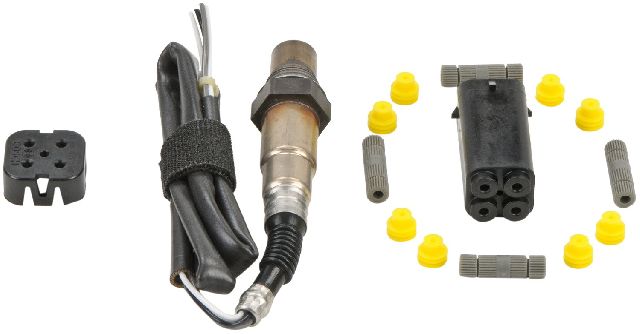
- Rear Oxygen Sensor (Post-Catalyst)
(OEM #1K0998262T)— This sensor is a common failure point and directly provides the reading that triggers the P2096 code. There are several superseding part numbers; always verify with your VIN.
Trusted brands: Bosch (OEM supplier), NTK, Denso
OEM price range: $180-$250
Aftermarket price range: $80-$160 - Exhaust Flex Pipe Repair Kit — The flex pipe is the most common location for an exhaust leak on this vehicle. Often, just this section can be cut out and a new one welded in, saving the cost of a full downpipe. The part is generic; a shop will match the diameter and length.
Trusted brands: Walker Exhaust, AP Exhaust
OEM price range: N/A (part of downpipe)
Aftermarket price range: $40-$100 - Downpipe to Turbo Gasket
(OEM #8K0253115K)— If the downpipe is removed for any reason (like a flex pipe repair or turbo work), this single-use metal gasket must be replaced to prevent a massive exhaust leak right at the source.
Trusted brands: Victor Reinz, Elring, Genuine VW/Audi
OEM price range: $20-$40
Aftermarket price range: $10-$25
Related Codes That Often Appear With This One
- P0171 — If a significant vacuum leak or fuel delivery issue is present, the system may also report a lean condition on Bank 1 from the *pre-catalyst* sensor. If you have both codes, the problem is likely engine-side (e.g., PCV, vacuum leak), not exhaust-side.
- P0420 — If the catalytic converter is truly failing, a 'Catalyst System Efficiency Below Threshold' code may appear along with the P2096 lean code.
Technical Service Bulletins (TSBs) & Recalls
- TSB 2046611/5 (for Audi Q5): While not for the A4 specifically, this TSB is for the same 2.0T engine and notes that codes P0139 and P2096 can be triggered by a contaminated rear O2 sensor, suggesting a known issue with the sensor itself across the platform.
Platform-Specific Known Issues
- A thread on Audizine titled 'P2096 - Post Catalyst Fuel Trim Sys Too Lean Bank 1' details a user's journey diagnosing this code. After replacing the rear O2 sensor didn't fix it, they discovered a cracked flex pipe on the downpipe was the true cause. URL: https://www.audizine.com/forum/showthread.php/737522-P2096-Post-Catalyst-Fuel-Trim-Sys-Too-Lean-Bank-1
- On the AudiWorld forums, a user with a 2011 A4 reported solving their P2096 code by replacing a leaking exhaust clamp, highlighting that even small leaks can trigger the code. URL: https://www.audiworld.com/forums/a4-b8-platform-discussion-128/p2096-cel-2883827/
- A Reddit thread in r/Audi confirms the pattern: an owner was quoted for a catalytic converter, but the community advised checking for an exhaust leak first, which is a much more common and cheaper fix for an isolated P2096.
Mechanic-Grade Diagnostic Values
- Downstream O2 Sensor (Narrowband) Voltage at steady cruise (warm engine) — expected: Relatively stable voltage between 0.6V and 0.8V.. Failure: Voltage is stuck low (near 0.1V) or is not stable, indicating a sensor or exhaust leak issue.
- Upstream O2 Sensor (Wideband) Voltage at idle (for comparison) — expected: Fluctuates but should center around 1.5V.. Failure: N/A for P2096, but provides context for what a healthy wideband sensor reading looks like on this platform.
- Fuel Pressure (general spec) — expected: 30-60 psi (200-410 kPa). Failure: Pressure below this range could indicate a weak fuel pump or clogged filter, leading to a true lean condition.
Wiring & Ground Locations
- Fuse for Post-Cat O2 Sensor — In the fuse holder B (SB), a 15A fuse (SB7) powers the 'Lambda probe 1 after catalytic converter -GX7-'.. A blown fuse would cause the sensor to be completely unresponsive, but a poor connection at the fuse block could cause intermittent issues or incorrect readings that might contribute to emissions codes.
- G12 Ground Point — Located at the left rear of the engine compartment.. This is a major engine ground point. A loose or corroded connection here can cause a variety of sensor reading issues, including those from the O2 sensors, due to a poor ground reference.
- Engine to Body Ground Strap — Typically runs from the engine block to the chassis frame rail, often near the engine mount.. This is the primary ground path for the entire engine block. If this strap is frayed, corroded, or broken, it can cause erratic behavior from all engine sensors, potentially leading to false codes like P2096.
Real Owner Repair Stories
- AudiWorld Forums user (2013 Audi S8 (D4)) — Check Engine Light with P2096 code after filling up with gas.
❌ Tried (didn't work) Initial diagnosis pointed towards potential vacuum leaks or gas cap issues.
✅ What actually fixed it The user noted the car is very sensitive to gasoline quality. After getting the code with gas from a generic station, another user recommended clearing the code and using a fuel system cleaner like Techron. The implication is that poor quality fuel can sometimes trigger this code on sensitive Audi engines.
OEM Part Supersession History
06F-906-262-P, 06H-906-262-A, 06J-906-262-K→1K0-998-262-T— Standard part evolution for improved reliability or manufacturing changes.1K0998262T (OEM Part Number)→16002 (Bosch Part Number)— This is the corresponding part number from Bosch, the OEM supplier.
Heads up: Bosch is the original equipment manufacturer for many Audi O2 sensors. Using the Bosch part is a reliable alternative to the more expensive dealer part.
Model Year Variations Within This Range
- 2013+: The B8.5 facelift (starting around 2013) introduced cosmetic changes (headlights, bumpers, MMI system) and some mechanical revisions. While the core EA888 Gen 2 engine and exhaust layout relevant to P2096 remained largely the same for the North American market, some components like the DSG transmission and thermostat were updated. These changes don't directly alter the common causes of P2096 but are good to be aware of when sourcing parts for a 'facelift' model.
- 2008-2012 (Pre-facelift B8): Early B8 models had a different MMI system and hydraulic power steering compared to the B8.5's electromechanical steering. These earlier models are also more known for issues with thermostats and water pumps, which, while not a direct cause of P2096, can be part of a larger pattern of age-related component failures.
Diagnostic Flowchart
Other Known Issues on This Vehicle
Issues unrelated to this code that are worth knowing about as an owner of this generation:
- Excessive Oil Consumption 🔴 High — Extremely common on 2009-2012 models with engine code CAEB due to faulty piston ring design. Less common but still present on later engines. Can be 1 quart per 300-1,200 miles. (Ref: Subject of a class-action lawsuit and multiple TSBs.)
- Timing Chain Tensioner Failure 🔴 High — Very common on pre-2013 EA888 Gen 2 engines. The original tensioner can fail without warning, causing the chain to jump and leading to catastrophic engine damage. A rattling noise on a cold start is a key warning sign. (Ref: An updated tensioner part (06K109467K) was introduced that resolves the issue.)
- Water Pump / Thermostat Housing Failure 🟠 Medium — The plastic water pump housing is prone to cracking and leaking coolant. The seal can also fail. Failure can occur as early as 30,000 miles but is common around 60,000-100,000 miles. (Ref: Multiple part revisions exist, including aftermarket all-aluminum housings.)
- Intake Valve Carbon Buildup 🟠 Medium — As a direct-injection engine, fuel does not wash over the intake valves. Oil vapor from the PCV system bakes onto the valves, causing buildup that restricts airflow. Typically requires cleaning every 50,000-80,000 miles. Symptoms include misfires, rough idle, and loss of power.
- PCV Valve / Oil Separator Failure 🔴 High — The diaphragm in the PCV is a rubber component that frequently tears, causing a large vacuum leak. Symptoms include a loud whistling or squealing noise, rough idle, high oil consumption, and lean/rich codes (P0171/P0172). (Ref: Audi has released numerous updated part revisions to address this.)
Used vs. New Parts: Buying Guide for This Vehicle
When a used part is the smart pick: A used catalytic converter/downpipe assembly from a low-mileage, rear-ended donor car can be a cost-effective option if the original has failed. It avoids the high cost of a new OEM unit and the potential emissions-test failures of some aftermarket converters. For all other common causes (O2 sensor, flex pipe), new parts are strongly recommended.
Donor-vehicle mileage cap: roughly under 70000 miles for the part to have meaningful remaining life.
What to inspect on the donor part:
- For a used catalytic converter, inspect the honeycomb structure with a light; it should be intact and not melted or broken.
- Check the flex pipe section for any signs of fraying, crushing, or black soot marks indicating a leak.
- Ensure the O2 sensor bung threads are not stripped or damaged.
- Verify the donor vehicle was not involved in a front-end collision that could have damaged the exhaust.
OEM-only on this vehicle (don't cheap out):
- Catalytic Converter: While expensive, a new Genuine Audi converter is the only guaranteed way to pass stringent emissions tests in some states. Aftermarket converters for this platform have a mixed reputation, with some failing to meet the efficiency thresholds required by the ECU, leading to a recurring P0420 code.
Aftermarket brands forum-validated for this vehicle:
- O2 Sensors: Bosch is the OEM supplier, making it the top choice. Denso and NTK are also highly reputable manufacturers of O2 sensors with proven quality.
- Flex Pipe Repair: Walker Exhaust and MagnaFlow are well-known brands for universal exhaust components like flex pipes.
Brands owners have reported issues with on this vehicle:
- Unbranded or 'white-box' O2 sensors from online marketplaces. These often use lower-quality sensor elements and can provide inaccurate readings or fail prematurely, causing the code to return.
Real Owner Stories
Aggregated from forums and TSBs cited above. Mileages and costs reflect what owners reported in those sources.
2011 Audi A4 2.0T
Symptoms: Check engine light with code P2096.
What fixed it: Replacing a leaking exhaust clamp.
Source hint: AudiWorld forums thread 'P2096 CEL' (URL: https://www.audiworld.com/forums/a4-b8-platform-discussion-128/p2096-cel-2883827/)
Audi A4 2.0T (B8)
Symptoms: Post Catalyst Fuel Trim Sys Too Lean Bank 1 code; owner replaced the rear O2 sensor but the code returned.
What fixed it: Discovered a cracked flex pipe on the downpipe.
Source hint: Audizine Forums thread 'P2096 - Post Catalyst Fuel Trim Sys Too Lean Bank 1' (URL: https://www.audizine.com/forum/showthread.php/737522-P2096-Post-Catalyst-Fuel-Trim-Sys-Too-Lean-Bank-1)
Related OBD-II Codes
Frequently Asked Questions
Does TSB 2046611/5 apply to my Audi A4 2.0T?
Is it common for the flex pipe to fail on the B8 Audi A4?
Can oil consumption issues on my EA888 engine cause P2096?
Should I replace my catalytic converter immediately if I see P2096?
How can I tell if my rear O2 sensor is failing versus an exhaust leak?
Will a failed PCV valve cause a P2096 code?
Helpful Videos
We Have This Part in Stock


The information in this article is provided for general reference and educational purposes only. Vehicle specifications, procedures, and part compatibility can vary by production date, trim level, and region. Always consult your vehicle's factory service manual and verify part numbers before purchasing or performing repairs. Safety-critical components such as airbags, seat belts, and braking systems should be installed by a qualified professional.
- Audi A4:
- 🧭 Diagnostic Flowchart
- 🎬 Helpful Videos
- 🛍️ Shop This Part
- What's Unique About the 2008-2016 Audi A4
- Symptoms You May Notice
- Most Likely Causes
- Rare But Worth Checking
- Diagnosis Steps
- Parts You'll Likely Need
- Related Codes That Often Appear With This One
- Technical Service Bulletins (TSBs) & Recalls
- Platform-Specific Known Issues
- Mechanic-Grade Diagnostic Values
- Wiring & Ground Locations
- Real Owner Repair Stories
- OEM Part Supersession History
- Model Year Variations Within This Range
- Other Known Issues on This Vehicle
- Used vs. New Parts: Buying Guide for This Vehicle
- Real Owner Stories
- 2011 Audi A4 2.0T
- Audi A4 2.0T (B8)
- Related OBD-II Codes
- Frequently Asked Questions
- 🎟️ Get 5% Off