

P2096 on 2003-2009 Mercedes-Benz E-Class: Post-Catalyst Lean Causes & Fixes
On a 2003-2009 Mercedes E-Class (W211), code P2096 is most often caused by an exhaust leak from a cracked manifold or failed gasket, or a faulty downstream oxygen (O2) sensor. A thorough inspection for exhaust leaks before replacing parts is the most effective first step, as leaks can trick a perfectly good sensor into reporting a lean condition.
- Always check for exhaust leaks before replacing any parts for a P2096 code on a W211 E-Class.
- A smoke test is the most effective way to find both exhaust and vacuum leaks.
- The code refers to the downstream (post-catalyst) sensor on Bank 1 (passenger side in the US).
- If the car has aftermarket exhaust components, an ECU tune may be required to resolve the code.
What's Unique About the 2003-2009 Mercedes-Benz E-Class
The W211 E-Class platform is sensitive to exhaust system integrity. While the root causes are common across many vehicles, forum discussions among W211 owners frequently point to exhaust leaks as a primary culprit, sometimes from unexpected places like failed welds on the exhaust piping or manifolds. One owner on MBWorld.org reported resolving a persistent P2096 code after finding and re-welding a break in the exhaust before the catalytic converter for $65. Additionally, these vehicles, especially performance models like the E55 AMG, are popular to modify; aftermarket headers or high-flow catalytic converters can often trigger this code if the vehicle's ECU is not retuned to compensate for the change in exhaust flow and sensor readings.
Generation note: The 2003-2009 year range covers the entire W211 generation of the E-Class, including its mid-cycle facelift in 2007. While the fundamental causes of P2096 are the same, engine variations exist (e.g., M112/M113 in earlier models, M272/M273 in later models), which may affect the specific location of components like exhaust manifolds and sensors, as well as introduce different common vacuum leak points (e.g., M272 intake manifold runner flaps).
Symptoms You May Notice
- Check Engine Light is on
- Reduced fuel economy
- Rough or fluctuating idle
- Hesitation during acceleration
- Audible exhaust leak (ticking or hissing sound) or smell of exhaust fumes in the cabin
- Immediately replacing the downstream oxygen sensor without first thoroughly inspecting for exhaust leaks. An exhaust leak will cause a perfectly good new sensor to read lean and re-trigger the P2096 code.
Most Likely Causes
- Exhaust Leak 🔴 High Probability Forum documentation points to weld failures on exhaust components and failing gaskets as a specific issue on the W211 platform. Age and corrosion also contribute to leaks at flanges and flex pipes. A user on CrossfireForum.org (a platform mate) fixed a P2098 (Bank 2 equivalent) by welding a split seam on the catalytic converter that was not visible from underneath the car.
How to confirm: Perform a visual inspection of the exhaust system from the engine to the rear O2 sensor. Look for black soot, cracks, or rust holes. An audible ticking or hissing sound that gets louder with engine RPM is a strong indicator. A definitive diagnosis can be made using a smoke machine to see where smoke escapes. 🎬 See this guide on finding exhaust leaks A low-tech method is to use a length of hose as a stethoscope to pinpoint the source of the leak while the engine is running.
Typical fix: Repair depends on the location. A cracked manifold may need replacement. A failed gasket is replaced. Small holes or cracked welds on pipes can often be repaired by a muffler shop for a reasonable cost.
Est. part cost: $10-$500 - Faulty Downstream (Post-Catalyst) Oxygen Sensor 🔴 High Probability → Shop Oxygen Sensor Oxygen sensors are wear items and have a finite lifespan, typically around 100,000 miles. Contamination from engine byproducts or age can cause them to fail and send inaccurate, biased-lean readings.
How to confirm: Use a scan tool to monitor the live voltage data from the Bank 1, Sensor 2. A healthy sensor will show relatively steady voltage when the engine is at a constant RPM, unlike the pre-cat sensor which fluctuates rapidly. If the voltage is stuck low (e.g., below 0.2V), it indicates a lean signal, but this could be due to a real leak or a bad sensor.
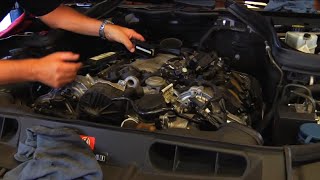
Typical fix: Replace the Bank 1 downstream oxygen sensor. An O2 sensor socket is required. 🎬 Watch: Step-by-step W211 oxygen sensor replacement Apply anti-seize to the threads of the new sensor before installation.
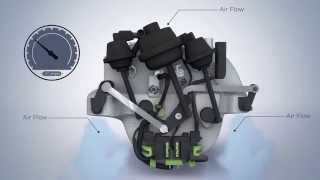
Est. part cost: $60-$150 - Vacuum Leak 🟡 Medium Probability With age, rubber and plastic components in the engine bay become brittle and crack. This includes vacuum hoses, intake manifold gaskets, and the PCV system. On M272/M273 engines, the plastic lever arm for the intake manifold runner flaps is a known failure point that can create a vacuum leak.
How to confirm: Listen for a hissing sound at idle. A smoke test is the most reliable method, feeding smoke into the intake system and watching for leaks. Spraying a small amount of carb cleaner near suspected areas and listening for a change in engine idle can also pinpoint a leak, but use caution as it is flammable.
Typical fix: Replace the cracked hose, leaking gasket, or faulty PCV valve. For M272/M273 engines, if the intake manifold runner linkage is broken, repair kits are available, though sometimes the entire manifold must be replaced. 🎬 Watch: M272 and M273 intake manifold issues explained
Est. part cost: $5-$600 - Insufficient Fuel Delivery ⚪ Low Probability
How to confirm: Check fuel pressure at the fuel rail using a pressure gauge to ensure it meets manufacturer specifications. Listen to the fuel injectors with a mechanic's stethoscope to check for consistent operation. A clogged fuel filter or a weak fuel pump could be the cause.
Typical fix: Replace the weak fuel pump, clogged fuel filter, or faulty fuel injector(s).
Est. part cost: $50-$700
Rare But Worth Checking
- Failing Catalytic Converter: → Shop Catalytic Converter While less common, a physically damaged or partially clogged catalytic converter can disrupt exhaust flow and cause incorrect readings from the downstream O2 sensor. A glowing red converter after a drive is a sign of a major clog.
- Dirty or Faulty Mass Air Flow (MAF) Sensor: A MAF sensor that under-reports airflow will cause the ECM to inject too little fuel, creating a true lean condition that can trigger P2096. Cleaning with a dedicated MAF sensor cleaner is a simple first step.
- ECM Software or Internal Fault: In very rare cases, outdated or corrupt software in the Engine Control Module can cause it to misinterpret sensor data. Check with a dealer or specialized independent shop for any available software updates from Mercedes-Benz.
Diagnosis Steps
- Read the code with an OBD-II scanner and check for any other stored codes, especially P2098 or P0171/P0174.
- With the engine cool, perform a thorough visual inspection of the exhaust system for Bank 1 (passenger side on US models). Look for cracks, holes, or black soot marks at gaskets and welds, especially on the exhaust manifold and downpipe.
- Start the engine and listen for audible ticking or puffing sounds from the exhaust system that would indicate a leak. Use a hose to your ear to isolate the sound.
- Use a scan tool to observe the live data for the Bank 1 Sensor 2 (downstream) oxygen sensor. If it reads a steady, low voltage (under 0.2V), it confirms a lean signal.
- Perform a smoke test on the exhaust system to definitively find any leaks. This is the most reliable method.
- If no exhaust leaks are found, perform a smoke test on the intake system to check for vacuum leaks, paying attention to common failure points like the M272 intake manifold linkage.
- If no leaks are present, the downstream O2 sensor itself is the most likely culprit. Inspect its wiring and connector before replacing.
- As a final step if the code persists, test fuel pressure and inspect the fuel delivery system.
Parts You'll Likely Need
- Downstream Oxygen Sensor (Bank 1, Sensor 2)
(OEM #A0045420718 (For M272 engines, check VIN), A0065429617)— This sensor is directly responsible for the reading that triggers the code. It is a common wear-and-tear item that fails over time.
Trusted brands: Bosch, Denso
OEM price range: $120-$200
Aftermarket price range: $60-$150 - Exhaust Manifold Gasket — If an exhaust leak is found at the junction between the cylinder head and the exhaust manifold, this gasket will need to be replaced.
Trusted brands: Victor Reinz, Elring
OEM price range: $20-$40
Aftermarket price range: $10-$25
Related Codes That Often Appear With This One
- P2098 — This is the identical code but for Bank 2. Seeing both P2096 and P2098 together strongly suggests a common cause affecting both sides of the engine, such as a vacuum leak, fuel delivery problem, or MAF sensor issue.
- P0171 — P0171 is 'System Too Lean (Bank 1)' based on the *upstream* O2 sensor. If you have both, it points to a more significant vacuum leak or fuel delivery issue causing a lean condition throughout the entire bank, which is then confirmed by the downstream sensor.
Platform-Specific Known Issues
- There are documented cases on owner forums for the W211 E-Class where a weld on the exhaust pipe or manifold fails, causing a significant exhaust leak that leads directly to a P2096 code.
- A specific repair story on MBWorld.org (https://mbworld.org/forums/w211-amg/540490-check-engine-obd2-p2096.html) details how a persistent P2096, after a sensor replacement failed to fix it, was ultimately traced to a w
Mechanic-Grade Diagnostic Values
- Downstream O2 Sensor (Bank 1, Sensor 2) Voltage at operating temperature, steady RPM — expected: A relatively stable voltage between 0.45V and 0.55V.. Failure: Voltage is stuck low (below 0.2V), fluctuates wildly, or is completely flat. A steady low voltage indicates a lean reading, which could be a bad sensor or a real exhaust/vacuum leak.
- Short-Term Fuel Trim (STFT) for Bank 1 — expected: Fluctuating near 0%, typically within +/- 10%.. Failure: Consistently high positive values (e.g., > +10%) indicate the ECM is adding fuel to compensate for a perceived lean condition.
- O2 Sensor Wiring Harness Resistance — expected: Less than 1.0 Ω from the sensor connector pin to the corresponding pin at the ME-SFI (ECM) connector.. Failure: Higher resistance indicates a corroded or damaged wire, which can alter the voltage signal sent by the sensor.
Scan Tool Commands That Help
- Mercedes STAR Diagnosis (SDS) / XENTRY: Guided Test for Oxygen Sensors — After retrieving code P2096, the factory scan tool will guide the technician through a series of checks, including monitoring live sensor voltage, checking for related codes, and suggesting component tests. It can also perform an O2 sensor heater circuit test.
- Mercedes STAR Diagnosis (SDS) / XENTRY: Reset Fuel Adaptations — After a repair is completed (e.g., fixing a vacuum leak or replacing a sensor), resetting the long-term fuel trim adaptations forces the ME-SFI module to relearn the baseline fuel mixture, which can speed up the verification of the fix and prevent the old, incorrect values from causing issues.
Wiring & Ground Locations
- Bank 1 Sensor 2 Connector — Underneath the vehicle, on the passenger side (for LHD cars), near the transmission. The sensor is located in the exhaust pipe just after the catalytic converter. The wiring harness runs up towards the transmission tunnel.. This connector is a primary point of failure due to exposure to road debris and heat. A bad connection here can mimic a failed sensor.
- W11 — In the engine bay, this is the ground point for the ME-SFI (engine control module) wiring harness.. A poor ground connection at W11 can cause a host of erratic engine management issues, including incorrect interpretation of sensor data, potentially leading to a false P2096 code.
- Z6/27 — This is a sensor ground connector sleeve located in the engine compartment wiring harness, on the right side of the vehicle. It provides a common ground for multiple sensors, including the oxygen sensors.. Corrosion or a loose connection within this splice can affect the ground reference for the O2 sensor, causing its voltage reading to be skewed and potentially triggering a lean code.
- ME-SFI (ECM) Location — Located in the right rear of the engine compartment (passenger side firewall area).. Knowing the location of the ECM is critical for performing wiring continuity and resistance checks between the O2 sensor connector and the module itself.
Real Owner Repair Stories
- MBWorld.org Forums user 'CaptMike' (W211 E-Class with 140,000 miles) — Check Engine Light with code P2096. Car ran fine with no hesitation or misfiring.
❌ Tried (didn't work) Replacing the front right O2 sensor., Replacing the left rear O2 sensor., Taking the car to a Mercedes-Benz dealer, who then suggested replacing all four O2 sensors.
✅ What actually fixed it The owner started hearing an exhaust leak that got progressively louder and could smell fumes in the cabin. This confirmed the root cause was an exhaust leak, not the O2 sensors that had been replaced. The story highlights the importance of diagnosing leaks before replacing sensors.
When the Usual Fixes Don't Work
- In one documented case, a W211 owner with 140,000 miles chased a P2096 code by replacing multiple O2 sensors, as suggested by both an independent shop and a Mercedes-Benz dealer. The code persisted. The actual cause was only discovered when an exhaust leak became loud enough to be audible, confirming that the sensors were not the root problem. This reinforces the critical advice to rule out all possible leaks before spending money on sensors.
Model Year Variations Within This Range
- 2006-2009 (Primarily affects M272 V6 and M273 V8 engines): These later-model engines feature an intake manifold with plastic swirl flaps controlled by a plastic actuator lever. This lever is a notorious failure point; it breaks, causing the flaps to remain in one position. This creates an unmetered air/vacuum leak, which can lead to lean codes like P2096. The failure often triggers codes P2004, P2005, or P2006, but can also contribute to general lean conditions. Upgraded aluminum repair kits are available to fix the lever without replacing the entire manifold.
Diagnostic Flowchart
Other Known Issues on This Vehicle
Issues unrelated to this code that are worth knowing about as an owner of this generation:
- Sensotronic Brake Control (SBC) Failure 🔴 High — Affects pre-facelift models (2003-2006). The hydraulic unit has a pre-programmed service life based on brake actuations, after which it must be replaced. Failure results in a red 'Brake Defective' warning and significantly reduced braking power. (Ref: Mercedes-Benz extended the warranty on the SBC hydraulic unit to 25 years with unlimited mileage, making replacement free at a dealership.)
- M272/M273 Balance Shaft / Idler Gear Wear 🔴 High — Affects V6 (M272) and V8 (M273) engines from roughly 2004-2008. Soft metal on the balance shaft (V6) or idler gear (V8) sprocket wears prematurely, causing timing chain slack. Onset can be from 80,000-120,000 miles, triggering check engine lights (P0016, P0017) and eventually engine rattle. (Ref: A class-action lawsuit addressed this, and Mercedes issued a service bulletin (DTB P-B-03.30/08j). The repair is extremely labor-intensive, requiring engine removal.)
- Airmatic Suspension Failure 🟠 Medium — Common on models equipped with optional Airmatic suspension. The rear air springs are the most common failure point, developing leaks and causing the rear of the car to sag. The compressor can also wear out from overwork. Failures typically occur after 80,000-120,000 miles.
- 722.6/722.9 Transmission Conductor Plate Failure 🟠 Medium — Affects both the 5-speed (722.6, pre-2006) and 7-speed (722.9, 2006+) automatic transmissions. The conductor plate, which houses speed sensors and solenoids, can fail, causing harsh shifting, getting stuck in gear (limp mode), or complete loss of drive. A leaking electrical connector plug is also a common issue on the 722.6, which can wick fluid into the control module.
- Valeo Radiator / Transmission Contamination 🔴 High — Affects early models (approx. 2003) equipped with Valeo brand radiators. A failure in the internal transmission cooler allows coolant to mix with the automatic transmission fluid, destroying the transmission.
Used vs. New Parts: Buying Guide for This Vehicle
When a used part is the smart pick: For structural exhaust components like manifolds or downpipes, a used part from a reputable salvage yard can be a cost-effective option. It is critical to inspect it thoroughly before purchase.
Donor-vehicle mileage cap: roughly under 100000 miles for the part to have meaningful remaining life.
What to inspect on the donor part:
- For exhaust manifolds: Inspect for any hairline cracks, especially near welds and mounting flanges. Check for severe rust or corrosion that could compromise the sealing surfaces. Ensure all mounting studs are intact.
- For intake manifolds (M272/M273): Strongly avoid used plastic manifolds unless the history is known. The swirl flap linkage is the failure point, and a used part may have the same issue. If buying used, operate the linkage by hand to ensure it moves smoothly without binding.
Aftermarket brands forum-validated for this vehicle:
- Oxygen Sensors: Bosch is the OEM supplier and the most recommended brand. Denso is also a highly regarded alternative.
- M272/M273 Intake Manifold Repair Kit: URO Premium and other brands offer an upgraded aluminum lever to replace the failure-prone plastic original.
Brands owners have reported issues with on this vehicle:
- Unbranded, 'no-name' oxygen sensors from online marketplaces. These often have poor calibration and a short lifespan, causing the code to return quickly.
Real Owner Stories
Aggregated from forums and TSBs cited above. Mileages and costs reflect what owners reported in those sources.
2004 Chrysler Crossfire (M112 V6)
Symptoms: The owner encountered a P2098 (the Bank 2 equivalent of P2096) and identified a lean condition caused by an exhaust issue.
What fixed it: Welding a split seam on the catalytic converter that was not visible from underneath the car.
Source hint: CrossfireForum.org - Thread 'Error code P2096 and P2099'
2003-2009 Mercedes-Benz E-Class (W211)
Symptoms: Persistent P2096 code that remained even after the oxygen sensor was replaced.
What fixed it: The issue was ultimately traced to a failed weld on the exhaust pipe or manifold causing a significant leak.
Source hint: MBWorld.org Forums and vehicle_specific_issues
Related OBD-II Codes
Frequently Asked Questions
I have a 2005 E350 with a P2096 code; could this be related to the common intake manifold issues on the M272 engine?
Is there a specific exhaust component on the W211 E-Class prone to causing this lean code?
My E-Class has over 100,000 miles and just threw a P2096. Should I just replace the oxygen sensors?
I hear a ticking sound from the engine bay of my E-Class along with the P2096 code. What does this mean?
Are there any other major W211 issues I should look out for while fixing this code?
Helpful Videos
We Have This Part in Stock

The information in this article is provided for general reference and educational purposes only. Vehicle specifications, procedures, and part compatibility can vary by production date, trim level, and region. Always consult your vehicle's factory service manual and verify part numbers before purchasing or performing repairs. Safety-critical components such as airbags, seat belts, and braking systems should be installed by a qualified professional.
- Mercedes-Benz E-Class:
- 🧭 Diagnostic Flowchart
- 🎬 Helpful Videos
- 🛍️ Shop This Part
- What's Unique About the 2003-2009 Mercedes-Benz E-Class
- Symptoms You May Notice
- Most Likely Causes
- Rare But Worth Checking
- Diagnosis Steps
- Parts You'll Likely Need
- Related Codes That Often Appear With This One
- Platform-Specific Known Issues
- Mechanic-Grade Diagnostic Values
- Scan Tool Commands That Help
- Wiring & Ground Locations
- Real Owner Repair Stories
- When the Usual Fixes Don't Work
- Model Year Variations Within This Range
- Other Known Issues on This Vehicle
- Used vs. New Parts: Buying Guide for This Vehicle
- Real Owner Stories
- 2004 Chrysler Crossfire (M112 V6)
- 2003-2009 Mercedes-Benz E-Class (W211)
- Related OBD-II Codes
- Frequently Asked Questions
- 🎟️ Get 5% Off