

P2097 on 2012-2019 Cadillac CTS: Post-Catalyst Rich Fuel Trim Causes and Fixes
On a 2012-2019 Cadillac CTS, code P2097 is often caused by a leaking fuel injector, not a bad oxygen sensor. A GM Technical Service Bulletin (TSB #PIP4964F) recommends performing a fuel injector balance test as a primary diagnostic step. Other common causes include small exhaust leaks before the rear O2 sensor or, less commonly, a failing catalytic converter. Replacing the O2 sensor is a frequent misdiagnosis.
- Do not immediately replace the oxygen sensor; it is rarely the cause for P2097 on a Cadillac CTS.
- The most likely culprit is a leaking fuel injector on Bank 1, as identified in a GM Technical Service Bulletin.
- A proper diagnosis involves checking for exhaust leaks and, most importantly, performing a fuel injector balance test.
- Driving for an extended period with this code can damage your catalytic converter, leading to a much more expensive repair.
What's Unique About the 2012-2019 Cadillac CTS
Unlike many vehicles where this code points to a bad oxygen sensor, on GM platforms like the Cadillac CTS, the root cause is frequently a fuel delivery issue. A key Technical Service Bulletin (TSB #PIP4964F) specifically directs technicians to check for faulty fuel injectors before other components. Furthermore, official GM diagnostic aids explicitly state that a Heated Oxygen Sensor (HO2S) itself is unlikely to cause this specific DTC without setting other sensor-circuit codes. This makes jumping to an O2 sensor replacement a common and costly mistake on these cars, a fact corroborated by numerous owner experiences in forums.
Diagnostic Flowchart
Tap your situation to follow the diagnostic path that matches what you're seeing on this vehicle.
Generation note: The 2012-2019 range covers two CTS generations. The 2nd Gen (2012-2014) primarily used 3.0L and 3.6L V6 engines (LFW, LFX). The 3rd Gen (2014-2019) introduced a 2.0L Turbo I4 (LTG) and had updated 3.6L V6 options. While the code's meaning is the same, the exact location of components and specific part numbers will vary by engine. The TSBs apply broadly to GM direct injection engines of this era.
Symptoms You May Notice
🎬 Watch: Overview of common causes and fixes for code P2097- Check Engine Light is on
- Reduced fuel economy
- Rough or erratic idle
- Poor engine performance, hesitation, or stumbling on acceleration
- A smell of gasoline or rotten eggs from the exhaust
- Black smoke from the tailpipe in some cases
- Replacing the downstream (post-catalyst) Oxygen Sensor. GM service information explicitly states not to replace the O2 sensor for this DTC unless there are specific circuit codes for the sensor itself. This is the most common unnecessary repair attempted by owners and shops.
Most Likely Causes
- Leaking or Faulty Fuel Injector(s) 🔴 High Probability → Shop Fuel Injector GM issued TSB #PIP4964F specifically for this issue, indicating it's a known problem across many models with HFV6 engines. Direct injection systems operate under very high pressure, making injectors a potential failure point that can leak fuel.
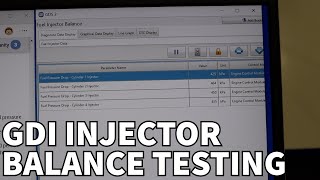
How to confirm: Perform a fuel injector balance test (AFIT) using a capable scan tool like the GM GDS2. 🎬 See how to perform a professional GM fuel injector balance test This measures the pressure drop for each injector to see if one is flowing more fuel than the others. This is the GM-recommended first step.
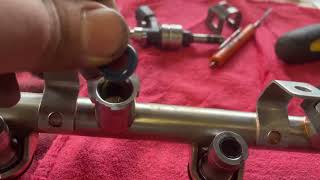
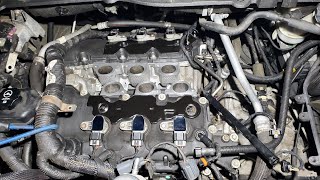
Typical fix: Replace the faulty fuel injector(s). It is often recommended to replace all injectors on the affected bank 🎬 Watch this step-by-step guide to replacing injectors on a GM 3.6L (Bank 1 has 3 injectors on a V6) to prevent future failures.
Est. part cost: $50-$150 per injector - Exhaust System Leak 🟡 Medium Probability TSB #PIP4964F also notes that a small, often inaudible, exhaust leak between the cylinder head and the post-catalyst O2 sensor can draw in air, fooling the sensor into a false lean reading and causing the ECM to over-fuel.
How to confirm: Visually inspect the exhaust system from the engine manifold to the post-catalyst O2 sensor for cracks, rust, or loose flange bolts. A smoke test is the most effective way to find small leaks. TSB #PIP4964F suggests applying low-pressure air (5-8 psi) to the tailpipe and using a soapy water solution on gaskets and welds to look for bubbles.
Typical fix: Repair the leak. This may involve replacing a gasket, tightening bolts, or welding a crack. The TSB suggests filing the mating surface of the pipe flange when replacing gaskets.
Est. part cost: $10-$100 - Failing Catalytic Converter ⚪ Low Probability → Shop Catalytic Converter
How to confirm: Use a scan tool to monitor the downstream (Bank 1, Sensor 2) O2 sensor voltage. If the converter is healthy, the voltage should be relatively stable (e.g., above 0.6V). If it fluctuates rapidly, mimicking the upstream sensor, the converter may be failing. An exhaust backpressure test or using a thermal gun to check inlet/outlet temperatures can also help confirm.
Typical fix: Replace the Bank 1 catalytic converter. This should only be done after definitively ruling out injectors and exhaust leaks.
Est. part cost: $500-$1500 - High Fuel Pressure ⚪ Low Probability
How to confirm: Connect a fuel pressure gauge to the fuel rail and check if the pressure is within the manufacturer's specified range. This can be caused by a faulty fuel pressure regulator or a failing high-pressure fuel pump on direct injection models.
Typical fix: Replace the faulty fuel pressure regulator or fuel pump.
Est. part cost: $100-$700
Rare But Worth Checking
- Contaminated Fuel: High ethanol content or other contaminants can affect the air/fuel mixture and trigger this code.
- Significant Crankcase Ventilation (PCV) System Leak: A large unmetered air leak in the PCV system can cause the ECM to overcompensate with fuel, potentially leading to this code.
- Software/ECU Issues: On some GM vehicles like the 2017 Chevy Volt and Malibu, TSBs (18-NA-047, 19-NA-017) were issued for software anomalies causing false P2097 codes. While not specific to the CTS, it highlights the possibility of a required ECM reflash.
Diagnosis Steps
- Verify the code with an OBD-II scanner and check for any other accompanying codes. Note the freeze frame data.
- Using the scanner's live data, monitor the long-term and short-term fuel trims for Bank 1 at idle and while driving. Per TSB PIP5534A, check for high positive long-term fuel trim values that may indicate a vacuum leak or skewed MAF sensor.
- Monitor the voltage of the upstream (Sensor 1) and downstream (Sensor 2) oxygen sensors for Bank 1. The downstream sensor's voltage should be relatively steady. If it's fluctuating like the upstream sensor, it may indicate a bad catalytic converter.
- Perform a thorough visual and physical inspection of the exhaust system for any leaks between the cylinder head and the downstream O2 sensor. Use the soapy water method described in TSB PIP4964F.
- Following GM TSB #PIP4964F, perform a fuel injector balance test (AFIT). This is the most critical step for this vehicle. If an injector is identified as faulty, replace it. TSB PIP5534A suggests if no single injector is found to be lean, but trims are high, to replace all four (on a 4-cyl) or all on the affected bank.
- Check fuel pressure to ensure it is within OEM specifications.
- Inspect the air intake system for modifications, a non-OEM air filter, or leaks in the air box, which can skew MAF sensor readings and cause high fuel trims.
- Only after ruling out all other possibilities, consider a failing catalytic converter.
Parts You'll Likely Need
- Fuel Injector
(OEM #ACDelco 12634126 (For 3.6L LFX V6, check VIN to confirm); ACDelco 12662571 (For 2.0L LTG I4, check VIN to confirm))— This is the most likely cause according to GM's own service bulletins for this code.
Trusted brands: ACDelco, Bosch
OEM price range: $90-$200
Aftermarket price range: $50-$150 - Exhaust Gasket — If an exhaust leak is found at a flange or manifold, a new gasket will be required for the repair.
Trusted brands: ACDelco, Fel-Pro, Walker Exhaust
OEM price range: $20-$50
Aftermarket price range: $10-$30
Related Codes That Often Appear With This One
- P0172 — P0172 is 'System Too Rich Bank 1', detected by the upstream O2 sensor. If both are present, it strongly points to a fuel delivery issue like a leaking injector causing a rich condition throughout the entire bank.
- P0300-P0306 — Misfire codes (P0300 for random, P0301-P0306 for specific cylinders) can occur if a leaking injector is fouling a spark plug or upsetting the combustion process.
- P2099 — This is the same code but for Bank 2. If both P2097 and P2099 are present, it suggests a problem affecting both engine banks, such as high fuel pressure, a MAF sensor issue, or contaminated fuel, rather than a single injector.
Technical Service Bulletins (TSBs) & Recalls
- PIP4964F: Points to performing a fuel injector balance test (AFIT) for DTC P2097 or P2099. Also details how to check for small exhaust leaks using low-pressure air and soapy water, identifying these as the two most common causes.
- PIP5534A: Notes the existence of additional, more complex diagnostics for code P2097 on 2.0L/2.5L engines, indicating it can be a difficult code to resolve. It discusses how driving habits (heavy stop-and-go, 'digital driving') can induce the code, and how to use long-term fuel trims to diagnose vacuum leaks or skewed MAF sensors.
Platform-Specific Known Issues
- Owner on CadillacForums.com with a 2014 CTS 3.6L reported chasing the P2097 code for months. They replaced O2 sensors with no luck. The final fix was replacing all three fuel injectors on Bank 1, which immediately solved the problem. This mirrors the advice in TSB PIP4964F.
- A Reddit user with a 2014 Cadillac ATS (platform mate) with the P2097 code was advised by a shop to clean the MAF sensor, which did not resolve the issue. The discussion pointed towards checking for vacuum leaks or faulty O2 sensors, but the injector issue is often overlooked by general mechanics.
Mechanic-Grade Diagnostic Values
- Downstream O2 Sensor (Bank 1, Sensor 2) Voltage — expected: Steady reading around 0.45V on a healthy, warm engine.. Failure: Voltage is stuck high (above 0.8V) or fluctuates rapidly similar to the upstream sensor. A steady voltage above 0.45V combined with positive long-term fuel trim (> +10%) indicates a rich condition.
- Upstream O2 Sensor (Bank 1, Sensor 1) Voltage — expected: Should fluctuate rapidly between 0.1V (lean) and 0.9V (rich) on a warm, running engine.. Failure: Sensor is slow to respond or has a fixed voltage, which would typically set other O2 sensor codes but is worth checking.
- Low-Side Fuel Pressure (Key On, Engine Off) — expected: 55-60 psi during the initial prime pulse.. Failure: Pressure below this range could indicate a weak in-tank fuel pump, affecting the high-pressure pump's ability to supply the rail.
- High-Pressure Fuel Rail (Direct Injection) — expected: Can be very high, with some GM systems reaching up to 5,076 psi under load. At idle, it will be significantly lower but still in the hundreds of psi.. Failure: Pressure that is erratic or does not respond to engine load changes as commanded by the ECM. A Reddit user noted a reading of 449 psi at idle was suspected to be high.
- DTC Set Condition (from GM Service Info) — expected: Code sets when the rich correction limit is exceeded for more than 4 seconds or a cumulative 30 seconds while engine speed is 1,280-3,480 RPM and load is 17-65%.. Failure: This indicates a persistent condition, not a momentary glitch.
Scan Tool Commands That Help
- GM GDS2 / Tech2: Injector Leak Test / Balance Test (AFIT) — This is the primary diagnostic step recommended by GM TSB #PIP4964F to identify a leaking or over-fueling injector, which is a very common cause for P2097 on this platform.
- GM GDS2 / Tech2: Fuel Trim Reset — After a repair (like replacing an injector or fixing an exhaust leak), the fuel trim values should be reset so the ECM can relearn the new parameters immediately, rather than slowly adapting over time.
- GM GDS2 / Tech2: O2 Sensor Heater Test — To verify the downstream O2 sensor's heater circuit is functioning. A failed heater can cause inaccurate readings, though it usually sets its own specific DTC.
Wiring & Ground Locations
- G102 — On the engine block, near the generator (alternator).. A poor engine ground can cause erratic sensor readings and incorrect data being sent to the ECM, including from the O2 sensors and fuel system components.
- G105 — On the right side of the engine compartment for 3.6L V6 models.. This is a major engine-related ground point. High resistance here can affect multiple systems and lead to hard-to-diagnose codes like P2097.
- ECM Connectors — Varies by year/engine, but often near the underhood fuse block or on the side of the engine.. Water intrusion into the main ECM harness connectors can cause a host of issues, including misfires and fuel control problems that could trigger a P2097 code.
Real Owner Repair Stories
- Reddit user on r/cars (2016 Chevy Malibu (similar GM platform and engine logic)) — Check Engine Light with code P2097, no noticeable driving issues.
❌ Tried (didn't work) Owner's friend, a mechanic, checked fuel pressure and noted high rail pressure (449 psi), suspecting a fuel pressure regulator.
✅ What actually fixed it The Chevrolet dealership performed a software/firmware update on the car's computer system. The dealer stated nothing was mechanically wrong and the update resolved the issue.
Model Year Variations Within This Range
- 2012-2014 (2nd Gen) vs 2014-2019 (3rd Gen): The 2nd generation primarily used the 3.0L LFW and 3.6L LFX V6 engines. The 3rd generation, starting in 2014, introduced the 2.0L LTG Turbo I4 and the updated 3.6L LGX V6. While the P2097 diagnosis is similar, part numbers for injectors, sensors, and the physical location of grounds and components will differ significantly between these engine families.
Helpful Videos

![How to Fix P2097 Engine Code in 4 Minutes [2 DIY Methods / Only $9.84]](https://img.youtube.com/vi/rCwtzRmhMwY/mqdefault.jpg)
We Have This Part in Stock


The information in this article is provided for general reference and educational purposes only. Vehicle specifications, procedures, and part compatibility can vary by production date, trim level, and region. Always consult your vehicle's factory service manual and verify part numbers before purchasing or performing repairs. Safety-critical components such as airbags, seat belts, and braking systems should be installed by a qualified professional.
- Cadillac CTS:
- 🧭 Diagnostic Flowchart
- 🎬 Helpful Videos
- 🛍️ Shop This Part
- What's Unique About the 2012-2019 Cadillac CTS
- Symptoms You May Notice
- Most Likely Causes
- Rare But Worth Checking
- Diagnosis Steps
- Parts You'll Likely Need
- Related Codes That Often Appear With This One
- Technical Service Bulletins (TSBs) & Recalls
- Platform-Specific Known Issues
- Mechanic-Grade Diagnostic Values
- Scan Tool Commands That Help
- Wiring & Ground Locations
- Real Owner Repair Stories
- Model Year Variations Within This Range
- 🎟️ Get 5% Off