

P2097 on 2017-2024 Cadillac XT5: Rich Fuel Causes & Fixes
On a Cadillac XT5, code P2097 often points to leaking fuel injectors, a cause highlighted in a General Motors technical service bulletin. Before replacing oxygen sensors, injectors should be tested. For 2.0L Turbo models, certain driving habits can also trigger this code without a mechanical fault. On the 3.6L V6, Bank 1 is the cylinder bank located against the firewall, making access more difficult.
- For a Cadillac XT5, do not assume P2097 means you need a new oxygen sensor.
- GM has specifically identified leaking fuel injectors as a likely cause; they should be tested early.
- Check with a dealer for any available ECM software updates, as this can be a simple fix.
- On 2.0L Turbo models, consider if your driving style involves heavy stop-and-go before pursuing expensive repairs.
- Always diagnose thoroughly. An exhaust leak or faulty purge valve can also trigger this code.
What's Unique About the 2017-2024 Cadillac XT5
While many guides for P2097 point to a bad oxygen sensor, this is often not the case for the Cadillac XT5 and its platform mates (GMC Acadia, Chevy Traverse/Blazer, Buick Enclave). General Motors has issued a specific Technical Service Bulletin (TSB #PIP4964F) advising technicians to test the fuel injectors for leaks early in the diagnostic process. Another TSB for related GM 2.0L Turbo engines (#PIP5534A) notes that certain driving styles, like heavy stop-and-go traffic or rapid on/off throttle application, can induce this code without an actual part failure. These manufacturer documents strongly suggest looking beyond the O2 sensor for the root cause.
Diagnostic Flowchart
Tap your situation to follow the diagnostic path that matches what you're seeing on this vehicle.
Symptoms You May Notice
- Check Engine Light is on
- Decreased fuel economy
- Rough or erratic idle
- Engine hesitation or stumbling
- A smell of fuel from the exhaust
- Black smoke from the tailpipe in extreme cases
- Immediately replacing the downstream oxygen sensor. GM service literature specifically warns that the O2 sensor itself may not be the cause if no other sensor-related circuit codes are present. The sensor is often correctly reporting a problem that originates elsewhere, such as a leaking fuel injector, which is a known issue on this platform.
Most Likely Causes
- Leaking Fuel Injector(s) 🔴 High Probability → Shop Fuel Injector A GM Technical Service Bulletin (#PIP4964F) specifically directs technicians to perform a fuel injector balance test for this code, indicating it's a known and common issue on this platform and related vehicles with the 3.6L engine.
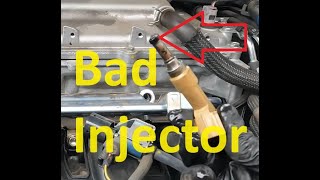
How to confirm: Perform a fuel injector balance test using a capable scan tool or an Active Fuel Injector Tester (AFIT). A leaking injector will deliver more fuel than commanded, causing a rich condition. You can also pull the spark plugs on Bank 1; a plug that is black, sooty, or wet with fuel points to an issue in that cylinder. 🎬 Watch: How to identify and test for a failing fuel injector.
Typical fix: Replace the faulty fuel injector(s) on Bank 1. It is often recommended to replace them as a set on the affected bank to ensure balanced fuel delivery.
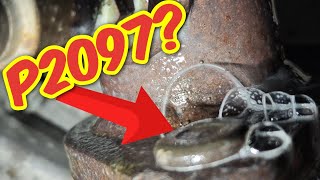
Est. part cost: $50-$150 per injector - Exhaust Leak (before or near the O2 sensor) 🟡 Medium Probability Exhaust system components can develop leaks at gaskets or welds over time. TSB #PIP4964F also mentions checking for small exhaust leaks if injectors test normal. A video of a 2011 Chevy Traverse with P2097 showed the cause to be a broken weld on the exhaust pipe flange right at the catalytic converter. 🎬 See how a broken exhaust weld causes these specific codes.
How to confirm: Visually inspect the exhaust manifolds and pipes on Bank 1 for cracks, rust, or loose flange bolts. A smoke test is the most effective method, where smoke is forced into the exhaust system to reveal small leaks. You may also hear a ticking or hissing sound from the engine bay, especially on a cold start. A confirmed repair on a 2019 Traverse with P2097 found the leak at the weld right next to the oxygen sensor. 🎬 Watch: Real-world diagnosis of a P2097 exhaust leak on this platform.
Typical fix: Replace the leaking exhaust gasket or repair/replace the cracked pipe section by re-welding the flange.
Est. part cost: $20-$100 - Faulty Downstream Oxygen Sensor (Bank 1, Sensor 2) ⚪ Low Probability → Shop Oxygen Sensor
How to confirm: Use a scan tool to monitor the voltage of the downstream O2 sensor. A healthy sensor on a warm engine should show a relatively steady voltage. If it's stuck high (above 0.8v) or fluctuating wildly like the upstream sensor, it may be faulty. However, GM service information explicitly advises against replacing the sensor unless other O2 circuit codes are present, as it is often correctly reporting a problem that originates elsewhere.
Typical fix: Replace the Bank 1 downstream (post-catalyst) oxygen sensor.
Est. part cost: $60-$180 - Faulty EVAP Purge Solenoid ⚪ Low Probability
How to confirm: A TSB for related GM engines (#PIP5534A) suggests checking the fuel trim response to rule out other issues. A stuck-open purge solenoid can allow un-metered fuel vapor into the intake manifold at idle, causing a rich condition. With the engine running, disconnect the vacuum line to the solenoid and check for vacuum with a gauge; there should be none at idle.
Typical fix: Replace the EVAP purge solenoid valve.
Est. part cost: $30-$70
Rare But Worth Checking
- Specific Driving Habits (2.0L Turbo): TSB #PIP5534A for related GM 2.0L engines states that heavy stop-and-go city driving or a 'digital' driving style (rapidly on and off the throttle) can induce a P2097 code without any mechanical fault. In these cases, GM states there is no repair and the code may clear with a different driving pattern.
- ECM Software Anomaly: A TSB for other GM models (#18-NA-047 for the 2017 Volt) indicates that this code can be caused by a software glitch that requires the Engine Control Module (ECM) to be reprogrammed by a dealer. It's worth checking if any software updates are available for your specific vehicle, as this is a known issue on other GM platforms.
- Contaminated or Failing Catalytic Converter: → Shop Catalytic Converter While less common, a failing catalytic converter can cause erratic readings from the downstream O2 sensor, potentially triggering a P2097 code. This is usually a result of a long-term rich condition (like a leaking injector) that has damaged the converter. It is typically accompanied by a P0420 code.
Diagnosis Steps
- Scan for other DTCs. Address any other fuel, misfire, or sensor circuit codes first, as they can provide crucial clues. GM service information notes that P2097 should not be addressed by replacing the O2 sensor unless other O2 circuit codes are present.
- Check for applicable TSBs. Contact a dealership with your VIN to see if there are any open recalls or software updates for the ECM related to P2097.
- Perform a fuel injector balance test. Following TSB #PIP4964F, this should be an early step to rule out leaking injectors, which are the most common cause. Use a scan tool's bidirectional controls to perform this test.
- Inspect for exhaust leaks. Visually and audibly check the exhaust system from the engine manifold to the catalytic converter on Bank 1 for any signs of leaks, paying close attention to flange welds. A smoke test is highly recommended to find small leaks that may not be obvious.
- Check the EVAP purge system. As suggested by TSB #PIP5534A, ensure the purge valve is not stuck open and leaking fuel vapors at idle.
- Analyze live O2 sensor data. Use a scan tool to observe the voltage readings from both upstream and downstream O2 sensors on Bank 1. Compare them to Bank 2 if possible (on V6 engines). A downstream sensor stuck high (e.g., >0.8V) confirms the rich reading.
- Test the downstream O2 sensor. If all other causes are ruled out and the sensor's readings are suspect (e.g., stuck high even when the engine is forced lean), test the sensor and its wiring before deciding to replace it.
Parts You'll Likely Need
- Fuel Injector
(OEM #12669384 (For 3.6L LGX))— Identified as a primary suspect in GM's own technical service bulletin (PIP4964F) for this code.
Trusted brands: ACDelco, Bosch
OEM price range: $100-$180
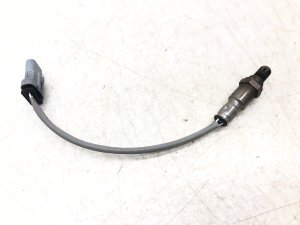
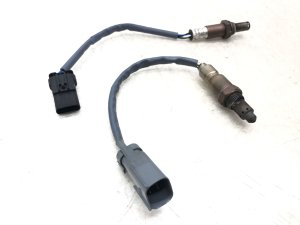
Aftermarket price range: $50-$120 - Downstream Oxygen Sensor (Bank 1, Sensor 2)
(OEM #12667438 (For 3.6L LGX, check VIN))— This is the sensor that triggers the code. While often not the root cause, it can fail and should be replaced if diagnostic testing proves it is faulty.
Trusted brands: ACDelco, Denso, Bosch, NGK
OEM price range: $85-$150
Aftermarket price range: $40-$70 - Exhaust Manifold Gasket — If an exhaust leak at the manifold is found to be the cause, this gasket will need to be replaced.
Trusted brands: ACDelco, Fel-Pro
OEM price range: $30-$60
Aftermarket price range: $15-$40
Related Codes That Often Appear With This One
- P0300 — A random misfire code can occur if a rich condition from a leaking injector or other issue leads to incomplete combustion and fouled spark plugs.
- P0172 — System Too Rich (Bank 1). This code indicates the upstream oxygen sensor is also detecting a rich condition, pointing more strongly to a fuel delivery issue like a leaking injector or stuck-open EVAP purge valve.
- P0420 — Catalyst System Efficiency Below Threshold (Bank 1). This code can appear alongside P2097 if the rich condition has persisted long enough to damage or contaminate the catalytic converter, or if an exhaust leak between the two O2 sensors is present.
Technical Service Bulletins (TSBs) & Recalls
- PIP4964F: Diagnostic information for DTC P2097 or P2099, pointing towards fuel injector testing as the primary step for 3.6L engines.
- PIP5534A: Information on P2097 being induced by driving habits on 2.0L Turbo engines, and diagnostic steps if a true fault is suspected.
- 19-NA-017: Addresses P2097 being caused by a software anomaly requiring an ECM reprogram on some GM vehicles.
Platform-Specific Known Issues
- TSB #PIP4964F: Instructs technicians to perform a fuel injector balance test prior to further diagnosis for code P2097 or P2099, noting it's the most common concern.
- TSB #PIP5534A: Notes that on related 2.0L Turbo engines, certain driving styles (heavy traffic, on/off throttle coasting) can induce a P2097 code without a mechanical fault.
Mechanic-Grade Diagnostic Values
- Long-Term Fuel Trim (from Freeze Frame Data) — expected: -13% to +13%. Failure: Positive counts above +13% indicate the system is adding fuel to compensate for a perceived lean condition (like a vacuum leak or restricted injector), which can lead to the P2097 code setting.
- Fuel Injector Balance Test (Low-Pressure Port Injection) — expected: All injectors should have a similar pressure drop.. Failure: The pressure drop difference between any injector and the average should not exceed 1.5 PSI (10 kPa). An injector with significantly less drop is restricted; one with significantly more drop is leaking.
- Fuel Injector Balance Test (High-Pressure GDI, via Scan Tool) — expected: All injectors should have a similar pressure drop/climb value.. Failure: The difference between any individual injector's pressure drop and the average of the others should not be greater than a 20% variance.
- Downstream O2 Sensor (Bank 1 Sensor 2) Voltage — expected: Relatively steady around 0.45V on a warm, running engine in closed loop.. Failure: A voltage signal stuck high (consistently above 0.8V) confirms the ECM is seeing a rich condition. This does not mean the sensor is bad, but that it is correctly reporting a rich exhaust stream.
Scan Tool Commands That Help
- GDS2 (GM) or equivalent professional scan tool: Fuel Injector Balance Test — This is a primary diagnostic step recommended by GM TSB #PIP4964F for P2097. It directly tests for leaking or restricted injectors, a very common cause on this platform. The test uses bidirectional control to pulse each injector and measure the corresponding drop in fuel rail pressure, identifying injectors that flow too much or too little fuel.
- GDS2 (GM) or equivalent professional scan tool: Fuel Trim Reset — After a repair is completed (e.g., replacing a leaking injector or fixing an exhaust leak), resetting the fuel trims will clear the learned long-term adjustments. This allows the ECM to relearn fuel delivery strategy immediately with the new components, confirming the fix more quickly and preventing the old trim values from affecting immediate performance.
Wiring & Ground Locations
- Main Engine Block Ground — A heavy gauge cable running from the engine block to the vehicle's frame/chassis. On some GM vehicles, this is located on the front or side of the engine block and bolts to the frame rail nearby.. The ECM and its sensors rely on a solid ground connection to the engine block for accurate readings. A loose or corroded main block ground can create a floating ground, causing erratic voltage readings from sensors like the O2 sensor, potentially leading to false rich or lean codes. While not a common cause, it should be inspected if electrical issues are suspected.
Real Owner Repair Stories
- YouTube video by 'G's Automotive' (2011 Chevy Traverse (platform mate with 3.6L V6)) — Check Engine Light with codes P2097 and P0420.
❌ Tried (didn't work) The technician began diagnostics by checking for backpressure, which led to the discovery of the real problem before parts were replaced.
✅ What actually fixed it A major exhaust leak from a broken factory weld on the flange connecting the Bank 1 catalytic converter to the intermediate pipe. The flange was re-welded to seal the leak, which resolved the codes. - YouTube video by 'Just Call Me Rosco' (2019 Chevrolet Traverse (platform mate with 3.6L V6)) — Check Engine Light with code P2097.
❌ Tried (didn't work) The technician initially suspected a bad gasket but found the leak persisted after replacement.
✅ What actually fixed it An exhaust leak was found directly at the weld on the exhaust pipe right next to the oxygen sensor bung. The proximity of the leak to the sensor was causing the false rich reading. Repairing the weld fixed the issue.
OEM Part Supersession History
12611545, 12632255, 12638530→12669384— Standard part evolution for improved performance, reliability, or manufacturing process.
Model Year Variations Within This Range
- 2020-2024: The introduction of the 2.0L Turbo LSY engine as a base option means that for these models, there is only one engine bank. Diagnostics are slightly simplified as there is no Bank 2 to compare against. The primary causes (injectors, exhaust leaks) remain the same, but TSB #PIP5534A regarding driving style inducing the code is more relevant to these turbo models.
Helpful Videos
We Have This Part in Stock

The information in this article is provided for general reference and educational purposes only. Vehicle specifications, procedures, and part compatibility can vary by production date, trim level, and region. Always consult your vehicle's factory service manual and verify part numbers before purchasing or performing repairs. Safety-critical components such as airbags, seat belts, and braking systems should be installed by a qualified professional.
- Cadillac XT5:
- 🧭 Diagnostic Flowchart
- 🎬 Helpful Videos
- 🛍️ Shop This Part
- What's Unique About the 2017-2024 Cadillac XT5
- Symptoms You May Notice
- Most Likely Causes
- Rare But Worth Checking
- Diagnosis Steps
- Parts You'll Likely Need
- Related Codes That Often Appear With This One
- Technical Service Bulletins (TSBs) & Recalls
- Platform-Specific Known Issues
- Mechanic-Grade Diagnostic Values
- Scan Tool Commands That Help
- Wiring & Ground Locations
- Real Owner Repair Stories
- OEM Part Supersession History
- Model Year Variations Within This Range
- 🎟️ Get 5% Off