

P2097 on 2012-2019 Chevrolet Impala: Rich Fuel Trim Causes and Fixes
On 2012-2019 Impalas, code P2097 is often caused by a leaking fuel injector, not a bad oxygen sensor. Per GM bulletins, diagnosis should start with a fuel injector balance test. Replacing the O2 sensor first is a common misdiagnosis.
- For the 2012-2019 Impala, suspect a leaking fuel injector before a bad oxygen sensor.
- Do not replace the downstream O2 sensor unless you have diagnosed it as faulty; it is usually just reporting the problem.
- A thorough diagnosis should include checking for exhaust leaks, vacuum leaks, and performing a fuel injector balance test.
- Many owners may only have a Check Engine Light with no other symptoms.
- Ignoring the code can lead to expensive catalytic converter damage in the long run.
What's Unique About the 2012-2019 Chevrolet IMPALA

Unlike many vehicles where this code points to a bad oxygen sensor, on the 2012-2019 Impala (and related GM vehicles), manufacturer technical service bulletins (TSBs) strongly suggest the cause is often a fuel system problem. Specifically, TSBs #PIP4964F and #PIP5534A instruct technicians to perform fuel injector balance tests before other extensive diagnostics. A GM diagnostic aid even states not to replace the oxygen sensor for this code unless a specific sensor circuit fault is also present, making O2 sensors a common point of misdiagnosis on this platform. TSB #PIP5534A also notes that for the 2.5L engine, diagnosis can be particularly tricky, with causes ranging from vacuum leaks to specific driving habits (frequent coasting followed by acceleration) that can induce the code without a hard fault.
Diagnostic Flowchart

Tap your situation to follow the diagnostic path that matches what you're seeing on this vehicle.
Generation note: This year range covers two Impala generations: the 9th (2012-2016) and the 10th (2014-2019). The 9th gen primarily used the 3.6L LFX V6. The 10th gen offered a 2.5L I4 (LCV/LKW) and the 3.6L V6. The diagnostic approach for P2097 is similar for both, with TSBs covering these engines and pointing towards fuel system and exhaust issues rather than simple sensor failure. TSB PIP5534A specifically applies to the 2.5L engines in the 10th generation.
Symptoms You May Notice
- Check Engine Light is on
- Reduced fuel economy
- Rough or erratic idle
- Engine may stumble or hesitate
- Fuel odor from the exhaust
- Louder than normal engine or exhaust noise
- Loss of power or acceleration
- Replacing the downstream (post-catalyst) oxygen sensor. GM diagnostic literature specifically advises against replacing the O2 sensor for this code unless a separate sensor circuit DTC is present. The downstream sensor is usually just reporting the problem, not causing it.
Most Likely Causes

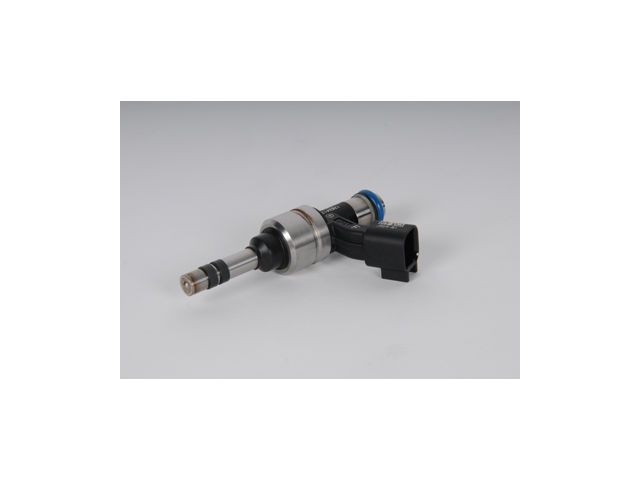
- Leaking or Faulty Fuel Injector(s) 🔴 High Probability → Shop Fuel Injector Manufacturer TSBs #PIP4964F and #PIP5534A specifically call out fuel injector testing as a key diagnostic step for this code on this platform, suggesting it's a known issue. A stuck-open injector will dump excess fuel into a cylinder, creating the rich condition detected downstream.
How to confirm: Perform a fuel injector balance test or an Active Fuel Injector Test (AFIT) with a capable scan tool to identify injectors with excessive flow or leakage. TSB #PIP5534A recommends this after checking for vacuum leaks.
Typical fix: Replace the faulty fuel injector(s). TSB #PIP5534A advises that if no single injector can be identified as faulty, all injectors on the affected bank should be replaced.
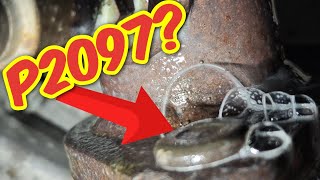
Est. part cost: $50-$120 per injector - Exhaust System Leak 🟡 Medium Probability The 10th generation Impala is noted to have issues with cracks forming on the catalytic converter housing near the mounting flange, which can cause leaks. A user on a mechanic forum with a 2017 3.6L Impala reported smelling exhaust in the cabin, which was diagnosed as a cracked radiator-side catalytic converter. A YouTube video shows a similar failure on a 2014 Impala, where hairline cracks developed where the pipe meets the manifold. 🎬 Watch this video to see where these hairline cracks develop.
How to confirm: Visually inspect the exhaust system from the engine to the downstream O2 sensor for cracks, holes, or loose flange connections, especially around the catalytic converter welds. A smoke test can reveal small, inaudible leaks. An exhaust leak can allow outside air to enter the exhaust stream, which can confuse the oxygen sensors and lead to an incorrect fuel trim adjustment.
Typical fix: Repair the leak by replacing the faulty gasket, tightening connections, or welding the damaged section of pipe. In cases of a cracked catalytic converter housing, the entire converter assembly may need replacement. 🎬 Watch: How to replace the catalytic converter and exhaust manifold.
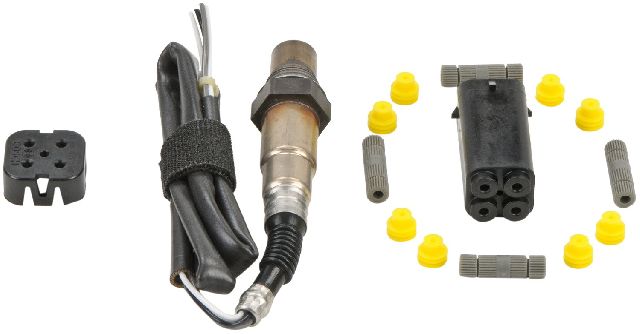
Est. part cost: $10-$100 for gaskets/welding, $1500+ for a new catalytic converter. - Faulty Upstream Oxygen Sensor (Sensor 1) 🟡 Medium Probability → Shop Oxygen Sensor
How to confirm: Use a scan tool to monitor live data from the upstream O2 sensor. If it is sending biased or slow-to-respond signals, it can cause the PCM to command a rich mixture, which the downstream sensor then correctly reports.
Typical fix: Replace the upstream (Bank 1, Sensor 1) oxygen sensor.
Est. part cost: $40-$90 - Vacuum Leak ⚪ Low Probability TSB #PIP5534A mentions this as a possible cause for the 2.5L engine. Another TSB for related vehicles mentions that loose intake manifold bolts can be a cause for this code.
How to confirm: TSB #PIP5534A mentions this as a possibility. Inspect all vacuum hoses for cracks or disconnections. A smoke test is the most effective way to find hidden leaks in the intake manifold or vacuum system. The TSB suggests checking for a skewed MAF sensor or damaged air box if a vacuum leak is suspected.
Typical fix: Replace the cracked hose or faulty gasket causing the leak. In some cases, simply torquing the intake manifold bolts to specification (12 Nm) may resolve the issue.
Est. part cost: $5-$50
Rare But Worth Checking
- Failing Catalytic Converter: → Shop Catalytic Converter While possible, a failing converter is more likely to set a P0420 (Catalyst Efficiency) code. However, if it becomes clogged or contaminated, it can affect exhaust flow and cause the post-catalyst sensor to give a rich reading.
- Faulty Mass Air Flow (MAF) Sensor: A dirty or failing MAF sensor can under-report airflow, causing the PCM to inject too much fuel. This would typically affect both banks on a V6 engine. TSB #PIP5534A lists a skewed MAF as a potential cause.
- Software Anomaly: For some GM vehicles, TSBs #19-NA-017 and #17058 have been issued for a software anomaly that can falsely trigger a P2097 code without any mechanical issue. The fix is to reprogram the ECM with updated software.
Diagnosis Steps
- Scan for all DTCs. Note any other codes present, as they can provide valuable clues (e.g., P0172, P030x).
- Review Freeze Frame data to understand the engine conditions when the code was set.
- Check for relevant TSBs. For some models, an ECM reprogram may be the first step to fix a software anomaly causing a false code.
- Inspect the exhaust system thoroughly for any leaks between the cylinder head and the downstream O2 sensor. Pay close attention to the exhaust manifold-to-head connection and welds on the catalytic converter, which are known failure points.
- Check for vacuum leaks using a smoke machine, as recommended by TSB #PIP5534A. Inspect the air intake system for damage or non-OEM parts.
- Follow TSB #PIP4964F: Perform a fuel injector balance test or Active Fuel Injector Test (AFIT) with a capable scan tool to check for leaking or over-fueling injectors.
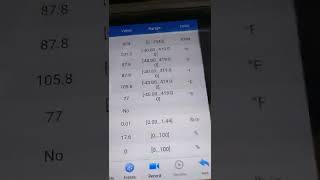
- Use a scan tool to monitor live data for both upstream (Sensor 1) and downstream (Sensor 2) oxygen sensors on Bank 1. The upstream sensor should fluctuate rapidly, while the downstream should be relatively steady. If the downstream sensor reads consistently high (e.g., >0.7V), it confirms a rich condition being reported.
- If all other tests are inconclusive, test the catalytic converter's efficiency by comparing inlet and outlet temperatures under load. A clogged converter can also be a cause.
Parts You'll Likely Need

- Fuel Injector
(OEM #12669384)— This is the most likely cause according to GM's own technical service bulletins for this code on this platform. This part number is for the 3.6L V6 engine in earlier models (approx. 2012-2016).
Trusted brands: ACDelco, Bosch
OEM price range: $80-$150
Aftermarket price range: $50-$100 - Upstream Oxygen Sensor (Bank 1 Sensor 1)
(OEM #12676225)— A faulty upstream sensor can cause an actual rich condition, which the downstream sensor then reports. This is a less likely cause than injectors but still common in the general automotive context.
Trusted brands: ACDelco, Denso, NTK
OEM price range: $70-$120
Aftermarket price range: $40-$90 - Exhaust Manifold Gasket
(OEM #12617904)— A common source of exhaust leaks that can skew O2 sensor readings. A leak here is a known issue on this platform.
Trusted brands: ACDelco, Fel-Pro
OEM price range: $20-$40
Aftermarket price range: $10-$25
Related Codes That Often Appear With This One
- P0172 — System Too Rich (Bank 1) - This code indicates the upstream O2 sensor is detecting a rich condition, which is the root cause that the downstream sensor is confirming with P2097.
- P0300-P0306 — Misfire codes can occur if a leaking injector is fouling a spark plug or causing incomplete combustion.
- P0420 / P0430 — Catalyst System Efficiency Below Threshold. If an exhaust leak near the manifold is the cause, it can sometimes trigger these codes alongside P2097.
Technical Service Bulletins (TSBs) & Recalls

- PIP4964F: Advises performing a fuel injector balance test before further diagnostics for P2097/P2099 codes.
- PIP5534A: Provides additional, advanced diagnostics for 2.5L engines, noting the difficulty of diagnosis and pointing to vacuum leaks, MAF issues, and ultimately faulty fuel injectors. It also mentions that certain driving styles (heavy stop-and-go, or repeated coasting and acceleration) can trigger the code without a mechanical fault.
- 19-NA-017: Addresses a software anomaly on some GM vehicles that can cause P2097 to set falsely. The fix is an ECM reprogram.
- PIP5419B (Superseded): While focused on P0420/P0430, this TSB identifies cracks around the catalytic converter mounting flange as a known issue on 2014-2018 Impalas, which can also cause the symptoms of P2097.
Platform-Specific Known Issues
- A Reddit user with a 2.5L Impala reported having c
Mechanic-Grade Diagnostic Values
- Low-Side Fuel Pressure (Key On, Engine Off prime pulse) — expected: 55-60 psi. Failure: Pressure below this range may indicate a weak in-tank fuel pump.
- Fuel System Leak-Down Test (High-Pressure Side) — expected: Pressure should not decrease more than 34 kPa (5 psi) in 1 minute.. Failure: A rapid decrease indicates a leaking high-pressure fuel pump or fuel injector(s).
- Downstream O2 Sensor (Bank 1, Sensor 2) Voltage at Idle — expected: A steady voltage, typically between 0.1V and 0.9V. For a rich condition, this will be consistently high.. Failure: A reading consistently above 0.7V confirms the rich condition reported by the P2097 code.
- O2 Sensor Heater Element Resistance — expected: Approximately 5 to 6 ohms.. Failure: An open circuit (infinite resistance) or no reading indicates a failed heater element within the sensor.
- Engine Compression (3.6L HFV6) — expected: 150-185 psi average.. Failure: A cylinder reading significantly lower than others can indicate a mechanical issue causing a rich condition.
Scan Tool Commands That Help
- GDS2 / Tech2: Active Fuel Injector Test (AFIT) — As recommended by TSB #PIP4964F, this is a primary step to identify leaking or malfunctioning fuel injectors that are a common cause of P2097 on this platform.
- GDS2 / Tech2: Fuel Pump Relay ON/OFF — To manually operate the in-tank fuel pump while observing a fuel pressure gauge, allowing for a controlled test of the low-pressure fuel system's ability to build and hold pressure.
Wiring & Ground Locations
- G115 — On the front of the left cylinder bank (for 3.6L V6 in 9th Gen Impala Limited).. This is a primary engine ground. A poor connection here can affect various sensors, including the crankshaft position sensor, which could indirectly impact fuel and ignition timing and lead to rich/lean issues.
- G302 — On the floor, to the right of the front passenger's seat (for 9th Gen Impala Limited).. This is a body ground point. While less likely to be the primary cause, modules related to fuel control or emissions may use this ground path. A poor connection could cause erratic behavior.
- Starter Ground Connection — The main ground cable connection at or near the starter motor on the engine block.. A real-world repair story on a related platform (2013 Malibu 2.5L) with P2097 and stalling issues found the root cause to be a loose ground at the starter. A poor main engine ground can cause erratic sensor readings and module behavior, leading to incorrect fuel trim adjustments.
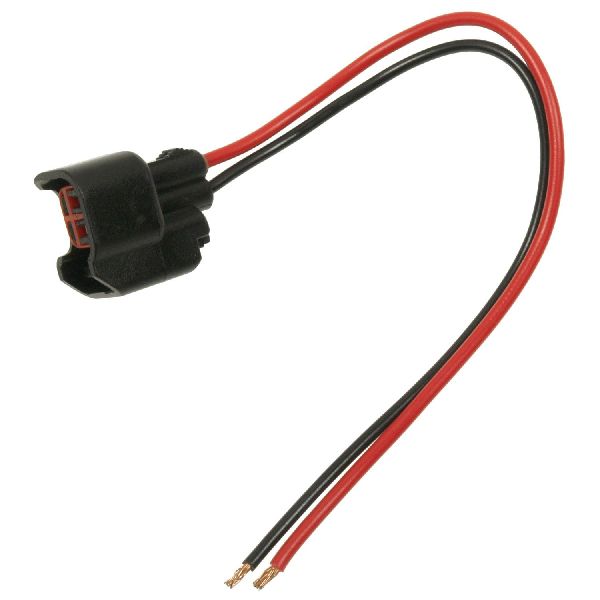
- O2 Sensor Connector — The 4-pin connector for the oxygen sensors.. The connector is a common point of failure due to heat and exposure. For the 2014-2019 Impala, this is often a gray, 4-pin male connector. Checking for corrosion or damage here is a key diagnostic step.
Real Owner Repair Stories
- Chevrolet Forum thread #intermittent-stalling (2013 Chevrolet Malibu 2.5L (related platform) and 2015 Chevrolet Impala with similar issues) — Car would intermittently stall when coming to a complete stop. The original poster had a P2097 code along with EVAP codes initially. Another user with a 2015 Impala reported the same stalling and had previous O2 sensor and fuel trim codes.
❌ Tried (didn't work) Cleaning O2 sensors, Cleaning throttle body and air sensors, Replacing the throttle body, Replacing auxiliary battery (dealership suggestion), Replacing cam solenoids (dealership suggestion)
✅ What actually fixed it For the Malibu owner who solved the problem, the intermittent stalling was fixed 'by accident' when they replaced the starter. They found a loose ground wire connection at the starter, and securing it properly resolved the stalling issue that had been present with the P2097 code.
OEM Part Supersession History
12638530, 12632255, 12611545→12669384— Standard part revision and consolidation by the manufacturer.
Heads up: When replacing fuel injectors for the 3.6L V6, ensure the replacement part is 12669384 or a direct, confirmed cross-reference. Using old stock of the superseded part numbers is not recommended.
Model Year Variations Within This Range
- 2012-2019 (3.6L V6 LFX): The 3.6L LFX V6 engine uses a high-pressure direct-injection fuel system. This requires specialized tools for fuel pressure testing and has different pressure specifications (e.g., 55-60 psi prime pulse) compared to a traditional port-injection system.
- 2012-2016 (9th Gen 'Limited' models): Wiring and ground locations are specific to the vehicle generation. For example, ground point G115 on the front of the left cylinder bank and G302 on the passenger floor apply to the 9th generation chassis. 10th generation vehicles (2014+) will have different locations.
Helpful Videos

We Have This Part in Stock


The information in this article is provided for general reference and educational purposes only. Vehicle specifications, procedures, and part compatibility can vary by production date, trim level, and region. Always consult your vehicle's factory service manual and verify part numbers before purchasing or performing repairs. Safety-critical components such as airbags, seat belts, and braking systems should be installed by a qualified professional.
- Chevrolet IMPALA:
- 🧭 Diagnostic Flowchart
- 🎬 Helpful Videos
- 🛍️ Shop This Part
- What's Unique About the 2012-2019 Chevrolet IMPALA
- Symptoms You May Notice
- Most Likely Causes
- Rare But Worth Checking
- Diagnosis Steps
- Parts You'll Likely Need
- Related Codes That Often Appear With This One
- Technical Service Bulletins (TSBs) & Recalls
- Platform-Specific Known Issues
- Mechanic-Grade Diagnostic Values
- Scan Tool Commands That Help
- Wiring & Ground Locations
- Real Owner Repair Stories
- OEM Part Supersession History
- Model Year Variations Within This Range
- 🎟️ Get 5% Off