

P2097 on 2019-2025 Subaru Ascent: Post Catalyst Fuel Trim Too Rich Causes and Fixes
On a 2019-2025 Subaru Ascent, code P2097 is most often caused by a failing rear (downstream) oxygen sensor (OEM Part No. 22690AB09A) or an exhaust leak before that sensor. Replacing the sensor is a common DIY fix costing around $80-$150 for an aftermarket part.
- P2097 on your Ascent means the exhaust is too rich after the catalytic converter.
- The most likely cause is a bad rear oxygen (O2) sensor, which is a straightforward DIY replacement for many owners.
- Before buying parts, check for exhaust leaks between the engine and the rear O2 sensor.
- Do not replace the expensive catalytic converter unless all other possibilities, especially the O2 sensors, have been ruled out.
- Check if your vehicle was affected by the 2019-2020 fuel pump recall, as this could be a related factor.
What's Unique About the 2019-2025 Subaru ASCENT
The Subaru Ascent, with its FA24F turbocharged engine, is specifically covered by Technical Service Bulletin (TSB) 18-228-25R. This TSB provides updated diagnostic flowcharts for technicians to follow when diagnosing P2097, indicating Subaru has recognized a need for a specific, refined procedure across many of its modern vehicles. While the causes are common, this official guidance suggests a pattern that dealers are equipped to handle. Additionally, some early Ascent models were subject to a recall for a faulty low-pressure fuel pump which, if failing, could potentially contribute to fuel delivery issues.
Diagnostic Flowchart
Tap your situation to follow the diagnostic path that matches what you're seeing on this vehicle.
Symptoms You May Notice
- Check Engine Light is on
- Decreased fuel economy
- Rough or erratic idle
- Engine may hesitate during acceleration
- A smell of fuel or rotten eggs from the exhaust
- Black smoke from the tailpipe in extreme cases
- Replacing the catalytic converter when the true fault is an inexpensive O2 sensor or an exhaust leak.
- Replacing the rear O2 sensor when an upstream issue (like a leaking injector or bad front A/F sensor) is causing a genuine rich condition that the rear sensor is correctly reporting.
Most Likely Causes
- Failing Rear (Downstream) Oxygen Sensor 🔴 High Probability → Shop Oxygen Sensor O2 sensors are wear-and-tear items that degrade over time. Contamination from fuel additives or engine byproducts can cause them to send inaccurate 'rich' signals to the ECM.
How to confirm: Use a scan tool to monitor the live voltage data from the rear O2 sensor (Bank 1, Sensor 2). A healthy sensor should show a relatively stable voltage (around 0.45V). 🎬 See how to test oxygen sensors with a scan tool If the voltage is stuck high (e.g., steady above 0.6V) or fluctuates wildly like the front sensor, it is likely faulty. A resistance test of the sensor's heater circuit should read between 5-6 ohms; a very high reading (over 50 ohms) or an open circuit indicates failure.
Typical fix: Replace the rear oxygen sensor. The OEM part number is 22690AB09A.
Est. part cost: $80-$180 - Exhaust System Leak 🟡 Medium Probability Gaskets and exhaust pipe welds can fail due to heat cycles and corrosion. Leaks are commonly found near the turbocharger, catalytic converter flanges, or any joint that has been recently disassembled.
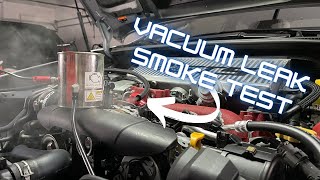
How to confirm: Perform a visual inspection of the exhaust system from the engine to the rear O2 sensor, looking for black soot marks, cracks, or holes. A smoke test is the most effective way to pinpoint small leaks. 🎬 Watch: How to perform a smoke test on a Subaru
Typical fix: Replace the leaking gasket or repair the leaking section of the exhaust pipe.
Est. part cost: $20-$100 - Failing Front (Upstream) Air/Fuel Ratio Sensor 🟡 Medium Probability → Shop Oxygen Sensor The front sensor is critical for fuel control. If it provides an incorrect 'lean' signal to the ECM, the computer will add too much fuel, causing a genuine rich condition that the rear sensor then correctly reports as P2097.
How to confirm: Monitor live data for both front and rear sensors. If the front sensor's readings are sluggish or biased, and short-term fuel trims are excessively negative as the ECM tries to compensate, it may be the root cause.
Typical fix: Replace the front air/fuel ratio sensor.
Est. part cost: $100-$250 - Leaking Fuel Injector(s) ⚪ Low Probability → Shop Fuel Injector Injectors can become stuck partially open due to internal wear or fuel deposits, allowing excess fuel to enter a cylinder.
How to confirm: This is more difficult to confirm and often requires professional diagnosis. It will usually be accompanied by other codes like P0172 (System Too Rich) or cylinder-specific misfire codes. Pulling the spark plugs may reveal one is much darker or more fouled than the others.
Typical fix: Replace the faulty fuel injector(s).
Est. part cost: $150-$400 per injector
Rare But Worth Checking
- Faulty Fuel Pump: Certain 2019-2020 Ascent models were recalled for a low-pressure fuel pump that could fail (NHTSA ID: 21V587). While failure usually causes a stall, a malfunctioning pump could potentially affect fuel pressure and contribute to a rich condition.
- Clogged or Failing Catalytic Converter: → Shop Catalytic Converter While a bad converter can cause this code, it's more often the *result* of a long-term rich condition, not the initial cause. Do not replace the converter until all sensor, exhaust leak, and fuel system issues have been ruled out.
Diagnosis Steps
- Scan for all stored DTCs. Address any other fuel system, misfire, or sensor circuit codes first.
- Perform a thorough visual inspection of the exhaust system from the turbocharger to the rear O2 sensor. Look for cracks, rust, and black soot trails indicating a leak.
- Use a scan tool to observe live data. Warm up the engine to enter closed-loop operation.
- Watch the Bank 1 Sensor 1 (front A/F sensor) voltage/current. It should fluctuate rapidly (typically between 0.1V and 0.9V).
- Watch the Bank 1 Sensor 2 (rear O2 sensor) voltage. It should be relatively steady. If it's stuck high (e.g., steady around 0.8V or higher) or fluctuating like the front sensor, the sensor itself is suspect or the catalytic converter is inefficient.
- Check short-term and long-term fuel trims. If they are highly negative (e.g., -10% or more), the ECM is trying to correct a genuine rich condition caused by something upstream (like a bad front sensor or leaky injector).
- If an exhaust leak is suspected, perform a smoke test to confirm its location.
- If a fuel delivery issue is suspected, test the fuel pressure and consider having the fuel injectors professionally cleaned or tested.
Parts You'll Likely Need
- Rear Oxygen (O2) Sensor
(OEM #22690AB09A)— This sensor is the most frequent point of failure for this specific code. It directly measures the condition that triggers the code and is a common wear item.
Trusted brands: Subaru OE, Denso (e.g., 234-4575), NTK
OEM price range: $170-$260
Aftermarket price range: $80-$150 - Exhaust Gasket — If an exhaust leak is found at a flange, replacing the gasket is the required fix. Common leak points are between the turbo and downpipe or at the catalytic converter flanges.
Trusted brands: Subaru OE, Fel-Pro
OEM price range: $20-$40
Aftermarket price range: $10-$25
Related Codes That Often Appear With This One
- P0172 — P0172 means 'System Too Rich Bank 1' based on the front A/F sensor. If both appear, it strongly suggests a real rich condition (e.g., leaking injector, faulty MAF sensor) rather than just a faulty rear O2 sensor.
- P2096 — P2096 is the opposite code ('Post Catalyst Fuel Trim Too Lean'). Seeing it logged in history may indicate an intermittent sensor or wiring problem. TSB 18-228-25R covers diagnostic procedures for both codes.
Technical Service Bulletins (TSBs) & Recalls
- 18-228-25R: Announces revised diagnostic procedures for DTCs P2096 and P2097, correcting the existing service manual. It applies to the Ascent and many other modern Subaru models.
Platform-Specific Known Issues
- Subaru issued Technical Service Bulletin (TSB) #18-228-25R to provide dealers with specific, updated diagnostic procedures for codes P2096 and P2097 on the Ascent and other models. This bulletin corrects/replaces the standard service manual steps.
- A recall (NHTSA ID: 21V587 / Subaru WRG-21R) was issued for the low-pressure fuel pump on some 2019-2020 Ascent models, which could cause engine performance issues.
- A CVT chain slip recall (WRK-21/22R) also affects 2019-2020 Ascents, though it is not directly related to the P2097 code, it is another known issue with the powertrain in this year range.
Mechanic-Grade Diagnostic Values
- Downstream O2 Sensor (Bank 1, Sensor 2) Voltage — expected: Relatively steady signal around 0.45V when the engine is at operating temperature and in closed loop.. Failure: Voltage is stuck high (consistently >0.6V) or fluctuates rapidly like the upstream sensor.
- O2 Sensor Heater Circuit Resistance — expected: 5 to 6 ohms on a good sensor.. Failure: Reading is very high (typically over 50 ohms) or shows an open circuit (OL).
- Upstream A/F Sensor (Bank 1, Sensor 1) Voltage — expected: Should fluctuate rapidly between approximately 0.1V and 0.9V.. Failure: Signal is sluggish, stuck, or does not switch between high and low values.
Scan Tool Commands That Help
- Subaru Select Monitor (SSM) or equivalent professional scanner: Follow Diagnostic Procedure in TSB 18-228-25R — This TSB provides a specific, updated diagnostic flowchart that supersedes the standard service manual for diagnosing P2097. It should be the primary guide for a technician to ensure the most accurate diagnosis as intended by the manufacturer.
Wiring & Ground Locations
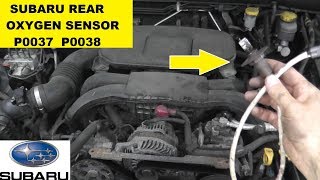
- Rear O2 Sensor Connector — On the passenger side of the engine bay, near the air intake box and power steering lines. The all-gray plug corresponds to the rear (downstream) sensor.. This is the primary connection point for the sensor. Checking for moisture, corrosion, or damage here is a critical step before replacing the sensor itself.
- Engine Ground (ECU) — The primary grounding points for the ECU are on the top of the intake manifold. Another critical ground runs from the engine block to the chassis.. A weak or corroded ground connection at the intake manifold can cause a wide range of strange electrical issues, potentially affecting sensor readings and ECU calculations. This should be checked if the primary causes have been ruled out.
- Rear Oxygen Sensor Harness — Runs from the rear oxygen sensor on the exhaust pipe up to the connector in the engine bay.. The harness itself can be damaged by heat or road debris, causing an open or short. The part number is 24039AA165, which supersedes 24039AA164.
Real Owner Repair Stories
- Reddit user on r/subaru (2005 Impreza RS (demonstrates a common Subaru issue)) — Check Engine Light with code P2097 appearing every 40-80 miles.
❌ Tried (didn't work) Using a fuel system cleaner (Cataclean), Replacing the downstream O2 sensor
✅ What actually fixed it The code appeared immediately after a clutch replacement, which requires removing the exhaust. The strong suspicion and logical cause was an exhaust leak introduced when the system was reinstalled, not a sensor failure. - Melnik's Automotive on YouTube (2010 Subaru Impreza WRX (relevant Subaru example)) — Check Engine Light on, traction light on, flashing cruise control light, and a sudden, significant drop in average fuel economy (from ~20 MPG to 17.4 MPG).
❌ Tried (didn't work) The owner noted that fuel injector cleaners are often suggested but have never permanently fixed such an issue in his experience.
✅ What actually fixed it Replacing the rear (downstream) oxygen sensor. After replacement and clearing the code, the average MPG immediately began to climb back to normal levels on the next drive cycle.
OEM Part Supersession History
24039AA164→24039AA165— Standard part revision/update by the manufacturer.
Heads up: The new part number (24039AA165) is the correct replacement for the old one.
Model Year Variations Within This Range
- 2019-2022 vs 2023-2025: The Subaru Ascent received a significant facelift for the 2023 model year, including a new front fascia, redesigned lights, and a larger 11.6-inch standard infotainment screen. However, the core powertrain, the 260-hp 2.4L turbocharged boxer engine (FA24F) and Lineartronic CVT, remained unchanged. Therefore, the causes, diagnostic procedures, and fixes for code P2097 are consistent across the entire 2019-2025 generation.
Helpful Videos

The information in this article is provided for general reference and educational purposes only. Vehicle specifications, procedures, and part compatibility can vary by production date, trim level, and region. Always consult your vehicle's factory service manual and verify part numbers before purchasing or performing repairs. Safety-critical components such as airbags, seat belts, and braking systems should be installed by a qualified professional.
- Subaru ASCENT:
- 🧭 Diagnostic Flowchart
- 🎬 Helpful Videos
- What's Unique About the 2019-2025 Subaru ASCENT
- Symptoms You May Notice
- Most Likely Causes
- Rare But Worth Checking
- Diagnosis Steps
- Parts You'll Likely Need
- Related Codes That Often Appear With This One
- Technical Service Bulletins (TSBs) & Recalls
- Platform-Specific Known Issues
- Mechanic-Grade Diagnostic Values
- Scan Tool Commands That Help
- Wiring & Ground Locations
- Real Owner Repair Stories
- OEM Part Supersession History
- Model Year Variations Within This Range
- 🎟️ Get 5% Off