

P2097 on 2017-2024 Subaru Crosstrek: Post-Catalyst Fuel Trim Too Rich Causes & Fixes
On a 2017-2024 Subaru Crosstrek with the 2.0L engine, code P2097 is most often caused by a failing front air/fuel (A/F) ratio sensor (Bank 1, Sensor 1), even though the code references the rear post-catalyst sensor. An exhaust leak before the catalytic converter is the second most likely cause. It is critical to use an OEM or Denso-branded replacement A/F sensor, as generic parts are known to cause performance issues. Expect to pay $180-$280 for a quality A/F sensor.
- Code P2097 means the exhaust is too rich after the catalytic converter.
- On a Subaru Crosstrek, the most likely cause is a failing *front* air/fuel ratio sensor, not the rear one.
- Before replacing any parts, perform a thorough inspection for exhaust leaks between the engine and the catalytic converter.
- Use a quality OEM-branded replacement sensor (like Denso) for the best results; cheaper aftermarket sensors can fail quickly.
- Do not immediately replace the rear O2 sensor or the catalytic converter, as they are often not the root cause.
What's Unique About the 2017-2024 Subaru CROSSTREK
A very common point of confusion for P2097 on this Subaru platform is that the root cause is frequently the *front* air/fuel (A/F) ratio sensor, not the rear oxygen sensor that the code directly refers to. The rear sensor is often just accurately reporting a rich condition caused by the failing upstream A/F sensor providing incorrect data to the engine computer. The TSB #18-228-25R issued by Subaru for this exact code on these vehicles underscores that it's a known issue requiring special diagnostic procedures. 🎬 Watch this diagnostic guide for P2097 and poor gas mileage. Many owners and even some shops mistakenly replace the rear sensor first, only to have the code return. Using non-OEM (generic) sensors is also a known cause of failure and performance issues like stalling.
Diagnostic Flowchart
Tap your situation to follow the diagnostic path that matches what you're seeing on this vehicle.
Generation note: The 2017-2024 range covers three Crosstrek generations: the 1st (model year 2017), 2nd (2018-2023), and 3rd (2024-present). However, the primary 2.0L FB20D engine and emissions system architecture are similar, making the causes and fixes for P2097 largely consistent across these years. Note that for 2024, only the Base and Premium trims retain the 2.0L engine.
Symptoms You May Notice
🎬 Watch this breakdown of P2097 symptoms and common causes.- Check Engine Light is on
- Decreased fuel economy
- Rough or erratic idling
- Poor engine performance or lack of power
- Strong fuel smell from the exhaust
- Black smoke from the tailpipe in extreme cases
- Immediately replacing the rear (downstream) oxygen sensor without first testing the front air/fuel sensor and thoroughly checking for exhaust leaks. The rear sensor is often just the messenger reporting a problem that originates upstream.
Most Likely Causes
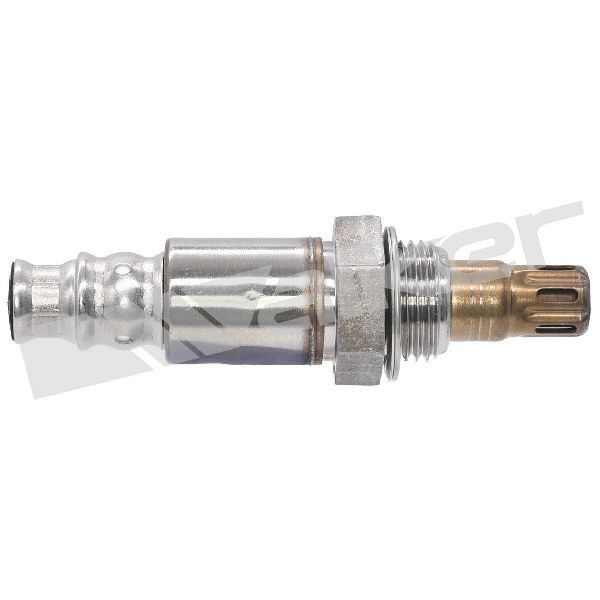
- Failing Front Air/Fuel (A/F) Ratio Sensor 🔴 High Probability → Shop Oxygen Sensor The front A/F sensor is a more complex, wideband sensor responsible for primary fuel control. They can become 'lazy' or biased over time, sending incorrect data to the ECM, which then commands an overly rich mixture. The rear O2 sensor correctly reports this rich condition, triggering the P2097 code. This is the most common failure point for this code on Subarus.
How to confirm: Use a scan tool to monitor live data. A healthy front A/F sensor's readings should fluctuate rapidly. A sensor that is slow to respond or provides a steady, biased reading is likely faulty. Also check long-term and short-term fuel trims; consistently high positive trims can indicate the ECM is adding fuel to compensate for a perceived lean condition (caused by a bad sensor or exhaust leak).
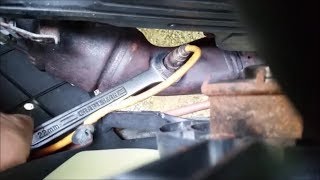
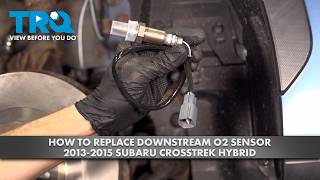
Typical fix: Replace the front A/F ratio sensor 🎬 See this walkthrough on how to replace both O2 sensors. (Bank 1, Sensor 1). It is highly recommended to use an OEM or OEM-supplier part (like Denso) for reliability. Generic parts have been reported to cause stalling and repeat codes.
Est. part cost: $180-$280 - Exhaust System Leak 🟡 Medium Probability Leaks from gaskets (especially after repairs like a clutch replacement), flex pipes, or weld seams before or near the front A/F sensor can allow outside oxygen to enter the exhaust stream. This tricks the front sensor into thinking the engine is running lean, causing the ECM to add excessive fuel and create a genuinely rich condition that the rear sensor then reports.
How to confirm: Visually inspect the entire exhaust system from the engine manifold to the catalytic converter for soot marks, cracks, or holes, paying close attention to gasket flanges. A smoke test is the most effective way to pinpoint small leaks. An audible ticking or hissing sound from the engine bay that changes with RPM can also indicate a leak.
Typical fix: Repair the leak. This may involve replacing a gasket, patching a small hole, or welding/replacing the damaged section of pipe. Re-torquing exhaust manifold bolts may be necessary if they have loosened.
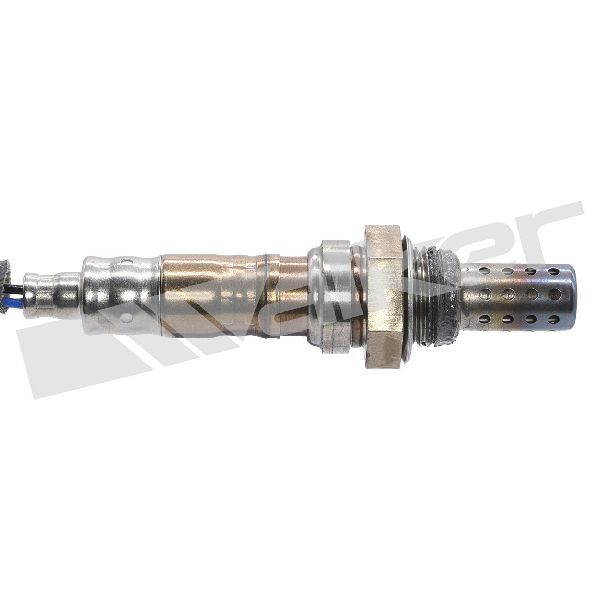
Est. part cost: $10-$300 - Failing Rear Oxygen (O2) Sensor ⚪ Low Probability → Shop Oxygen Sensor While less common than the front sensor failing, the rear O2 sensor can fail and send incorrect rich readings to the ECM. However, this should be considered only after ruling out the front A/F sensor and exhaust leaks.
How to confirm: With a scan tool, observe the rear O2 sensor's voltage. On a warm engine at steady RPM, it should remain relatively stable and not mirror the rapid fluctuations of the front sensor. If it's stuck high (e.g., >0.8V), it may be faulty.
Typical fix: Replace the rear oxygen sensor (Bank 1, Sensor 2).
Est. part cost: $80-$150
Rare But Worth Checking
- Leaking Fuel Injectors or High Fuel Pressure: → Shop Fuel Injector This creates a true rich condition. It would likely be accompanied by other codes like P0172 (System Too Rich) and possibly misfire codes.
- Failing Catalytic Converter: → Shop Catalytic Converter A clogged or inefficient catalytic converter can sometimes cause this code, but it's more often a symptom of a long-term rich condition rather than the initial cause.
- Faulty Mass Airflow (MAF) Sensor: A dirty or failing MAF sensor can under-report the amount of air entering the engine, causing the ECM to inject too much fuel.
- Broken Engine Ground Strap: In some Subaru models, a broken engine-to-frame ground strap located near the O2 sensor connectors can cause erratic sensor readings. This should be inspected during diagnosis.
Diagnosis Steps
- Read all stored trouble codes with an OBD-II scanner to check for any other related faults.
- Perform a thorough visual inspection of the exhaust system from the engine block to the rear O2 sensor. Look for any signs of leaks, such as black soot, cracks, or broken hangers. Pay close attention to the manifold gaskets.
- Inspect wiring to all O2 sensors for damage, and check for a broken engine-to-frame ground strap, which can be located near the sensor connectors on some models.
- Use a scan tool to monitor live data. Watch the signals from the front A/F sensor (Bank 1, Sensor 1) and the rear O2 sensor (Bank 1, Sensor 2). Also, observe Short-Term and Long-Term Fuel Trims.
- Evaluate the front A/F sensor. It should react quickly to changes in throttle. A lazy or biased reading points to a faulty sensor.
- Evaluate the rear O2 sensor. Its voltage should be relatively stable. If it's stuck high or mirroring the front sensor's activity, it could be suspect, but this could also indicate a bad catalytic converter.
- If sensors and exhaust appear fine, perform a smoke test to definitively rule out hard-to-see vacuum or exhaust leaks.
- If no issues are found, investigate the fuel system for high fuel pressure or leaking injectors.
- Check for any available Technical Service Bulletins (TSBs) for your vehicle, as an ECM software update may be required per TSB 18-228-25R.
Parts You'll Likely Need
- Front Air/Fuel Ratio Sensor (Bank 1, Sensor 1)
(OEM #22641AA61A (Verify by VIN))— This is the most frequent cause of P2097 on modern Subarus. It is the primary sensor for fuel control, and its failure leads to the rich condition reported by the rear sensor.
Trusted brands: Denso (OEM Supplier), NTK
OEM price range: $220-$280
Aftermarket price range: $180-$250 - Rear Oxygen Sensor (Bank 1, Sensor 2) — This part is often replaced mistakenly but can be the cause in some cases. It is responsible for reporting the code.
Trusted brands: Denso, Bosch
OEM price range: $120-$180
Aftermarket price range: $80-$150 - Exhaust Gasket(s) — If an exhaust leak is found at a flange (e.g., manifold to pipe, pipe to converter), the gasket will need to be replaced. This is common after other repairs where the exhaust was removed.
Trusted brands: Fel-Pro, Walker Exhaust
OEM price range: $15-$40
Aftermarket price range: $10-$25
Related Codes That Often Appear With This One
- P0172 — P0172 (System Too Rich Bank 1) indicates the front A/F sensor is detecting a rich condition. They often appear together as the ECM tries to understand the persistent rich signals.
- P0420 — P0420 (Catalyst System Efficiency Below Threshold) can appear if the rich condition persists long enough to damage or foul the catalytic converter, reducing its efficiency. Some owners report P0420 appearing before P2097 becomes persistent.
Technical Service Bulletins (TSBs) & Recalls
- Bulletin #18-228-25R: Announces updated diagnostic procedures for DTCs P2096 (Post Catalyst Fuel Trim System Too Lean) and P2097 (Post Catalyst Fuel Trim System Too Rich), applicable to 2017-2025 Crosstreks among other models.
Platform-Specific Known Issues
- Subaru Technical Service Bulletin (TSB) #18-228-25R: Subaru issued this TSB which applies to 2017-2025 Crosstreks. It acknowledges codes P2096 and P2097 as known issues and provides updated, specific diagnostic procedures for technicians to follow, which supersede the standard service manual. This highlights that the manufacturer has a special protocol for diagnosing this common code.
- Real-World Repair Story: The Perils of Generic Sensors: In a documented case involving an '18 Crosstrek with a rear O2 sensor heater code, the owner replaced the sensor with an aftermarket (Walker brand) part. The code returned within a week, highlighting the platform's sensitivity to non-OEM components and reinforcing the recommendation to use Denso or genuine Subaru parts.
Mechanic-Grade Diagnostic Values
- Rear O2 Sensor (Bank 1, Sensor 2) Heater Circuit Resistance — expected: 5.6 Ohms +/- 0.8 Ohms at 68°F (20°C). Failure: A reading of infinity (open circuit) or significantly outside the specified range indicates a faulty heater element within the sensor.
- Rear O2 Sensor (Bank 1, Sensor 2) Connector Voltage (Key On, Engine Off) — expected: Battery Voltage (B+) on Pin 1 (Red wire). Failure: No voltage on Pin 1 suggests a problem in the wiring harness or fuse, not the sensor itself.
- Downstream O2 Sensor (Bank 1, Sensor 2) Voltage (Engine Warm, Closed Loop) — expected: A relatively steady voltage.. Failure: If the voltage is fluctuating wildly like the front (upstream) sensor, it may indicate a failing catalytic converter. If it is stuck high (e.g., >0.8V), the sensor may be biased or faulty.
Wiring & Ground Locations
- Rear O2 Sensor Connector (B1S2) — On the exhaust pipe after the catalytic converter. The connector is typically mounted to the vehicle's underbody nearby.. Testing at the connector is required to determine if a fault is in the sensor itself or the vehicle's wiring harness. For an '18 Crosstrek, Pin 1 (Red) is power and Pin 2 (Green/Yellow) is the ground for the heater circuit.
- Front A/F Sensor Plug (B1S1) — On the exhaust manifold/header pipe before the catalytic converter.. This is the connector for the most common failed part. When referencing a Subaru factory wiring diagram, the plug may be identified as E23, E24, B18, B262, or B379.
Real Owner Repair Stories
- Reddit user on r/subaru (2005 Impreza RS with 259k miles) — Code P2097 started appearing every 40-80 miles immediately after a clutch replacement, which required removing the exhaust. Was previously getting an intermittent P0420 code.
❌ Tried (didn't work) Using a fuel system cleaner (Cataclean)., Replacing the downstream (rear) O2 sensor.
✅ What actually fixed it The user concluded the next logical step was replacing the upstream (front) O2 sensor or fixing an exhaust leak created during the clutch repair, strongly implying one of these was the root cause. This supports the common diagnostic path. - YouTube channel Melniks Automotive (2010 Subaru Impreza WRX) — Check Engine Light with code P2097 and very poor fuel economy (17.4 MPG).
❌ Tried (didn't work) The owner dismissed using a fuel injector cleaner as a likely permanent fix based on experience.
✅ What actually fixed it Replacing the rear oxygen sensor (downstream). After replacement and clearing the code, fuel economy improved to over 20 MPG, and the repair was considered confirmed. This serves as a counter-example to the common wisdom that the front sensor is always the cause. - Reddit user on r/Crosstrek (2018 Crosstrek 6MT with 110k miles) — Intermittent Check Engine Light for the downstream O2 sensor heater circuit.
❌ Tried (didn't work) Replacing the rear O2 sensor with an aftermarket Walker brand sensor (part #350-34052). The code returned after about a week.
✅ What actually fixed it The user confirmed the new sensor's heater resistance was in spec (6.0 Ohms) and that the ECU was correctly modulating the heater circuit. The unresolved issue after replacing with an aftermarket part strongly points to the part's incompatibility, reinforcing the common advice to use OEM (Denso) sensors.
When the Usual Fixes Don't Work
- While the overwhelming majority of documented cases for P2097 on Subarus point to a faulty front A/F sensor or an exhaust leak, there are confirmed repairs where the cause was, in fact, the rear O2 sensor that the code directly references. One owner of a 2010 WRX fixed their P2097 and poor fuel economy by replacing only the rear O2 sensor. This demonstrates that while it should not be the first part replaced, a faulty rear sensor cannot be completely ruled out.
OEM Part Supersession History
22641AA61A (Subaru OEM)→22641AA670, 22641AA71A (Subaru OEM)— Standard part updates and revisions by the manufacturer.
Heads up: The aftermarket equivalent for these parts, fitting many 2017+ Crosstreks, is Denso 234-9138. Do not confuse this with Denso 234-9109, which fits older 2013-2014 models and is not compatible.
Model Year Variations Within This Range
- 2017-2024: The front A/F ratio sensor part number differs from the first-generation XV Crosstrek (2013-2014 models use Denso 234-9109) compared to the 2017 and newer models (which use a part cross-referenced to Denso 234-9138). Using the wrong part will cause issues.
- 2024: For the 2024 model year, the 2.0L FB20D engine is only available in the Base and Premium trim levels. Higher trims (Sport, Limited, Wilderness) use a 2.5L engine, which may have different diagnostic considerations.
Helpful Videos
We Have This Part in Stock

The information in this article is provided for general reference and educational purposes only. Vehicle specifications, procedures, and part compatibility can vary by production date, trim level, and region. Always consult your vehicle's factory service manual and verify part numbers before purchasing or performing repairs. Safety-critical components such as airbags, seat belts, and braking systems should be installed by a qualified professional.
- Subaru CROSSTREK:
- 🧭 Diagnostic Flowchart
- 🎬 Helpful Videos
- 🛍️ Shop This Part
- What's Unique About the 2017-2024 Subaru CROSSTREK
- Symptoms You May Notice
- Most Likely Causes
- Rare But Worth Checking
- Diagnosis Steps
- Parts You'll Likely Need
- Related Codes That Often Appear With This One
- Technical Service Bulletins (TSBs) & Recalls
- Platform-Specific Known Issues
- Mechanic-Grade Diagnostic Values
- Wiring & Ground Locations
- Real Owner Repair Stories
- When the Usual Fixes Don't Work
- OEM Part Supersession History
- Model Year Variations Within This Range
- 🎟️ Get 5% Off