

OBD-II Code P2099: Post Catalyst Fuel Trim System Too Rich, Bank 2
An Expert Guide to Diagnosing and Fixing P2099
- P2099 triggers when the Bank 2 downstream oxygen sensor detects a persistent rich exhaust condition, meaning too much fuel or too little air.
- Always check for manufacturer Technical Service Bulletins (TSBs) first, as a 30-minute PCM software update resolves this code on many Jeep, Dodge, and GM vehicles.
- Do not blindly replace the $150 oxygen sensor; verify the failure by checking if the Bank 2 Sensor 2 live voltage is stuck above 0.8V.
- Ignoring a P2099 code drops fuel economy by up to 25% and destroys the catalytic converter within 3 to 6 months, turning a minor repair into a $2,000+ expense.
What Does P2099 Mean?
Your Powertrain Control Module (PCM) detects too much fuel or too little oxygen in the exhaust on Bank 2. The downstream oxygen sensor (located after the catalytic converter) measures this. Bank 2 is the side of the engine opposite cylinder number one.
Technical definition: The SAE/OBD-II definition is "Post Catalyst Fuel Trim System Too Rich (Bank 2)". The PCM uses the downstream oxygen sensor (Bank 2, Sensor 2) to monitor catalyst efficiency and adjust fuel strategy. When this sensor consistently reports a high voltage (indicating a rich mixture) and the PCM's long-term fuel trim adjustments reach their maximum correction limit, the code sets.
Can I Drive With P2099?
Yes, But With Caution. Yes, but only for a few days. A persistent rich condition wastes fuel and overheats the catalytic converter. Ignoring P2099 turns a $150 sensor replacement into a $1,000–$4,000 catalytic converter failure. Diagnose the vehicle immediately to prevent permanent exhaust damage.
Common Causes
- Faulty Downstream O2 Sensor or Wiring (Very Common) — The Bank 2, Sensor 2 oxygen sensor fails, becomes contaminated, or suffers wiring damage (shorts to voltage), sending a false 'rich' signal (stuck high voltage) to the computer. This is the most frequent cause of a false P2099 code. 🎬 See the fastest way to find hidden exhaust leaks.
- Exhaust Leaks Before the Sensor (Common) — Leaks at the exhaust manifold, gaskets, or pipe flanges draw in outside air. The upstream O2 sensor detects this unmetered air and commands extra fuel. The downstream sensor then correctly reports the resulting rich condition.
- Leaking Fuel Injectors (Common) — A fuel injector on Bank 2 gets stuck open or leaks, dripping excess fuel into the engine. This creates a genuine rich condition. This is a documented issue on specific GM, Ford, and BMW engines.
- PCM Software Glitch (Less Common) — The original PCM software is overly sensitive and triggers a P2099 code incorrectly. A dealership software update resolves this on several Jeep, Dodge, and BMW models.
- Dirty or Faulty Mass Airflow (MAF) Sensor (Less Common) — A dirty or failing MAF sensor under-reports the amount of air entering the engine, causing the computer to inject too much fuel across all banks.
- Faulty Fuel Pressure Regulator (Less Common) — A failed regulator allows excessively high fuel pressure, forcing more fuel than needed through the injectors and creating a rich mixture.
- Clogged or Failing Catalytic Converter (Rare) — Usually the result of a long-term rich condition, a failing catalytic converter causes erratic backpressure and exhaust flow readings, triggering this code as a secondary fault.
- Faulty EVAP Purge Valve (Rare) — A stuck-open evaporative emissions (EVAP) purge valve allows unmetered fuel vapors from the gas tank into the intake manifold, introducing unaccounted-for fuel.
Symptoms
- Check Engine Light is On — The Check Engine Light illuminates immediately. Some vehicles display a 'Service Emissions System' message.
- Reduced Fuel Economy — Fuel economy drops by 15-25% because the engine runs rich and wastes gasoline.
- Strong Smell of Gasoline — The exhaust emits a raw gasoline or rotten egg odor, indicating unburned fuel passing through the catalytic converter.
- Rough Idle or Engine Hesitation — The engine shakes when stopped, stumbles during acceleration, or hesitates for a few seconds after a cold start.
- Black Smoke from Exhaust — The tailpipe emits black smoke, a definitive sign of soot created by burning excessive fuel.
- Failed Emissions Test (also visible on scanner) — The vehicle fails state emissions inspections due to high levels of hydrocarbons (HC) and carbon monoxide (CO).
Diagnostic Flowchart
Tap your situation to follow the diagnostic path that matches what you're seeing on this code.
Common Fixes & Costs
- Replace Downstream Oxygen (O2) Sensor (Bank 2, Sensor 2) — Parts: $50-$150, Labor: $100-$200, ~0.8 hr book time (DIY)
- Repair Exhaust Leak — Parts: $30-$100, Labor: $150-$400, ~2.5 hr book time (Intermediate)
- Replace Leaking Fuel Injector(s) — Parts: $100-$300 per injector, Labor: $200-$600, ~2.0 hr book time (Professional)
- Perform PCM Software Update — Parts: $0, Labor: $100-$200, ~1.0 hr book time (Professional)
- Replace Fuel Pressure Regulator — Parts: $50-$200, Labor: $150-$300, ~1.5 hr book time (Intermediate)
DIY vs Professional
- Replace Downstream Oxygen (O2) Sensor 🟢 Beginner
Tools: Jack and jack stands, ratchet, O2 sensor socket set, penetrating oil, anti-seize lubricant. - Repair Exhaust Leak (Gasket) 🟢 Beginner
Tools: Jack and jack stands, socket/wrench set, torque wrench, gasket scraper, new gaskets. - Replace Leaking Fuel Injector(s) 🟢 Beginner
Tools: Fuel line disconnect tools, socket set, torque wrench, new o-rings/seals. - Perform PCM Software Update 🟢 Beginner
Tools: Dealership-specific diagnostic and programming tool (e.g., wiTECH for Chrysler, IDS for Ford). - Replace Fuel Pressure Regulator 🟢 Beginner
Tools: Fuel line disconnect tools, wrench set, new regulator.
Used vs. New Parts: Buying Guide
When a used part is worth it: Buy a used OEM catalytic converter from a low-mileage donor for older vehicles to save money. Never buy used O2 sensors or fuel injectors, as they are wear items with unknown remaining lifespans.
Donor-vehicle mileage cap: roughly under 80000 miles for the part to have meaningful remaining life.
Donor quality checklist:
- Verify the donor vehicle was not scrapped for emissions failure or engine problems.
- Match the part number exactly; visual similarities do not guarantee compatibility.
- Avoid parts from regions with heavy road salt use to prevent hidden corrosion.
- Buy from a reputable recycler offering at least a 30-90 day warranty.
Decision logic:
- If The part is an O2 sensor or fuel injector → Always buy new. The minimal cost savings of a used part do not justify the risk of premature failure and repeat labor costs.
- If The part is a catalytic converter and the vehicle is under 8 years/80,000 miles → Check if the repair is covered under the federal emissions warranty before buying parts.
- If The part is a catalytic converter on a high-mileage vehicle and budget is the primary concern → A used OEM converter from a verified low-mileage donor outperforms cheap, new aftermarket units that lack sufficient catalyst material.
Warranty tradeoff: Used parts include a 30-90 day functional warranty. New aftermarket parts offer a 1-year or limited lifetime warranty. New OEM parts carry the manufacturer's standard warranty.
Worst-case if a used part fails: $500-$1500, representing the repeat labor to remove the failed used part and install a replacement, plus the cost of the second part.
What Happens If You Wait — Timeline
- 0-2 weeks: The Check Engine Light (P2099) turns on with no other noticeable symptoms. The computer detects a rich condition but compensates in the short term. (MPG impact: 0-5%% · Added cost: $0)
- 2 weeks - 3 months: Fuel economy drops noticeably, and the exhaust smells of gasoline after a cold start. The catalytic converter operates at higher-than-normal temperatures due to excess fuel. (MPG impact: 5-15%% · Added cost: $30-$80 in wasted fuel)
- 3-6 months: The catalytic converter's internal substrate coats or melts from constant high heat. The engine idles roughly. A P0430 (Catalyst Inefficiency) code appears alongside P2099. (MPG impact: 15-25%% · Added cost: $1,200-$2,800 (catalytic converter replacement required))
- 6+ months: The catalytic converter completely clogs or melts, causing severe exhaust backpressure. This leads to massive power loss, blown engine seals, and stalling. (MPG impact: 25-50%% · Added cost: $1,500-$4,000+ (catalytic converter, O2 sensors, and exhaust manifold replacement))
Cost of Not Fixing It
- 0-1 month: Fuel economy decreases by 15-25%, and the exhaust emits a strong gasoline odor. (Added cost: $20-$60 per month in wasted fuel.)
- 1-6 months: Unburned fuel ignites inside the catalytic converter, causing irreversible overheating damage and triggering a P0430 code. (Added cost: $1,200-$2,800 for catalytic converter replacement.)
- 6+ months: Complete catalytic converter meltdown causes severe engine power loss and backpressure that destroys engine seals. (Added cost: $1,500-$4,000+ to replace the catalytic converter and damaged engine components.)
Diagnosis Steps
- Check for TSBs and Other Codes
Search for Technical Service Bulletins (TSBs) for your vehicle; a simple software update often fixes this code. Plug in an OBD-II scanner to check for additional codes. Codes for specific sensors (P0175, P0138) or misfires point directly to the root cause.
Tools: OBD-II Scanner, Internet Access (Beginner) - Analyze O2 Sensor Live Data
Use an OBD-II scanner with live data. The Bank 2, Sensor 2 (downstream) voltage should remain relatively stable between 0.5V and 0.8V on a warm engine. If it is stuck high (above 0.8V) or fluctuates rapidly like the upstream sensor, the sensor failed or the catalyst is compromised.
Tools: OBD-II Scanner with Live Data (Intermediate) - Inspect for Exhaust Leaks
Visually inspect the exhaust manifold, gaskets, and pipes on Bank 2 for cracks, rust, or black soot. Feed smoke from a smoke machine into the cold exhaust system to pinpoint leaks. Alternatively, have an assistant briefly block the tailpipe with a rag while you listen for hissing.
Tools: Flashlight, Safety Glasses, Smoke Machine or Assistant (Beginner) - [PRO TIP] Analyze Fuel Trim (STFT/LTFT) Data
Observe Short-Term (STFT) and Long-Term (LTFT) fuel trims for Bank 2. Normal LTFT values sit between +/- 10%. If the upstream sensor commands significant negative trims (-10% or more) while the downstream sensor reads high voltage, a genuine rich condition (like a leaking injector) exists. If upstream trims are normal but downstream is high, the downstream sensor failed.
Tools: Advanced OBD-II Scanner with Live Data (Advanced) - Inspect for Vacuum Leaks
Inspect all vacuum hoses connected to the intake manifold for cracks or disconnections. Vacuum leaks trick the computer into adding extra fuel. Use a smoke machine on the intake system to find hidden leaks definitively.
Tools: Flashlight, Smoke Machine (Intermediate) - [PRO TIP] Test O2 Sensor Response & Heater Circuit
Force a lean condition by creating a small, temporary vacuum leak; the B2S2 voltage must drop below 0.4V. Force a rich condition by feeding unlit propane into the intake; the voltage must rise above 0.8V. Replace slow or non-responsive sensors. Check the sensor's heater circuit resistance with a multimeter (typically 4-25 ohms). Zero or infinite ohms means a failed heater.
Tools: Advanced Scan Tool, Multimeter, Propane Torch (unlit) (Advanced) - Check Fuel Injectors
Listen to each Bank 2 injector with a mechanic's stethoscope; they must emit a consistent clicking sound. Perform a fuel injector balance test with an advanced scan tool to identify injectors flowing excessive fuel. This is critical for GM and Ford vehicles.
Tools: Mechanic's Stethoscope, Advanced Scan Tool (Advanced) - Test Fuel Pressure
Connect a fuel pressure gauge to the fuel rail test port and compare the reading to specifications. Port-injected engines typically read 40-60 PSI at idle. Direct-injection low-side pressure is 40-60 PSI, while high-side exceeds 2,000 PSI under load. High pressure indicates a faulty regulator or high-pressure pump.
Tools: Fuel Pressure Gauge, Repair Manual (Intermediate) - [ADVANCED] Analyze MAF Sensor Data
Monitor the Mass Airflow (MAF) sensor PID. At idle, a 2.0L-3.0L engine reads 2-5 grams/second (g/s). A significantly lower reading indicates a contaminated sensor, causing the PCM to under-report airflow and inject excessive fuel.
Tools: Advanced OBD-II Scanner, Repair Manual (Advanced)
When This Code Triggers (Freeze-Frame Conditions)
- Engine Coolant Temp: 170-220°F (Engine is fully warmed up and operating in closed-loop mode.)
- RPM: 1500-2500 (Steady cruise or light acceleration, not during heavy load or deceleration.)
- Engine Load: 20-60% (Indicates the engine is running under a consistent, moderate workload.)
- Vehicle Speed: 40-65 mph (Triggers during highway or steady-speed driving conditions.)
Related Codes
- P2097 — The identical code for Bank 1 ('Post Catalyst Fuel Trim System Too Rich Bank 1'). Having both P2097 and P2099 indicates a problem affecting the entire engine (MAF sensor, high fuel pressure) rather than a single bank.
- P0175 — 'System Too Rich (Bank 2)' detected by the upstream O2 sensor. Having both P0175 and P2099 confirms a genuine rich condition (leaky injector or high fuel pressure) because both sensors see the problem.
- P0430 — 'Catalyst System Efficiency Below Threshold (Bank 2)'. Appears after ignoring P2099. The long-term rich condition overheats and destroys the catalytic converter, causing it to fail efficiency tests. P2099 is the cause; P0430 is the effect.
- P0056 / P0057 / P0058 — Relates to the heater circuit for the Bank 2, Sensor 2 oxygen sensor. A failed heater circuit prevents the sensor from working, triggering P2099. If present, the O2 sensor is the root cause.
Climate & Environmental Factors
- Cold Weather: Cold temperatures exacerbate exhaust leaks. Metal exhaust components contract in the cold, opening small cracks or gaps in gaskets. These leaks quiet down as the exhaust heats up and expands.
- Road Salt / Humidity: Road salt and high humidity accelerate exhaust system corrosion. This develops pinholes or cracks in the exhaust pipes, causing leaks that trigger P2099.
- Short-Trip Driving in Cold: Frequent short trips prevent the exhaust system from reaching temperatures high enough to evaporate condensation. Trapped moisture rusts exhaust components from the inside out.
- High Altitude: Lower air density at high altitudes naturally causes an engine to run slightly richer. This reduces the PCM's margin for error, allowing minor issues to push fuel trims past their limit and set a P2099 code.
How to Talk to a Mechanic About This Code
Say this: "I have a P2099 code and need to schedule a diagnostic. I authorize one hour of diagnostic time to analyze live data from the oxygen sensors and check for exhaust leaks before replacing any parts."
This proves you researched the issue and prevents the shop from blindly replacing the O2 sensor. It forces the technician to perform data-driven analysis.
Avoid saying:
- 'My check engine light is on, can you just fix it?' (Too vague; invites upselling).
- 'I think it's the oxygen sensor, can you replace it?' (You take responsibility for the diagnosis and pay even if it fails to fix the problem).
- 'Just do whatever you think is best.' (Gives the shop a blank check).
Questions to ask before authorizing the repair:
- What were the live voltage readings for the upstream and downstream O2 sensors on Bank 2?
- Did you find any exhaust or vacuum leaks? If so, where?
- If you recommend a catalytic converter, what tests confirmed it failed?
- Can you provide the freeze-frame data for the P2099 code?
- What is the warranty on the parts and labor for this specific repair?
Where to Take It: Dealer vs Independent vs Chain
- Dealer:
Best for: Vehicles under the 8-year/80,000-mile federal emissions warranty., Vehicles with known TSBs for a PCM reflash (Jeep, Dodge, BMW)., Complex diagnostic issues on newer or German vehicles.
Downsides: Labor rates are 1.5x to 2x higher than independent shops., Service advisors push expensive, wholesale repairs instead of targeted fixes. (Typical cost: +50% vs. baseline) - Independent Shop:
Best fit for most out-of-warranty vehicles. P2099 is a common code that a well-equipped independent shop diagnoses effectively, saving money compared to a dealer.
Best for: Out-of-warranty vehicles where cost is a major factor., Diagnosing common causes like exhaust leaks, bad O2 sensors, and fuel system issues.
Downsides: Diagnostic capabilities vary widely; verify ASE certifications and reviews., Lacks access to the latest manufacturer-specific software updates. (Typical cost: +0% vs. baseline) - Chain Shop:
Acceptable for a straightforward O2 sensor replacement, but avoid for initial diagnosis. Their business model fails at complex troubleshooting.
Best for: Simple part replacements like an easily accessible O2 sensor after you perform the diagnosis yourself.
Downsides: Technician skill varies dramatically and service writers pressure you into unnecessary services., Incapable of diagnosing nuanced codes like P2099 with multiple potential causes. (Typical cost: -10% vs. baseline)
When to Walk Away From the Repair
If the estimated repair cost exceeds 50% of your car's private-party value, sell or trade it in instead of repairing it.
- Car worth $4000, fix is $2200: Walk away. The repair cost is over 50% of the car's value. It is a poor financial decision.
- Car worth $12000, fix is $1800: Fix it. The repair cost is well below the 50% threshold and is a reasonable investment to keep a valuable car running.
- Car worth $2500, fix is $1500: Walk away. At 60% of the vehicle's value, this repair is too expensive. Put the money toward a reliable replacement.
What Scan Tool You Need for This Code
Minimum: A scanner that reads and graphs live O2 sensor voltage data and displays freeze-frame data.
A basic $20 code reader only provides the P2099 code, forcing you to guess the cause. Proper diagnosis requires live data graphing to see if the downstream O2 sensor voltage is stuck high.
Budget: BlueDriver Bluetooth Pro (~$100) — Connects to your smartphone, provides live data graphing for O2 sensors, reads freeze-frame data, and offers repair reports based on verified fixes for your specific vehicle.
Mid-range: Foxwell NT510 Elite (~$180) — A handheld scanner offering manufacturer-specific diagnostics, active tests, and component recalibration. Essential for in-depth troubleshooting beyond reading sensor data.
Professional: Autel MaxiCOM MK808S / MK808Z (~$500) — A professional-grade tablet scanner with full bidirectional controls to test fuel injectors, access all vehicle modules, and perform dozens of service functions. Provides dealer-level diagnostics.
Rent vs buy: For a one-time diagnosis, borrow a scanner for free from AutoZone's 'Loan-A-Tool' program. Buy a scanner only if you perform vehicle diagnostics regularly.
How to Clear the Code After You Fix It
- Use an OBD-II scan tool to clear the diagnostic trouble code (DTC).
- Reconnect the battery if disconnected (this resets monitors).
- Perform a complete drive cycle to allow the vehicle's computer to run self-tests.
Drive cycle (~20 minutes): Start the engine cold, idle for 2-3 minutes with the A/C on, then drive 5-10 minutes in mixed city/highway conditions (steady cruising between 40-60 mph) with coast-down periods without braking.
Readiness monitors affected: Catalyst monitor, O2 sensor monitor, O2 sensor heater monitor
Before emissions retest: drive at least 50 miles to fully set monitors.
Watch out for:
- Clearing the code without fixing the underlying problem guarantees the code returns.
- On 2010+ vehicles, P2099 stores as a 'Permanent DTC' that scan tools cannot clear; it disappears only after the computer confirms the fix over several drive cycles.
- Failing to complete the drive cycle leaves readiness monitors 'Not Ready', resulting in an automatic emissions test failure.
Will This Fail Emissions / State Inspection?
Yes — this code typically fails an OBD-II emissions inspection.
- California: An active P2099 code is an automatic failure. All applicable OBD readiness monitors must be 'Ready'. After a repair, complete a specific drive cycle (50-100 miles) before re-testing.
- New York: NYS DMV emissions inspections fail vehicles immediately for a P2099 code. For 2001+ vehicles, only one readiness monitor is allowed to be 'Not Ready'.
- Texas: In the 17 counties requiring emissions testing, an active P2099 code results in a failed test. The vehicle fails until the issue is repaired and the Check Engine Light is off.
Most Commonly Affected Vehicles
- Jeep Wrangler (JK), Grand Cherokee (2012-2018) — Caused by exhaust leaks at collector flanges or requires a PCM software update (TSB #18-029-14 REV. A). A bad ground connection (G104) also causes false readings. Bank 2 is the driver's side on the 3.6L V6.
- Dodge/Chrysler Charger, Challenger, 300 (with V6 or V8) (2014-2021) — Caused by a faulty Bank 2 downstream O2 sensor or broken exhaust manifold bolts on HEMI V8s. A PCM software update exists (TSB #18-094-16 for 6.4L). On V8s, Bank 2 is the passenger's side.
- Chevrolet/GMC Silverado, Sierra, Traverse, Acadia (with 3.6L V6) (2009-2019) — GM document PIP4964F identifies leaking fuel injectors as a primary cause. Cracked exhaust pipes from failed bracket welds are also documented (TSB PIP5681C). Bank 2 is the front bank.
- Ford F-150 (with 2.7L/3.5L EcoBoost), Explorer (2018-2022) — Linked to leaking fuel injectors per Ford TSB 21-1467. Cracked exhaust manifolds frequently occur on Explorers.
- Lexus RX350 (2016-2020) — A failed downstream O2 sensor (Bank 2, Sensor 2) is the most common cause, presenting with a sensor voltage stuck at 0.9V.
- Subaru Outback, Legacy (with 3.0L H6) (2005-2009) — Triggered by exhaust leaks or failing downstream O2 sensors. The boxer engine layout makes accessing sensors and exhaust components difficult.
- Hyundai/Kia Santa Fe, Sorento (V6 engines) (2013-2019) — Caused by failing downstream O2 sensors or failing catalytic converters that trigger the rich code as a secondary symptom.
- BMW, Audi X3, Q5, various models (2015-2021) — Caused by leaking fuel injectors, failing downstream O2 sensors, or overly sensitive engine control module software requiring a dealership update.
Manufacturer-Specific Notes
- Jeep/Dodge/Chrysler: A PCM software update fixes overly sensitive monitors on the Jeep Wrangler (TSB #18-029-14 REV. A) and Dodge Charger (TSB #18-094-16). Always check for a TSB first.
- General Motors (Chevrolet/GMC): GM document PIP4964F states P2099 is frequently caused by leaking fuel injectors on 3.6L V6 engines. Perform an injector balance test early in diagnosis. Cracked exhaust pipes are also common (PIP5681C).
- Ford: Leaking fuel injectors cause P2099 on F-150 EcoBoost engines (TSB 21-1467). Diagnosis must heavily focus on the fuel system.
- BMW/Audi: Engine control module (DME/ECU) software is often too sensitive. Check with a dealer for software updates before replacing expensive catalytic converters.
- All: The downstream oxygen sensor and catalytic converter fall under the Federal Emissions Control System Warranty (8 years/80,000 miles). Dealership repairs are covered if your vehicle is within this window.
Real Owner Stories
2018 Chevy Silverado with recurring P2099
Check Engine Light illuminated, but the truck drove perfectly. Owner needed to pass an upcoming emissions test.
What they tried:
- A mechanic replaced the downstream O2 sensor, but the code returned.
- Cleaned the MAF sensor, which failed to solve the problem.
- Performed a smoke test on the intake system.
Outcome: The smoke test revealed a significant vacuum leak at the intake manifold gasket. Replacing the gasket resolved the P2099 code permanently.
Lesson: Never assume the O2 sensor is the problem just because the code mentions it. Vacuum leaks trick sensors into false rich readings; a smoke test definitively locates them.
2017 Lexus RX350 with P2099 and no symptoms
The Check Engine Light appeared with no change in drivability, fuel economy, or unusual smells.
What they tried:
- A technician used a scan tool to view live data.
- Live data showed the Bank 2, Sensor 2 (downstream) O2 sensor voltage stuck at a constant 0.9V.
Outcome: The technician identified the downstream O2 sensor as faulty because a healthy sensor's voltage fluctuates slightly. Replacing the sensor fixed the issue.
Lesson: Live data prevents misdiagnosis. A sensor stuck at high voltage indicates sensor failure, not a true rich condition, saving money on unnecessary parts.
2019 Ford F-150 2.7L EcoBoost with P2099 and rough idle
The truck developed a rough idle, the Check Engine Light illuminated, and fuel economy decreased.
What they tried:
- Found Ford TSB 21-1467, pointing to leaking fuel injectors as a common cause.
- A diagnostic tool confirmed a rich condition on Bank 2.
- Performed an injector balance test, confirming one injector flowed significantly more fuel.
Outcome: Replaced the leaking fuel injector with an OEM part (BL3Z-9F593-A), correcting the rough idle and clearing the P2099 code.
Lesson: Always check Technical Service Bulletins (TSBs) for your specific vehicle. Manufacturers document known common problems, saving hours of diagnostic time.
How to Prevent This Code From Triggering
- Use Top Tier certified gasoline (Every fill-up) — Top Tier fuels contain higher detergent concentrations that prevent carbon deposits on fuel injectors. Clean injectors maintain proper spray patterns and prevent rich conditions.
- Replace engine air filter (Every 15,000-30,000 miles) — A clogged air filter restricts airflow. The engine computer fails to compensate correctly, leading to a rich air-fuel mixture.
- Perform regular oil changes with high-quality oil (Every 5,000-7,500 miles) — High-quality oil resists breakdown and prevents oil from contaminating sensors. It also reduces fuel blow-by into the crankcase, which creates rich conditions.
- Replace upstream O2 sensors preventatively (Every 80,000 to 100,000 miles) — Aging O2 sensors become slow and biased. A lazy upstream sensor causes incorrect fuel adjustments, leading to a rich condition that damages the catalytic converter and triggers post-catalyst codes.
- Address engine misfires immediately (As needed) — Misfires send unburned fuel directly into the exhaust. This raw fuel ignites in the catalytic converter, causing extreme temperatures that melt it in a matter of miles.
Frequently Asked Questions
What's the most common mistake when fixing a P2099 code?
The most common mistake is immediately replacing the downstream O2 sensor without proper diagnosis. While the sensor is a frequent culprit, the code is often caused by an exhaust leak or a vehicle-specific issue like a needed software update. Always check for TSBs and inspect for exhaust leaks before buying parts.
Can I pass an emissions test with a P2099 code?
No. An active P2099 code causes an automatic failure of any state emissions inspection. The underlying rich condition means your vehicle emits excessive pollutants.
Can a bad catalytic converter cause a P2099 code?
Yes, but it is far more common for P2099 to destroy a good catalytic converter. A partially clogged converter disrupts exhaust flow and causes erratic downstream O2 sensor readings. However, always rule out fuel injectors and exhaust leaks first.
How do I tell if it's a bad O2 sensor or a real rich condition?
Use a scan tool with live data. If the upstream sensor (Bank 2, Sensor 1) shows negative fuel trims and you have a P0175 code, you have a real rich problem like a leaky injector. If the upstream sensor reads normally but the downstream sensor is stuck around 0.9V, the downstream sensor failed.
What is 'Bank 2'?
On a V-style engine, Bank 1 contains cylinder #1, and Bank 2 is the opposite side. The exact location varies by manufacturer. For example, on Dodge V8s it is the passenger side, while on GM V6s it is the front side.
How much does it cost to diagnose a P2099 code?
Most repair shops charge a diagnostic fee ranging from $120 to $180. This covers reading codes, checking TSBs, and performing initial live data analysis. This fee is often applied to the final repair cost if you have the shop do the work.
Can I fix a P2099 code myself?
Yes, if the cause is a simple downstream oxygen sensor replacement or a cracked vacuum hose. Accurately diagnosing the exact cause requires an OBD-II scanner with live data capabilities. Stop DIYing and take it to a shop if you suspect leaking fuel injectors or need exhaust welding.
Will a catalytic converter cleaner fix a P2099 code?
No. Catalytic converter cleaners only remove minor carbon deposits and cannot fix faulty sensors, leaking injectors, or exhaust leaks. Using a cleaner wastes money and delays the actual repair.
What is a 'Permanent' Trouble Code?
On 2010 and newer vehicles, emissions codes store as Permanent Diagnostic Trouble Codes (PDTCs). You cannot clear a PDTC with a scan tool or by disconnecting the battery. It only clears after the vehicle's computer confirms the underlying fault is repaired over several drive cycles.
Key Takeaways
- P2099 triggers when the Bank 2 downstream oxygen sensor detects a persistent rich exhaust condition, meaning too much fuel or too little air.
- Always check for manufacturer Technical Service Bulletins (TSBs) first, as a 30-minute PCM software update resolves this code on many Jeep, Dodge, and GM vehicles.
- Do not blindly replace the $150 oxygen sensor; verify the failure by checking if the Bank 2 Sensor 2 live voltage is stuck above 0.8V.
- Ignoring a P2099 code drops fuel economy by up to 25% and destroys the catalytic converter within 3 to 6 months, turning a minor repair into a $2,000+ expense.
Helpful Videos
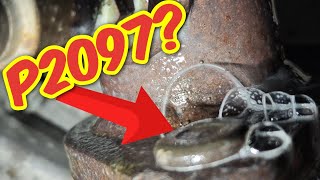
![How to Fix P2099 Engine Code in 4 Minutes [2 DIY Methods / Only $9.49]](https://img.youtube.com/vi/tZdHNVnheeA/mqdefault.jpg)

Shop the Parts Behind P2099
Below are the parts most often responsible for code P2099, ranked by how frequently each one is the actual culprit (per the diagnosis above). Tap any to see what we have for your vehicle.



The information in this article is provided for general reference and educational purposes only. Vehicle specifications, procedures, and part compatibility can vary by production date, trim level, and region. Always consult your vehicle's factory service manual and verify part numbers before purchasing or performing repairs. Safety-critical components such as airbags, seat belts, and braking systems should be installed by a qualified professional.
- 🧭 Diagnostic Flowchart
- 🎬 Helpful Videos
- 🛍️ Shop This Part
- What Does P2099 Mean?
- Can I Drive With P2099?
- Common Causes
- Symptoms
- Common Fixes & Costs
- DIY vs Professional
- Used vs. New Parts: Buying Guide
- What Happens If You Wait — Timeline
- Cost of Not Fixing It
- Diagnosis Steps
- When This Code Triggers (Freeze-Frame Conditions)
- Related Codes
- Climate & Environmental Factors
- How to Talk to a Mechanic About This Code
- Where to Take It: Dealer vs Independent vs Chain
- When to Walk Away From the Repair
- What Scan Tool You Need for This Code
- How to Clear the Code After You Fix It
- Will This Fail Emissions / State Inspection?
- Most Commonly Affected Vehicles
- Manufacturer-Specific Notes
- Real Owner Stories
- 2018 Chevy Silverado with recurring P2099
- 2017 Lexus RX350 with P2099 and no symptoms
- 2019 Ford F-150 2.7L EcoBoost with P2099 and rough idle
- How to Prevent This Code From Triggering
- Frequently Asked Questions
- What's the most common mistake when fixing a P2099 code?
- Can I pass an emissions test with a P2099 code?
- Can a bad catalytic converter cause a P2099 code?
- How do I tell if it's a bad O2 sensor or a real rich condition?
- What is 'Bank 2'?
- How much does it cost to diagnose a P2099 code?
- Can I fix a P2099 code myself?
- Will a catalytic converter cleaner fix a P2099 code?
- What is a 'Permanent' Trouble Code?
- Key Takeaways
- 🎟️ Get 5% Off