

P2111 on 2009-2017 Chevrolet Traverse 3.6L: Causes and Fixes for a Stuck Throttle Body
This code means the throttle plate is stuck open. On the 3.6L Traverse, this is almost always caused by a dirty or failed throttle body assembly. Cleaning it may work, but replacement is the most common fix, costing around $90-$250 for an aftermarket part or $200-$500 for OEM. A throttle relearn procedure is required after cleaning or replacement.
- P2111 means the throttle is stuck open, which is a serious issue that will put your Traverse in a reduced power 'limp mode'.
- The first and cheapest step is to thoroughly clean the throttle body with a dedicated cleaner to remove carbon buildup.
- If cleaning doesn't fix it, the entire throttle body assembly needs to be replaced. This is a common failure and a manageable DIY job for many owners.
- After cleaning or replacing the throttle body, a 'relearn' procedure is often required to restore normal idle and performance.
- Do not continue to drive with this code, as the vehicle's performance will be severely and unpredictably limited, creating a safety hazard.
What's Unique About the 2009-2017 Chevrolet Traverse
The 2009-2017 Chevrolet Traverse uses the LLT 3.6L V6 engine, which, like many direct-injection engines of its era, can be prone to carbon buildup. While P2111 can occur on any vehicle with electronic throttle control, on this platform, the primary culprits are either heavy carbon deposits causing the throttle plate to physically stick or the complete failure of the electronic throttle body assembly itself. The issue was common enough that GM issued a Special Coverage Adjustment (14682) for some model years related to the throttle position sensor, which is integral to the throttle body.
Symptoms You May Notice
- Check Engine Light is illuminated
- Reduced Power or 'Engine Power is Reduced' message on the dash
- Vehicle is in 'limp mode' with very limited acceleration
- Rough or unstable idle
- Poor or hesitant engine performance
- Abnormal transmission shifting behavior
- 'Service Stabilitrak' and 'Traction Control Off' messages appearing simultaneously with the other symptoms
- Replacing the accelerator pedal position (APP) sensor. While the APP sensor is part of the overall throttle control system, a failure there typically sets different codes. P2111 specifically points to a problem at the throttle body itself.
- Assuming the 'Service Stabilitrak' message points to a problem with the stability control system. On this platform, the throttle body fault triggers the Stabilitrak warning because the system cannot rely on predictable engine torque.
Most Likely Causes
- Dirty or Carbon-Fouled Throttle Body 🔴 High Probability → Shop Fuel Injection Throttle Body Direct injection engines can contribute to carbon buildup in the intake system, including the throttle body. The PCV system routes oil vapors back into the intake, which bake onto the hot throttle plate and bore, causing it to stick.
How to confirm: Remove the air intake hose from the throttle body and visually inspect the throttle plate and bore for a thick layer of black carbon, especially around the edges where the plate seats.
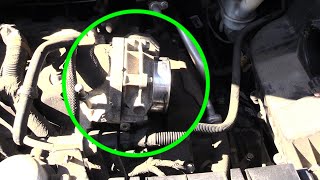
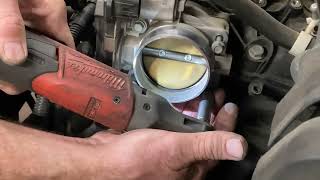
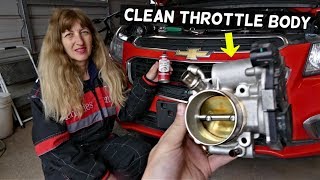
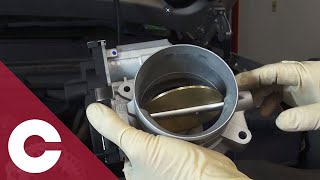
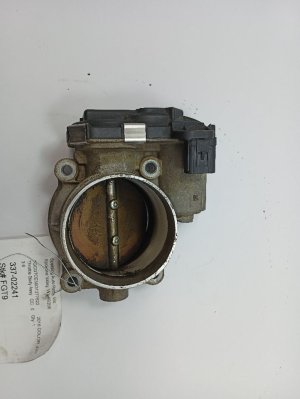
Typical fix: Thoroughly clean the throttle body bore and plate with a dedicated throttle body cleaner and a soft cloth or brush. A throttle relearn procedure is required after cleaning to reset idle values. 🎬 See this guide on how to clean your throttle body.
Est. part cost: $10-$15 - Failed Throttle Body Assembly 🔴 High Probability → Shop Fuel Injection Throttle Body The internal electronic motor or position sensors within the throttle body assembly are common failure points. Owners on forums frequently report that cleaning provides only a temporary fix, with replacement being the permanent solution.
How to confirm: If cleaning the throttle body does not resolve the code, and the wiring is confirmed to be good, the assembly itself is defective. A scan tool can monitor commanded vs. actual throttle position; a discrepancy points to a bad throttle body.
Typical fix: Replace the entire throttle body assembly. A throttle relearn procedure is mandatory after installation.
Est. part cost: $90-$505 - Wiring or Connector Issue ⚪ Low Probability Vibration and heat in the engine bay can cause wires to chafe or the connector pins to become loose or corroded over time.
How to confirm: Visually inspect the wiring harness leading to the throttle body for any signs of chafing, breaks, or corrosion. Unplug the connector and check for bent or corroded pins.
Typical fix: Repair the damaged section of wiring or replace the pigtail connector.
Est. part cost: $15-$50
Rare But Worth Checking
- Powertrain Control Module (PCM) Failure: → Shop Engine Control Module (ECM) This is very uncommon. Before condemning the PCM, all other possibilities, especially the throttle body and its wiring, must be exhaustively ruled out.
Diagnosis Steps
- Read the codes with an OBD-II scanner and confirm P2111 is present. Note any other codes, especially those related to Stabilitrak or other throttle performance codes.
- Visually inspect the wiring harness and electrical connector at the throttle body for damage, looseness, or corrosion.
- Disconnect the negative battery terminal.
- Remove the air intake ducting connected to the throttle body.
- Inspect the throttle bore and plate for heavy carbon buildup. If dirty, proceed with cleaning.
- Spray a throttle-body-safe cleaner onto a rag (not directly into the throttle body while connected) and manually open the plate to clean the bore and both sides of the plate thoroughly.
- Reassemble the intake and reconnect the battery.
- Perform a throttle relearn procedure. A common method without a scan tool is: Start the engine and let it idle in Park for 3 minutes. Turn the engine off for 60 seconds. Restart the engine and let it idle in Park for another 3 minutes. The idle should now be stable.
- If the code returns after cleaning and a successful relearn, the throttle body assembly is the confirmed failure point.
- Replace the throttle body assembly and the gasket.
- Perform the throttle relearn procedure again after installing the new part to ensure proper idle and performance.
Parts You'll Likely Need
- Throttle Body Assembly
(OEM #12631016)— This is the most common cause of P2111, as the internal motor or sensors fail, or it becomes too contaminated to clean effectively. The entire unit is replaced as one piece. 🎬 Watch: Step-by-step throttle body replacement walkthrough for the Traverse.
Trusted brands: ACDelco (OEM, Service P/N 217-3107), Bosch, Hitachi, Dorman
OEM price range: $200-$505
Aftermarket price range: $90-$250 - Throttle Body Cleaner — Required for the first, and least expensive, diagnostic step of cleaning the existing throttle body to see if the problem is just carbon buildup.
Trusted brands: CRC, Berryman, Gumout
Aftermarket price range: $10-$15
Related Codes That Often Appear With This One
- P2119 — This code indicates a range/performance issue with the throttle body, which can be caused by the same sticking or electronic faults that trigger P2111.
- P0121, P0221 — These codes relate to the Throttle Position Sensor (TPS) performance. Since the TPS is integrated into the throttle body assembly, these codes often appear when the throttle body is failing.
- P1516, P2101 — These are also throttle actuator control (TAC) module performance codes that point to a discrepancy between what the PCM is commanding and what the throttle body is actually doing.
Technical Service Bulletins (TSBs) & Recalls
- GM Special Coverage 14682: Addresses issues with the throttle position sensor on 2009-2012 Traverse models (among others), which can cause reduced power mode. The fix involves replacing the throttle body assembly.
Platform-Specific Known Issues
- A very common owner complaint associated with P2111 on the Traverse is the simultaneous illumination of the 'Service Stabilitrak', 'Traction Control Off', and 'Engine Power is Reduced' messages. Many owners initially suspect a fault in the braking or stability system, but the root cause is the engine's inability to provide predictable torque, which forces the PCM to disable these safety systems. 🎬 Watch: How the throttle body causes Stabilitrak and traction warnings.
Mechanic-Grade Diagnostic Values
- Throttle Position Sensor 1 (TPS1) Signal Voltage — expected: Approximately 0.5V - 0.7V at idle (throttle closed) and smoothly increasing to ~4.5V at wide-open throttle (WOT).. Failure: Voltage that is erratic, jumps, has dead spots, or does not change when the throttle plate is moved indicates a failed sensor.
- Throttle Position Sensor 2 (TPS2) Signal Voltage — expected: Approximately 4.5V at idle (throttle closed) and smoothly decreasing to ~0.5V at wide-open throttle (WOT). This sensor often works in opposition to TPS1 for redundancy.. Failure: Voltage that does not change smoothly or does not correlate inversely with TPS1 points to a sensor failure.
- Scan Tool Live Data: Commanded vs. Actual Throttle Position — expected: The 'Actual Throttle Position' PID should mirror the 'Commanded Throttle Position' PID with minimal lag as the accelerator is pressed and released.. Failure: A significant discrepancy between the commanded and actual values indicates the throttle plate is sticking or the motor/gears are failing.
Scan Tool Commands That Help
- GM GDS2 (Global Diagnostic System 2) / Tech2: Throttle Position Control / TAC Motor Control — This bidirectional control allows a technician to command the throttle plate to specific angles (e.g., 10%, 25%, 50%) while monitoring the actual TPS sensor feedback. It is the definitive test to confirm if the throttle body is physically sticking or if the motor is failing to respond to commands from the PCM.
- GM GDS2 (Global Diagnostic System 2) / Tech2: Idle Learn Reset / Throttle/Idle Learn — This function must be used after cleaning or replacing the throttle body. It resets the learned idle airflow values in the PCM, preventing high or unstable idle. While a manual relearn exists, the scan tool function is the most reliable method.
Wiring & Ground Locations
- G113 — Located on the left side of the engine, at an engine-to-transmission stud.. This is a primary engine block ground. A loose or corroded connection at G113 can cause erratic behavior in various engine sensors and actuators, including the electronic throttle body, leading to intermittent performance codes.
- G103 — Located on the left side of the engine compartment, on the inner fender panel, sometimes described as being near the brake booster.. This ground serves the Body Control Module (BCM) and Engine Control Module (ECM). A poor connection here can cause a host of seemingly unrelated electronic issues, including communication errors with the throttle body.
- Throttle Body Connector — The 6-pin electrical connector on the throttle body assembly itself.. This is the single point of connection for the throttle motor and both throttle position sensors. Technicians will back-probe this connector to test for 5V reference, ground, and the two signal wire voltages to determine if the fault is in the throttle body or the vehicle's wiring/PCM.
OEM Part Supersession History
12631016→12694877— Likely an internal revision for improved reliability or manufacturing process change. Function remains the same.
Heads up: The parts are interchangeable for the specified applications. The ACDelco service part number is 217-3107, which corresponds to the original GM P/N 12631016.
Model Year Variations Within This Range
- 2009-2012: These model years are specifically covered by GM Special Coverage Adjustment 14682, which addresses throttle body position sensor issues that lead to reduced power mode. This suggests a higher failure rate or known defect in the throttle bodies used in earlier first-generation models.
- 2013-2017: These models received a facelift but retained the LLT 3.6L V6 engine. While not covered under the specific TSB 14682, they can still experience the same throttle body failures from carbon buildup or electronic malfunction.
Diagnostic Flowchart
Other Known Issues on This Vehicle
Issues unrelated to this code that are worth knowing about as an owner of this generation:
- Premature Timing Chain Stretch 🔴 High — Very common, especially on 2009-2012 models. Often occurs between 70,000 and 120,000 miles. Linked to long oil change intervals from the original Oil Life Monitor (OLM) calibration. (Ref: Special Coverage Adjustment 11340C extended warranty to 10 years/120,000 miles for 2009 models.)
- Cracked 3-5-R Wave Plate in 6T75 Transmission 🔴 High — Common on earlier models (especially 2009), leading to loss of 3rd, 5th, and Reverse gears, often requiring a transmission rebuild or replacement. (Ref: Special Coverage 14404B provided an extended warranty for 2009 models to 10 years/120,000 miles.)
- Power Steering Pump Failure or Noise 🟠 Medium — Widespread reports of power steering fluid leaks, whining noises, or sudden loss of assist, particularly in 2009-2011 models. (Ref: Special Coverage 14329 covered pump replacement for 10 years/150,000 miles on affected models.)
- Excessive Carbon Buildup on Intake Valves 🟠 Medium — A common issue for the direct-injected LLT engine, leading to misfires (P0300 series codes), rough idle, and poor performance. Requires manual cleaning (walnut blasting). (Ref: GM Technical Bulletin PIP5029 discusses this issue and cleaning procedures.)
Used vs. New Parts: Buying Guide for This Vehicle
When a used part is the smart pick: A used throttle body can be a cost-effective option if the budget is tight, as it is a simple bolt-on part with no complex coding required. However, given that it is a known failure point, it carries some risk.
Donor-vehicle mileage cap: roughly under 80000 miles for the part to have meaningful remaining life.
What to inspect on the donor part:
- Visually inspect the throttle plate and bore. If it's excessively black and caked with carbon, it may have been the reason the donor car was junked.
- Check the electrical connector pins for any signs of corrosion, bending, or damage.
- If possible, manually move the throttle plate (on the bench) to feel for any binding, grinding, or roughness in its movement.
- Ask for the donor vehicle's mileage. A part from a lower-mileage vehicle is always preferable.
Aftermarket brands forum-validated for this vehicle:
- ACDelco (OEM)
- Bosch (Often the OEM supplier)
- Hitachi
Brands owners have reported issues with on this vehicle:
- No-name, unbranded units from online marketplaces are a gamble. While they may be cheap, forum discussions often mention premature failure or inconsistent performance.
Real Owner Stories
Aggregated from forums and TSBs cited above. Mileages and costs reflect what owners reported in those sources.
2011 Chevrolet Traverse 3.6L V6
Symptoms: Sudden loss of power accompanied by Stabilitrak errors. The dealer initially suspected various sensors and transmission issues.
What fixed it: The dealer identified and replaced the throttle body assembly.
Source hint: Edmunds Forums
2012 Chevrolet Traverse 3.6L V6
Symptoms: Ongoing issues with Stabilitrak and reduced power mode. Owner attempted to fix it by replacing the MAF sensor, spark plugs, and water pump without success.
What fixed it: Replacing the throttle body assembly.
Source hint: chevroletforum.com
Chevrolet Traverse LLT 3.6L V6
Symptoms: Reduced Engine Power and Service Stabilitrak warnings. Cleaning the throttle body only worked for one week before the code returned.
What fixed it: Installation of a new ACDelco throttle body.
Source hint: traverseforum.com
Related OBD-II Codes
Frequently Asked Questions
Why are my 'Service Stabilitrak' and 'Traction Control Off' lights on at the same time as the P2111 code?
Is there a special warranty or TSB for throttle issues on my 2011 Traverse?
Can I just clean the throttle body on my LLT 3.6L V6 to fix P2111?
How do I perform the throttle relearn on my Traverse after cleaning the part?
What other major issues should I look out for on a 2009 Traverse besides the throttle body?
Why does my Traverse engine get so much carbon buildup in the throttle body?
Helpful Videos
We Have This Part in Stock

The information in this article is provided for general reference and educational purposes only. Vehicle specifications, procedures, and part compatibility can vary by production date, trim level, and region. Always consult your vehicle's factory service manual and verify part numbers before purchasing or performing repairs. Safety-critical components such as airbags, seat belts, and braking systems should be installed by a qualified professional.
- Chevrolet Traverse:
- 🧭 Diagnostic Flowchart
- 🎬 Helpful Videos
- 🛍️ Shop This Part
- What's Unique About the 2009-2017 Chevrolet Traverse
- Symptoms You May Notice
- Most Likely Causes
- Rare But Worth Checking
- Diagnosis Steps
- Parts You'll Likely Need
- Related Codes That Often Appear With This One
- Technical Service Bulletins (TSBs) & Recalls
- Platform-Specific Known Issues
- Mechanic-Grade Diagnostic Values
- Scan Tool Commands That Help
- Wiring & Ground Locations
- OEM Part Supersession History
- Model Year Variations Within This Range
- Other Known Issues on This Vehicle
- Used vs. New Parts: Buying Guide for This Vehicle
- Real Owner Stories
- 2011 Chevrolet Traverse 3.6L V6
- 2012 Chevrolet Traverse 3.6L V6
- Chevrolet Traverse LLT 3.6L V6
- Related OBD-II Codes
- Frequently Asked Questions
- 🎟️ Get 5% Off