

P2111 on 2019-2021 Ford Ranger: Throttle Stuck Open Causes and Fixes
On a 2019-2021 Ford Ranger, code P2111 is most often caused by water or ice buildup behind the throttle body, a known issue cited in Ford's Technical Service Bulletin #SSM 50597. The original fix was cleaning, but the TSB was updated to recommend replacing the intake manifold (KB3Z-9424-B) and a PCV hose (LB5Z-6A664-D) if moisture is found. For many owners, a simple DIY cleaning of the throttle body is still the first step.
- For a 2019-2021 Ranger, P2111 is very likely caused by water or ice jamming the throttle body, as noted in Ford TSB #SSM 50597.
- Before buying any parts, the first diagnostic step is to remove the throttle body and inspect the intake manifold for moisture or ice.
- If no ice or water is present, cleaning carbon buildup from the throttle plate is the next most likely solution.
- Replacing the entire throttle body assembly should only be done after confirming it is not being physically obstructed.
- The repair is DIY-friendly and often only requires basic tools and a can of throttle body cleaner.
What's Unique About the 2019-2021 Ford RANGER
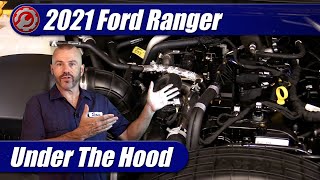
For the 2019-2021 Ford Ranger with the 2.3L EcoBoost engine, this code 🎬 Watch: A deep dive into the 2.3L EcoBoost engine design has a very specific and well-documented cause. Ford issued a Technical Service Bulletin (TSB #SSM 50597) acknowledging that water or ice can accumulate in the intake manifold directly behind the throttle body. This buildup can physically jam the throttle plate, preventing it from closing and directly causing the P2111 code, especially in cold or wet climates. The TSB was later updated to recommend replacing the intake manifold and a PCV hose if this condition is confirmed, indicating a design issue that cleaning alone may not permanently solve.
Diagnostic Flowchart
Tap your situation to follow the diagnostic path that matches what you're seeing on this vehicle.
Symptoms You May Notice
- Illuminated Malfunction Indicator Lamp (Check Engine Light)
- Illuminated Powertrain Malfunction Indicator (Wrench Light)
- Vehicle enters 'limp mode' with drastically reduced engine power
- Poor, hesitant, or no throttle response
- Engine may idle high or erratically
- Potential for the engine to stall or not start
- Sudden loss of acceleration while driving
- Replacing the accelerator pedal position (APP) sensor. The P2111 code is specific to the throttle body's operation, not the pedal's input. While they work together, a stuck throttle is rarely caused by the pedal sensor.
Most Likely Causes
- Water or Ice Buildup in Intake Manifold 🔴 High Probability → Shop Engine Intake Manifold As documented in Ford TSB #SSM 50597, the design of the intake system on this platform can allow moisture, possibly from the PCV system or intercooler, to collect behind the throttle body. This can freeze in cold weather and physically jam the throttle plate.
How to confirm: Remove the four 8mm bolts holding the throttle body to the intake manifold. Carefully pull it away and visually inspect the area behind it for any signs of water, ice, or a milky oil/water residue.
Typical fix: For a DIY approach, thoroughly dry out the intake manifold and clean the throttle body plate and bore. However, the official Ford procedure per TSB #SSM 50597 is to replace the intake manifold (Part No. KB3Z-9424-B) and the crankcase vent oil separator hose (Part No. LB5Z-6A664-D) if water is found.
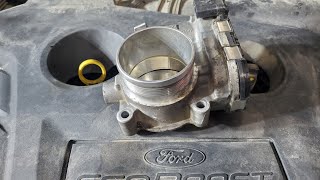
Est. part cost: $10-$20 for cleaner, or $200+ for manifold and hose replacement. - Dirty or Obstructed Throttle Body 🟡 Medium Probability → Shop Fuel Injection Throttle Body Direct-injection engines like the 2.3L EcoBoost can be prone to carbon and oil vapor buildup from the PCV (Positive Crankcase Ventilation) system, which can create a sticky residue on the throttle plate over time, impeding its movement.
How to confirm: Remove the air intake tube from the throttle body and inspect the throttle plate and bore for a layer of black carbon or oily residue.
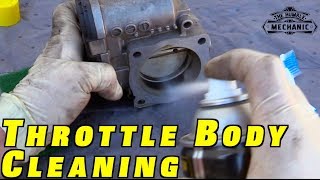
Typical fix: Clean the throttle plate and bore using a dedicated throttle body cleaner and a soft cloth or toothbrush. Do not spray cleaner directly into the throttle body on the vehicle; spray it on the cloth or brush. 🎬 See: How to clean a throttle body the right way
Est. part cost: $10-$20 - Failed Throttle Body Assembly ⚪ Low Probability → Shop Fuel Injection Throttle Body While less common than external obstructions, the internal electronic motor or position sensor within the throttle body can fail, causing it to report incorrect positions or fail to move as commanded. This is a common failure mode on many Ford electronic throttle bodies.
How to confirm: After confirming there is no physical obstruction, use a bidirectional scan tool to command the throttle plate to open and close. Observe if it moves smoothly or fails to respond correctly. An electrical test of the motor may also be performed.
Typical fix: Replace the entire throttle body assembly.
Est. part cost: $150-$400
Rare But Worth Checking
- Wiring or Connector Issue: Damage to the wiring harness or corrosion in the connector for the throttle body can interrupt the signal between it and the PCM. It's worth inspecting the harness for any visible chafing, breaks, or green corrosion on the pins.
- Powertrain Control Module (PCM) Fault: → Shop Engine Control Module (ECM) This is extremely rare, but a software glitch or internal failure of the PCM could theoretically cause this code. This should only be considered after all other possibilities have been exhaustively ruled out.
Diagnosis Steps
- Read the trouble codes with an OBD-II scanner and note any other codes present.
- Check for Technical Service Bulletins (TSBs) related to your VIN. Specifically, review the full text of TSB #SSM 50597.
- Inspect the wiring harness and electrical connector at the throttle body for any signs of damage, looseness, or corrosion.
- Loosen the clamp on the air intake duct at the throttle body (typically a 7mm or 8mm socket) and remove the ducting.
- Following the guidance of TSB #SSM 50597, unbolt and remove the four 8mm bolts holding the throttle body to the intake manifold.
- Inspect the intake manifold behind the throttle body for any signs of water, ice, or corrosion. If found, the official fix is to replace the intake manifold and a PCV hose.
- While the throttle body is removed, inspect the throttle plate and bore for heavy carbon or oil buildup.
- If an obstruction is found (ice or carbon), clean the components thoroughly, dry the intake, and reinstall.
- If no obstruction is found, the throttle body assembly itself is suspect. Test with a scan tool or replace it.
- After cleaning or replacement, perform a throttle body relearn procedure. A common method is: Turn key to 'ON' (engine off) for 30 seconds. Start engine and let it idle for 3 minutes with all accessories off. Turn engine off for 1 minute. Restart and drive normally for 10-15 minutes.
Parts You'll Likely Need
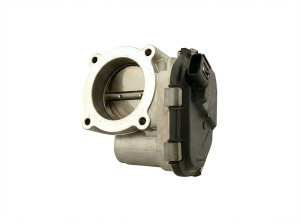
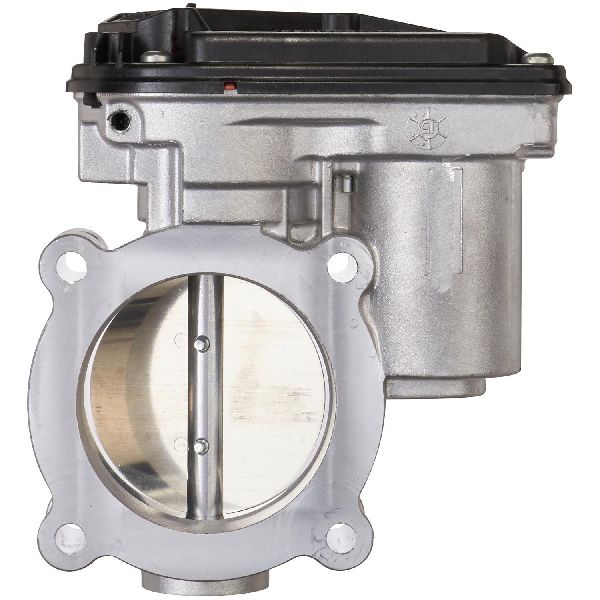
- Throttle Body Assembly
(OEM #JT4Z-9E926-A (or JT4E-9F991-AA))— This is needed if the internal motor or sensor has failed, which is the next most likely cause after ruling out physical obstructions like ice or carbon.
Trusted brands: Motorcraft, Standard Motor Products, SKP, Dorman
OEM price range: $170-$400
Aftermarket price range: $150-$250 - Intake Manifold
(OEM #KB3Z-9424-B)— This is the official Ford-recommended replacement part per TSB #SSM 50597 if water or ice is found in the intake, designed to prevent the issue from recurring.
Trusted brands: Motorcraft
OEM price range: $150-$250 - Throttle Body Cleaner — Required for the most common DIY fix, which is cleaning ice, water, or carbon buildup from the throttle body and intake area.
Trusted brands: CRC, Berryman, WD-40 Specialist
Aftermarket price range: $10-$20
Related Codes That Often Appear With This One
- P2112 — This code means 'Throttle Actuator Control System - Stuck Closed'. It's the opposite of P2111 but relates to the same component. Seeing both may indicate an erratic failure of the throttle body motor or sensor. Ford's TSB #SSM 50597 and other service documents often list P2111 and P2112 together.
- P2119 — This code relates to 'Throttle Actuator Control Throttle Body Range/Performance'. It can appear alongside P2111 if the throttle plate's movement is erratic or not matching the expected performance, which is consistent with a sticking or failing throttle body. TSB #SSM 50597 also groups this code with P2111.
Technical Service Bulletins (TSBs) & Recalls
- SSM 50597: Some 2019-2021 Ranger and 2021 Bronco vehicles equipped with a 2.3L engine may experience reduced engine power in freezing temperatures with DTCs P2111, P2112, and/or P2119. This may be due to water or ice buildup in the intake manifold behind the throttle body. If water or ice is found, replace the intake manifold (KB3Z-9424-B) and crankcase vent oil separator hose (LB5Z-6A664-D).
Platform-Specific Known Issues
- TSB #SSM 50597: Ford directly addresses P2111, P2112, and P2119 on 2019-2021 Rangers (and 2021 Broncos) built on or before 09-Aug-2021. It states the cause may be 'water or ice buildup in the intake manifold behind the throttle body.' The updated service procedure instructs technicians to replace the intake manifold with part number KB3Z-9424-B and the crankcase vent oil separator hose (LB5Z-6A664-D) if water or ice is found.
Mechanic-Grade Diagnostic Values
- Throttle Plate Angle Deviation (Scan Tool) — expected: The difference between 'Desired Throttle Plate Position' and 'Actual Throttle Plate Position' should be less than 3 degrees during normal operation.. Failure: A difference greater than 3-5 degrees will likely set a fault code like P2111 or P2119.
- Throttle Position Sensor (TPS) Signal Voltage — expected: At idle (throttle closed), voltage should be approximately 0.5V to 0.9V. At wide-open throttle, voltage should increase smoothly to approximately 4.5V.. Failure: Voltage that is jumpy, inconsistent, or outside the expected range indicates a faulty sensor. Note: On this vehicle, the TPS is integrated into the throttle body assembly and is not serviced separately.
Hidden / Shadow Codes Worth Checking
- Mode 6 Data: Mode 6 is not a specific code, but a diagnostic mode that provides test results for various onboard monitors before they reach the threshold to set a DTC. For a P2111 concern, a technician could use a tool like FORScan to watch the raw data for the electronic throttle control monitor to see if it is approaching failure limits, even if no code is currently set. (see via Advanced scan tools like Ford's IDS or software like FORScan can access Mode 6 data.)
Scan Tool Commands That Help
- FORScan / Ford IDS: Reset All Adaptations / Clear Transmission Adaptive Tables / Reset KAM (Keep Alive Memory) — This is the correct procedure to use after cleaning or replacing the throttle body. Unlike some manufacturers, there is no specific 'throttle calibration' command. Resetting the KAM forces the PCM to erase its learned values and start a new learning process for idle and throttle response.
- FORScan / Ford IDS: Live Data PID Monitoring — Monitor PIDs such as TP_ACT (Actual Throttle Position), TP_DES (Desired Throttle Position), and APP (Accelerator Pedal Position) sensors to verify that the throttle body is responding correctly to pedal inputs and PCM commands.
Wiring & Ground Locations
- Main Chassis Ground — An existing ground point is located behind the driver's side kick panel. This location is also used for the OEM trailer brake controller ground.. The electronic throttle body relies on stable voltage and clean grounds to function. A poor ground can cause erratic behavior and fault codes. Verifying this easily accessible ground point is a valid diagnostic step for any electronic issue.
- C2280A, C1035B — C2280A is a major connector at the Body Control Module (BCM). C1035B is a connector at the underhood Battery Junction Box.. These are key connectors in the vehicle's electrical architecture. While a full pinout is required for deep diagnosis, knowing their designation is the first step in tracing wiring from the PCM to the throttle body circuit if a wiring fault is suspected.
Real Owner Repair Stories
- General mechanic knowledge from diagnostic videos (Toyota Sienna with 3.3L engine (example of failure pattern)) — Intermittent P2111 and P2112 codes, vehicle enters limp mode only when hot.
❌ Tried (didn't work) Initial testing of the throttle body when the engine was cold showed it was within resistance specifications.
✅ What actually fixed it The throttle body was failing intermittently due to heat soak. When tested after the vehicle reached normal operating temperature and failed, the resistance was out of spec. Replacing the throttle body assembly resolved the issue. This highlights that components can test 'good' when cold but fail under real-world operating conditions.
OEM Part Supersession History
N/A (Original design)→KB3Z-9424-B— This is the updated intake manifold specified by TSB #SSM 50597 to fix the water/ice accumulation issue. It presumably has a revised internal design to prevent moisture pooling behind the throttle body.
Heads up: This is the required replacement part for vehicles built on or before 09-Aug-2021 that experience the issue. Some parts vendors note this part is for vehicles built 'From 11/17/2021', suggesting this is when the revised part may have entered production or the parts system.
Model Year Variations Within This Range
- 2019-2021: The primary cause of P2111 (water/ice in the intake) is officially recognized by Ford on vehicles built on or before August 9, 2021. Vehicles built after this date may have the revised intake manifold (KB3Z-9424-B) from the factory, making them less susceptible to this specific issue.
Helpful Videos
Used OEM Parts in Stock
New Aftermarket Parts Available


The information in this article is provided for general reference and educational purposes only. Vehicle specifications, procedures, and part compatibility can vary by production date, trim level, and region. Always consult your vehicle's factory service manual and verify part numbers before purchasing or performing repairs. Safety-critical components such as airbags, seat belts, and braking systems should be installed by a qualified professional.
- Ford RANGER:
- 🧭 Diagnostic Flowchart
- 🎬 Helpful Videos
- 🛍️ Shop This Part
- What's Unique About the 2019-2021 Ford RANGER
- Symptoms You May Notice
- Most Likely Causes
- Rare But Worth Checking
- Diagnosis Steps
- Parts You'll Likely Need
- Related Codes That Often Appear With This One
- Technical Service Bulletins (TSBs) & Recalls
- Platform-Specific Known Issues
- Mechanic-Grade Diagnostic Values
- Hidden / Shadow Codes Worth Checking
- Scan Tool Commands That Help
- Wiring & Ground Locations
- Real Owner Repair Stories
- OEM Part Supersession History
- Model Year Variations Within This Range
- 🎟️ Get 5% Off