

OBD-II Code P2119: Throttle Actuator Control Throttle Body Range/Performance
The Ultimate Guide to Meaning, Diagnosis, and Repair
- Thoroughly clean the throttle body with an electronic-safe solvent as your first diagnostic step, which resolves code P2119 in over 50% of cases for under $20.
- Do not drive the vehicle with an active P2119 code, as the engine will force a 20-40 mph 'limp mode' limit or stall unexpectedly in traffic.
- Perform a mandatory throttle relearn procedure using a bi-directional scan tool after any cleaning or replacement to prevent the engine from idling at a dangerous 1,500+ RPM.
- Verify your battery delivers at least 12.4 volts before replacing the $300+ throttle body assembly, as low system voltage frequently causes the actuator motor to fail its self-test.
What Does P2119 Mean?

P2119 means the Powertrain Control Module (PCM) detects a critical performance error in the electronic throttle control system. The throttle valve, which controls engine airflow, is not responding accurately to the PCM's commands. This discrepancy between the commanded and actual throttle position causes dangerous acceleration and stalling issues.
Technical definition: The SAE/OBD-II definition for P2119 is 'Throttle Actuator Control Throttle Body Range/Performance'. The PCM detects the actual position of the throttle plate does not match the commanded position. The plate is physically sticking, moving too slowly, failing to close quickly, or sending incorrect sensor feedback.
Can I Drive With P2119?
No — Do Not Drive. Driving is unsafe and highly discouraged. The vehicle enters a reduced power 'limp mode,' severely limiting acceleration and capping speed around 20-40 mph, making it dangerous in traffic. If the throttle plate sticks, it causes uncontrolled acceleration or unexpected stalling. Continuing to drive forces an incorrect air-fuel mixture that destroys the catalytic converter, adding $800-$2,500 to your repair bill. Tow the vehicle to a safe diagnostic location.
Common Causes

- Dirty or Carbon-Clogged Throttle Body (Very Common) — This is the most frequent cause, especially in vehicles over 50,000 miles. Carbon and oil residue from the PCV system build up around the throttle plate and bore, physically restricting movement and preventing it from opening or closing properly.
- Faulty Throttle Body Assembly (Common) — The electronic throttle body contains the throttle plate, an electric motor, and position sensors. The internal motor wears out, plastic gears strip, or integrated sensors fail, requiring replacement of the entire unit.
- Defective Throttle Position Sensor (TPS) (Common) — The TPS tells the computer the exact angle of the throttle plate. If it sends erratic or out-of-range voltage signals, the computer detects a mismatch and sets P2119. On most modern cars, the TPS is integrated into the throttle body and cannot be replaced separately.
- Wiring or Connector Issues (Less Common) — Frayed wires, internal breaks, or corroded connector pins between the PCM and throttle body disrupt command and sensor signals. This is a known issue on GM and Jeep models where the harness chafes against other components.
- Weak or Broken Throttle Return Spring (Less Common) — A calibrated spring inside the housing snaps the throttle plate shut during deceleration or power loss. Heat cycles weaken or break this spring, causing the plate to return too slowly and triggering a performance error.
- Faulty Accelerator Pedal Position Sensor (APPS) (Less Common) — The APPS measures how far you press the gas pedal. A faulty sensor sends incorrect signals, tricking the computer into thinking the throttle is unresponsive. This usually triggers specific APPS codes (like P2138) alongside P2119.
- Low or Unstable System Voltage (Rare) — The electronic throttle actuator requires stable voltage. A weak battery or failing alternator provides insufficient power, causing the actuator motor to underperform and trigger a false P2119 code.
- Intake Manifold Obstruction (Cold Climates) (Rare) — On specific models like the Ford Ranger, PCV moisture collects in the intake manifold behind the throttle body. In freezing weather, this turns to ice and physically blocks the throttle plate.
- PCM Software Glitch or Failure (Rare) — Outdated vehicle software misinterprets data from the throttle system. A dealership software update resolves this. In extremely rare cases, the Powertrain Control Module (PCM) itself fails.
Symptoms

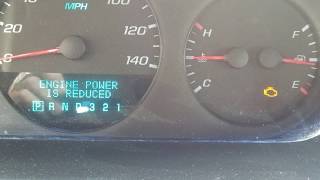
- Reduced Engine Power (Limp Mode) — The vehicle enters a safety mode with severely limited power, throttle response, and speed to prevent unintended acceleration. A 'Reduced Engine Power' message appears on the dash.
- Check Engine Light is On — The Malfunction Indicator Lamp (MIL) illuminates. A 'wrench' light, 'Throttle Control' warning, or stability control light also frequently appears.
- Poor, Delayed, or Surging Acceleration — The car hesitates, lags, or surges when pressing the gas pedal because the throttle plate sticks or moves erratically.
- Rough or Unstable Idle — The engine idles higher or lower than normal, or RPMs fluctuate at a stop due to incorrect airflow from a partially open throttle plate.
- Engine Stalling or No-Start Condition — The engine stalls when slowing down or idling. If the throttle plate sticks completely closed, the engine cranks but fails to start.
- Increased Fuel Consumption (also visible on scanner) — An incorrectly positioned throttle plate forces an inefficient air-fuel mixture, burning 5-15% more fuel than necessary.
Diagnostic Flowchart
Tap your situation to follow the diagnostic path that matches what you're seeing on this code.
Common Fixes & Costs

- Cleaning the Throttle Body — Parts: $10-$20, Labor: $75-$200, ~0.8 hr book time (DIY)
- Performing a Throttle Relearn Procedure — Parts: $0, Labor: $50-$150, ~0.3 hr book time (DIY)
- Replacing the Throttle Body Assembly
— Parts: $150-$700, Labor: $100-$300, ~1.2 hr book time
(Intermediate)
Chevrolet/GMC (Trucks/SUVs): OEM GM 12678223 (Alt: ACDelco 12678223, Dorman 977-024)
Ford F-150 (3.5L EcoBoost): OEM Ford BL3Z-9E926-B (Alt: Motorcraft TB-1, Bosch 0280750562)
Toyota Tacoma (4.0L V6): OEM Toyota 22030-0P010 (Alt: Denso 294009-0250, Aisan TBT021) - Repairing Damaged Wiring or Connectors — Parts: $10-$50, Labor: $80-$250, ~2.0 hr book time (Professional)
- Replacing the Accelerator Pedal Position Sensor — Parts: $50-$250, Labor: $50-$170, ~0.8 hr book time (DIY)
Used vs. New Parts: Buying Guide
When a used part is worth it: A used throttle body is a budget-friendly option for older, high-mileage vehicles where a new OEM part is cost-prohibitive. Source from a reputable salvage yard offering a warranty.
Donor-vehicle mileage cap: roughly under 75000 miles for the part to have meaningful remaining life.
Donor quality checklist:
- Verify the part number is an exact match.
- Source from a vehicle scrapped for collision, not engine failure.
- Inspect for corrosion, connector damage, and free movement of the throttle plate.
- Ensure the seller offers at least a 90-day warranty.
Decision logic:
- If Vehicle is less than 8 years old or has under 100,000 miles → Buy new (OEM or high-quality aftermarket). The risk of premature failure outweighs the savings.
- If The cost of a new part exceeds 25% of the vehicle's total value → A warrantied used part is a reasonable choice to keep the vehicle operational.
- If Your vehicle make requires special programming to pair the throttle body to the ECU → Favor a new part, as programming a used component is problematic for some shops.
Warranty tradeoff: Used parts carry a 30-90 day part-only warranty. New aftermarket parts offer 1-year to lifetime warranties, while new OEM parts offer 1-2 year warranties.
Worst-case if a used part fails: $250-$500, representing repeated labor to diagnose and replace a faulty used part.
What Happens If You Wait — Timeline
- 0-1 month: Check Engine Light comes on with code P2119. You notice a slightly rough or high idle, but acceleration feels normal. The problem is intermittent. (MPG impact: 0-5%% · Added cost: $0-$20 in wasted fuel.)
- 1-3 months: The vehicle hesitates during acceleration. The engine randomly enters 'Reduced Engine Power' mode during city driving. Increased fuel consumption is measurable. (MPG impact: 5-15%% · Added cost: $50-$150 in wasted fuel.)
- 3-6 months: Limp mode becomes frequent, making the vehicle unsafe for traffic. The engine stalls when stopping. The incorrect air/fuel mixture stresses the catalytic converter. (MPG impact: 15-25%% · Added cost: $150+ in wasted fuel, plus initial catalytic converter degradation.)
- 6+ months: Sustained operation destroys the catalytic converter by melting its internal structure. The engine runs poorly, fails to start, and fouls O2 sensors and spark plugs. (MPG impact: >25%% · Added cost: $1,000-$3,000 for catalytic converter replacement, plus O2 sensors and spark plugs.)
Cost of Not Fixing It
- Immediate (0-1 month): Unpredictable entry into 'limp mode,' making the vehicle unsafe in traffic. Fuel consumption increases by 5-15% alongside a rough idle. (Added cost: $20-$60 per month in wasted fuel.)
- Short Term (1-6 months): An incorrect air/fuel ratio overheats the catalytic converter, breaking down internal catalyst materials and causing permanent failure. (Added cost: $1,000-$3,000)
- Long Term (6+ months): Sustained bad air/fuel mixtures foul spark plugs, damage oxygen sensors, and create excessive carbon buildup on internal engine components. (Added cost: $300-$800 in addition to catalytic converter replacement.)
Diagnosis Steps

- Read Codes and Review Freeze Frame Data
Use an OBD-II scanner to confirm P2119. Check for related codes (e.g., P2110, P0121, P2135) to pinpoint the fault. Analyze freeze-frame data to identify the exact engine RPM, speed, and temperature when the code triggered.
Tools: OBD-II Scanner (Beginner) - Inspect the Throttle Plate for Mechanical Issues
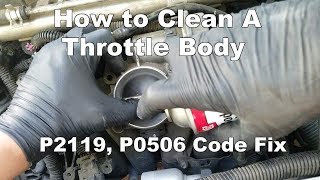
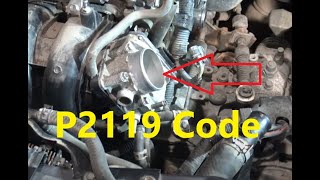
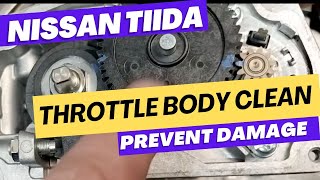
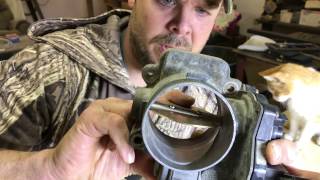
Remove the air intake hose. Look for heavy carbon buildup on the throttle plate and bore. With the key off, gently push the plate open. Feel for sticking or binding. It must snap back shut instantly and audibly. A slow return proves a weak spring or thick carbon deposits. 🎬 Watch: How to clean your throttle body to fix P2119.
Tools: Screwdriver or socket set, Flashlight (Beginner) - Analyze Live Data with a Scan Tool
Observe live data for 'Commanded Throttle Position' vs. 'Actual Throttle Position'. With the key on and engine off, slowly press the gas pedal. Both percentages must increase smoothly and mirror each other. Lag, spikes, or dropouts in the 'Actual' reading confirm a faulty throttle body or sensor.
Tools: Advanced OBD-II Scanner (Intermediate) - PRO TIP: Perform a Throttle Actuator Test (Bi-Directional Control)
Command the throttle actuator to open and close in set increments (10%, 25%, 50%) using a bi-directional scanner. Listen for a smooth whirring sound. If the plate doesn't move, sticks, or grinds, the internal motor or gears are destroyed, requiring full assembly replacement.
Tools: Advanced OBD-II Scanner (Intermediate) - Visually Inspect the Throttle Body Wiring
Examine the wiring harness for frayed wires, corrosion on connector pins, or loose connections. Wiggle the harness with the engine running (if safe); if the idle changes, you have an intermittent electrical connection.
Tools: Flashlight (Beginner) - Check for Power Supply Issues
Measure voltage at the battery terminals with the engine running. A healthy system reads 13.2V-14.8V. Operating voltage below 12.4V causes the throttle actuator to malfunction and set a false P2119. Fix battery/alternator issues first.
Tools: Digital Multimeter (Intermediate) - PRO TIP: Test Sensor Voltage at the Connector
Back-probe the throttle body connector. Verify a 5V reference voltage and a solid ground (<0.1V). Probe the TPS signal wire. With key on/engine off, voltage must rise smoothly from ~0.5V at closed throttle to ~4.5V at wide-open throttle. Glitches indicate a failed sensor.
Tools: Digital Multimeter, Back-probe kit (Advanced) - Test Actuator Motor and Sensor Resistance
Disconnect the throttle body. Measure resistance between the two actuator motor pins. Compare to manufacturer specs (typically 1.5-5.0 ohms). Open circuits or high resistance confirm a dead motor. Test TPS resistance (typically 1,000-3,000 ohms).
Tools: Digital Multimeter (Advanced) - PRO TIP: Use an Oscilloscope for Definitive Sensor Analysis
Connect an oscilloscope to the TPS signal and ground wires. Slowly operate the throttle. The waveform must be a smooth, clean ramp. Sharp drops or 'hairy' sections instantly reveal sensor dropouts or electrical noise that a multimeter misses.
Tools: Oscilloscope (Advanced)
When This Code Triggers (Freeze-Frame Conditions)
- Engine State: Key-Off or Cruise (The code often sets after the ignition turns off, when the PCM checks if the throttle plate returns to its default position within a set time.)
- Engine Coolant Temp: 170-210°F (77-99°C) (Occurs when the engine is at full operating temperature, as heat worsens electronic or mechanical sticking issues.)
- RPM: 1200-2500 RPM (Triggered during light acceleration or steady cruising, not necessarily during wide-open throttle events.)
- Vehicle Speed: 25-60 mph (40-97 km/h) (Consistent with city or highway cruise conditions where the throttle is held steady, making performance deviations obvious to the PCM.)
Related Codes
- P2110 — Indicates 'Throttle Actuator Control System - Forced Limited RPM'. This confirms the PCM actively put the vehicle into limp mode because of P2119. P2119 is the cause; P2110 is the symptom.
- P2112 — Indicates 'Throttle Actuator Control System - Stuck Closed'. P2119 means movement is sluggish; P2112 means the plate is completely seized shut, resulting in a crank-no-start condition.
- P0121, P0122, P0123 — Relate to Throttle Position Sensor (TPS) circuit performance, low input, and high input. These point specifically to an electrical fault in the TPS circuit. If you only have P2119, the cause is more likely mechanical.
- P2135 — Indicates 'Throttle/Pedal Position Sensor/Switch A/B Voltage Correlation'. Throttle bodies use two redundant sensors; this code means their readings disagree. Its presence strongly suggests internal electrical failure of the throttle body.
Climate & Environmental Factors
- Cold Weather / Freezing Temperatures: Moisture from the PCV system freezes inside the throttle body bore or intake manifold, physically preventing the throttle plate from moving. This is documented in GM TSB #PIP4573B and Ford TSB SSM 50597.
- High Humidity: High humidity increases moisture collection in the PCV and intake systems, raising the likelihood of icing issues in freezing weather.
- High Altitude: No direct correlation. The PCM compensates for changes in air density. P2119 at high altitude is coincidental.
How to Talk to a Mechanic About This Code
Say this: "I have an OBD-II code P2119 and the car is in limp mode. I suspect a dirty throttle body, but I'd like you to check the live data for the throttle position sensor and run an actuator test before recommending a full replacement."
This signals you understand proper diagnostic steps. It steers the mechanic away from blindly replacing the most expensive part and toward a logical diagnosis, saving money if a simple cleaning suffices.
Avoid saying:
- 'My car is acting weird and the check engine light is on.' (Too vague, invites an expensive diagnostic).
- 'I think I need a new throttle body.' (Leads a shop to replace the part without proper diagnosis).
- 'Just fix it.' (Gives the shop a blank check).
Questions to ask before authorizing the repair:
- Did you find heavy carbon buildup on the throttle plate?
- Did the actual throttle position match the commanded position on your scan tool?
- If recommending replacement, did the actuator motor fail its bi-directional test?
- Does the repair estimate include a throttle relearn procedure?
- What is the warranty on the new part and your labor?
Where to Take It: Dealer vs Independent vs Chain
- Dealer:
Best for: Vehicles under powertrain or emissions warranty., Complex electrical issues or when a PCM software update is required., Vehicles with known manufacturer-specific TSBs related to P2119.
Downsides: Significantly higher labor rates, often 1.5 to 2 times that of an independent shop., More likely to recommend full assembly replacement rather than cleaning. (Typical cost: +50% vs. baseline) - Independent Shop:
Best fit for most out-of-warranty vehicles. Competent independent shops are well-equipped to diagnose P2119 efficiently, often starting with the most cost-effective solution.
Best for: Out-of-warranty vehicles where cost is a primary concern., Straightforward diagnosis and repair, such as throttle body cleaning or replacement.
Downsides: Diagnostic capabilities vary; ensure the shop has modern bi-directional scan tools., May lack experience with brand-specific software updates. (Typical cost: +0% vs. baseline) - Chain Shop:
Use with caution. Acceptable for a straightforward cleaning, but avoid for comprehensive diagnosis as they may lack tools to differentiate between a dirty part, wiring issue, or software problem.
Best for: Basic maintenance tasks like oil changes.
Downsides: Technician skill and diagnostic equipment are inconsistent., High pressure to upsell services; may push for replacement when cleaning suffices. (Typical cost: -10% vs. baseline)
When to Walk Away From the Repair
If the estimated repair cost exceeds 40-50% of the car's current private-party value, seriously consider selling or trading in the vehicle.
- Car worth $4000, fix is $2000: Walk away. A repair costing 50% of the car's value is a poor investment, as other age-related issues are likely looming.
- Car worth $12000, fix is $600: Fix it. The repair cost is only 5% of the vehicle's value, making it a clear investment.
- Car worth $2500, fix is $700: Borderline. At 28% of the car's value, the decision depends on overall condition. If reliable, proceed. If other major repairs are looming, sell.
What Scan Tool You Need for This Code
Minimum: A scanner that reads live data streams for commanded and actual throttle position, and performs the throttle relearn procedure.
A basic $20 code reader only confirms P2119 exists. It cannot show live sensor data to verify the discrepancy, and crucially, it cannot perform the mandatory throttle relearn procedure, causing the code to return.
Budget: BlueDriver Pro (~$100) — Provides detailed definitions, freeze-frame data, and graphs live data for throttle position sensors. However, it lacks the throttle relearn function on many vehicles.
Mid-range: Foxwell NT510 Elite (~$180) — Offers bi-directional control for throttle actuator tests. Most importantly, it includes the specific 'Throttle Body Alignment' (TBA) function required for the post-repair relearn procedure.
Professional: Autel MaxiCOM MK808 (~$500) — Provides OE-level diagnostics, robust bi-directional control to test the actuator motor, and a dedicated function for the electronic throttle relearn procedure across a wide range of vehicles.
Rent vs buy: Auto parts stores loan basic scanners for free to read codes. However, since a throttle relearn is mandatory and loaner tools lack this function, buying a capable scanner like the Foxwell NT510 Elite is a necessary investment for DIYers.
How to Clear the Code After You Fix It
- Use an OBD-II scan tool to clear P2119 and related fault codes.
- Perform the mandatory 'Throttle Relearn' or 'Idle Adaptation' procedure using a scan tool or manual method.
- Perform a complete drive cycle to reset readiness monitors.
Drive cycle (~20 minutes): A standard drive cycle includes: cold start, 3 minutes idling, 10 minutes of moderate city driving (20-40 mph), 10 minutes of steady highway speed (50-60 mph), and coasting down to idle.
Readiness monitors affected: Catalyst Monitor, Evaporative System Monitor, Oxygen (O2) Sensor Monitor
Before emissions retest: drive at least 50 miles to fully set monitors.
Watch out for:
- Skipping the throttle relearn procedure guarantees a high idle, erratic performance, or immediate return of the code.
- Clearing the code without cleaning or replacing the throttle body results in the code returning instantly.
- Driving to an emissions test immediately after repair results in a 'Not Ready' rejection.
Will This Fail Emissions / State Inspection?
Yes — this code typically fails an OBD-II emissions inspection.
- California: An illuminated MIL automatically fails the Smog Check. All readiness monitors must be 'Ready' (with an allowance for only the EVAP monitor on some years).
- New York: An active P2119 code results in a failed NYS Vehicle Inspection, requiring immediate repairs.
- Texas: In emissions-testing counties, an active P2119 code fails the OBD portion of the annual state inspection.
Most Commonly Affected Vehicles
- Chevrolet / GMC Silverado, Sierra, Tahoe, Trailblazer, Colorado, Cruze, Malibu, Corvette (2004-2018) — Extremely common across GM trucks and cars, almost always due to carbon buildup restricting the throttle plate. TSB PIP4578B addresses this issue on many models.
- Ford F-150, Explorer, Focus, Escape, Fusion, Ranger (2005-2021) — Electronic throttle body failures are well-documented. On 2019-2021 Rangers, TSB SSM 50597 notes ice buildup in the intake causes P2119 in freezing weather.
- Toyota Tacoma, Camry, Tundra (2005-2015) — Often caused by carbon buildup restricting the throttle plate or failure of the integrated throttle position sensor.
- Honda Accord, Civic, CR-V (2003-2012) — Frequently related to a faulty Throttle Position Sensor (TPS) within the throttle body assembly or a dirty throttle body causing limp mode.
- Jeep Wrangler, Patriot, Compass (2007-2017) — The wiring harness chafes and corrodes near the throttle body connector, causing intermittent signals and triggering the code.
- Hyundai Sonata, Elantra, Santa Fe (2006-2020) — Sets P2119 due to a mismatch in sensor feedback from the throttle body assembly, often requiring complete unit replacement.
- Volkswagen / Audi Golf, Jetta, A4, Passat (2005-2018) — Experiences P2119 due to TPS faults, wiring issues, or software glitches. Always check for a PCM software update before replacing hardware.
- BMW 3 Series, 5 Series, X3, X5 (2006-2016) — Often traced back to a faulty throttle actuator motor or out-of-range signals from the integrated position sensor.
Manufacturer-Specific Notes
- General Motors (Chevrolet, GMC): A 'Throttle Relearn' or 'Idle Learn Reset' procedure must be performed with a scan tool after cleaning or replacing the throttle body. Skipping this causes the code to return or creates an unstable, high idle.
- Ford: Ford vehicles abruptly enter a highly restrictive limp mode, displaying a 'wrench' light. TSB SSM 50597 addresses P2119 on 2019-2021 Rangers caused by ice in the intake.
- Volkswagen/Audi: P2119 is sometimes caused by a software glitch. Check for a PCM software update from a dealership before replacing parts. A throttle body adaptation via scan tool is mandatory after any service.
- Chevrolet (Volt): TSB PIP5513 warns technicians not to replace the throttle body for a standalone P2119 code. On the Volt, P2119 alone does not trigger the check engine light or limp mode; the root cause lies in another accompanying fault code.
Real Owner Stories
2008 Chevy Silverado at 130K miles - The Easy Fix
Owner experienced 'Reduced Engine Power' and poor acceleration. Codes P2119 and P2110 were present.
What they tried:
- Cleaned the throttle body with electronic throttle body cleaner to remove carbon buildup restricting the plate.
Outcome: After cleaning and clearing codes, the truck ran perfectly. Total cost was under $20.
Lesson: Always start with the simplest solution. A thorough throttle body cleaning fixes P2119 a majority of the time.
2005 Saturn Ion with multiple codes - Misdiagnosis Story
Car sputtered but wouldn't start, showing P2119 and P0300. The scan tool showed the throttle stuck at 35% open, even though it was physically closed.
What they tried:
- Replaced the throttle body, but the new unit also read 35% open.
- Replaced ignition module, coil pack, and spark plugs.
Outcome: The issue was a faulty ECM or wiring problem sending incorrect data, not the throttle body itself.
Lesson: Do not assume a part is bad just because the code points to it. An incorrect live data reading that doesn't change with a new part points to a wiring or PCM issue.
2018 Subaru Crosstrek at ~50K miles - An Unusual Suggestion
Vehicle stalled when accelerating. A mechanic diagnosed a 'gummed up' throttle body.
What they tried:
- Mechanic cleaned the throttle body, temporarily resolving the stalling.
- Mechanic incorrectly advised using premium gasoline to prevent recurrence.
Outcome: Stalling returned. Fuel type has no effect on throttle body cleanliness in direct-injection engines, as fuel does not pass through it. Buildup is caused by PCV oil vapors.
Lesson: Using premium fuel in a car designed for regular will not prevent throttle body carbon buildup. If cleaning provides only a temporary fix, internal sensors or the motor are failing.
How to Prevent This Code From Triggering
- Clean the throttle body periodically. (Every 30,000-50,000 miles.) — Removes carbon and oil deposits from the PCV system, which are the #1 cause of throttle plate sticking and code P2119.
- Use high-quality, top-tier gasoline. (Every fill-up.) — Quality fuels with good detergent packages promote cleaner combustion, reducing soot in blow-by gases routed through the PCV system, lessening throttle body deposits.
- Maintain the PCV (Positive Crankcase Ventilation) system. (Inspect every 30,000 miles; replace as needed.) — A clogged PCV valve increases the flow of oil vapors into the intake, accelerating sticky throttle body deposits.
- Install an oil catch can (for performance or direct-injection engines). (One-time installation; drain every 3,000-5,000 miles.) — Physically traps and separates oil vapors from crankcase gases before they reach the throttle body, drastically reducing carbon buildup.
- Ensure battery and charging system health. (Test annually.) — The electronic throttle actuator requires stable voltage (13.2-14.8V). A weak battery provides erratic voltage, causing the motor to underperform and falsely trigger P2119.
Frequently Asked Questions
Can I just clean the throttle body to fix P2119?
Yes, in many cases. If carbon buildup restricts the throttle plate, a thorough cleaning with dedicated electronic throttle body cleaner solves the issue. This is the most common and least expensive first step.
What is a common misdiagnosis for P2119?
A common mistake is immediately replacing the accelerator pedal sensor. The pedal sensor has distinct codes (like P2138). Code P2119 almost always points to a mechanical or electrical issue at the throttle body itself.
What is 'limp mode'?
Limp mode is a safety feature where the computer intentionally restricts engine power and speed to 20-40 mph. It prevents uncontrolled acceleration when a serious throttle fault like P2119 is detected.
Do I need to perform a 'relearn' procedure after the repair?
Yes, on most modern vehicles, this step is non-negotiable. A 'relearn' procedure resets the computer's learned values so it can establish the new idle and closed-throttle positions. Skipping this causes a high idle or immediately triggers the P2119 code again.
Is it safe to use carburetor cleaner on an electronic throttle body?
No. Carburetor cleaners strip the low-friction coatings on the throttle plate and damage sensitive electronic sensors and plastic gears.
Can a low battery cause a P2119 code?
Yes. The electronic throttle body relies on a stable voltage supply. A weak battery providing less than 12.4V causes the actuator motor to perform outside its expected range, triggering a false P2119 code.
How do I prevent P2119 from happening again?
Clean the throttle body every 30,000 to 50,000 miles to prevent carbon buildup. Maintaining your PCV system also reduces the oil vapors that create these sticky deposits.
Key Takeaways
- Thoroughly clean the throttle body with an electronic-safe solvent as your first diagnostic step, which resolves code P2119 in over 50% of cases for under $20.
- Do not drive the vehicle with an active P2119 code, as the engine will force a 20-40 mph 'limp mode' limit or stall unexpectedly in traffic.
- Perform a mandatory throttle relearn procedure using a bi-directional scan tool after any cleaning or replacement to prevent the engine from idling at a dangerous 1,500+ RPM.
- Verify your battery delivers at least 12.4 volts before replacing the $300+ throttle body assembly, as low system voltage frequently causes the actuator motor to fail its self-test.
Helpful Videos
Shop the Parts Behind P2119
Below are the parts most often responsible for code P2119, ranked by how frequently each one is the actual culprit (per the diagnosis above). Tap any to see what we have for your vehicle.






The information in this article is provided for general reference and educational purposes only. Vehicle specifications, procedures, and part compatibility can vary by production date, trim level, and region. Always consult your vehicle's factory service manual and verify part numbers before purchasing or performing repairs. Safety-critical components such as airbags, seat belts, and braking systems should be installed by a qualified professional.
- 🧭 Diagnostic Flowchart
- 🎬 Helpful Videos
- 🛍️ Shop This Part
- What Does P2119 Mean?
- Can I Drive With P2119?
- Common Causes
- Symptoms
- Common Fixes & Costs
- Used vs. New Parts: Buying Guide
- What Happens If You Wait — Timeline
- Cost of Not Fixing It
- Diagnosis Steps
- When This Code Triggers (Freeze-Frame Conditions)
- Related Codes
- Climate & Environmental Factors
- How to Talk to a Mechanic About This Code
- Where to Take It: Dealer vs Independent vs Chain
- When to Walk Away From the Repair
- What Scan Tool You Need for This Code
- How to Clear the Code After You Fix It
- Will This Fail Emissions / State Inspection?
- Most Commonly Affected Vehicles
- Manufacturer-Specific Notes
- Real Owner Stories
- 2008 Chevy Silverado at 130K miles - The Easy Fix
- 2005 Saturn Ion with multiple codes - Misdiagnosis Story
- 2018 Subaru Crosstrek at ~50K miles - An Unusual Suggestion
- How to Prevent This Code From Triggering
- Frequently Asked Questions
- Can I just clean the throttle body to fix P2119?
- What is a common misdiagnosis for P2119?
- What is 'limp mode'?
- Do I need to perform a 'relearn' procedure after the repair?
- Is it safe to use carburetor cleaner on an electronic throttle body?
- Can a low battery cause a P2119 code?
- How do I prevent P2119 from happening again?
- Key Takeaways
- 🎟️ Get 5% Off