

P2120 on 2007-2014 Cadillac Escalade: Causes, Fixes, and 'Reduced Power' Guide
On a 2007-2014 Escalade, code P2120 almost always points to a faulty Accelerator Pedal Position (APP) sensor or its wiring. This triggers 'Reduced Engine Power' mode. The most common fix is replacing the entire accelerator pedal assembly, which is a simple DIY job costing between $60 and $120 for the part. Before replacing, always check the connector terminals for looseness, as per a specific GM TSB.
- P2120 on a 2007-2014 Escalade will almost certainly put the vehicle into 'Reduced Engine Power' mode.
- Before replacing any parts, follow GM's TSB (PIP3783D) and inspect the electrical connector at the accelerator pedal for loose or corroded terminals.
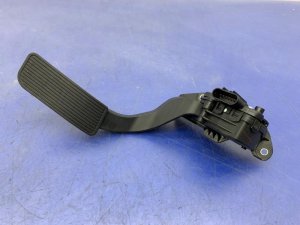
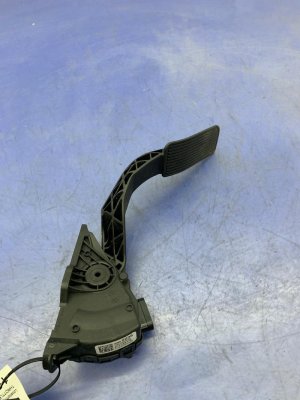
- The most likely part to fail is the entire accelerator pedal assembly, which includes the non-serviceable sensor.
- Replacing the accelerator pedal is a very easy DIY job (1/5 difficulty) that requires only basic hand tools and about 30 minutes.
- The correct OEM part number for the non-adjustable pedal assembly is commonly 25832864.
What's Unique About the 2007-2014 Cadillac ESCALADE
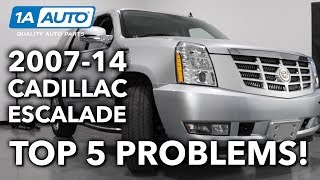
🎬 Watch: Top 5 common problems for this Escalade generationFor this generation of GM trucks and SUVs (GMT900 platform), including the Escalade, issues with the accelerator pedal assembly and its related wiring are a well-documented weak point. GM even issued a Technical Service Bulletin (PIP3783D) specifically highlighting that intermittent 'Reduced Engine Power' messages accompanied by codes like P2120 are often due to poor electrical terminal tension in the APP sensor's connector, not necessarily a failed sensor. The TSB also advises checking other harness connectors (C109/X109 and C205/X205) for issues. This makes checking the wiring a critical first step before buying parts.
Diagnostic Flowchart
Tap your situation to follow the diagnostic path that matches what you're seeing on this vehicle.
Symptoms You May Notice
- "Reduced Engine Power" message on the dashboard.
- Check Engine Light is on.
- "Service StabiliTrak" and "Traction Control Off" messages may also appear.
- Poor, delayed, or non-existent throttle response.
- Vehicle is stuck in 'limp mode' with very limited speed.
- Engine may hesitate or stumble on acceleration.
- Replacing the Throttle Body. While throttle body issues can also cause 'Reduced Engine Power', code P2120 specifically points to the pedal sensor circuit. Other codes, like P1516 or P2135, are more commonly associated with the throttle body itself.
Most Likely Causes
- Poor Terminal Tension at APP Sensor Connector 🔴 High Probability GM TSB #PIP3783D specifically calls this out as a common, intermittent issue for this platform. Vibration and heat cycles can cause the female terminals in the connector to loosen their grip on the sensor's pins, causing a momentary loss of signal.
How to confirm: With the ignition off, disconnect the APP sensor connector. Visually inspect for corrosion or damage. Use a proper terminal test probe to check if the female terminals have a tight grip on the male pins. Wiggling the connector while monitoring live data can also expose the fault.
Typical fix: If terminals are loose, they can sometimes be carefully re-tensioned or the connector pigtail can be replaced. Cleaning corroded terminals may also resolve the issue. TSB PIP3783D suggests recrimping the terminals as a potential repair.
Est. part cost: $15-$40 for a new pigtail connector. - Faulty Accelerator Pedal Position (APP) Sensor 🔴 High Probability → Shop Accelerator Pedal Assembly The sensor is an electronic component subject to wear and eventual failure. It is one of the most common failure points on these vehicles leading to reduced power mode. Many owner forums confirm that replacing the pedal assembly is the ultimate fix.
How to confirm: If wiring and terminals are confirmed to be good, use a scan tool to monitor the live data for APP Sensor 1 and APP Sensor 2. The voltage readings should sweep smoothly and in correlation as the pedal is pressed. For this GM system, the voltage should typically range from about 0.24V to 4.49V. Jumps, dropouts, or a static reading indicate a failed sensor.
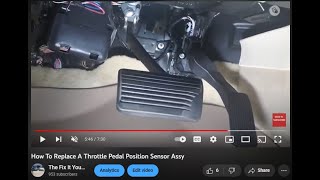
Typical fix: Replace the entire accelerator pedal assembly. 🎬 See this walkthrough on replacing the pedal assembly The sensor is integrated into the pedal and is not sold separately. This is a straightforward DIY repair involving a few bolts and one electrical connector.
Est. part cost: $80-$120 - Damaged Wiring Harness 🟡 Medium Probability Wires can chafe, break, or corrode anywhere between the pedal assembly and the Engine Control Module (ECM), especially where the harness passes through the firewall or near sharp edges. In one documented case, mice chewed through the harness where it passed through the firewall grommet after an amplifier wire was run through the same spot.
How to confirm: Perform a 'wiggle test' by moving sections of the harness while monitoring live sensor data on a scan tool. If the voltage fluctuates, you've found the problem area. A continuity test with a multimeter can also be used to find an open or short in a specific wire between the APP connector and the ECM.
Typical fix: Repair the broken or shorted section of wire. This may involve soldering and heat-shrinking the damaged area.
Est. part cost: $5-$20 for wiring repair supplies. - Broken Ground Wire ⚪ Low Probability A specific ground wire located on the passenger side of the intake manifold has been identified as a potential culprit. If this wire breaks or has a poor connection, it can cause a loss of communication and trigger multiple throttle-related codes, including P2120.
How to confirm: Visually inspect the small black ground wire coming from the main harness on the passenger side of the intake. Wiggling this wire may cause the fuel pump relay to click on and off, confirming an intermittent connection.
Typical fix: Cut the old ground connection and secure the wire to a new, clean grounding point on the engine or chassis.
Est. part cost: <$5 for a new terminal and hardware.
Rare But Worth Checking
- Faulty Engine Control Module (ECM): → Shop Engine Control Module (ECM) This is very rare and should only be considered after all other possibilities (sensor, connector, wiring, grounds) have been exhaustively ruled out. The TSB even suggests replacing the ECM only if circuit tests point directly to it.
Diagnosis Steps
- Scan the ECM for all stored trouble codes and review freeze-frame data to see the conditions when the fault occurred. Note all codes present.
- Visually inspect the accelerator pedal assembly, its electrical connector, and the visible portion of the wiring harness for any obvious damage, looseness, or corrosion.
- As per TSB #PIP3783D, carefully disconnect the APP sensor connector and inspect the terminals for corrosion or signs of water intrusion. Use the correct terminal test probes to verify good pin tension.
- Using a scan tool with live data, monitor the voltage readings for both APP Sensor 1 and APP Sensor 2. Press the pedal slowly from fully released to fully depressed. The voltage should change smoothly with no spikes or dropouts, typically within a range of 0.24V to 4.49V.
- Perform a 'wiggle test': while watching the live data, gently wiggle the connector and sections of the wiring harness between the pedal and the firewall. Also wiggle the ground wire on the passenger side of the intake manifold. If the voltage readings jump around or the 'Reduced Power' message appears, it indicates an intermittent wiring fault.
- If the wiring and connector are confirmed good but the live data is erratic, the accelerator pedal assembly is faulty and should be replaced.
- If a new pedal does not fix the issue, perform continuity checks on the individual wires between the APP sensor connector and the ECM connector to rule out a hidden break or short in the harness. Also check connectors C109/X109 and C205/X205 as advised by the TSB.
- As a final step, if all wiring and the sensor are known to be good, the ECM may be the issue, but this is highly unlikely.
Parts You'll Likely Need
- Accelerator Pedal Assembly with Sensor
(OEM #25832864)— This is the most common cause of failure. The sensor is integrated into the pedal assembly and must be replaced as a single unit. The part number 25832864 supersedes older numbers 15101848 and 15847349.
Trusted brands: ACDelco (OEM), Standard Motor Products (APS265), NGK/NTK (ADA105), Wells (5S7950), Dorman (699-105)
OEM price range: $90-$120
Aftermarket price range: $60-$90
Related Codes That Often Appear With This One
- P2138 — This code indicates a 'Throttle/Pedal Position Sensor/Switch D/E Voltage Correlation' error. It is very common to see with P2120 as it means the two internal pedal sensors are not agreeing with each other, which is often the result of one sensor circuit failing (P2120).
- P2122 — This code indicates 'Throttle/Pedal Position Sensor/Switch 'D' Circuit Low Input', pointing to a short to ground or an open in the same circuit as P2120.
- P2123 — This code indicates 'Throttle/Pedal Position Sensor/Switch 'D' Circuit High Input', pointing to a short to voltage in the same circuit as P2120.
- P1125 — A manufacturer-specific code often related to the accelerator pedal position system performance. It is frequently logged alongside P2120 and P2125 on these trucks.
- P2125 — This code is for the 'Throttle/Pedal Position Sensor/Switch 'E' Circuit', which is the second sensor within the same pedal assembly. It's common for both sensor circuits to log faults simultaneously.
Technical Service Bulletins (TSBs) & Recalls
- PIP3783D: Addresses intermittent SES light and Reduced Engine Power with various APP sensor DTCs (P2120, P2122, P2123, P2125, P2127, P2128, P2138), advising technicians to inspect circuit terminal tension at the APP sensor, ECM, and intermediate harness connectors.
Platform-Specific Known Issues
- GM Technical Service Bulletin #PIP3783D was issued for these vehicles due to intermittent 'Reduced Engine Power' modes caused by poor terminal tension in the APP sensor connector, leading to codes like P2120. The bulletin advises checking terminal tension at the APP sensor, ECM, and intermediate connectors C109/X109 and C205/X205.
- A broken ground wire on the passenger side of the intake manifold is a known, though less common,
Mechanic-Grade Diagnostic Values
- APP Sensor 1 Signal Voltage — expected: Approx. 0.6-0.8V at idle (pedal up), sweeping smoothly up to approx. 4.0V at wide-open throttle (pedal down).. Failure: Voltage is stuck, jumps, drops out, or is outside the 0.24V to 4.49V range that triggers the code.
- APP Sensor 2 Signal Voltage — expected: Inverse of Sensor 1. Approx. 3.8-4.0V at idle (pedal up), sweeping smoothly down to approx. 0.9V at wide-open throttle (pedal down).. Failure: Voltage does not sweep inversely to Sensor 1, is stuck, jumps, or is outside the valid range.
- 5-Volt Reference Circuit at APP Connector — expected: 4.8V to 5.2V with key on, engine off.. Failure: Voltage below 4.8V or above 5.2V indicates a problem with the ECM or a short in the reference circuit.
- Low Reference (Ground) Circuit at APP Connector — expected: Less than 3 ohms of resistance to a known good chassis ground.. Failure: Resistance greater than 3 ohms indicates an open or high resistance in the ground circuit.
Scan Tool Commands That Help
- Tech2 / GDS2 or equivalent professional scanner: Throttle/Idle Learn Reset — This function is not strictly required for an APP sensor replacement, as the ECM typically self-calibrates. However, it can be useful to perform after repairs to the throttle body or if idle issues persist, as it resets all learned values for the entire throttle control system.
Wiring & Ground Locations
- APP Sensor Connector — At the top of the accelerator pedal assembly inside the cabin.. This is the primary connection point for the sensor. TSB PIP3783D specifically calls out poor terminal tension in this 6-pin connector as a main cause of P2120. Pins provide 5V reference, low reference (ground), and signal return for both APP Sensor 1 and APP Sensor 2.
- G103 — On the front of the passenger side (right) cylinder head.. This is a critical engine ground point. A loose or corroded connection here can disrupt the ground reference for multiple sensors, including the APP sensor circuits, causing erratic voltage readings and fault codes.
- G104 — On the rear of the driver's side (left) cylinder head, near the firewall.. This ground serves the Vehicle Control Module (VCM/ECM) and various other systems. A poor connection can lead to a host of intermittent electronic issues, including throttle control faults.
- X109 / C109 — Large inline harness connector located on the driver's side of the engine compartment, below the underhood fuse block.. This is a major pass-through connector between the engine harness and body harness. The APP sensor circuits run through it. TSB PIP3783D identifies it as a potential location for corrosion or poor pin connection, causing the same symptoms as a bad pedal sensor.
- OBD-II Port — Under the driver's side dashboard, typically to the left of the steering column, near the hood release lever.. This is the connection point for the scan tool needed to read codes, view live sensor data, and clear faults after repair.
Real Owner Repair Stories
- Tahoe/Yukon Forum User (2007-2014 GM SUV (GMT900 Platform)) — Intermittent 'Reduced Engine Power' message, codes P2120 and P2138.
❌ Tried (didn't work) Replacing the accelerator pedal assembly.
✅ What actually fixed it The final solution was cleaning the main engine-to-chassis and battery-to-chassis ground straps. They were corroded, causing intermittent voltage drops across the entire electrical system that the sensitive APP sensor circuit would detect as a fault. - Cadillac Forums User (2008 Cadillac Escalade) — Reduced Engine Power, Service StabiliTrak, multiple APP sensor codes.
❌ Tried (didn't work) Replacing the accelerator pedal., Replacing the throttle body.
✅ What actually fixed it The problem was traced to a pin that had slightly backed out of the main ECM connector. It was making just enough contact to pass a simple wiggle test of the harness, but would lose connection intermittently while driving, triggering the fault codes.
OEM Part Supersession History
15101848, 15847349→25832864— Standard part evolution and design updates by GM.
Heads up: The listed part numbers are for vehicles with power-adjustable pedals. A different part is required for fixed-pedal models. Ensure you order the correct assembly for your vehicle's options.
Model Year Variations Within This Range
- 2007-2014: While the core GMT900 platform and drive-by-wire system remained consistent, there was a minor interior and exterior refresh around 2009-2010. However, this did not significantly alter the accelerator pedal assembly, its function, or the common causes of code P2120 for this vehicle range.
Helpful Videos
We Have This Part in Stock

The information in this article is provided for general reference and educational purposes only. Vehicle specifications, procedures, and part compatibility can vary by production date, trim level, and region. Always consult your vehicle's factory service manual and verify part numbers before purchasing or performing repairs. Safety-critical components such as airbags, seat belts, and braking systems should be installed by a qualified professional.
- Cadillac ESCALADE:
- 🧭 Diagnostic Flowchart
- 🎬 Helpful Videos
- 🛍️ Shop This Part
- What's Unique About the 2007-2014 Cadillac ESCALADE
- Symptoms You May Notice
- Most Likely Causes
- Rare But Worth Checking
- Diagnosis Steps
- Parts You'll Likely Need
- Related Codes That Often Appear With This One
- Technical Service Bulletins (TSBs) & Recalls
- Platform-Specific Known Issues
- Mechanic-Grade Diagnostic Values
- Scan Tool Commands That Help
- Wiring & Ground Locations
- Real Owner Repair Stories
- OEM Part Supersession History
- Model Year Variations Within This Range
- 🎟️ Get 5% Off