

P2120 on 2007-2014 GMC Yukon: Causes and Fixes for APP Sensor Circuit Faults
On a 2007-2014 GMC Yukon, code P2120 almost always points to a problem with the Accelerator Pedal Position (APP) sensor circuit, often triggering 'Reduced Engine Power' mode. Before replacing the pedal assembly (GM Part #25832864, approx. $95-$170), thoroughly inspect the wiring and connector for loose terminals or damage, as this is a very common cause documented in GM Technical Service Bulletin #PIP3783D.
- P2120 on a 2007-2014 Yukon will almost certainly put the vehicle into 'Reduced Engine Power' mode.
- Check the wiring first! A GM Technical Service Bulletin points directly to loose connector terminals as a primary cause, which is a much cheaper fix than a new pedal.
- A 'wiggle test' on the harness while watching sensor voltage on a scan tool is the most effective way to find an intermittent wiring fault.
- Do not confuse this with a throttle body problem. P2120 is about the gas pedal, not the engine's throttle plate.
- If you must replace the pedal, use a quality part from brands like ACDelco or Dorman, as this is a critical safety component.
What's Unique About the 2007-2014 Gmc YUKON
On this generation of GMC Yukon and other GMT900 trucks/SUVs, wiring issues are a well-documented cause for APP sensor codes like P2120. A manufacturer TSB specifically advises technicians to check for poor terminal tension in the connectors before replacing parts. This means the problem is frequently a poor connection, not a failed pedal sensor, making a thorough wiring inspection the critical first step. Forum users and mechanics frequently report that simply replacing the pedal does not fix the issue, only to later find a broken ground wire or a loose pin in the connector.
Diagnostic Flowchart
Tap your situation to follow the diagnostic path that matches what you're seeing on this vehicle.
Symptoms You May Notice
- "Reduced Engine Power" message on the instrument cluster.
- Check Engine Light is on.
- Poor, delayed, or no throttle response.
- Vehicle has limited acceleration and may not shift properly.
- Engine may idle but not rev up when the pedal is pressed.
- "Stability Control Disabled" message may appear simultaneously.
- Gauges and lights on the dash may act erratically if the fault is related to a bad ground wire.
- Replacing the throttle body. This code is related to the driver's gas pedal input (APP sensor), not the throttle body itself. While throttle body issues can also cause 'Reduced Engine Power', they will set different codes (like P1516 or P2135).
Most Likely Causes
- Poor Terminal Tension or Damaged Wiring at APP Sensor Connector 🔴 High Probability As noted in GM TSB #PIP3783D, the female terminals in the 6-pin APP sensor connector can loosen over time, causing an intermittent connection. The harness is also in a location where it can be kicked or stressed by the driver's foot or damaged by aftermarket accessory installation (like for an amplifier).
How to confirm: With the ignition off, disconnect the APP sensor connector at the pedal. Carefully inspect the terminals for corrosion or being spread too far apart. Use a proper terminal test probe to check the tension of each pin. A 'wiggle test' on the harness while monitoring live APP sensor voltage on a scan tool can also reveal intermittent faults; wiggling a bad wire will cause the voltage to jump or drop out.
Typical fix: If terminals are loose, they may need to be carefully re-tensioned or replaced. A more robust fix is to replace the connector pigtail. 🎬 See the real fix for wiring and connector correlation codes. Damaged wires should be properly soldered and sealed with heat shrink tubing.
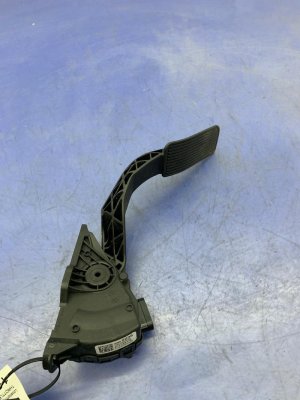
Est. part cost: $10-$40 for a connector pigtail (e.g., Standard Motor Products S-1479, Dorman 645-595, ACDelco PT2712). - Faulty Accelerator Pedal Position (APP) Sensor 🟡 Medium Probability → Shop Accelerator Pedal Assembly The APP sensor is an electronic component that can wear out over time. It is integrated into the accelerator pedal assembly and is not sold separately. The internal wipers can develop dead spots, causing signal glitches or spikes.
How to confirm: If the wiring and connectors are confirmed to be good, and live data from a scan tool shows erratic or incorrect voltage readings from the APP sensor that don't correspond smoothly with pedal movement, the sensor itself is likely faulty. A good sensor's voltage should sweep smoothly up and down as the pedal is pressed and released.
Typical fix: Replace the entire accelerator pedal assembly. This is typically held on by two or three nuts and is a straightforward replacement. 🎬 Watch this walkthrough on how to fix reduced engine power.
Est. part cost: $70-$150 for an aftermarket part, $95-$180 for the OEM part. - Chafed or Shorted Wiring Harness / Bad Ground ⚪ Low Probability Wiring harnesses, particularly ground wires, can become brittle and break internally or chafe against other components. A common failure point on GMT900 trucks is a small black ground wire on the passenger side of the intake manifold, which can cause a host of electrical issues, including reduced power mode.
How to confirm: Visually inspect the entire length of the APP sensor wiring harness from the pedal to the Engine Control Module (ECM) for any signs of chafing, melting, or physical damage. Check engine bay ground points, especially those on the firewall and engine block, for corrosion or looseness.
Typical fix: Repair the damaged section of the wiring harness. If a ground wire is broken, clean the contact point and re-secure it or run a new ground wire.
Est. part cost: $5-$20 for wiring repair supplies
Rare But Worth Checking
- Faulty Engine Control Module (ECM): → Shop Engine Control Module (ECM) This is very rare and should only be considered after all other possibilities (wiring, connectors, and the APP sensor itself) have been definitively ruled out with proper circuit testing.
Diagnosis Steps
- Scan the ECM for all stored trouble codes. Note P2120 and any other related codes like P2125 or P2138.
- Observe the freeze frame data to see the conditions under which the code was set.
- Using a scan tool, monitor the live data for APP Sensor 1 and APP Sensor 2 voltages. The values should change smoothly as you press and release the gas pedal. For APP1, the range is typically 0.9V at idle to 2.4V at wide-open throttle. For APP2, it may be around 3.1V to 2.6V. The key is a smooth sweep with no dropouts or spikes.
- Perform a thorough visual inspection of the accelerator pedal wiring harness and its 6-pin connector. Look for any signs of damage, chafing, or loose connections.
- As recommended by TSB #PIP3783D, check the terminal tension at the APP sensor connector. The female pins should fit snugly onto the male pins of the sensor.
- Perform a 'wiggle test' by gently moving the wiring harness for the APP sensor while watching the live voltage data on your scan tool. If the voltage jumps or drops out, you have found a wiring issue.
- If wiring appears good, test the circuits between the APP connector and the ECM connector for continuity and shorts to ground/power, following the vehicle's wiring diagram.
- If all wiring and connections are confirmed to be good, and the voltage readings are still erratic or incorrect, the accelerator pedal assembly is the most likely cause.
- As a final and rare check, inspect the wiring and connectors at the ECM.
Parts You'll Likely Need
- Accelerator Pedal Assembly
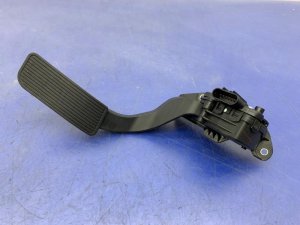
(OEM #25832864 (replaces 15101848, 15847349))— This is the most common part to fail after wiring issues have been ruled out. The sensor is integrated into the pedal assembly and is not sold separately.
Trusted brands: ACDelco (GM Genuine), Dorman (e.g., 699-105), Standard Motor Products (e.g., APS265), NTK
OEM price range: $95-$180
Aftermarket price range: $70-$150 - APP Sensor Connector Pigtail
(OEM #ACDelco PT2712 (cross-references to 13584094, 88988944))— If the connector itself is damaged or the terminals have lost tension, replacing the pigtail is the standard repair. This is a common failure point.
Trusted brands: ACDelco, Dorman (645-595), Standard Motor Products (S-1479)
OEM price range: $25-$50
Aftermarket price range: $10-$40
Related Codes That Often Appear With This One
- P2122 — Indicates APP Sensor 'D' Circuit Low Voltage, a specific type of fault for the same circuit.
- P2123 — Indicates APP Sensor 'D' Circuit High Voltage, a specific type of fault for the same circuit.
- P2125 — Relates to the second APP sensor ('E' circuit) within the same assembly. A fault in one sensor circuit often triggers a code for the other.
- P2138 — Indicates a correlation error between the two APP sensors (APP1 vs APP2). This is very common when one sensor's circuit is failing, as the PCM sees a disagreement between the two signals.
Technical Service Bulletins (TSBs) & Recalls
- PIP3783D: Addresses Service Engine Soon light, Reduced Engine Power messages, and DTCs including P2120, P2125, and P2138. The primar
Platform-Specific Known Issues
- A GM Technical Service Bulletin (TSB #PIP3783D) directly addresses intermittent 'Reduced Engine Power' messages with code P2120 (and related codes) on 2007-2014 Yukon models. It specifically instructs technicians to inspect the APP sensor circuits for poor terminal tension at the connectors, highlighting that this is a known issue.
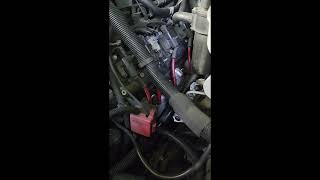
- Real Owner Experience: Ground Wire Failure: In a YouTube video by 'Pine Hollow Auto Diagnostics', a similar GM truck with reduced power was fixed by repairing a broken ground wire located on the passenger side of the intake manifold. Wiggling this specific wire caused the fuel pump relay to click on and off, demonstrating how a seemingly unrelated ground can cause this exact problem.
- Real Owner Experience: Aftermarket Parts Issues: A YouTube video from 'Just Rolled In' highlights an issue on a GMC Yukon where a new aftermarket throttle body was causing the 'Reduced Engine Power' light. The problem was only resolved by installing a genuine GM throttle body, emphasizing that for critical electronic parts on these vehicles, OEM is often the better choice even if the code points elsewhere.
Mechanic-Grade Diagnostic Values
- APP Sensor 1 (D Circuit) Voltage Range — expected: 0.24V - 4.49V. Failure: Voltage is less than 0.24V or more than 4.49V for over 0.5 seconds.
- APP Sensor 2 (E Circuit) Voltage Range — expected: 0.24V - 4.49V. Failure: Voltage is less than 0.24V or more than 4.49V for over 0.5 seconds.
- 5-Volt Reference at APP Connector — expected: 4.8V - 5.2V. Failure: Voltage is below 4.8V or above 5.2V, indicating a problem with the ECM or wiring.
- Low Reference Circuit Resistance to Ground — expected: Less than 3 ohms. Failure: Resistance is greater than 3 ohms, indicating an open or high resistance in the ground circuit.
- APP Sensor Connector Pinout (Trucks) — expected: Pin A: Low Ref, Pin B: APP 2 Sig, Pin C: 5V Ref, Pin D: Low Ref, Pin E: APP 1 Sig, Pin F: 5V Ref. Failure: Wiring does not match expected pinout, possibly due to incorrect pigtail replacement. Note that GM cars may swap Pins D and F.
Hidden / Shadow Codes Worth Checking
- ABS History Codes: In some cases, a dead pedal or reduced power event can be triggered by the traction control system detecting wheel spin. This may not set a Check Engine Light but can store a history code in the ABS module that is only visible with an ABS-capable scanner. (see via An OBD-II scanner with ABS/EBCM diagnostic capabilities.)
Wiring & Ground Locations
- G103 — On the front of the right (passenger side) cylinder head.. This is a primary engine and sensor ground point. A loose or corroded connection here can cause erratic sensor readings and multiple fault codes, including those for the APP sensor.
- G104 — On the left (driver side) rear corner of the engine, mounted to the cylinder head.. This is another critical engine ground. While less commonly cited for APP issues than G103, it should be checked as part of a thorough ground inspection.
- G102 — On the lower left front of the engine block.. Grounds the ignition coils, but poor connections in the engine bay can create electrical noise that may affect sensitive sensor circuits.
- APP Sensor Connector — At the top of the accelerator pedal assembly, inside the cabin.. This 6-pin connector is the primary failure point for wiring issues related to P2120, as noted in TSB #PIP3783D. The terminals can lose tension, or the wires can be damaged from being kicked.
Real Owner Repair Stories
- Tahoe Yukon Forum user 'rockola1971' (2007-2014 GM Truck/SUV (model not specified)) — Intermittent dead pedal, no throttle response, but no 'Reduced Engine Power' message and no check engine codes.
❌ Tried (didn't work) Replacing the accelerator pedal assembly., Replacing the throttle body., Disconnecting the battery to reset the ECM.
✅ What actually fixed it The user suspected a hidden ABS code. When traction control detects wheel spin, it can cause a temporary dead pedal for 5 seconds without triggering a check engine light. The user found that turning off traction control prevented the issue, pointing to a fault within the EBCM (Electronic Brake Control Module) or a wheel speed sensor, not the APP circuit itself. - Reddit user r/MechanicAdvice (2007 Yukon Denali XL) — CEL with P0122 (TPS code) and reduced engine power, occurring when decelerating downhill.
❌ Tried (didn't work) Replacing the Throttle Position Sensor (TPS)., Replacing the Mass Airflow (MAF) sensor.
✅ What actually fixed it After replacing the TPS and MAF, the user then replaced the accelerator pedal. This changed the code from P0122 to P2138 (APP correlation error). The user's post ends there, asking if a relearn is needed, which highlights a common point of confusion. No relearn is required, but the new code P2138 after pedal replacement strongly suggests the new pedal was either faulty or, more likely, the original problem was in the wiring/connector, which was not fixed by replacing parts.
OEM Part Supersession History
15101848, 15847349→25832864— Standard part consolidation and potential design revision over the production life of the vehicle.
Heads up: Part 25832864 is the correct replacement for the entire 2007-2014 range for Yukons with adjustable pedals. No programming is required upon replacement.
Helpful Videos
We Have This Part in Stock

The information in this article is provided for general reference and educational purposes only. Vehicle specifications, procedures, and part compatibility can vary by production date, trim level, and region. Always consult your vehicle's factory service manual and verify part numbers before purchasing or performing repairs. Safety-critical components such as airbags, seat belts, and braking systems should be installed by a qualified professional.
- Gmc YUKON:
- 🧭 Diagnostic Flowchart
- 🎬 Helpful Videos
- 🛍️ Shop This Part
- What's Unique About the 2007-2014 Gmc YUKON
- Symptoms You May Notice
- Most Likely Causes
- Rare But Worth Checking
- Diagnosis Steps
- Parts You'll Likely Need
- Related Codes That Often Appear With This One
- Technical Service Bulletins (TSBs) & Recalls
- Platform-Specific Known Issues
- Mechanic-Grade Diagnostic Values
- Hidden / Shadow Codes Worth Checking
- Wiring & Ground Locations
- Real Owner Repair Stories
- OEM Part Supersession History
- 🎟️ Get 5% Off