

P2122 on 2007-2013 Chevrolet Avalanche: APP Sensor Circuit Low Causes & Fixes
On a 2007-2013 Avalanche, code P2122 almost always points to a wiring or connector problem at the accelerator pedal, not the pedal sensor itself. Before replacing the pedal assembly, inspect the connector for loose or corroded terminals, a known issue covered by a GM Technical Service Bulletin. Applying dielectric grease and ensuring terminal tension is the most common and effective fix.
- P2122 on a 2007-2013 Avalanche will cause the truck to enter 'Reduced Engine Power' mode.
- The most likely cause is a poor electrical connection at the accelerator pedal, not a failed part.
- Always inspect the connector terminals for looseness or corrosion before spending money on a new pedal assembly.
- Do not replace the throttle body; this code is specific to the pedal circuit.
- Applying dielectric grease to the connector is a critical preventative step.
- The issue is common to all GMT900 platform vehicles, including Silverado, Sierra, Tahoe, and Yukon.
What's Unique About the 2007-2013 Chevrolet AVALANCHE
The GMT900 platform, which this Avalanche is built on, is known for electrical issues related to poor terminal tension and fretting corrosion in various connectors. Fretting corrosion is a buildup of insulating oxidized debris caused by micro-vibrations between electrical contacts, leading to increased resistance and signal loss. General Motors issued a Technical Service Bulletin (TSB #PIP3783D) specifically for this problem on the Accelerator Pedal Position (APP) sensor circuits. This means the connector and its wiring are a much more likely failure point than the pedal assembly itself, a fact supported by numerous owner complaints of replacing the pedal multiple times without fixing the root cause.
Diagnostic Flowchart
Tap your situation to follow the diagnostic path that matches what you're seeing on this vehicle.
Symptoms You May Notice
- "Reduced Engine Power" message on the instrument cluster
- Check Engine Light (Malfunction Indicator Lamp) is on
- Poor or no throttle response
- Vehicle is stuck in a high idle
- Inability to accelerate past a low speed
- "Service Traction Control" or "Service Stabilitrak" message may also appear
- Replacing the Throttle Body. P2122 is specific to the accelerator pedal circuit. The throttle body has its own sensor (TPS) which typically sets codes like P2135. An owner complaint filed with the NHTSA shows a user replaced the throttle body and the pedal three times before discovering the issue was in the wiring.
Most Likely Causes
- Poor Connection at the APP Sensor Connector 🔴 High Probability As cited in TSB #PIP3783D, these vehicles are susceptible to poor terminal tension and fretting corrosion in the APP sensor connector, leading to a low voltage signal. Fretting is caused by micro-movements from vibration and thermal cycles, which wears away the protective metal plating on the terminals, allowing an insulating oxide layer to form.
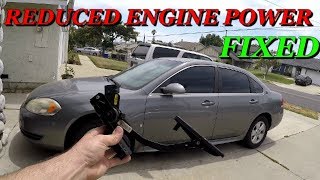
How to confirm: Disconnect the accelerator pedal connector and visually inspect the female terminals for being spread too far apart or showing dark smudges (fretting corrosion). Wiggling the connector with the engine running may also trigger or clear the fault, confirming a connection issue. 🎬 See how to diagnose and fix the reduced engine power message.
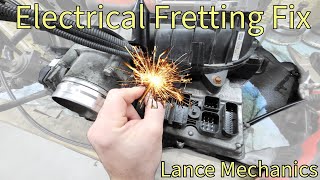
Typical fix: Clean the terminals with contact cleaner. Use a terminal pick tool to carefully tighten the female pins. Apply a quality dielectric grease (like NyoGel 760G) to the connector to prevent moisture and future fretting. 🎬 Watch: A mechanic's guide to identifying and fixing electrical fretting. If terminals are damaged, replace the connector pigtail.
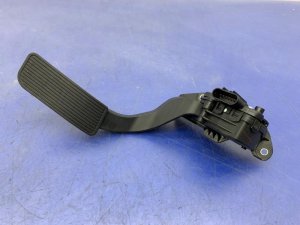
Est. part cost: $15-$40 - Failed Accelerator Pedal Position (APP) Sensor 🟡 Medium Probability → Shop Accelerator Pedal Assembly While less common than the wiring issue, the sensor itself can fail internally over time. It is integrated into the pedal assembly and is not sold separately.
How to confirm: After confirming the wiring and connector are good, use a scan tool to monitor the APP Sensor 1 voltage while slowly pressing the pedal. The voltage should increase smoothly. If it drops out, is erratic, or stays low, the sensor has failed. A multimeter can also be used to check for smooth resistance changes across the sensor's pins.
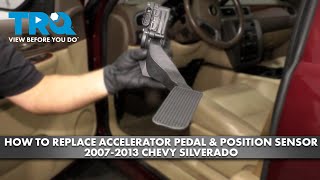
Typical fix: Replace the entire accelerator pedal assembly. This is typically held on by two bolts.
Est. part cost: $70-$150 - Damaged Wiring Harness ⚪ Low Probability The harness can be damaged by abrasion or foreign objects. One owner of a 2007 Silverado found a sheet metal screw had pierced the harness near the power distribution box, shorting the APP sensor signal wire to ground. A known chafe point for engine harnesses on GM trucks is on the corner of the cylinder head.
How to confirm: Perform a continuity test on the signal wire (typically a dark blue wire for APP sensor 1) between the APP sensor connector and the ECM. Check for a short to ground, which would pull the circuit voltage low.
Typical fix: Repair the specific section of damaged wire and protect it from future abrasion.
Est. part cost: $5-$20
Rare But Worth Checking
- Faulty Engine Control Module (ECM): → Shop Engine Control Module (ECM) This is extremely rare and should only be considered after all other possibilities, including all wiring and the sensor itself, have been definitively ruled out.
Diagnosis Steps
- Read all stored DTCs with an OBD-II scanner. Note any other codes present, especially P2127 and P2138.
- Visually inspect the accelerator pedal assembly, its connector, and the visible portion of the wiring harness for any obvious damage.
- With the ignition on, gently wiggle the connector and harness at the pedal. If this causes the 'Reduced Engine Power' message to appear or disappear, the problem is in the wiring/connector.
- Disconnect the APP sensor connector. Carefully inspect the female terminals for corrosion, moisture, or being spread apart (poor tension). This is the most critical step.
- If terminals look loose, use a terminal pick tool to gently bend them for a tighter fit. Clean the terminals with electrical contact cleaner and apply dielectric grease before reconnecting.
- Using a scan tool with live data, monitor the voltage for 'APP Sensor 1'. It should read around 0.6V-0.9V at rest and sweep smoothly up to ~4.7V when fully depressed. A reading below 0.325V confirms the low input condition.
- If the connector terminals are good but the voltage is still low, check the dark blue wire (APP Sensor 1 signal) for a short to ground between the pedal and the ECM.
- If all wiring and connections are confirmed to be in good condition, the APP sensor (pedal assembly) is the likely culprit and should be replaced.
Parts You'll Likely Need
- Accelerator Pedal Assembly
(OEM #25832864)— This is the complete assembly that includes the integrated position sensors. It's the correct part to replace if the sensor itself has failed. Aftermarket versions from brands like Standard Motor Products are available and sometimes feature an updated design.
Trusted brands: ACDelco, GM Genuine Parts, Standard Motor Products, Dorman
OEM price range: $110-$150
Aftermarket price range: $70-$100 - APP Sensor Connector Pigtail
(OEM #19418888)— If the connector housing or terminals are damaged beyond repair, this pigtail allows you to splice in a new, reliable connector, which often solves the problem per TSB #PIP3783D. An alternative part number may be 84880893.
Trusted brands: ACDelco
OEM price range: $25-$40
Aftermarket price range: $15-$25 - Dielectric Grease — Essential for preventing fretting corrosion and moisture intrusion in the connector, which is the root cause of the issue in many cases.
Trusted brands: Permatex, NyoGel 760G
OEM price range: $5-$15
Aftermarket price range: $5-$15
Related Codes That Often Appear With This One
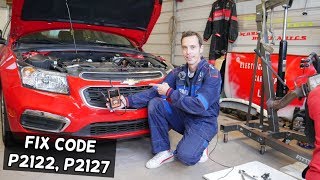
- P2127 — This code is for 'APP Sensor 2 Circuit Low'. The pedal has two sensors; a fault in the harness or connector often affects both, causing them to set codes simultaneously.
- P2138 — This code indicates a 'Throttle/Pedal Position Sensor/Switch D/E Voltage Correlation' error. The ECM compares the signals from the two pedal sensors; if one is reading low (P2122) while the other is normal, their signals won't match, triggering P2138.
- P2120, P2123, P2125, P2128 — These are all related APP sensor circuit codes that can be triggered by the same root cause, as noted in TSB #PIP3783D.
Technical Service Bulletins (TSBs) & Recalls
- PIP3783D: Addresses DTCs P2120, P2122, P2123, P2125, P2127, P2128, and/or P2138, advising inspection of APP circuits for poor terminal tension.
Platform-Specific Known Issues
- A GM Technical Service Bulletin (PIP3783D) specifically instructs technicians to inspect the Accelerator Pedal Position circuits for poor terminal tension when codes like P2122 are present.
- The issue is widespread across the GMT900 platform, affecting not just the Avalanche but also the Silverado, Tahoe, Suburban, Sierra, Yukon, and Escalade from the same era.
Mechanic-Grade Diagnostic Values
- APP Sensor 1 Voltage (Scan Tool) — expected: 0.6V-0.9V at idle, sweeping smoothly to ~4.7V at full pedal.. Failure: Voltage is below 0.325V for more than 0.4 seconds.
- APP Sensor 2 Voltage (Scan Tool) — expected: 0.3V-0.6V at idle, sweeping smoothly to 1.95V-2.4V at full pedal.. Failure: Voltage is below 0.325V for more than 0.4 seconds.
- 5-Volt Reference at APP Connector — expected: 4.8V to 5.2V with key on, engine off.. Failure: Voltage is significantly lower than 5.0V, indicating a problem with the ECM or a short on the reference circuit.
- Low Reference (Ground) at APP Connector — expected: Less than 5 ohms of resistance to a known good ground (like the battery negative terminal).. Failure: High or infinite resistance (open circuit) indicates a bad ground connection for the sensor.
Scan Tool Commands That Help
- Tech 2 / GDS2 or capable scan tool: Idle Learn Reset / Throttle/Idle Learn — After replacing the accelerator pedal, ECM, or throttle body, or after disconnecting the battery. This procedure is necessary for the ECM to relearn the throttle's idle and closed positions. Failure to perform this can cause erratic idle or prevent the P2122 code from clearing.
Wiring & Ground Locations
- APP Sensor Connector — At the top of the accelerator pedal assembly, under the driver's side dashboard.. This 6-pin connector is the primary failure point mentioned in TSB #PIP3783D due to poor terminal tension and fretting corrosion. The pins correspond to two 5V reference circuits, two ground circuits, and the two signal circuits for APP1 and APP2.
- G103 — On the front of the right (passenger side) cylinder head.. This is a primary engine and ECM ground location for GMT900 trucks. A poor connection at G103 can cause erratic sensor readings and various electrical faults, including APP sensor codes, because it disrupts the sensor's ground reference which the ECM uses to interpret the voltage signal.
- X115 — Large inline connector in the engine bay, connecting the main body harness to the engine harness.. The APP sensor circuits pass through this major connector. While less common than the pedal connector, corrosion or pin tension issues here can also cause the P2122 code.
Real Owner Repair Stories
- YouTube video by 'Auto Repair Guys' (Chevrolet/GMC Truck (GMT900 platform)) — Engine light on, 'Engine Power is Reduced' message, car starts and idles fine but has zero throttle response.
❌ Tried (didn't work) Scanning the system confirmed P2122 and P2127.
✅ What actually fixed it The accelerator pedal assembly was replaced. After replacement and clearing the codes, the throttle response was restored. - YouTube video by 'big dawg' (2008 Chevrolet Avalanche) — Check engine light and reduced power message.
✅ What actually fixed it Replaced the accelerator pedal position sensor assembly. The owner specifically demonstrated applying a connector protector (dielectric grease) to the pins of the new part before installation to prevent future corrosion, which directly addresses the cause outlined in the GM TSB.
OEM Part Supersession History
15101848, 15847349→25832864— Standard part evolution, likely for improved durability or sensor design.
Helpful Videos
We Have This Part in Stock

The information in this article is provided for general reference and educational purposes only. Vehicle specifications, procedures, and part compatibility can vary by production date, trim level, and region. Always consult your vehicle's factory service manual and verify part numbers before purchasing or performing repairs. Safety-critical components such as airbags, seat belts, and braking systems should be installed by a qualified professional.
- Chevrolet AVALANCHE:
- 🧭 Diagnostic Flowchart
- 🎬 Helpful Videos
- 🛍️ Shop This Part
- What's Unique About the 2007-2013 Chevrolet AVALANCHE
- Symptoms You May Notice
- Most Likely Causes
- Rare But Worth Checking
- Diagnosis Steps
- Parts You'll Likely Need
- Related Codes That Often Appear With This One
- Technical Service Bulletins (TSBs) & Recalls
- Platform-Specific Known Issues
- Mechanic-Grade Diagnostic Values
- Scan Tool Commands That Help
- Wiring & Ground Locations
- Real Owner Repair Stories
- OEM Part Supersession History
- 🎟️ Get 5% Off