

P2122 on 2007-2011 GMC Sierra: Accelerator Pedal Sensor Causes and Fixes
On a 2007-2011 GMC Sierra, code P2122 almost always triggers the 'Reduced Engine Power' message and is caused by a faulty accelerator pedal position (APP) sensor or, very commonly, a poor electrical connection at the sensor. Before replacing the pedal assembly (Part No. 25832864, around $60-$150), inspect the connector for loose terminals as noted in GM TSB PIP3783D, as this is a well-documented weak point.
- P2122 on a 2007-2011 Sierra will cause a 'Reduced Engine Power' warning and limit your ability to accelerate.
- Before buying any parts, ALWAYS inspect the electrical connector at the gas pedal for loose pins (poor terminal tension), as this is a known GM issue (TSB PIP3783D).
- If the connector is secure, the most likely fix is to replace the entire accelerator pedal assembly, which is a simple, DIY-friendly job.
- Do not confuse this with a throttle body problem; P2122 points specifically to the pedal sensor inside the cabin.
What's Unique About the 2007-2011 Gmc SIERRA
For this generation of GMC Sierra (GMT900 platform), the P2122 code is very frequently linked to a specific, documented weakness. General Motors issued Technical Service Bulletin #PIP3783D which points directly to 'poor terminal tension' in the electrical connector at the accelerator pedal. This means the female pins inside the connector spread apart over time due to vibration and thermal cycles, causing a weak or intermittent signal. Before you even consider replacing the pedal assembly, the first and most important check is to ensure the pins in the connector are making a solid connection, as this known issue is often the root cause of the problem.
Diagnostic Flowchart
Tap your situation to follow the diagnostic path that matches what you're seeing on this vehicle.
Symptoms You May Notice
- "Reduced Engine Power" message on the dashboard.
- Check Engine Light is on.
- Severely limited acceleration or no throttle response at all.
- Vehicle may feel like it's stuck in a low gear or won't go over a certain speed (e.g., 25 mph).
- Unstable or erratic idle.
- Traction control light may also illuminate.
- Replacing the Throttle Body. The throttle body has its own position sensors (TPS), but code P2122 specifically refers to the accelerator pedal in the cabin. A throttle body issue would typically set different codes, such as P2135.
Most Likely Causes
- Poor Connection at the APP Sensor Connector 🔴 High Probability GM Technical Service Bulletin PIP3783D specifically identifies 'poor terminal tension' as a common cause for this code on this platform. The female terminals in the connector can loosen over time, causing an intermittent or weak signal. This is the most common cause and should always be checked first.
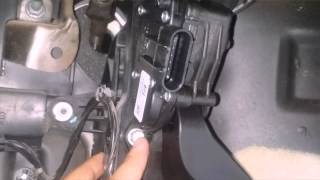
How to confirm: Disconnect the electrical connector from the accelerator pedal assembly. Visually inspect the terminals for corrosion or damage. Perform a 'wiggle test': with the key on, wiggle the connector and harness while a helper watches for the 'Reduced Power' message to appear or disappear. Use a special tool (terminal pick) to slightly bend the female terminals to ensure a tighter fit on the male pins of the sensor. 🎬 Watch: How to fix terminal tension and clear the P2122 code.
Typical fix: Clean the terminals and adjust them for better tension. If the terminals are too damaged or spread, replacing the connector pigtail is necessary.
Est. part cost: $0-$30 - Faulty Accelerator Pedal Position (APP) Sensor 🔴 High Probability → Shop Accelerator Pedal Assembly The sensor is an electronic component that wears out from constant use. The internal potentiometers can develop dead spots or fail entirely, leading to incorrect voltage readings.
How to confirm: After confirming the wiring is good, use a scan tool to monitor the APP sensor 1 and 2 voltage readings while pressing the pedal. The voltage should sweep smoothly from about 0.7V at idle to over 4.0V at wide-open throttle. If the 'D' circuit voltage (APP Sensor 1) is stuck low (below 0.2V), doesn't change, or drops out, the sensor is bad.
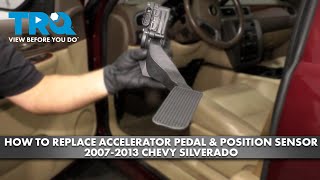
Typical fix: Replace the entire accelerator pedal assembly. The sensor is integrated into the pedal and is not sold separately. 🎬 See this step-by-step walkthrough for replacing the accelerator pedal assembly.
Est. part cost: $60-$150 - Damaged Wiring Harness ⚪ Low Probability Wires can chafe or break, especially where the harness passes through the firewall or near sharp metal edges under the dashboard. A specific, documented failure point on GMT900 trucks is a sheet metal screw from the fender wall piercing the harness near the power distribution box, shorting the APP sensor signal wire (often a dark blue wire) to ground.
How to confirm: Perform a continuity test on the signal wire (Dark Blue wire on Pin E of the APP connector) between the sensor connector and the ECM connector. Check the wire for any shorts to ground. Visually inspect the harness in the driver's side footwell and near the firewall for any signs of piercing or chafing.
Typical fix: Repair the damaged section of the wire and protect it with loom or anti-abrasion tape. If a screw has pierced the harness, remove it and repair the wire.
Est. part cost: $5-$25
Rare But Worth Checking
- Faulty Engine Control Module (ECM): → Shop Engine Control Module (ECM) This is very rare. The ECM should only be considered after all other possibilities, including the sensor and all related wiring, have been thoroughly tested and ruled out.
Diagnosis Steps
- Read all fault codes with an OBD-II scanner. Note any other codes, especially P2127 or P2138, as they strongly point to the APP sensor circuit.
- Check for Technical Service Bulletins (TSBs). TSB PIP3783D is highly relevant and points to checking connector terminal tension first.
- Locate the accelerator pedal assembly under the dashboard.
- Disconnect the electrical connector from the APP sensor. Inspect the connector and sensor pins for corrosion, moisture, or damage.
- Perform the TSB Check: Carefully inspect the female terminals in the connector for looseness ('poor terminal tension'). This is the most common issue. If loose, use a terminal pick to gently tighten them.
- Check for Power and Ground: With the key on, engine off, use a multimeter to test the connector pins. Based on wiring diagrams, you should find: - Pin F (White/Black): 5-Volt Reference - Pin C (Tan): 5-Volt Reference - Pin A (Purple): Low Reference (Ground) - Pin D (Brown): Low Reference (Ground) - Pin E (Dark Blue): APP Sensor 1 Signal (This is the 'D' circuit for P2122) - Pin B (Light Blue): APP Sensor 2 Signal
- Live Data Test: If power and ground are good, reconnect the connector. Use a scan tool to observe live data for 'APP Sensor 1' and 'APP Sensor 2' voltage. Slowly press and release the pedal. Both voltages should sweep smoothly. For P2122, APP Sensor 1 will likely be stuck low (<0.2V) or be erratic.
- Wiggle Test: While monitoring live data, wiggle the connector and harness. If the voltage reading jumps or the code appears, you have confirmed a connection or wiring issue.
- If the sensor fails the live data test and the connector is confirmed to be tight, replace the accelerator pedal assembly.
- If the new sensor does not fix the issue, perform a continuity and short-to-ground test on the Dark Blue wire (Pin E) between the APP connector and the ECM.
Parts You'll Likely Need
- Accelerator Pedal Assembly
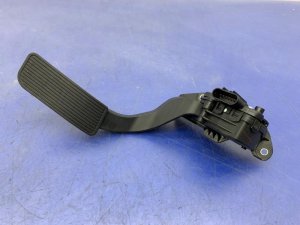
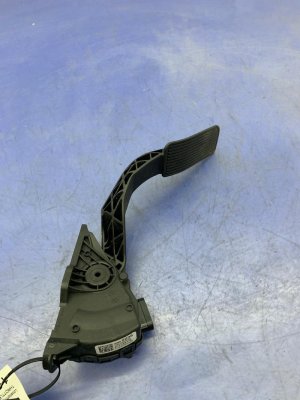
(OEM #25832864)— This is the most common fix for code P2122 when wiring issues are ruled out. The sensor is integrated into the pedal and cannot be replaced separately. 🎬 Watch: A quick guide to swapping the pedal on Yukon and Sierra models. This part number is superseded by several others but remains the most commonly referenced.
Trusted brands: ACDelco (GM Genuine), Dorman (699-105), Standard Motor Products (APS265)
OEM price range: $100-$150
Aftermarket price range: $60-$120
Related Codes That Often Appear With This One
- P2127 — This code is for 'APP Sensor 'E' Circuit Low Input'. Since the pedal assembly has two sensors for redundancy (APP1 and APP2), it's common for a fault in the connector or the assembly itself to affect both sensors, triggering P2122 and P2127 simultaneously.
- P2138 — This code indicates a 'Voltage Correlation' problem between the two APP sensors. It is often triggered alongside P2122 because the ECM sees that the signal from one sensor (stuck low) doesn't match the signal from the other, which is a critical safety fault.
Technical Service Bulletins (TSBs) & Recalls
- PIP3783D: Addresses vehicles with reduced engine power and codes like P2120, P2122, P2123, P2125, P2127, P2128, and/or P2138. It advises technicians to inspect the Accelerator Pedal Position circuits for poor terminal tension before replacing parts.
Platform-Specific Known Issues
- A primary documented issue for this platform is poor terminal tension at the APP sensor connector, as outlined in GM TSB #PIP3783D. This can cause intermittent signal loss and trigger P2122 without the pedal sensor itself being faulty.
- A less common but documented issue is the wiring harness being pierced by a fender wall screw near the power distribution box, causing a direct short to ground on the APP sensor signal wire.
Mechanic-Grade Diagnostic Values
- APP Sensor 1 vs. APP Sensor 2 Live Data Correlation — expected: APP Sensor 2 voltage should be approximately 50% of APP Sensor 1 voltage throughout the pedal's travel.. Failure: If the 50% relationship is not maintained or one signal is flat while the other moves, it indicates a sensor or wiring fault.
- APP Signal Wire Continuity Check — expected: Less than 1 Ω of resistance between the APP connector pin and the corresponding ECM pin.. Failure: Resistance greater than 1 Ω suggests high resistance in the wire or a partial break.
- Battery Voltage (Key On, Engine Off) — expected: 12.4–12.7V.. Failure: Voltage below 12.0V can cause various electronic modules, including the ECM, to receive insufficient power, potentially leading to false low-input sensor codes.
Scan Tool Commands That Help
- Tech2: Live Plot — This function is used to graph the APP Sensor 1 and APP Sensor 2 voltage signals simultaneously in real-time. It is extremely useful for diagnosing intermittent issues by visually identifying any spikes, dropouts, or glitches in one signal relative to the other as the pedal is pressed and the harness is wiggled.
Wiring & Ground Locations
- APP Connector (X209) — At the top of the accelerator pedal assembly in the driver's side footwell.. This 6-pin connector is the primary point for testing sensor signals and is a known failure point for poor terminal tension per TSB PIP3783D.
- G102 & G103 — G102 is located at the left rear of the engine; G103 is often on the rear of the driver's side cylinder head.. The ECM receives its main ground connections through these points via the underhood fuse box. A poor connection at G102 or G103 can cause erratic behavior and incorrect voltage readings for all sensors grounded through the ECM, including the APP sensor.
- G104 — Located on the left rear of the engine block or cylinder head.. This is another major engine-to-chassis ground point. A loose or corroded G104 can introduce electrical noise and voltage offsets that may affect sensitive sensor circuits and trigger fault codes.
Real Owner Repair Stories
- YouTube channel 'JM Auto Repair' (GMC Truck (Silverado/Sierra family)) — Reduced Engine Power message, traction control light on, codes P2138 and P2122 present.
❌ Tried (didn't work) The owner was stuck on the road, so extensive diagnosis was skipped in favor of replacing the most likely part.
✅ What actually fixed it Replacing the accelerator pedal position sensor assembly fixed the problem immediately. The 'Reduced Engine Power' message disappeared, and the truck could accelerate normally after the new part was installed. - YouTube channel 'DrivnAuto' (Chevrolet vehicle (similar GMT900 platform)) — Reduced Engine Power, Check Engine Light, Traction Control Light, and codes P2122, P2138, and P2135.
❌ Tried (didn't work) The video advises against immediately replacing the throttle body (related to P2135) before addressing the pedal sensor codes.
✅ What actually fixed it The problem was solved by replacing the accelerator gas pedal assembly. The video notes that the pedal sensor going bad can often trigger the throttle body code (P2135) as a secondary fault, and fixing the pedal resolves all codes.
"I Checked Everything" — The Actual Cause
- In the context of this electrical code, the equivalent of a 'smoke test clean' scenario is when both the APP sensor and its connector pigtail have been replaced, yet the P2122 code persists. In this situation, the root cause is often the known issue of the wiring harness being pierced by a screw near the driver's side fender or chafing near the underhood fuse block. Standard parts replacement will not fix this, and the fault can be missed if the short-to-ground is intermittent and not present during a simple continuity test.
OEM Part Supersession History
15101848, 15847349→25832864— Standard part evolution, design updates, and consolidation of inventory by GM.
Heads up: Part 25832864 is the correct replacement for the earlier numbers on vehicles with adjustable pedals. No programming is required for replacement.
Model Year Variations Within This Range
- 2007-2011: No significant variations have been documented for this specific P2122 issue within this year range. The cause (terminal tension, faulty sensor) and the primary fix (connector check, pedal replacement with PN 25832864) are consistent across the early GMT900 platform.
Helpful Videos
We Have This Part in Stock

The information in this article is provided for general reference and educational purposes only. Vehicle specifications, procedures, and part compatibility can vary by production date, trim level, and region. Always consult your vehicle's factory service manual and verify part numbers before purchasing or performing repairs. Safety-critical components such as airbags, seat belts, and braking systems should be installed by a qualified professional.
- Gmc SIERRA:
- 🧭 Diagnostic Flowchart
- 🎬 Helpful Videos
- 🛍️ Shop This Part
- What's Unique About the 2007-2011 Gmc SIERRA
- Symptoms You May Notice
- Most Likely Causes
- Rare But Worth Checking
- Diagnosis Steps
- Parts You'll Likely Need
- Related Codes That Often Appear With This One
- Technical Service Bulletins (TSBs) & Recalls
- Platform-Specific Known Issues
- Mechanic-Grade Diagnostic Values
- Scan Tool Commands That Help
- Wiring & Ground Locations
- Real Owner Repair Stories
- "I Checked Everything" — The Actual Cause
- OEM Part Supersession History
- Model Year Variations Within This Range
- 🎟️ Get 5% Off