

P2127 on 2007-2011 Chevrolet Silverado: Causes and Fixes for Reduced Power
On a 2007-2011 Silverado, code P2127 almost always points to a problem with the Accelerator Pedal Position (APP) sensor. The most common fix is inspecting the sensor's electrical connector for poor pin tension, as noted in a GM TSB. If the wiring is good, replacing the entire accelerator pedal assembly is the next step. Expect to pay $60-$150 for the part.
- P2127 on a 2007-2011 Silverado will put the truck in 'Reduced Engine Power' mode.
- Before buying any parts, inspect the wiring connector at the gas pedal. A loose connection is the most likely cause, as noted in a GM service bulletin.
- If the wiring is good, the fix is to replace the entire accelerator pedal assembly, which includes the faulty sensor.
- This is a DIY-friendly repair that can be done with basic hand tools in under an hour.
- Do not confuse this with a throttle body problem; the code specifically points to the pedal.
What's Unique About the 2007-2011 Chevrolet SILVERADO

The GMT900 platform, which includes the 2007-2011 Silverado, is well-known for issues related to the accelerator pedal's wiring. General Motors issued Technical Service Bulletin #PIP3783D specifically to address poor terminal tension in the APP sensor connector causing this and related codes. This indicates a common manufacturing or design weakness, meaning the problem is often the connector itself, not necessarily a failed pedal assembly. The TSB also advises checking intermediate connectors like C109/X109 (below the underhood fuse block) for the same issue. Some owners have also found the wiring harness can chafe on a metal screw or bracket behind the dash, causing a short to ground.
Diagnostic Flowchart

Tap your situation to follow the diagnostic path that matches what you're seeing on this vehicle.
Symptoms You May Notice

- "Reduced Engine Power" message on the driver information center.
- Check Engine Light is on.
- Very poor or no throttle response.
- Vehicle will not accelerate past a low speed (e.g., 30-40 mph).
- Engine may stall when coming to a stop.
- "Service Stabilitrak" or "Service Traction Control" messages may also appear, as the throttle control system is linked to traction and stability control.
- Replacing the throttle body. P2127 specifically points to a fault in the accelerator *pedal* circuit, not the throttle body at the engine. While they work together, the code isolates the problem to the pedal side. Owners on forums often replace the throttle body first, only to have the problem remain.
Most Likely Causes

- Poor Terminal Tension at APP Sensor Connector 🔴 High Probability This is a known issue documented by GM in TSB #PIP3783D. The female pins in the connector can loosen over time, causing an intermittent or poor connection. Water intrusion can also lead to corrosion in the connector.
How to confirm: With the key on, wiggle the wiring harness at the accelerator pedal. 🎬 Watch: How to diagnose terminal tension and sensor correlation issues. If the engine RPM changes or the error message flickers, the connection is faulty. Inspect the connector for loose, spread, or corroded pins. A more thorough test involves using a multimeter to check for voltage drops while wiggling the wires.
Typical fix: Repairing the connection. This can involve carefully re-tensioning the female terminals with a pick tool, cleaning the terminals, or replacing the connector with a new pigtail harness if damaged.
Est. part cost: $20-$40 for a connector pigtail. - Failed Accelerator Pedal Position (APP) Sensor 🔴 High Probability → Shop Accelerator Pedal Assembly The sensor is an electronic component (a potentiometer) that wears out over time from use and exposure to moisture. It is integrated into the pedal assembly and cannot be replaced separately.
How to confirm: If the wiring and connector are confirmed to be good, the sensor itself is the likely culprit. A scan tool can monitor the voltage from APP Sensor 1 and APP Sensor 2; if Sensor 2 (related to circuit 'E') shows a consistently low, zero, or erratic voltage that doesn't change smoothly as the pedal is pressed, the assembly has failed.
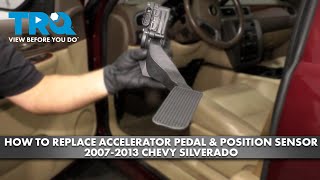
Typical fix: Replace the entire accelerator pedal assembly. This is a direct bolt-in replacement. 🎬 See this step-by-step guide to replacing the pedal assembly.
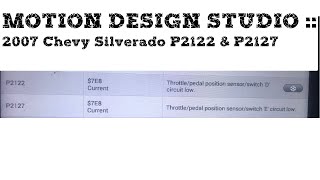
Est. part cost: $60-$150 - Damaged Wiring Harness 🟡 Medium Probability The harness can be damaged by being pinched, abraded by floor mats, or chafing against sharp metal edges under the dash or on the firewall. A specific YouTube repair video for a 2007 Silverado showed the harness had been pierced by a metal screw behind the dash 🎬 Watch: Finding a hidden short to ground behind the dash., causing a short to ground on the APP sensor signal wire.
How to confirm: Visually inspect the entire length of the harness from the pedal to the firewall. Look for nicks, cuts, or areas where the loom is rubbing against a bracket. Use a multimeter to check for continuity and shorts to ground on the signal wire for APP sensor 2 (typically a Light Blue wire on these models).
Est. part cost: $5-$20 for wiring repair supplies.
Rare But Worth Checking
- Faulty Engine Control Module (ECM): → Shop Engine Control Module (ECM) This is extremely rare. The ECM should only be considered as the cause after all wiring and sensor-related possibilities have been thoroughly ruled out. An ECM failure typically presents with multiple, unrelated trouble codes.
Diagnosis Steps
- Read all Diagnostic Trouble Codes (DTCs) with an OBD-II scanner. Note all codes present and any freeze frame data.
- Visually inspect the accelerator pedal connector for any signs of damage, corrosion, or pushed-out pins.
- With the ignition on (engine off), gently wiggle the connector and wiring harness at the pedal while observing live data for APP sensor voltage on a scan tool. If the voltage for APP Sensor 2 is erratic or jumps from 0V, the connection is bad.
- Following TSB #PIP3783D, disconnect the battery and the APP connector. Check the tension of the female terminals in the connector. They should provide a snug fit on the male pins of the sensor.
- If the connection is good, use a multimeter to verify the APP sensor circuits. For APP Sensor 2, check for 5V reference on the Tan wire (Pin D) and a good ground on the Purple wire (Pin B). The signal wire is typically Light Blue (Pin C).
- If all wiring and connections are confirmed to be good, the accelerator pedal assembly is faulty and should be replaced.
- After repair, clear all DTCs and perform a test drive to ensure the issue is resolved. A throttle relearn procedure is generally not required for this repair.
Parts You'll Likely Need
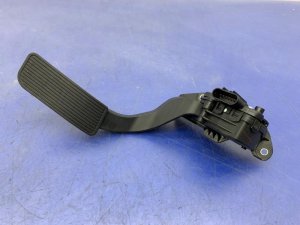
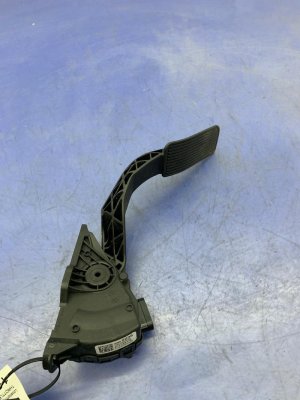
- Accelerator Pedal Assembly
(OEM #25832864)— This assembly contains the integrated APP sensors that cause this code when they fail. It is the most common part replaced after wiring issues are ruled out. This part number supersedes 15847349 and 15101848.
Trusted brands: ACDelco / GM Genuine, Dorman (p/n 699-205), Standard Motor Products, NGK/NTK
OEM price range: $100-$150
Aftermarket price range: $60-$120 - Accelerator Pedal Position Sensor Connector — Used to replace the factory connector if the terminals are corroded, damaged, or have lost tension, as described in TSB PIP3783D. Often sold as a pigtail for easier splicing.
Trusted brands: ACDelco, Dorman, Standard Motor Products
OEM price range: $30-$50
Aftermarket price range: $20-$40
Related Codes That Often Appear With This One
- P2122 — This code is for 'APP Sensor 'D' Circuit Low', which is the other sensor (APP Sensor 1) in the pedal assembly. They often fail or have connection issues together, and a wiring problem can affect both circuits.
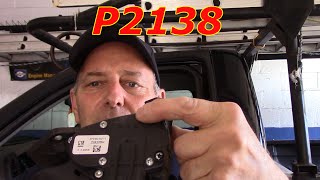
- P2138 — This code means 'APP Sensor 1-2 Correlation'. The ECM sets this when the voltage signals from the two pedal sensors do not match, which is a direct result of one sensor failing or its circuit having a problem (as indicated by P2127).
- P2120, P2123, P2125, P2128 — These are all related to the APP sensor circuits (high voltage, circuit malfunction, etc.). The presence of any of these codes alongside P2127 strongly confirms the problem is located at the accelerator pedal or its wiring.
Technical Service Bulletins (TSBs) & Recalls
- PIP3783D: Addresses codes P2120, P2122, P2123, P2125, P2127, P2128, and/or P2138 accompanied by a 'Reduced Engine Power' message. The bulletin advises technicians to inspect the Accelerator Pedal Position circuits for poor terminal tension at the APP sensor connector, ECM connector, and intermediate body connectors (C109/X109).
Platform-Specific Known Issues
- A primary documented issue for this platform is poor terminal tension in the APP sensor electrical connector, as outlined in GM Technical Service Bulletin #PIP3783D.
- A specific failure point noted by owners is the wiring harness chafing on a sharp metal screw or bracket behind the lower dash panel, leading to a short circuit on one of the APP sensor wires.
Mechanic-Grade Diagnostic Values
- APP Sensor 2 Signal Voltage (P2127 Trigger) — expected: Greater than 0.325V at all times.. Failure: Voltage drops below 0.325V for more than 0.4 seconds.
- APP Sensor 2 Signal Voltage (Scan Tool, KOEO) — expected: Should vary smoothly between approx. 0.32V and 4.75V as the pedal is pressed and released.. Failure: Voltage is stuck low, does not change, or has dropouts/spikes.
- APP Sensor 5-Volt Reference Circuit — expected: 4.8V - 5.2V at the sensor connector with key on.. Failure: Voltage is below 4.8V or above 5.2V, indicating a wiring or ECM issue.
- APP Sensor Low Reference Circuit Resistance — expected: Less than 5.0 ohms between the low reference pin on the connector and a known good chassis ground.. Failure: Resistance is greater than 5.0 ohms, indicating a poor ground connection.
Scan Tool Commands That Help
- GM Tech2 / Tech2Win: Live Data Display: 'APP Sensor 1 Voltage' & 'APP Sensor 2 Voltage' — This is the primary diagnostic step. It allows a technician to watch the voltage signals from both sensors in real-time as the pedal is operated to see if APP Sensor 2 drops out, is erratic, or does not correlate with APP Sensor 1.
- GM Tech2 / GDS2: Module Info / DTC Information — To check for any related DTCs in the ECM that could point to a broader issue, such as reference voltage codes (P0641, P0651) which must be addressed first.
Wiring & Ground Locations
- G103 / G106 — G103 is on the front of the right cylinder head. G106 is on the right rear of the engine.. These are primary engine grounds. A poor connection at these points can cause erratic behavior and low voltage readings in various engine sensors, including the APP sensor.
- ECM Connector X1 — This is one of the main harness connectors at the Engine Control Module (ECM).. The APP sensor circuits run directly to this connector. TSB #PIP3783D advises checking for poor pin tension here, as well as at the sensor itself. For example, the APP Sensor 2 signal wire connects to pin 18 of the X1 connector.
- APP Sensor Connector Pinout — The 6-pin connector at the accelerator pedal assembly.. Correctly identifying pins is crucial for testing. Per service data, the layout is: Pin A: Low Reference, Pin B: APP Sensor 2 Signal, Pin C: 5V Reference 2, Pin D: 5V Reference 1, Pin E: APP Sensor 1 Signal, Pin F: Low Reference.
Real Owner Repair Stories
- CorvetteForum user 'Hib Halverson' (2009 Chevrolet Z06 (similar GM drive-by-wire system)) — Sudden 'Reduced Engine Power' mode with code P2127. Problem was intermittent.
❌ Tried (didn't work) Cycling the ignition would sometimes temporarily clear the issue.
✅ What actually fixed it The expert advice provided was that the most common cause is a high-resistance condition in the accelerator pedal sensor circuits (wiring or connectors), not a hard failure of the pedal assembly itself. The final fix advised was a thorough inspection and testing of all wires and connections in the circuit between the pedal and the ECM.
OEM Part Supersession History
15101848, 15847349→25832864— GM regularly updates service parts to integrate new materials or technologies and consolidate part numbers.
Model Year Variations Within This Range
- 2011 (optional feature): Some 2011 models were available with an optional adjustable throttle and brake pedal feature. While the underlying APP sensor function is the same, these assemblies contain an additional motor and are linked to the memory seat module. A failure in the adjustment mechanism or its wiring could potentially affect the pedal assembly, though it is not a common cause of P2127.
Helpful Videos
We Have This Part in Stock

The information in this article is provided for general reference and educational purposes only. Vehicle specifications, procedures, and part compatibility can vary by production date, trim level, and region. Always consult your vehicle's factory service manual and verify part numbers before purchasing or performing repairs. Safety-critical components such as airbags, seat belts, and braking systems should be installed by a qualified professional.
- Chevrolet SILVERADO:
- 🧭 Diagnostic Flowchart
- 🎬 Helpful Videos
- 🛍️ Shop This Part
- What's Unique About the 2007-2011 Chevrolet SILVERADO
- Symptoms You May Notice
- Most Likely Causes
- Rare But Worth Checking
- Diagnosis Steps
- Parts You'll Likely Need
- Related Codes That Often Appear With This One
- Technical Service Bulletins (TSBs) & Recalls
- Platform-Specific Known Issues
- Mechanic-Grade Diagnostic Values
- Scan Tool Commands That Help
- Wiring & Ground Locations
- Real Owner Repair Stories
- OEM Part Supersession History
- Model Year Variations Within This Range
- 🎟️ Get 5% Off