

P2127 on 2007-2011 GMC Sierra: Causes and Fixes for Reduced Engine Power
On a 2007-2011 GMC Sierra, code P2127 is most often caused by a faulty Accelerator Pedal Position (APP) sensor assembly. This triggers a 'Reduced Engine Power' warning. Replacing the entire pedal assembly is the most common fix, costing around $70-$160 for the part. Before replacement, it is critical to inspect the electrical connector for loose terminals, as this is a known issue covered by a TSB.
- P2127 on a 2007-2011 Sierra means the second sensor in your electronic gas pedal has a low voltage problem.
- The most common symptom is the 'Reduced Engine Power' message, which severely limits your truck's speed and acceleration.
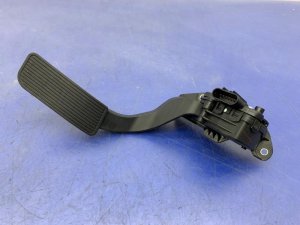
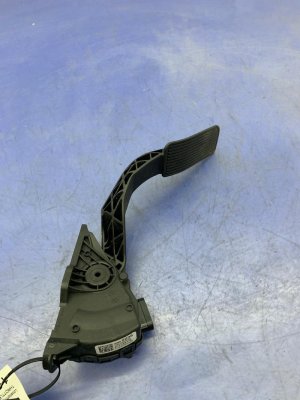
- The most likely fix is replacing the entire accelerator pedal assembly (part #25832864), which is a DIY-friendly job that requires no programming.
- Before buying a new pedal, always check the electrical connector for loose or spread terminals, as this is a known issue (TSB PIP3783D).
- If the problem is intermittent and happens over bumps, check for a broken ground wire near the passenger side of the intake manifold.
What's Unique About the 2007-2011 Gmc SIERRA
For this generation of GMC Sierra (GMT900 platform), the most common point of failure is the Accelerator Pedal Position (APP) sensor assembly itself. However, a notable issue documented in a Technical Service Bulletin (TSB) is poor electrical contact in the sensor's connector. This makes checking the connector terminals for a tight fit a critical first step before replacing the entire pedal assembly, potentially saving you from buying a part you don't need. Furthermore, the TSB also points to intermediate connectors, like X205 under the dash, as potential failure points.
Diagnostic Flowchart
Tap your situation to follow the diagnostic path that matches what you're seeing on this vehicle.
Symptoms You May Notice
- Check Engine Light is on
- "Reduced Engine Power" message displayed on the instrument cluster
- "Service Stabilitrak" and "Service Traction Control" messages may also appear
- Poor or no throttle response (dead pedal)
- Vehicle is stuck in "limp mode" with limited RPM and speed
- Unstable or hesitant acceleration
- Engine may stall or die when hitting bumps
- Replacing the throttle body. P2127 specifically points to a fault in the accelerator pedal's circuit, not the throttle body at the engine. While throttle body issues can cause similar symptoms like 'Reduced Engine Power', they will set different codes (e.g., P1516, P2101, P2135).
Most Likely Causes
- Failed Accelerator Pedal Position (APP) Sensor Assembly 🔴 High Probability → Shop Accelerator Pedal Assembly This is a high-wear electronic component that is known to fail over time on these drive-by-wire trucks. The internal potentiometers wear out, causing signal loss.
How to confirm: Use a scan tool to monitor live data for APP Sensor 1 and APP Sensor 2. When pressing the pedal, Sensor 2's voltage will be stuck near zero (below 0.32V) or respond erratically, while Sensor 1 may read normally.
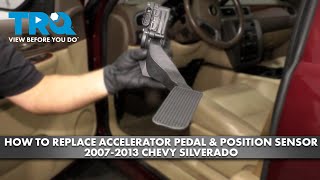
Typical fix: Replace the entire accelerator pedal assembly. The sensors are integrated into the pedal unit and are not sold separately. No programming is required after installation. 🎬 Watch: Step-by-step guide to replacing the accelerator pedal assembly.
Est. part cost: $70-$160 - Poor Terminal Tension at the APP Sensor Connector 🟡 Medium Probability A specific GM Technical Service Bulletin (PIP3783D) calls this out as a known issue for these trucks, where the female terminals in the connector spread and lose contact with the sensor pins.
How to confirm: Disconnect the electrical connector at the accelerator pedal. Visually inspect the female terminals to ensure they are not spread open. A good terminal should have a tight grip on the male pin of the sensor. Wiggling the connector with the engine running may trigger the fault.
Typical fix: Carefully use a terminal pick tool to tighten the female terminals in the connector. Apply dielectric grease before reconnecting. In severe cases, the connector pigtail may need to be replaced.
Est. part cost: $0-$30 - Damaged Wiring or Poor Connection ⚪ Low Probability Wires under the dash can be susceptible to damage from foot traffic or previous repairs. A specific, documented failure is a broken ground wire in the harness near the passenger side of the intake manifold 🎬 Watch this video to find hidden wiring breaks near the engine., which can cause intermittent power loss and multiple throttle-related codes when going over bumps.
How to confirm: Visually inspect the wiring harness leading to the pedal for any signs of chafing, breaks, or corrosion. Specifically check the ground wire bundle on the back of the passenger side cylinder head/intake area for breaks. Use a multimeter to check for continuity between the sensor connector and the ECM connector.
Typical fix: Repair the broken or shorted section of wire. Clean any corroded connectors with an electrical contact cleaner and apply dielectric grease.
Est. part cost: $5-$25
Rare But Worth Checking
- Faulty Powertrain Control Module (PCM): → Shop Engine Control Module (ECM) This is very uncommon. Before condemning the PCM, all other possibilities, including wiring, connectors, and the sensor itself, must be exhaustively ruled out.
- Aftermarket Cruise Control Module Interference: One owner on a Reddit forum reported that an aftermarket cruise control system, which plugged into both the OBD-II port and the accelerator pedal harness, was the source of the fault. Unplugging the module resolved the issue permanently.
Diagnosis Steps
- Read all fault codes using an OBD-II scanner. Note any other codes present, especially P2138 or P2122, as they strongly point to the pedal assembly or its connector.
- Observe live data from both APP Sensor 1 and APP Sensor 2. Confirm that Sensor 2 voltage is stuck low (typically below 0.32V) when the pedal is pressed, while Sensor 1 sweeps normally.
- Turn the ignition off and disconnect the electrical connector at the accelerator pedal.
- Inspect the connector and sensor pins for corrosion, damage, or backed-out pins. Check for interference from aftermarket devices.
- Check for proper terminal tension as described in TSB PIP3783D. The female terminals should grip the male pins tightly. This is a very common point of failure.
- With the key on and engine off, use a multimeter to verify you have a 5-volt reference and a good ground at the connector.
- If power, ground, and connector integrity are good, the APP sensor assembly is faulty and should be replaced.
- If the problem persists after replacement, inspect intermediate connectors (like X205) and check the main engine harness for broken ground wires, particularly on the passenger side of the intake manifold.
Parts You'll Likely Need
- Accelerator Pedal Assembly
(OEM #25832864)— This is the most common cause of P2127. The sensors are integrated into the pedal assembly and cannot be replaced individually. The original part 25832864 supersedes older numbers 15847349 and 15101848.
Trusted brands: ACDelco (OEM), Standard Motor Products (APS265), Dorman (699-105)
OEM price range: $95-$168
Aftermarket price range: $70-$120
Related Codes That Often Appear With This One
- P2138 — This code indicates a 'Voltage Correlation' error between APP Sensor 1 and Sensor 2. It means the PCM is seeing signals from the two sensors that don't match. This is a direct consequence of one sensor's signal being lost or incorrect (as in P2127), making it the most common companion code.
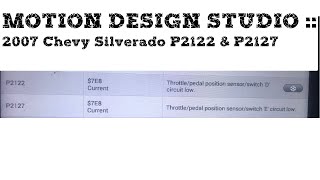
- P2122 — This code is for 'APP Sensor 1 Circuit Low'. Seeing both P2122 and P2127 together strongly suggests a problem common to both sensor circuits, like a loss of the 5-volt reference or ground at the pedal connector, or a major internal failure of the pedal assembly.
Technical Service Bulletins (TSBs) & Recalls
- PIP3783D: Advises technicians to inspect the Accelerator Pedal Position circuits for poor terminal tension at the APP sensor, ECM, and intermediate connectors when codes like P2127, P2138, etc., are present along with a 'Reduced Engine Power' message.
Platform-Specific Known Issues
- A known issue, documented in TSB #PIP3783D, is poor terminal tension in the accelerator pedal position sensor connector, which can cause intermittent low voltage readings and trigger this code. The TSB also advises checking intermediate connectors like C109/X109 and C205/X205.
- A documented failure point is a broken ground wire within the main wiring harness located on the passenger side of the intake manifold. This break can be internal to the harness and causes intermittent loss of power and throttle control, often triggered by bumps in the road.
Mechanic-Grade Diagnostic Values
- APP Sensor 5V Reference Voltage — expected: 5.0 V (± 0.5 V). Failure: A reading below 4.5V indicates a problem in the reference circuit from the PCM or a short.
- APP Sensor 2 Signal Voltage (at rest) — expected: ~0.3 V to 0.5 V. Failure: A voltage reading below ~0.2V for more than a fraction of a second will trigger DTC P2127.
- APP Sensor 2 Signal Voltage (full throttle) — expected: ~4.0 V to 4.5 V. Failure: Voltage does not sweep smoothly, is stuck low, or drops out during pedal press.
- APP Sensor Ground Circuit Resistance — expected: < 1.0 ohms. Failure: Resistance greater than 1.0 ohms to a known good chassis ground indicates a poor ground connection.
Scan Tool Commands That Help
- GDS2 / Tech2: Idle Learn Reset / Throttle Position Sensor Learn — After replacing the accelerator pedal assembly or throttle body, this function forces the PCM to relearn the sensor's idle and full-travel positions. While not always required for a pedal replacement, performing it can prevent the code from returning if the PCM retains old values.
- GDS2 / Tech2: Module Diagnostics - ECM - Data Display — To view live voltage readings of both APP Sensor 1 and APP Sensor 2 simultaneously. This is the primary method to confirm if Sensor 2's voltage is out of sync with Sensor 1 and is reading below the fault threshold.
Wiring & Ground Locations
- APP Connector (X210) — At the top of the accelerator pedal assembly, under the driver's side dashboard.. This is the primary connection point for the sensor. TSB PIP3783D specifically calls out checking for poor terminal tension in this 6-pin connector as a common cause of P2127.
- G103 / G104 — G103 is on the cowl, above the brake booster. G104 is on the rear of the passenger side cylinder head.. These are critical engine and body ground points. The pass-through wiring for the APP sensor relies on a clean ground path. A loose or corroded G104, in particular, has been cited in forums as a cause for intermittent throttle-related issues.
- X205 Connector — An intermediate connector located under the upper instrument panel trim, near the windshield defroster grille.. TSB PIP3783D identifies this as a potential point of failure for the APP sensor circuits between the pedal and the ECM. It can suffer from corrosion, water intrusion, or poor pin connection.
- APP Connector Pinout (Typical) — On the 6-pin connector at the pedal assembly.. Knowing the function of each pin is required for manual voltage testing. Pin A: APP Sensor 2 Low Reference (Ground). Pin B: APP Sensor 1 5V Reference. Pin C: APP Sensor 1 Signal. Pin D: APP Sensor 2 Signal (This is the 'E' circuit for P2127). Pin E: APP Sensor 1 Low Reference (Ground). Pin F: APP Sensor 2 5V Reference.
Real Owner Repair Stories
- Tahoe Yukon Forum (2014 GMC Yukon Denali (similar GMT platform)) — Intermittent "Service Stabilitrak," "Service Traction Control," and "Reduced Engine Power" with codes P2127 and P2138.
❌ Tried (didn't work) Replaced accelerator pedal assembly (twice, second time with OEM part), Replaced throttle body and throttle position sensor, Traced wires and checked plugs visually, Multiple dealer visits could not replicate or fix the issue
✅ What actually fixed it The final resolution was not posted by the original user, but the consensus from experienced members was that the issue was not the parts themselves, but an intermittent short-to-ground in the APP sensor 2 signal wire or a faulty connector/terminal that was not caught during visual inspection. This highlights the importance of wiggle-testing the harness and checking terminal tension per the TSB.
OEM Part Supersession History
15101848, 15847349→25832864— Standard part design updates and consolidation by GM.
Heads up: The replacement part 25832864 is a direct fit for the specified model years and does not require programming.
Helpful Videos
We Have This Part in Stock

The information in this article is provided for general reference and educational purposes only. Vehicle specifications, procedures, and part compatibility can vary by production date, trim level, and region. Always consult your vehicle's factory service manual and verify part numbers before purchasing or performing repairs. Safety-critical components such as airbags, seat belts, and braking systems should be installed by a qualified professional.
- Gmc SIERRA:
- 🧭 Diagnostic Flowchart
- 🎬 Helpful Videos
- 🛍️ Shop This Part
- What's Unique About the 2007-2011 Gmc SIERRA
- Symptoms You May Notice
- Most Likely Causes
- Rare But Worth Checking
- Diagnosis Steps
- Parts You'll Likely Need
- Related Codes That Often Appear With This One
- Technical Service Bulletins (TSBs) & Recalls
- Platform-Specific Known Issues
- Mechanic-Grade Diagnostic Values
- Scan Tool Commands That Help
- Wiring & Ground Locations
- Real Owner Repair Stories
- OEM Part Supersession History
- 🎟️ Get 5% Off