

P2135 on 2011-2012 Buick Regal: Throttle Position Sensor Causes and Fixes
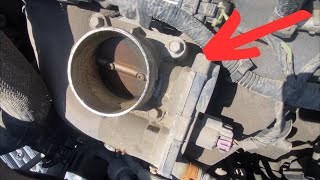
On a 2011-2012 Buick Regal, code P2135 is almost always caused by a failing throttle body assembly. This triggers the 'Reduced Engine Power' mode. Replacing the entire throttle body is the most common and reliable fix, costing between $250 and $400 for the part.
- P2135 on a 2011-2012 Regal almost always points to a bad throttle body, not the gas pedal.
- The most common symptom is the vehicle suddenly entering 'Reduced Engine Power' mode.
- Replacing the entire throttle body assembly is the most effective and recommended repair.
- After replacement, an 'Idle Relearn Procedure' is necessary to prevent idling issues.
What's Unique About the 2011-2012 Buick Regal
This issue is very common across many General Motors vehicles from this era that use the 2.4L Ecotec engine, including the Buick Regal. The problem was so widespread that GM issued a Special Coverage Adjustment (#11273A) that extended the warranty on the throttle position sensor to 10 years or 120,000 miles. While this warranty has likely expired for all 2011-2012 models, it confirms a high failure rate for the original part. The failure is almost always internal to the throttle body's electronic sensors, not the accelerator pedal.
Symptoms You May Notice
- Check Engine Light is on
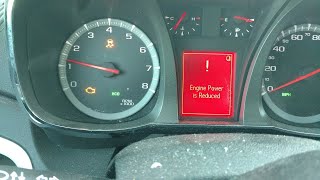
- "Reduced Engine Power" message on the dashboard
- "Service Stabilitrak" light may illuminate
- Vehicle has very limited acceleration and speed (limp mode)
- Hesitation or surging during acceleration
- Rough or unstable idle
- Engine may stall
- Replacing the Accelerator Pedal Position (APP) Sensor. While the code definition includes 'Pedal Position Sensor', the failure on this specific Buick model is almost always at the throttle body on the engine, not the gas pedal assembly inside the car.
Most Likely Causes
- Faulty Throttle Body Assembly 🔴 High Probability → Shop Fuel Injection Throttle Body The integrated Throttle Position Sensors (TPS) are a known high-failure item on this platform, as acknowledged by GM's special coverage program. The internal electronics fail over time, causing the voltage signals to become erratic.
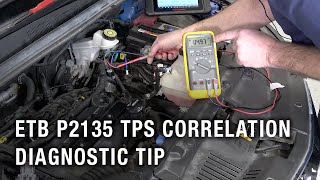
How to confirm: Using a scan tool, observe the live data for the two throttle position sensors 🎬 Watch: How to diagnose P2135 sensor correlation issues (TP1 and TP2). With the key on, engine off, slowly press the accelerator pedal. The voltage readings should change smoothly and mirror each other (one rising from ~1.0V to ~4.0V, the other falling from ~4.0V to ~1.0V). A jump, drop, or freeze in one or both sensor readings confirms a faulty throttle body.
Typical fix: Replace the entire throttle body assembly. After replacement, an idle relearn procedure is required to prevent a high or unstable idle. While GM once provided a TSB (11-06-04-007C) to replace just the sensor cover and terminals, this is now considered a less reliable, temporary fix, and most technicians and owners opt to replace the complete unit.
Est. part cost: $250-$400 - Wiring or Connector Issue ⚪ Low Probability
How to confirm: Visually inspect the wiring harness and connector at the throttle body for any signs of damage, corrosion, or loose pins. Wiggle the connector while observing live sensor data on a scan tool to see if the voltage readings fluctuate. Pay close attention to the harness where it may rub against other components.
Typical fix: Repair the damaged section of the wiring harness or clean/replace the connector.
Est. part cost: $10-$50
Rare But Worth Checking
- Faulty Powertrain Control Module (PCM): → Shop Engine Control Module (ECM) This is very rare. Before condemning the PCM, all other possibilities, especially the throttle body and its wiring, must be exhaustively ruled out.
Diagnosis Steps
- Connect an OBD-II scanner and confirm P2135 is the primary code.
- Using the scanner's live data function, monitor the voltage of Throttle Position Sensor 1 (TPS1) and Throttle Position Sensor 2 (TPS2).
- With the key in the 'On' position but the engine off, slowly press and release the accelerator pedal. Watch the voltage readings for both sensors.
- The readings should be smooth, without any spikes or dropouts. One sensor's voltage should rise while the other falls, but they should always correlate in a predictable pattern.
- If you see any erratic behavior or a disagreement between the sensor values, the throttle body is faulty.
- If the sensor data looks perfect, inspect the wiring harness and connector going to the throttle body for any visible damage, corrosion, or loose connections.
- If the wiring is intact and the sensor data is erratic, the throttle body assembly is the confirmed cause of the problem.
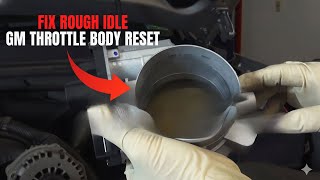
- After replacing the throttle body, perform the Idle Relearn Procedure: Start the engine in Park and let it idle for 3 minutes. Turn the engine OFF for 60 seconds. Restart the engine and let it idle for another 3 minutes. The idle should now be stable. If not, a drive cycle 🎬 Watch: How to manually relearn your GM throttle body above 45 mph with several decelerations may be required.
Parts You'll Likely Need
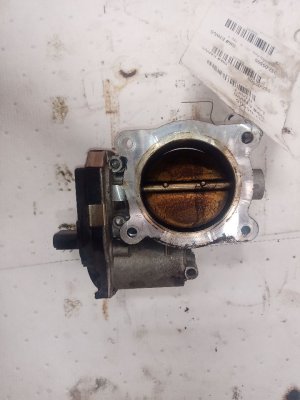
- Fuel Injection Throttle Body
(OEM #12694871)— This is the primary failure point for code P2135 on this vehicle due to faulty internal throttle position sensors.
Trusted brands: ACDelco, Bosch, Hitachi
OEM price range: $300-$400
Aftermarket price range: $150-$250
Related Codes That Often Appear With This One
- P1516 — This is another GM-specific code that relates to the Throttle Actuator Control (TAC) module performance, often triggered alongside P2135 when the throttle body fails.
- P2176 — This code for 'Throttle Actuator Control System - Idle Position Not Learned' can appear after the battery is disconnected or the throttle body is replaced without performing the idle relearn procedure.
Technical Service Bulletins (TSBs) & Recalls
- TSB #11-06-04-007C: Addresses DTC P2135 and provides a procedure for replacing the throttle position sensor components instead of the entire throttle body. It notes that some models may require a PCM reprogram after the repair.
- Special Coverage Adjustment #11273A: Extended the warranty for the throttle position sensor condition to 10 years or 120,000 miles from the vehicle's in-service date.
- TSB Bulletin #12-06-04-003: Although issued for the Lucerne, this manufacturer bulletin provides a procedure for the replacement of the throttle position sensor cover for concerns involving a malfunction indicator lamp, reduced power message, and DTC P2135.
Platform-Specific Known Issues
- General Motors issued Technical Service Bulletin (TSB) #11-06-04-007C and Special Coverage Adjustment #11273A for this exact issue on many vehicles, including those with the 2.4L engine. The TSB detailed a more complex repair of just the sensor cover and terminals (Kit P/N 19259452), but replacing the entire throttle body is now the standard, more reliable repair due to the higher long-term success rate.
Mechanic-Grade Diagnostic Values
- TPS1 Signal Voltage (Key On, Engine Off) — expected: Approx. 4.5V at closed throttle, sweeping smoothly to approx. 0.5V at wide-open throttle.. Failure: Voltage that is erratic, jumps, drops out, or does not sweep smoothly indicates a sensor fault.
- TPS2 Signal Voltage (Key On, Engine Off) — expected: Approx. 0.5V at closed throttle, sweeping smoothly to approx. 4.5V at wide-open throttle.. Failure: Voltage that is erratic, jumps, drops out, or does not sweep smoothly indicates a sensor fault.
- 5-Volt Reference at Throttle Body Connector — expected: Stable 5.0 Volts with key on, engine off.. Failure: Voltage below 4.8V or above 5.2V indicates a problem with the ECM or the wiring harness.
- Throttle Actuator Motor Resistance — expected: Between 2 to 15 ohms across the two motor terminals.. Failure: A reading over the limit (open circuit) or less than 1 ohm (short circuit) indicates a failed actuator motor within the throttle body.
Scan Tool Commands That Help
- GDS2 / Tech2: Idle Learn Reset / ETCS Reset — After replacing the throttle body, this function forces the ECM to relearn the new sensor's baseline idle and off-idle values. It is a more direct method than the manual relearn procedure and can quickly resolve high or unstable idle.
- GDS2 / Tech2: Freeze Frame / Failure Records — For intermittent P2135 faults, viewing the freeze frame data is critical. It provides a snapshot of all sensor values, including the conflicting TP1 and TP2 percentages or voltages, at the exact moment the fault was logged by the PCM.
Wiring & Ground Locations
- Throttle Body Connector — The 6-pin electrical connector on the electronic throttle body assembly.. This is the primary connection point for power, ground, and signal wires for both internal throttle position sensors. Corrosion, moisture intrusion, or damaged pins/wires at this connector can directly cause code P2135.
- G107 / G106 — On the lower left side of the 2.4L engine block.. This is a primary engine block and ECM ground. A loose or corroded connection here can create an unstable ground reference for the entire engine management system, leading to erratic sensor voltage readings and false correlation codes like P2135.
- G103 — Located at the left rear of the engine compartment, sometimes on the cowl or under the battery tray.. This is another key ground point for the Engine Control Module (ECM). A poor ground here can cause a variety of issues, including sensor correlation faults.
Real Owner Repair Stories
- AliExpress Reviewer (2011 GMC Terrain 2.4L L4 Ecotec (platform mate)) — Persistent check engine light with codes P0121 and P2135.
✅ What actually fixed it Replacing the original throttle body with a new unit (specifically mentioning compatibility with OEM part numbers 12616668, 12631186, and 12694871) resolved the codes. - JOE THE AUTO GUY (YouTube) (2011 Buick Regal 2.4L) — Check engine light, 'Reduced Engine Power' message, rough running, and a P2135 code.
❌ Tried (didn't work) Initial visual inspection of throttle plate actuation seemed normal., Considered cleaning the throttle body first, but ultimately decided against it as the primary repair.
✅ What actually fixed it Replacing the entire throttle body assembly resolved all symptoms and the trouble code.
OEM Part Supersession History
12607362, 12616668, 12631186→12694871— Standard part evolution by GM to improve reliability and integrate design updates.
Diagnostic Flowchart
Other Known Issues on This Vehicle
Issues unrelated to this code that are worth knowing about as an owner of this generation:
- Excessive Oil Consumption 🔴 High — Very common, particularly on 2010-2013 models. Can start as early as 60,000-70,000 miles. Caused by poorly designed piston rings. (Ref: TSB #13-06-01-003J outlines an oil consumption test and piston/ring replacement as the fix.)
- Timing Chain Stretch/Failure 🔴 High — Common issue on the 2.4L Ecotec, often exacerbated by low oil levels from the oil consumption problem. Can lead to catastrophic engine failure. (Ref: Special Coverage Adjustment #12313C extended warranty coverage for the balance chain to 10 years/120,000 miles.)
- High-Pressure Fuel Pump (HPFP) Failure 🟠 Medium — A frequent failure point. A key symptom is fuel leaking into the crankcase, causing a strong gasoline smell on the oil dipstick and potentially triggering codes like P0089 or P0172. (Ref: TSB #12313 addressed this as part of a special coverage, which was later rolled into recall #43180 for some vehicles.)
- Cracked Exhaust Manifold 🟡 Low — The exhaust manifold on the 2.4L engine is known to develop cracks over time, leading to an exhaust leak and ticking noise, especially when cold.
Used vs. New Parts: Buying Guide for This Vehicle
When a used part is the smart pick: A used throttle body from a low-mileage donor vehicle can be a cost-effective option, but it carries a significant risk. The failure is electronic and age-related, not typically caused by wear. A used part may have limited remaining life. It makes most sense for a budget-critical repair where the owner accepts the risk of a shorter lifespan.
Donor-vehicle mileage cap: roughly under 60000 miles for the part to have meaningful remaining life.
What to inspect on the donor part:
- Verify the part number on the used unit matches the OEM number or its supersessions for your vehicle.
- Inspect the electrical connector pins for any signs of corrosion, bending, or damage.
- Check the throttle bore for excessive carbon buildup, which might indicate a poorly maintained donor engine.
- Ensure the throttle plate moves freely by hand (with the unit off the car) without binding or sticking.
OEM-only on this vehicle (don't cheap out):
- While not strictly 'OEM-only', using a new OEM ACDelco or a reputable OE-supplier part (like Bosch or Hitachi) is strongly recommended for the throttle body due to the high failure rate of cheaper, unproven aftermarket units.
Aftermarket brands forum-validated for this vehicle:
- ACDelco (OEM)
- Bosch
- Hitachi
- Dorman (often offers a reliable alternative)
Brands owners have reported issues with on this vehicle:
- Unnamed, no-brand units from online marketplaces are a gamble and frequently have a short service life.
Real Owner Stories
Aggregated from forums and TSBs cited above. Mileages and costs reflect what owners reported in those sources.
2011 Buick Regal 2.4 liter 4-cylinder
Symptoms: Misfire, check engine light on, running extremely rough, foul smell of misfire from the exhaust, 'reduced engine power' notice on the cluster, and the StabiliTrak service light was on. Scanned DTC P2135.
What fixed it: Performed a throttle body cleaning and reassembled.
Source hint: owner_reports: JOE THE AUTO GUY (joetheautoguy.blogspot.com 2011 buick regal p2135 reduced engine power case study)
2012 Buick Regal GS
Symptoms: 'Engine Power is Reduced' and 'Service Stabilitrak' messages along with code P2176.
What fixed it: The source notes P2176 often appears after a relearn procedure is needed, which is standard following throttle body work.
Source hint: forum_citations: Reddit r/MechanicAdvice - '2012 Buick Regal GS - "Engine Power is Reduced"...'
2011 Buick Regal
Symptoms: Classic symptoms of 'Reduced Engine Power' and 'Service Stabilitrak' with code P2135.
What fixed it: Discussion references TSB 11-06-04-007 regarding the commonality of throttle position sensor failure across GM platforms.
Source hint: forum_citations: Tahoe Yukon Forum - 'Can't solve P2135 mystery'
Related OBD-II Codes
Frequently Asked Questions
Is there a special warranty extension for the P2135 code on my 2011 Buick Regal?
My 2012 Regal GS is showing 'Engine Power is Reduced' and code P2176. Is this related to P2135?
Should I follow TSB #11-06-04-007C and just replace the sensor cover?
Why does my Regal also show a 'Service Stabilitrak' light when the P2135 code triggers?
What is the 'Idle Relearn Procedure' I need to do after replacing the throttle body?
Could my Regal's high oil consumption be causing the P2135 code?
Helpful Videos
Used OEM Parts in Stock
New Aftermarket Parts Available







The information in this article is provided for general reference and educational purposes only. Vehicle specifications, procedures, and part compatibility can vary by production date, trim level, and region. Always consult your vehicle's factory service manual and verify part numbers before purchasing or performing repairs. Safety-critical components such as airbags, seat belts, and braking systems should be installed by a qualified professional.
- Buick Regal:
- 🧭 Diagnostic Flowchart
- 🎬 Helpful Videos
- 🛍️ Shop This Part
- What's Unique About the 2011-2012 Buick Regal
- Symptoms You May Notice
- Most Likely Causes
- Rare But Worth Checking
- Diagnosis Steps
- Parts You'll Likely Need
- Related Codes That Often Appear With This One
- Technical Service Bulletins (TSBs) & Recalls
- Platform-Specific Known Issues
- Mechanic-Grade Diagnostic Values
- Scan Tool Commands That Help
- Wiring & Ground Locations
- Real Owner Repair Stories
- OEM Part Supersession History
- Other Known Issues on This Vehicle
- Used vs. New Parts: Buying Guide for This Vehicle
- Real Owner Stories
- 2011 Buick Regal 2.4 liter 4-cylinder
- 2012 Buick Regal GS
- 2011 Buick Regal
- Related OBD-II Codes
- Frequently Asked Questions
- 🎟️ Get 5% Off