

P2135 on 2007-2013 Chevrolet Silverado 4.3L V6: Reduced Power Causes and Fixes
On a 2007-2013 Silverado with the 4.3L V6, code P2135 almost always means the internal sensors in the electronic throttle body have failed, causing a 'Reduced Engine Power' warning. The most reliable fix is replacing the entire throttle body assembly, which costs around $150-$350 for the part and is a DIY-friendly job. A throttle relearn procedure is required after the repair but can be done without special tools.
- P2135 on your Silverado will almost certainly cause the 'Reduced Engine Power' mode, making the truck unsafe for normal highway driving.
- The problem is overwhelmingly likely to be a failed electronic throttle body assembly, a very common issue on this truck.
- Before buying parts, perform a quick visual inspection and 'wiggle test' of the wiring harness at the throttle body to rule out a simple connection problem.
- While a cheaper sensor-only repair kit exists (per TSB #11-06-04-007C), most mechanics and owners find that replacing the entire throttle body is a more reliable, long-term fix.
- After replacing the throttle body, you must perform a throttle relearn procedure, which can usually be done without special tools by following a sequence of engine idling steps.
What's Unique About the 2007-2013 Chevrolet Silverado
This is an extremely common and well-documented failure on the GMT900 truck platform (2007.5-2013). The electronic throttle body assemblies used on these engines are known to have a high failure rate of the internal sensors. The problem was so widespread that General Motors issued a Technical Service Bulletin (TSB #11-06-04-007C) and a special warranty extension (#11273A), though the warranty has since expired for all vehicles. While the code definition includes the 'pedal sensor', on these trucks, P2135 almost exclusively points to the sensors on the throttle body itself, not the accelerator pedal.
Generation note: The 2007-2013 year range primarily covers the second generation (GMT900) Silverado, introduced in 2007. The 2007 model year also included a 'Classic' version based on the previous GMT800 platform. This P2135 issue is most famously associated with the GMT900 models (2007.5-2013).
Symptoms You May Notice
- "Reduced Engine Power" message displayed on the instrument cluster
- Check Engine Light is on
- Severely limited acceleration (limp mode)
- Unstable or rough idle
- Hesitation or surging during acceleration
- Engine may stall when coming to a stop
- "Service StabiliTrak" or "Service Traction Control" message may also appear
- Replacing the Accelerator Pedal Position (APP) Sensor. A faulty pedal sensor typically sets a different code (like P2138). On these trucks, P2135 points specifically to a correlation fault between the two sensors on the throttle body itself.
- Cleaning the throttle body. While cleaning carbon buildup is good maintenance for a sticky throttle plate or minor idle issues, it will not fix the internal electronic failure of the sensors that causes code P2135.
Most Likely Causes
- Failing Throttle Body Assembly 🔴 High Probability → Shop Fuel Injection Throttle Body The internal electronic throttle position sensors (TPS) are a known high-failure part on this generation of GM trucks, as acknowledged by GM's own TSB. The internal contacts wear out, causing the voltage signals to become erratic and trigger the correlation fault.
How to confirm: After ruling out wiring issues, use a scan tool to monitor live data for TPS1 and TPS2. As you slowly press the accelerator with the key on and engine off, the voltage readings should change smoothly and have an inverse relationship (e.g., TPS1 goes from ~4.5V to ~0.7V while TPS2 goes from ~0.7V to ~4.5V). A glitch, spike, or dropout in one of the signals confirms a sensor fault.
Typical fix: Replace the entire throttle body assembly. This is the most common and reliable long-term repair.
Est. part cost: $150-$350 - Wiring Harness or Connector Issue ⚪ Low Probability A GM technical bulletin (PIP3089B) mentions that the engine wiring harness on some models can have bad terminal crimps or broken wires near the throttle body connector. The harness is also subject to heat and vibration which can cause chafing against engine components.
How to confirm: Visually inspect the wiring harness leading to the throttle body for any signs of chafing, melting, or breaks, paying close attention to the first few inches from the connector. Unplug the connector and check for corrosion, moisture, or bent/backed-out pins. Perform a 'wiggle test' on the harness and connector with the engine running to see if it triggers the fault.
Typical fix: Repair the damaged section of wire or replace the connector pigtail. Secure the harness away from any sharp edges or heat sources.
Est. part cost: $20-$50
Rare But Worth Checking
- Faulty Powertrain Control Module (PCM): → Shop Engine Control Module (ECM) This is extremely rare. The PCM should only be considered after the throttle body and all related wiring have been thoroughly tested and confirmed to be good. A PCM failure is unlikely to manifest only as a P2135 code.
- Outdated PCM Software: TSB #11-06-04-007C requires an ECM software update for 2008-2010 models after the sensor repair, suggesting the original software logic was too sensitive. If the issue persists after part replacement, a dealer reflash may be necessary.
- Battery and Cable Integrity: While less common, some owners have reported that electrical system instability can trigger throttle codes. For instance, NHTSA ODI #11191393 describes a case where P2135 and P2176 were present and the recommended fix involved replacing the battery and battery cables.
Diagnosis Steps
- Read the trouble codes with an OBD-II scanner to confirm P2135 is present. Note any other codes.
- Check for Technical Service Bulletins. TSB #11-06-04-007C is highly relevant, as is TSB #PIP3089B for wiring issues.
- Turn the ignition off. Visually inspect the electrical connector and wiring harness at the throttle body. Look for chafed wires, loose connections, or corrosion. Perform a 'wiggle test' on the harness with the engine running to see if the problem can be induced. NHTSA ODI #10683602 notes that technicians may also run a "throttle sweep test" to check for signal consistency.
- If a scan tool with live data is available, monitor the voltage of TPS Sensor 1 and TPS Sensor 2. The values should be inverse and change smoothly as the throttle is applied (e.g., one goes 4.5V -> 0.7V, the other 0.7V -> 4.5V). Any jumps, flat spots, or dropouts indicate a faulty sensor.
- If the wiring and connector are in good condition and the sensor data is erratic, the throttle body assembly is the most likely cause of the problem.
- After replacing the throttle body, perform a throttle relearn procedure. This is mandatory to prevent high or erratic idle.
Parts You'll Likely Need
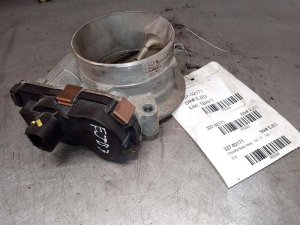
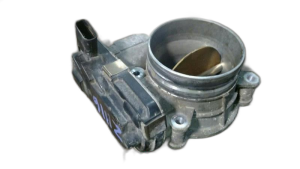
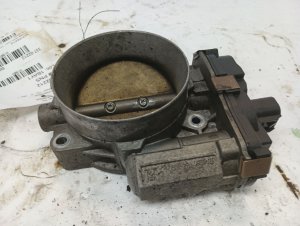
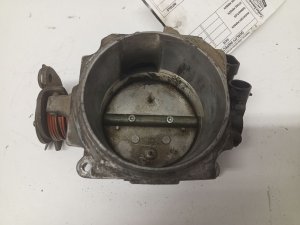
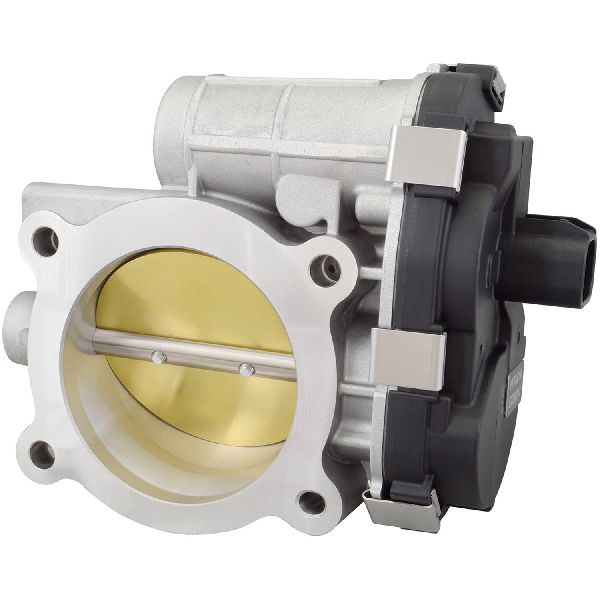
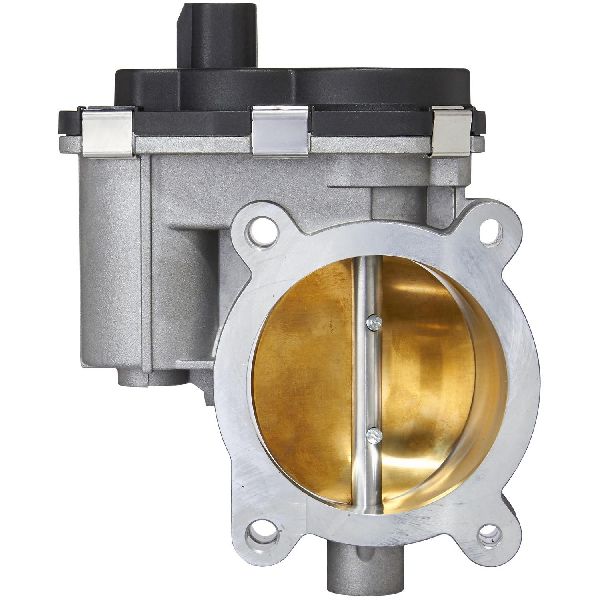
- Throttle Body Assembly
(OEM #12615503)— This is the most common cause of P2135. The failure-prone throttle position sensors are integrated into the assembly, and replacing the whole unit is the most reliable fix.
Trusted brands: ACDelco (GM Genuine Part #12615503, also sold as ACDelco #217-3150), Bosch, TRQ
OEM price range: $250-$350
Aftermarket price range: $150-$250 - Throttle Position Sensor (TPS) Kit
(OEM #19259452)— As an alternative repair detailed in TSB #11-06-04-007C, this kit allows replacement of just the sensor cover and terminals. Manufacturer Bulletin #12-06-04-003 also provides a procedure for replacing the throttle position sensor cover to address the reduced power message and DTC P2135.
Trusted brands: ACDelco
OEM price range: $50-$90
Aftermarket price range: $30-$60
Related Codes That Often Appear With This One
- P1516 — This is a GM-specific code for 'Throttle Actuator Control (TAC) Module Throttle Actuator Position Performance'. It often appears with P2135 because both relate to the PCM's ability to control and verify the throttle's position.
- P2101 — This code means 'Throttle Actuator Control Motor Circuit Range/Performance'. It can be triggered by the same root cause, such as a faulty throttle body or wiring issue.
- P0121 — A generic code for 'Throttle/Pedal Position Sensor/Switch 'A' Circuit Performance,' which can be set alongside P2135 when the primary sensor circuit acts erratically.
- P2176 — This code indicates the Minimum Throttle Position is not learned and is sometimes seen alongside P2135 during electrical system failures.
Technical Service Bulletins (TSBs) & Recalls
- 11-06-04-007C: 'Diagnosis and Repair - Malfunction Indicator Lamp (MIL) Illuminated, Reduced Engine Power Message Displayed, DTC P2135 Set'. Details a procedure to replace the TPS cover (P/N 19259452) instead of the whole throttle body and requires an ECM reprogram on 2008-2011 models.
- PIP3089B: Addresses P2135 and other throttle codes caused by bad terminal crimps or broken wires within the harness near the throttle body connector.
- Bulletin #12-06-04-003: Provides a specific procedure for the replacement of the throttle position sensor cover to resolve the reduced power message and DTC P2135.
Platform-Specific Known Issues
- GM issued Special Coverage Adjustment #11273A which extended the warranty for this specific issue to 10 years or 120,000 miles. This program has now expired for all 2007-2013 vehicles.
- TSB #11-06-04-007C provides a detailed procedure for diagnosing the code and offers a repair by replacing only the TPS cover and terminals (Kit P/N 19259452). However, it also requires an ECM reprogram for 2008-2011 models.
- A throttle relearn procedure is necessary after replacing the throttle body. This can be done without a scan tool. The most commonly cited method is: 1) Start the engine and let it idle in Park for 3 minutes. 2) Turn the engine OFF for 60 seconds. 3) Start the engine again and let it idle in Park for another 3 minutes. The idle should now be stable. If not, a drive cycle above 44 mph may be needed.
Mechanic-Grade Diagnostic Values
- TPS1 Signal Voltage (Key On, Engine Off) — expected: Some GM schematics show this sensor starting high (~4.0-4.5V) at closed throttle and sweeping low to ~0.5-0.7V at wide-open throttle.. Failure: Voltage is erratic, jumps, has dropouts, or does not sweep smoothly as the pedal is pressed.
- TPS2 Signal Voltage (Key On, Engine Off) — expected: Inverse to TPS1. Starts low (~0.5-0.7V) at closed throttle and sweeps high to ~4.0-4.5V at wide-open throttle.. Failure: Voltage is stuck, jumps, or does not correlate with TPS1's movement.
- TPS1 and TPS2 Voltage Sum — expected: The sum of the two sensor voltages should remain relatively constant, around 5.0V, throughout the throttle sweep.. Failure: The sum deviates significantly from 5.0V (e.g., below 4.5V or above 5.5V) for more than a fraction of a second.
- 5-Volt Reference at Throttle Body Connector (Pin E, Gray wire) — expected: 4.8 - 5.2V with key on, engine off.. Failure: Voltage is low or absent, indicating a wiring issue or a problem with the PCM's 5V reference circuit.
- Low Reference/Ground at Throttle Body Connector (Pin B, Black/White wire) — expected: Near 0V, with good continuity to chassis ground.. Failure: Voltage is present or resistance to ground is high, indicating a bad ground connection.
Scan Tool Commands That Help
- GDS2 / Tech2 (or equivalent professional scanner): Idle Learn Reset / Throttle Relearn — This function should be used after replacing the throttle body or cleaning it. It forces the PCM to immediately find the new closed-throttle position and other parameters. While a manual relearn procedure exists, this is the faster and more direct method used by dealerships.
Wiring & Ground Locations
- Throttle Body Connector Pins — The 8-pin connector on the driver's side of the throttle body.. Knowing the specific pins allows for accurate voltage and ground testing. Pin G (Dark Green) is for TPS1 Signal, Pin F (Purple) is for TPS2 Signal, Pin E (Gray) is the 5V Reference, and Pin B (Black/White) is the Low Reference/Ground.
- G103 / G104 — Main engine-to-chassis grounds. G103 is typically on the left front of the engine block. G104 is often on the front of the left cylinder head.. A corroded or loose main engine ground can cause erratic sensor readings throughout the engine management system, including the TPS. This can lead to a P2135 code even if the throttle body and its harness are perfectly fine.
Real Owner Repair Stories
- GM-Trucks.com forum user 'PH-Wolf' (2011 Chevrolet Silverado, 52,000 miles) — Check Engine Light, Traction Control Light, 'Reduced Engine Power', 'Service Traction Control', 'Service Stabilitrak' messages. Codes P0121 and P2135.
✅ What actually fixed it A Chevrolet dealer replaced the Throttle Position Sensor (TPS) on the throttle body, reprogrammed the ECU, and reset the engine idle speed. The total cost was $260 and the fix was durable. - ChevroletForum.com user '2012_Silverado' (2012 Chevrolet Silverado, 45,000 miles) — Truck started to jump/shut off, 'Reduced Engine Power' message, and code P2135.
❌ Tried (didn't work) The user was skeptical that a software-only fix would be permanent.
✅ What actually fixed it A mechanic performed a software update, noting the throttle body looked suspiciously clean (possibly replaced by a previous owner). The user noted that forum consensus pointed toward hardware (throttle body, terminals, grounds) as the true root cause, implying the software update was unlikely to be a final fix. - YouTube Comment (General GM application) — Recurring P2135 over several years.
❌ Tried (didn't work) Spending thousands of dollars on unspecified parts replacements.
✅ What actually fixed it The owner unplugged, blew out with compressed air, and firmly reseated every electrical connector from the throttle body, to the ECM, to the accelerator pedal. This 10-minute, zero-cost action resolved the long-standing issue.
Documented NHTSA Reports
- An owner reported in NHTSA ODI #10585778 that after a diagnosis of P2135, the dealer traced the fault to the throttle position sensor and replaced the sensor assembly using GM sensor kit 19300180 under the powertrain warranty.
- In NHTSA ODI #10691577, an inspection following a P2135 code for throttle/pedal position sensor voltage correlation led to the replacement of the accelerator position sensor.
- According to NHTSA ODI #10683602, a dealership investigated a P2135 code by checking connectors for corrosion and damage and performing a throttle sweep test, though no physical damage was initially found.
"I Checked Everything" — The Actual Cause
- While P2135 is an electrical code not diagnosed with a smoke test, an equivalent scenario occurs when all wiring and the throttle body test 'good' with a multimeter. In these cases, the actual cause is often a high-resistance ground connection (like G103 or G104) that only fails under electrical load, or a short in a completely different sensor that shares the same 5-volt reference circuit as the throttle position sensors, causing the reference voltage to drop intermittently.
OEM Part Supersession History
12595829, 12618735→12615503— Standard part evolution and revision by the manufacturer.
Heads up: The ACDelco equivalent part number for GM 12615503 is 217-3150. Ensure you are purchasing the correct part for the 4.3L V6, as throttle bodies for other GM engines may physically fit but have different electronic calibrations.
Model Year Variations Within This Range
- 2008-2010 vs. 2011: According to TSB #11-06-04-007C, if only the TPS sensor cover kit is used for the repair, 2008-2010 models MUST have the ECM reprogrammed by a dealer. 2011 models do not require this reprogram, suggesting they have updated factory software logic that is less sensitive to minor sensor variations.
- 2007-2013 (GMT900): The 4.3L V6 (LU3) engine in the 2007+ GMT900 trucks is significantly updated from the pre-2007 version. It uses a distributorless ignition system and a 58x crankshaft reluctor wheel (similar to Gen IV V8s), making it electronically incompatible with older 4.3L engines and components.
Diagnostic Flowchart
Other Known Issues on This Vehicle
Issues unrelated to this code that are worth knowing about as an owner of this generation:
- Excessive Oil Consumption 🟠 Medium — Common after 60,000 miles. Often caused by a faulty PCV system in the driver-side valve cover.
- Oil Pressure Sensor / Switch Failure 🟡 Low — Frequently reported after 60,000 miles. Causes erratic or zero oil pressure readings on the gauge due to a failed sensor or a clogged screen beneath it.
- Cracked Dashboard 🟡 Low — Extremely common on GMT900 interiors, especially the 'pure truck' dash. The plastic becomes brittle and cracks, typically near the passenger airbag and driver-side instrument cluster.
- Cab Corner and Rocker Panel Rust 🟠 Medium — Very common in regions using road salt. Rust forms at the rear cab corners and rocker panels.
- Steering Wheel Position Sensor Fault 🟡 Low — Can cause a 'Service StabiliTrak' message. The sensor at the base of the steering column fails, requiring replacement.
Used vs. New Parts: Buying Guide for This Vehicle
When a used part is the smart pick: For this specific P2135 failure, a used throttle body from a junkyard is NOT recommended. The failure is electronic and related to wear and contamination of the internal sensors. A used part carries a high risk of being faulty or having very limited life remaining.
What to inspect on the donor part:
- Not applicable, as used parts are not advised for this repair.
OEM-only on this vehicle (don't cheap out):
- While not strictly 'OEM-only', using a new, quality part is critical. A genuine GM/ACDelco part is the safest bet for guaranteed compatibility and performance.
Aftermarket brands forum-validated for this vehicle:
- ACDelco (OEM supplier)
- Bosch
- Dorman (specifically their OE FIX line, which may include design improvements like better shaft seals to prevent contamination)
Brands owners have reported issues with on this vehicle:
- Avoid unbranded, no-name parts from online marketplaces. These often have poor quality control and can fail quickly or not perform to specification, leading to a repeat of the P2135 code.
Real Owner Stories
Aggregated from forums and TSBs cited above. Mileages and costs reflect what owners reported in those sources.
2011 Chevy Silverado 1500 4.3L V6 — 52000 miles
Symptoms: Service Stabilitrack, Service Traction Control, and Engine Power Is Reduced messages; SES and TCS lights on; slow acceleration with 40 mph top speed; rough idle and harsh transmission shifts.
What fixed it: Dealer replaced the TPS, reprogrammed the ECU, and reset the idle.
Cost: $260-$260
Source hint: GM-Trucks.com - 'P2135 code reduced engine power service traction contro'
2012 Chevrolet Silverado — 45000 miles
Symptoms: Classic P2135 limp mode (Reduced Engine Power).
What fixed it: Mechanic performed a software update, though the owner noted community consensus usually requires hardware replacement.
Source hint: ChevroletForum.com - 'P2135 Help!'
Related OBD-II Codes
Frequently Asked Questions
Is the P2135 issue on my 2007-2013 Silverado covered under a special warranty?
Does TSB #11-06-04-007C apply to my 2010 Silverado 4.3L?
Can I fix the P2135 code on my Silverado without replacing the entire throttle body?
Why does my Silverado show 'Service Traction Control' when the problem seems to be the throttle?
Do I need a professional scan tool to perform the throttle relearn after a repair?
Is there a specific wiring issue I should check for on my 4.3L V6 Silverado?
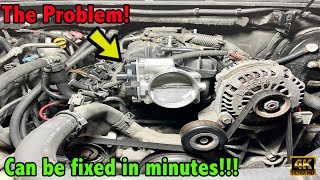
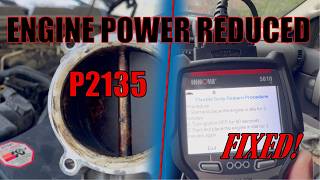
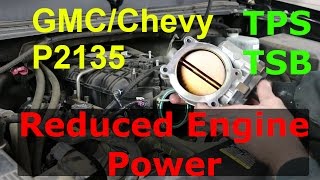
Helpful Videos
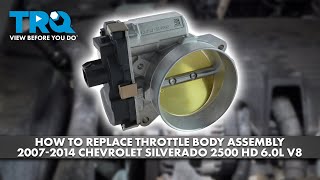
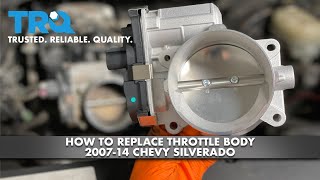
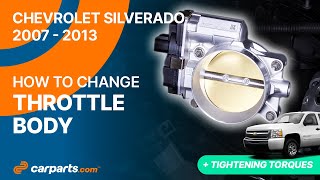
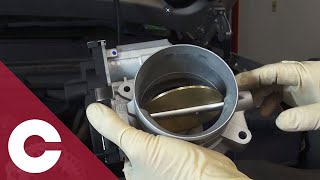
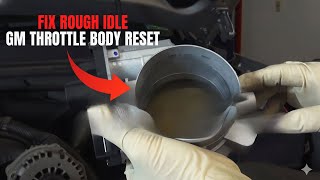
Used OEM Parts in Stock
New Aftermarket Parts Available




The information in this article is provided for general reference and educational purposes only. Vehicle specifications, procedures, and part compatibility can vary by production date, trim level, and region. Always consult your vehicle's factory service manual and verify part numbers before purchasing or performing repairs. Safety-critical components such as airbags, seat belts, and braking systems should be installed by a qualified professional.
- Chevrolet Silverado:
- 🧭 Diagnostic Flowchart
- 🎬 Helpful Videos
- 🛍️ Shop This Part
- What's Unique About the 2007-2013 Chevrolet Silverado
- Symptoms You May Notice
- Most Likely Causes
- Rare But Worth Checking
- Diagnosis Steps
- Parts You'll Likely Need
- Related Codes That Often Appear With This One
- Technical Service Bulletins (TSBs) & Recalls
- Platform-Specific Known Issues
- Mechanic-Grade Diagnostic Values
- Scan Tool Commands That Help
- Wiring & Ground Locations
- Real Owner Repair Stories
- Documented NHTSA Reports
- "I Checked Everything" — The Actual Cause
- OEM Part Supersession History
- Model Year Variations Within This Range
- Other Known Issues on This Vehicle
- Used vs. New Parts: Buying Guide for This Vehicle
- Real Owner Stories
- 2011 Chevy Silverado 1500 4.3L V6 — 52000 miles
- 2012 Chevrolet Silverado — 45000 miles
- Related OBD-II Codes
- Frequently Asked Questions
- 🎟️ Get 5% Off