

P2135 on 2005-2010 Ford Mustang: Throttle Position Sensor Correlation Error Causes and Fixes
On a 2005-2010 Mustang, code P2135 is almost always caused by a failing throttle body assembly. The throttle position sensors (TPS) are integrated, so the entire unit is replaced. Expect to pay $150-$300 for a new throttle body, and the repair is DIY-friendly (2/5 difficulty).
- P2135 on a 2005-2010 Mustang means the two throttle position sensors are sending conflicting signals.
- The most likely cause is a failed throttle body assembly, which contains the integrated sensors.
- Before buying parts, inspect the wiring and connector at the throttle body for damage, as this is a common and cheaper fix.
- After replacing the throttle body, you must perform a throttle 'relearn' procedure for the fix to be effective.
- If a new throttle body doesn't fix the issue, the accelerator pedal assembly is the next most likely culprit.
What's Unique About the 2005-2010 Ford Mustang
For the S197 generation Mustang (2005-2010), the dual throttle position sensors are integrated into the electronic throttle body assembly and are not typically sold or serviced separately. While a very early Technical Service Bulletin (TSB 05-09-15) for 2005 models mentioned a TPS service kit, the common and accepted repair for this code across the entire year range has become the replacement of the complete throttle body unit. Owners frequently experience this failure as a sudden 'limp mode' event during steady-state cruising, often around 2000 RPM.
Symptoms You May Notice
- Check Engine Light is on
- Wrench light is illuminated on the dashboard
- Vehicle enters 'limp mode' (fail-safe mode) with drastically reduced power and acceleration.
- Hesitation or stumbling upon acceleration.
- Engine surges or has erratic RPMs
- Engine stalls when coming to a stop or at low speeds.
- Accelerator pedal becomes unresponsive intermittently.
- Traction control light may illuminate simultaneously.
- Replacing only the accelerator pedal when the throttle body is the actual cause.
- Replacing the throttle body when the issue is a simple wiring fault at the connector.
- Cleaning the throttle body. While good for maintenance and potentially fixing other issues, cleaning carbon buildup will not fix an internal electrical sensor correlation fault.
Most Likely Causes
- Faulty Throttle Body Assembly 🔴 High Probability → Shop Fuel Injection Throttle Body The electronic components of the integrated Throttle Position Sensor (TPS) are a common failure point. Wear and tear over time causes the internal sensor contacts to degrade, leading to conflicting voltage signals that the PCM flags as a correlation error.
How to confirm: Using a scan tool with live data, monitor the two TPS voltage PIDs (TP1 and TP2 or TPS A and TPS B). With the key on and engine off, slowly press the accelerator pedal. The voltages should change smoothly and in opposite correlation (e.g., one goes from 0.9V to 4.5V while the other goes from 4.5V to 0.9V). A jump, drop, freeze, or erratic movement in one of the signals, while the other remains smooth, indicates a faulty sensor within the throttle body.
Typical fix: Replace the entire throttle body assembly. After replacement, a throttle relearn procedure is required. A manufacturer report (NHTSA ODI #10537825) notes that pinpoint tests can show the throttle actuator control motor itself is failing, requiring a full assembly replacement.
Est. part cost: $150-$350 - Wiring Harness or Connector Issue 🟡 Medium Probability The wiring connector at the throttle body is exposed to engine heat and vibration, which can lead to poor connections, corroded pins, or broken wires over time. This is especially common on modified vehicles with aftermarket superchargers (like Whipple or E-Force) that use harness extensions, as the splices or pins can fail.
How to confirm: Visually inspect the wiring harness and connector going to the throttle body for any signs of damage, corrosion, or loose pins. With the engine running, gently wiggle the connector and wiring to see if it causes the engine to stumble or the code to appear. One owner found a wire had pulled directly out of a poorly crimped connector pin on their extended harness.
Typical fix: Repair the damaged section of the wiring harness or replace the connector pigtail. If splices from an aftermarket kit have failed, soldering them securely is a robust fix.
Est. part cost: $15-$50 - Faulty Accelerator Pedal Position (APP) Sensor ⚪ Low Probability → Shop Accelerator Pedal Assembly The APP sensor, located on the gas pedal assembly, also uses redundant sensors to report pedal position to the PCM. While generally more reliable than the throttle body, it can fail and send conflicting signals that can also trigger a P2135 code.
How to confirm: Using a scan tool, monitor the APP sensor PIDs (APP1 and APP2). They should also show smooth, correlated changes as the pedal is pressed. A forum user reported fixing the code by replacing the pedal assembly after a new throttle body didn't solve the issue. However, NHTSA ODI #11097577 describes a case where the code persisted even after replacing both the gas pedal and the throttle body, suggesting deeper electrical or PCM issues.
Typical fix: Replace the entire accelerator pedal assembly.
Est. part cost: $50-$100
Rare But Worth Checking
- PCM Software Glitch or Failure: An early TSB (05-09-15) for 2005 models built before 11/29/2004 called for a PCM reprogram for this code. While rare, a faulty PCM can also be the root cause if all other components and wiring test good, though this should be the last item to consider after exhausting all other possibilities. NHTSA ODI #10748493 corroborates that for early builds, this code may require a powertrain control module reset.
Diagnosis Steps
- Scan for Codes: Confirm P2135 is present. Note any other codes, especially P2106, P2104, P0122, or P0223, which point to a limp mode condition and can help isolate the fault.
- Inspect Wiring: Carefully inspect the electrical connector and wiring harness at the throttle body. Look for loose pins, corrosion, or chafed wires. Pay extra attention to harness extensions on supercharged cars. Wiggle the connector with the engine running to check for intermittent faults.
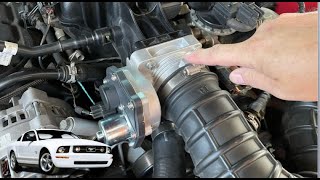
- Analyze Live Data: Use a scan tool to graph the live data for TPS1, TPS2, APP1, and APP2. With the key on and engine off, slowly press and release the gas pedal. Watch for any jumps, dropouts, or non-linear responses from any of the sensors. The TPS voltages should move smoothly in opposite directions. 🎬 Watch how to test and replace an electronic throttle body. A glitch in a TPS reading points to the throttle body; a glitch in an APP reading points to the pedal assembly.
- Test Components: If live data points to the throttle body, it is the most likely culprit. If the throttle body sensors appear fine, perform the same live data test on the accelerator pedal position sensors. If both test well, re-examine the wiring for an intermittent open or short.
- Replace the Faulty Component: Based on testing, replace the throttle body assembly or the accelerator pedal assembly.
- Perform Relearn Procedure: After replacing the throttle body or disconnecting the battery, a relearn procedure is necessary. A widely cited method is: disconnect the battery for at least one minute. Reconnect it, turn the key to the 'ON' position (without starting) for one minute. Then, slowly press the gas pedal to the floor and slowly release it. Turn the key off, then start the engine. Some sources suggest this may need to be repeated three times.
Parts You'll Likely Need
- Throttle Body Assembly
(OEM #Motorcraft 9R3Z-9E926-A (for 4.6L V8), 6R3Z-9E926-A (for 4.0L V6))— This is the most common cause of P2135, as the internal throttle position sensors fail. The sensors are integrated into the assembly for this vehicle generation.
Trusted brands: Motorcraft, BBK Performance, Standard Motor Products (SMP)
OEM price range: $250-$350
Aftermarket price range: $150-$250 - Accelerator Pedal Assembly
(OEM #AR3Z-9F836-A (fits most 2007-2010 models))— A less common but possible cause. If a new throttle body and wiring check don't resolve the code, the pedal sensor is the next logical part to replace.
Trusted brands: Motorcraft, Standard Motor Products
OEM price range: $70-$120
Aftermarket price range: $50-$90
Related Codes That Often Appear With This One
- P2106 — P2106 (Throttle Actuator Control System - Forced Limited Power) is an informational code that is often set alongside P2135. It indicates that the PCM has activated the 'limp mode' as a direct result of the fault detected by P2135.
- P2104 — Similar to P2106, this code indicates the throttle actuator control system has forced the engine to idle, which is a failure management mode triggered by the P2135 fault.
- P0122 — This code for 'Throttle/Pedal Position Sensor/Switch A Circuit Low' can accompany P2135, pointing more specifically to a problem with the 'A' sensor circuit.
- P0223 — This code for 'Throttle/Pedal Position Sensor/Switch B Circuit High' can also appear with P2135, indicating a specific fault in the 'B' sensor circuit.
- P2111 — This code indicates the throttle actuator control system is stuck open and is frequently seen alongside P2135 in manufacturer reports such as NHTSA ODI #10825626.
Technical Service Bulletins (TSBs) & Recalls
- TSB 05-09-15: For some 2005 Mustangs built on or before 11/29/2004, this TSB addresses P2135 and P2106 by reprogramming the PCM and replacing the TPS with a service kit. This TSB is largely obsolete as replacement throttle bodies became the standard repair, but it confirms the issue was present from the start of the generation.
Platform-Specific Known Issues
- Supercharger Harness Extensions: → Shop Turbocharger On Mustangs with aftermarket superchargers (e.g., Whipple, Roush, Edelbrock E-Force), the throttle body wiring harness is often extended. The crimps or solder joints on these extensions are a frequent failure point, leading to intermittent P2135 codes. Resoldering these connections often permanently fixes the issue.
- Steady-State Cruise Failure: Many owners report the P2135 code and limp mode triggering specifically during steady-state cruising, particularly around 2000 RPM. This points to a wear spot on the TPS sensor tracks that is most frequently used during highway driving.
- A/C Load Correlation: Some reports, such as NHTSA ODI #10403627, indicate that the loss of power and P2135/P2106 codes may occur more frequently when the air conditioning is turned on.
Mechanic-Grade Diagnostic Values
- TPS Reference Voltage (VREF) — expected: 5.0 volts (nominal) between the reference voltage and ground pins at the connector with the key on.. Failure: A voltage significantly lower or higher than 5.0V, or an unstable voltage, points to a PCM or wiring issue, not a faulty throttle body.
- TPS1/TPS2 Voltage at Closed Throttle (Idle Position) — expected: The PCM accepts a wide range, typically between 0.6V and 1.15V for the primary sensor. The secondary sensor will have an opposing high voltage.. Failure: A voltage outside this range, or one that jumps erratically when the connector is wiggled, indicates a sensor or wiring fault.
- TPS1/TPS2 Voltage at Wide Open Throttle (WOT) — expected: The primary sensor should read around 4.5V to 4.8V. The secondary sensor should read a corresponding low voltage.. Failure: Failure to reach the expected voltage or a signal that drops out before reaching WOT indicates a worn-out sensor track.
- Throttle Actuator Control (TAC) Motor Resistance — expected: Between 1 and 900 ohms across the two motor terminals on the throttle body.. Failure: A reading of 4 ohms was considered good in one diagnostic case, but an open circuit (infinite resistance) or a dead short (0 ohms) would indicate a failed motor. Wiggling wires during the test can reveal intermittent opens.
Scan Tool Commands That Help
- Ford IDS (Integrated Diagnostic System): Power Balance Test — While not directly for P2135, if the code is accompanied by a rough idle or misfires, this test can help rule out individual cylinder issues that might be confused with throttle-related stumbling.
- High-End OBD-II Scanner with Graphing: Live Data Graphing of TP1 vs TP2 — This is the primary diagnostic method. Graphing the two PIDs simultaneously while slowly operating the pedal will visually expose any dropouts, spikes, or non-linear movement in one sensor relative to the other, confirming an internal throttle body fault.
Wiring & Ground Locations
- Throttle Body Connector (C175B) — Directly on the electronic throttle body, top of the engine.. This is the primary connection point for the TPS sensors and throttle motor. Corrosion, loose pins, or wire damage here is a direct cause of P2135. The pins are: Pin 1 (Throttle Motor), Pin 2 (TPS2), Pin 3 (Signal Return/Ground), Pin 4 (Throttle Motor), Pin 5 (TPS1), Pin 6 (5V Reference).
- G104 — On the left (driver's side) front fender apron, located behind the battery.. This is a critical ground point for the PCM. A corroded or loose connection at G104 can cause a host of electrical issues, including erratic sensor readings and false correlation codes like P2135.
- G201 — Located directly below the PCM, which is typically in the passenger-side cowl/kick panel area.. This is another primary ground for the Powertrain Control Module. A fault here can directly impact the PCM's ability to correctly interpret sensor voltages.
Real Owner Repair Stories
- S197Forum.com user '07VistaChicago' (2007 Mustang GT with an Edelbrock E-Force supercharger) — Intermittent P2135 code, limp mode, and erratic throttle behavior that became progressively more frequent.
❌ Tried (didn't work) Initial diagnosis was difficult due to the intermittent nature of the problem.
✅ What actually fixed it The root cause was a poorly pinned connector on the 5-inch wiring harness extension required for the supercharger. The user de-pinned and properly re-crimped the connector for the throttle body motor, which resolved the intermittent connection and cleared the code permanently.
OEM Part Supersession History
4R3Z-9E926-DA→7R3Z-9E926-AA, then 9R3Z-9E926-B, and finally 9R3Z-9E926-A for the 4.6L V8.— Ford often updates parts to improve reliability or address known failure modes. The multiple supersessions suggest revisions were made to the electronic throttle body over its life.
Model Year Variations Within This Range
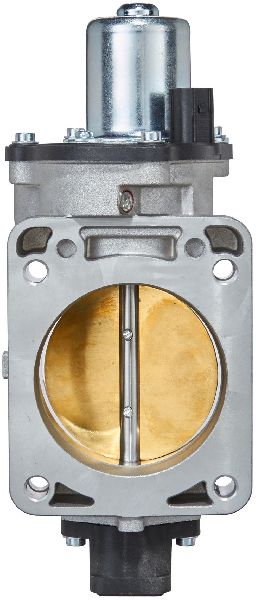
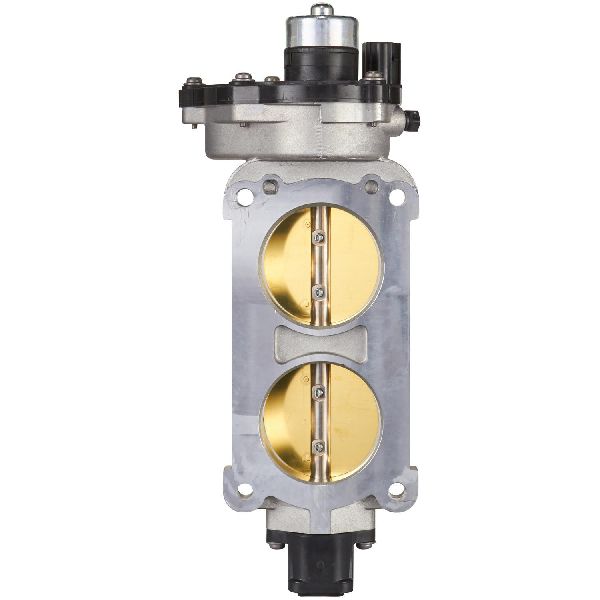
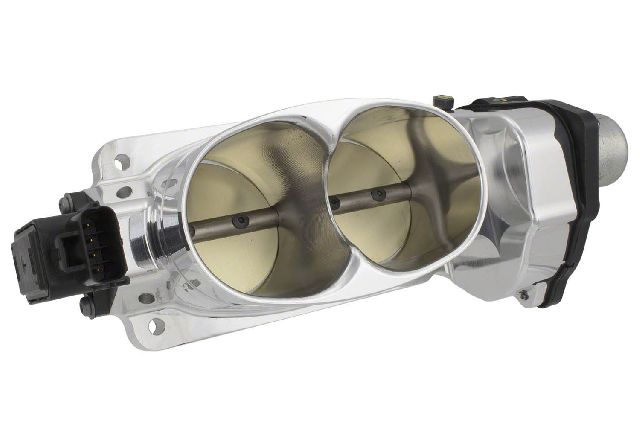
- 2005-2010: The V8 GT models use a twin 55mm throttle body (PN series like 9R3Z-9E926-A), while the V6 4.0L models use a single 68mm throttle body (PN 6R3Z-9E926-A). While the failure mode and code are the same, the parts are not interchangeable.
Diagnostic Flowchart
Other Known Issues on This Vehicle
Issues unrelated to this code that are worth knowing about as an owner of this generation:
- 4.6L 3V Spark Plug Breakage 🔴 High — Very common on 2005 to mid-2008 models with the 4.6L 3V V8. The original two-piece spark plugs are prone to separating during removal, leaving the lower portion stuck in the cylinder head. (Ref: TSB 08-7-6)
- Water Leaks from Cowl Grommets 🟠 Medium — Common across all 2005-2014 models. Foam seals on 10 grommets under the cowl panel degrade, allowing water to leak into the passenger footwell, potentially damaging the Smart Junction Box (SJB).
- Alternator Failure 🟠 Medium — A widely reported issue, particularly on GT models. The alternator can fail prematurely, often with little warning, leading to a no-charge condition.
- 4.0L V6 Thermostat Housing Crack 🟠 Medium — The plastic thermostat housing on the 4.0L V6 engine is known to become brittle and crack over time, causing a significant coolant leak.
- Clogged A/C Evaporator Drain 🟡 Low — The A/C evaporator drain can become clogged, causing condensation to back up and leak into the passenger side footwell, often mistaken for a cowl or heater core leak.
Used vs. New Parts: Buying Guide for This Vehicle
When a used part is the smart pick: A used throttle body is a significant gamble for this repair. The failure is due to electronic wear on internal sensor tracks, not mechanical breakage. A used part may work for a short time but is likely to have similar wear and fail again. It should only be considered as a last resort or for temporary diagnostic purposes, and only if from a very low-mileage, verifiable donor vehicle.
Donor-vehicle mileage cap: roughly under 40000 miles for the part to have meaningful remaining life.
What to inspect on the donor part:
- Verify the exact part number matches your original (V6 vs V8).
- Inspect the electrical connector pins for any corrosion, discoloration, or damage.
- Ask for the mileage of the donor car; anything over 50,000 miles carries a high risk of repeat failure.
- Avoid parts that show signs of having been stored poorly (out in the rain, heavy dirt/grime).
OEM-only on this vehicle (don't cheap out):
- Throttle Body Assembly
Aftermarket brands forum-validated for this vehicle:
- Motorcraft (OEM)
- Standard Motor Products (SMP)
- BBK Performance (Note: Often larger bore, may require a tune for optimal performance).
Brands owners have reported issues with on this vehicle:
- No-name, unbranded parts from online marketplaces. Forum discussions often highlight that these cheaper alternatives can have calibration issues, create whistling noises, or fail prematurely.
Real Owner Stories
Aggregated from forums and TSBs cited above. Mileages and costs reflect what owners reported in those sources.
2005 Ford Mustang
Symptoms: Intermittent stalling and the P2135 error code appearing on the dash.
What fixed it: The discussion pointed to the TPS, APP sensor, or wiring as the likely culprits for the intermittent failure.
Source hint: MustangForums.com - Thread 'P2135 Error code! Throttle position sensor!'
Ford Mustang with aftermarket supercharger
Symptoms: Intermittent P2135 codes and the vehicle entering limp mode with a wrench light.
What fixed it: Found a wire had pulled directly out of a poorly crimped connector pin on the harness extension; resoldering the connections provided a robust fix.
Source hint: S197Forum.com - Thread 'P2135 TPS/Pedal sensor issue, intermittent'
2005-2010 Ford Mustang
Symptoms: The P2135 code persisted even after a new throttle body was installed.
What fixed it: Replacing the accelerator pedal assembly resolved the code after the throttle body failed to fix it.
Source hint: S197Forum.com - Thread 'P2135 TPS/Pedal sensor issue, intermittent'
Supercharged Ford Mustang
Symptoms: Recurring P2135 codes and 'Never ending' limp mode/wrench light issues.
What fixed it: Identified loose or poorly soldered wires in the TPS harness extensions as the root cause.
Source hint: S197Forum.com - Thread 'Never ending problem!!!! Limp Mode/Wrench Light'
Documented NHTSA Reports
Ford Owner Report
Symptoms: Vehicle went into safety mode in traffic with codes P2135, P2110, and P2111.
What fixed it: The problem was identified as the throttle body, as noted in Consumer Satisfaction Alert # 13NO3.
Source hint: NHTSA ODI #10825626
Ford Owner Report
Symptoms: Loss of power on the highway at 60mph with check engine and wrench lights illuminated.
What fixed it: Diagnosed as a throttle body issue with codes P2106 and P2135; the owner noted the problem occurred more frequently when the A/C was on.
Source hint: NHTSA ODI #10403627
Related OBD-II Codes
Frequently Asked Questions
Does TSB 05-09-15 apply to my 2005 Ford Mustang?
Why does my Mustang go into 'limp mode' when the P2135 code triggers?
I have a Whipple supercharger on my Mustang and keep getting P2135; what should I check?
Can I just replace the sensor, or do I need the whole throttle body assembly?
Is there a specific procedure I need to follow after replacing the throttle body?
Why does the P2135 code only seem to happen when I am cruising on the highway?
Helpful Videos


Used OEM Parts in Stock
New Aftermarket Parts Available


The information in this article is provided for general reference and educational purposes only. Vehicle specifications, procedures, and part compatibility can vary by production date, trim level, and region. Always consult your vehicle's factory service manual and verify part numbers before purchasing or performing repairs. Safety-critical components such as airbags, seat belts, and braking systems should be installed by a qualified professional.
- Ford Mustang:
- 🧭 Diagnostic Flowchart
- 🎬 Helpful Videos
- 🛍️ Shop This Part
- What's Unique About the 2005-2010 Ford Mustang
- Symptoms You May Notice
- Most Likely Causes
- Rare But Worth Checking
- Diagnosis Steps
- Parts You'll Likely Need
- Related Codes That Often Appear With This One
- Technical Service Bulletins (TSBs) & Recalls
- Platform-Specific Known Issues
- Mechanic-Grade Diagnostic Values
- Scan Tool Commands That Help
- Wiring & Ground Locations
- Real Owner Repair Stories
- OEM Part Supersession History
- Model Year Variations Within This Range
- Other Known Issues on This Vehicle
- Used vs. New Parts: Buying Guide for This Vehicle
- Real Owner Stories
- 2005 Ford Mustang
- Ford Mustang with aftermarket supercharger
- 2005-2010 Ford Mustang
- Supercharged Ford Mustang
- Documented NHTSA Reports
- Ford Owner Report
- Ford Owner Report
- Related OBD-II Codes
- Frequently Asked Questions
- 🎟️ Get 5% Off