

P2135 on 2009-2012 GMC Acadia: Throttle Position Sensor Causes and Fixes
On a 2009-2012 GMC Acadia, code P2135 is almost always caused by a failing throttle position sensor (TPS) inside the throttle body. This triggers a "Reduced Engine Power" warning. The most common and reliable fix is to replace the entire throttle body assembly, which costs between $150 and $400 for the part.
- P2135 on a 2009-2012 Acadia almost always points to a bad throttle body.
- The primary symptom is the vehicle entering "Reduced Engine Power" mode, which severely limits speed.
- Do not replace the gas pedal (APP sensor); the fault is with the sensors on the throttle body itself.
- The most reliable fix is to replace the entire throttle body assembly, not just the sensor component.
- A throttle relearn procedure is required after replacing the part to ensure proper idle and performance.
What's Unique About the 2009-2012 GMC Acadia
The first-generation GMC Acadia, along with its GM Lambda platform siblings (Buick Enclave, Chevrolet Traverse, and Saturn Outlook) using the 3.6L V6 engine, has a well-documented history with this specific failure. The issue became so common that General Motors issued a Technical Service Bulletin (TSB #11-06-04-007C) and a Special Coverage Adjustment (#11273A) that extended the warranty for this part to 10 years or 120,000 miles. While this coverage has likely expired for all 2009-2012 models, it confirms a known weakness in the original throttle body's sensor components. The TSB initially detailed a procedure to replace only the sensor cover and terminals (P/N 19259452), but owner and mechanic consensus is that a full throttle body replacement is the more durable, long-term solution.
Symptoms You May Notice
- "Reduced Engine Power" message on the dashboard
- Check Engine Light is on
- Severely limited acceleration and power (limp mode)
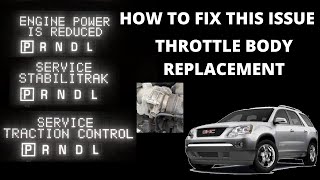
- "Service StabiliTrak" or "Service Traction Control" message may also appear
- Unstable, surging, or high idle
- Hesitation or stumbling during acceleration
- The vehicle may stall unexpectedly
- Harsh or difficult shifting
- Replacing the Accelerator Pedal Position (APP) Sensor. While the APP sensor is part of the drive-by-wire system, code P2135 specifically points to a voltage correlation problem between the two sensors located on the throttle body itself, not the pedal.
Most Likely Causes
- Failing Throttle Position Sensor (TPS) 🔴 High Probability → Shop Fuel Injection Throttle Body The original equipment sensors were prone to internal electronic failure, often exacerbated by cold or damp weather. This was acknowledged by GM through TSB #11-06-04-007C and extended warranty program #11273A. The internal contacts and electronics within the sensor cover fail, leading to the voltage correlation error.
How to confirm: The presence of code P2135 is the primary indicator. 🎬 See how to test and diagnose the electronic throttle body A scan tool can monitor the live data streams for TPS1 and TPS2; their voltage readings should move smoothly and in opposition to each other as the accelerator pedal is pressed. If they do not track each other smoothly, or one signal drops out, the sensor is faulty.
Typical fix: Replace the entire throttle body assembly. While a sensor-only repair kit exists (GM P/N 19259452, per TSB #11-06-04-007C), replacing the complete assembly is generally considered a more reliable and durable repair by the community. An ECM reprogram may be required on 2009-2011 models after replacement to prevent the code from returning.
Est. part cost: $150 - $400 - Wiring Harness or Connector Issue ⚪ Low Probability
How to confirm: Visually inspect the wiring harness and the 6-pin electrical connector at the throttle body for any signs of corrosion, damage, fretting, or loose pins. Wiggle the connector with the engine running to see if it induces the fault or causes a change in engine behavior.
Typical fix: Repair the damaged section of the wiring harness or replace the connector pigtail. Ensure a secure connection with dielectric grease.
Est. part cost: $20 - $50
Rare But Worth Checking
- Faulty Powertrain Control Module (PCM): → Shop Engine Control Module (ECM) This is extremely rare. Before condemning the PCM, all other possibilities, especially the throttle body and its wiring, must be exhaustively ruled out. An outdated PCM software calibration could also be a factor on some models.
Diagnosis Steps
- Scan the vehicle's computer for fault codes to confirm P2135 is the primary code.
- Inspect the wiring harness and electrical connector at the throttle body for any visible damage, corrosion, or loose connections.
- Using a scan tool with live data capability, monitor the voltage readings for Throttle Position Sensor 1 and Throttle Position Sensor 2. The voltages should be different but should change in a smooth, parallel manner as the accelerator is slowly pressed and released.
- If one sensor's reading is erratic, jumps, or doesn't change, the throttle body assembly has failed.
- If the wiring is intact and the sensor data is erratic, the most likely cause is a faulty throttle body.
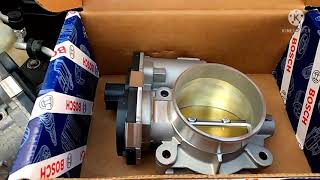
- Replace the throttle body assembly. 🎬 Watch this step-by-step throttle body replacement walkthrough
- After replacement, perform a throttle relearn procedure. 🎬 Watch: How to perform the GM throttle relearn procedure This can sometimes be done without a scan tool by letting the engine idle in Park for 3 minutes, turning the ignition off for 60 seconds, and repeating the cycle. However, using a scan tool is the most reliable method.
Parts You'll Likely Need
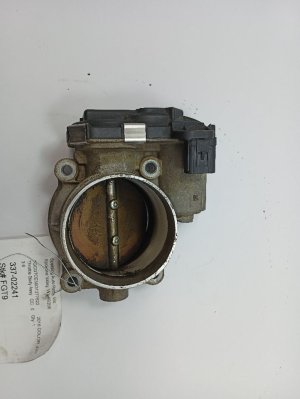
- Throttle Body Assembly
(OEM #12632172, 12670981)— This is the most common failure point for P2135. The throttle position sensors are integrated into the assembly, and replacing the entire unit is the most reliable fix.
Trusted brands: ACDelco, Bosch
OEM price range: $200-$400
Aftermarket price range: $150-$250 - Throttle Position Sensor Cover Kit
(OEM #19259452)— This is the less-common repair detailed in TSB #11-06-04-007C. It allows for replacement of just the sensor electronics. It's a cheaper but potentially less durable fix than a full throttle body replacement.
Trusted brands: ACDelco
OEM price range: $50-$80
Technical Service Bulletins (TSBs) & Recalls
- TSB #11-06-04-007C: Addresses DTC P2135 and the "Reduced Engine Power" message. It originally provided a procedure to replace only the sensor cover and terminals (P/N 19259452), though most now recommend replacing the full assembly for durability. It also mandates an ECM reprogram for 2009-2011 models. This bulletin notes it is the specific procedure for replacing the throttle position sensor cover for concerns regarding an indicator lamp illuminated and reduced power message.
- Special Coverage Adjustment #11273A: This document officially extended the warranty coverage for the throttle position sensor failure to 10 years or 120,000 miles from the vehicle's original in-service date.
Platform-Specific Known Issues
- GM Special Coverage Adjustment #11273A extended the warranty on the throttle body for this issue to 10 years/120,000 miles, highlighting the prevalence of this failure on this platform.
- GM Technical Service Bulletin (TSB) #11-06-04-007C addresses this specific code and provides diagnostic and repair information. For 2009-2011 models, this TSB also specifies that the ECM must be reprogrammed with the latest calibration after the repair.
- The combination of "Reduced Engine Power," "Service StabiliTrak," and "Traction Control Off" is often referred to by owners as the "terrible trifecta" of warning lights, which almost always points to this throttle body issue.
- NHTSA ODI #11080681 describes a similar GM platform issue where the vehicle drops speed to 20 MPH with codes P0120 and P2135, creating dangerous conditions on the highway.
Mechanic-Grade Diagnostic Values
- TPS 1 Signal Voltage (Key-On, Engine-Off) — expected: Smoothly sweeps from ~0.5V at closed throttle to ~4.5V at wide-open throttle (WOT).. Failure: Any voltage spikes, dropouts, or non-linear movement during a slow pedal press.
- TPS 2 Signal Voltage (Key-On, Engine-Off) — expected: Smoothly sweeps from ~4.5V at closed throttle to ~0.5V at wide-open throttle (WOT), mirroring TPS 1.. Failure: Signal does not move in opposition to TPS 1 or has spikes/dropouts.
- Combined TPS1 + TPS2 Voltage — expected: The sum of the two sensor voltages should remain constant at approximately 5.0V throughout the pedal's travel.. Failure: If the combined voltage deviates significantly from 5.0V, it indicates a sensor or wiring fault.
- Throttle Actuator Motor Resistance — expected: Between 2 to 15 Ohms between the two motor terminals.. Failure: A reading of less than 1 Ohm indicates a short, while an over-limit or infinite reading indicates an open circuit within the motor.
Scan Tool Commands That Help
- GM GDS2/Tech2: Idle Learn Reset or Throttle/Idle Learn — This function must be performed after replacing the throttle body assembly to reset learned idle values and allow the PCM to learn the new sensor's home position. Failure to do so often results in a high or unstable idle.
- Professional Scan Tool: Live Data Graphing of TP Sensor 1 and TP Sensor 2 — This is the primary diagnostic step. Graphing both sensor voltages simultaneously while slowly operating the accelerator pedal will visually expose any dropouts, spikes, or non-linear behavior in a failing sensor that a simple numeric display might miss.
Wiring & Ground Locations
- Throttle Body Connector (X110) — The 6-pin electrical connector plugged directly into the throttle body assembly at the front of the engine.. This is the single point of connection for both TPS sensors and the throttle actuator motor. Corrosion (fretting), spread terminals, or chafed wires at this connector are a known cause of P2135. A 'wiggle test' on this connector while monitoring live data can help identify a poor connection.
- Throttle Body Connector Pinout — Within the X110 connector at the throttle body.. Knowing the pin functions is critical for manual voltage and resistance testing. For example, on similar GM models, Pin G (Dark Green wire) is often TP Sensor 1 Signal and Pin F (Purple wire) is TP Sensor 2 Signal. A vehicle-specific wiring diagram should be used to confirm these for the Acadia.
- Engine Control Module (ECM) Grounds (e.g., G102, G103) — Typically located on the engine block or cylinder head, and on the cowl in the engine compartment.. A poor ground connection for the ECM can cause erratic sensor readings and various driveability issues, including throttle-related codes. Ensuring these grounds are clean and tight is a fundamental diagnostic step.
Real Owner Repair Stories
- YouTube channel 'Axle's Garage' (2010 Chevrolet Silverado 1500 4.8L (similar GM truck platform with same issue)) — Intermittent Check Engine Light with code P2135, traction control error, and vehicle entering 'limp mode' with reduced power.
❌ Tried (didn't work) Clearing the code with a scanner provided a temporary fix, but the problem would return., Disconnecting the battery to clear the code also worked temporarily.
✅ What actually fixed it The problem was permanently resolved by replacing the throttle position sensor component on the throttle body. The video notes that replacing the entire throttle body assembly is also a common and effective repair. - NHTSA ODI #10495252 — An owner reported that after a P2135 code was read, the vehicle stopped accelerating and would not go over 25 MPH, taking nearly two minutes to reach that speed.
- NHTSA ODI #11063373 — A driver experienced the vehicle losing power on the side of the road; a subsequent test revealed code P2135 for the throttle/pedal sensor switch.
OEM Part Supersession History
12632172→12670981— Part has been updated by GM over time to improve reliability and address known failure modes.
Heads up: The latest part number, 12670981, is the correct service replacement for the earlier numbers and is compatible with the 2009-2012 Acadia. Using old stock or a used part with an earlier number may lead to a repeat failure.12648415→12670981— Part has been updated by GM over time to improve reliability and address known failure modes.
Heads up: The latest part number, 12670981, is the correct service replacement for the earlier numbers and is compatible with the 2009-2012 Acadia.12669016→12670981— Part has been updated by GM over time to improve reliability and address known failure modes.
Heads up: The latest part number, 12670981, is the correct service replacement for the earlier numbers and is compatible with the 2009-2012 Acadia.
Model Year Variations Within This Range
- 2009-2011: TSB #11-06-04-007C explicitly states that after replacing the throttle position sensor or the entire throttle body, the Engine Control Module (ECM) must be reprogrammed with the latest software calibration. This is not listed as a requirement for 2012 models. Failure to reprogram the ECM on these specific years can result in the P2135 code returning even with a new part.
Diagnostic Flowchart
Other Known Issues on This Vehicle
Issues unrelated to this code that are worth knowing about as an owner of this generation:
- Premature Timing Chain Stretch 🔴 High — Very common, often occurs between 70,000 and 120,000 miles. Exacerbated by extended oil change intervals. (Ref: Special Coverage Adjustment #11340C extended warranty to 10 years/120,000 miles.)
- Transmission 3-5-R Wave Plate Failure 🔴 High — Common on 2009 models, leading to loss of 3rd, 5th, and Reverse gears, often requiring a transmission rebuild. (Ref: Special Coverage Adjustment #14404 extended warranty to 10 years/120,000 miles.)
- Power Steering Pump Failure / Leaks 🟠 Medium — Widespread issue causing whining noises, fluid leaks, and intermittent loss of power steering assist, especially at low speeds. (Ref: Special Coverage Adjustment #14329B extended warranty to 10 years/150,000 miles.)
- Water Pump Shaft Seal Leak 🟠 Medium — Common failure leading to coolant leaks from the front of the engine, which can cause overheating if not addressed. (Ref: Customer Satisfaction program #13079 extended warranty to 10 years/120,000 miles.)
- Intake Valve Carbon Buildup 🟠 Medium — A known issue with the direct-injected (LLT) engine, causing cold start misfires, rough idle, and reduced performance over time. (Ref: TSB #PIP5029C)
Used vs. New Parts: Buying Guide for This Vehicle
When a used part is the smart pick: For this specific P2135 failure, using a part from a junkyard is strongly discouraged. The throttle position sensor is a known high-failure electronic component, and a used part has a high probability of failing again in a short time, wasting both time and money.
What to inspect on the donor part:
- Not applicable, as a used part is not recommended for this repair.
OEM-only on this vehicle (don't cheap out):
- While not strictly OEM-only, using a GM Genuine Part (ACDelco) is the most reliable choice. The part has been revised multiple times to improve durability, and an OEM part ensures you get the latest, most robust version.
Aftermarket brands forum-validated for this vehicle:
- Bosch: Bosch is an original equipment manufacturer for many automotive components and is a trusted alternative to ACDelco.
- Dorman: Dorman offers a replacement throttle body and sometimes includes design improvements, such as an enhanced butterfly shaft seal to prevent future failures.
Brands owners have reported issues with on this vehicle:
- Unbranded, low-cost throttle bodies from online marketplaces should be avoided. These often use lower-quality sensors and electronics that can fail prematurely or be dead-on-arrival, leading to a repeat of the P2135 code.
Real Owner Stories
Aggregated from forums and TSBs cited above. Mileages and costs reflect what owners reported in those sources.
2009-2012 GMC Acadia
Symptoms: The car became 'almost undrivable' when the fault occurred, displaying the 'terrible trifecta' of error codes.
What fixed it: Replacing the entire throttle body assembly.
Source hint: Youtube.com video titled 'Acadia Engine Power Reduced! Replacing the Throttle Body to solve the terrible trifecta error codes'
2009-2012 GMC Acadia
Symptoms: Sudden onset of 'Reduced Engine Power' and P2135, specifically noted after a cold snap.
What fixed it: Replacing the entire throttle body assembly resolved the issue permanently.
Source hint: acadiaforum.net
2009-2012 GMC Acadia
Symptoms: P2135 frequently seen with 'Reduced Engine Power' and 'Service Traction Control' messages in cold weather.
What fixed it: Replacement of the throttle body, potentially covered under the 10 year/120k mile special policy.
Source hint: GM-Trucks.com
2009-2012 GMC Acadia
Symptoms: An owner reported that codes P1516, P2135, and P0120 returned for a third time, causing the vehicle to enter reduced power mode while driving (NHTSA ODI #11341685).
What fixed it: Repeated repairs were documented; typically requires full throttle body replacement and circuit inspection.
Related OBD-II Codes
Frequently Asked Questions
Is there a special warranty for the throttle body on my 2009-2012 GMC Acadia?
What is the 'terrible trifecta' of warning lights Acadia owners report?
Does TSB #11-06-04-007C apply to my 2011 Acadia?
Can I just replace the sensor instead of the whole throttle body?
Why does my Acadia go into 'Reduced Engine Power' mode during cold weather?
Is a used throttle body from a junkyard a good idea for my Acadia?
Helpful Videos

Used OEM Parts in Stock
New Aftermarket Parts Available

The information in this article is provided for general reference and educational purposes only. Vehicle specifications, procedures, and part compatibility can vary by production date, trim level, and region. Always consult your vehicle's factory service manual and verify part numbers before purchasing or performing repairs. Safety-critical components such as airbags, seat belts, and braking systems should be installed by a qualified professional.
- GMC Acadia:
- 🧭 Diagnostic Flowchart
- 🎬 Helpful Videos
- 🛍️ Shop This Part
- What's Unique About the 2009-2012 GMC Acadia
- Symptoms You May Notice
- Most Likely Causes
- Rare But Worth Checking
- Diagnosis Steps
- Parts You'll Likely Need
- Technical Service Bulletins (TSBs) & Recalls
- Platform-Specific Known Issues
- Mechanic-Grade Diagnostic Values
- Scan Tool Commands That Help
- Wiring & Ground Locations
- Real Owner Repair Stories
- OEM Part Supersession History
- Model Year Variations Within This Range
- Other Known Issues on This Vehicle
- Used vs. New Parts: Buying Guide for This Vehicle
- Real Owner Stories
- 2009-2012 GMC Acadia
- 2009-2012 GMC Acadia
- 2009-2012 GMC Acadia
- 2009-2012 GMC Acadia
- Related OBD-II Codes
- Frequently Asked Questions
- 🎟️ Get 5% Off